
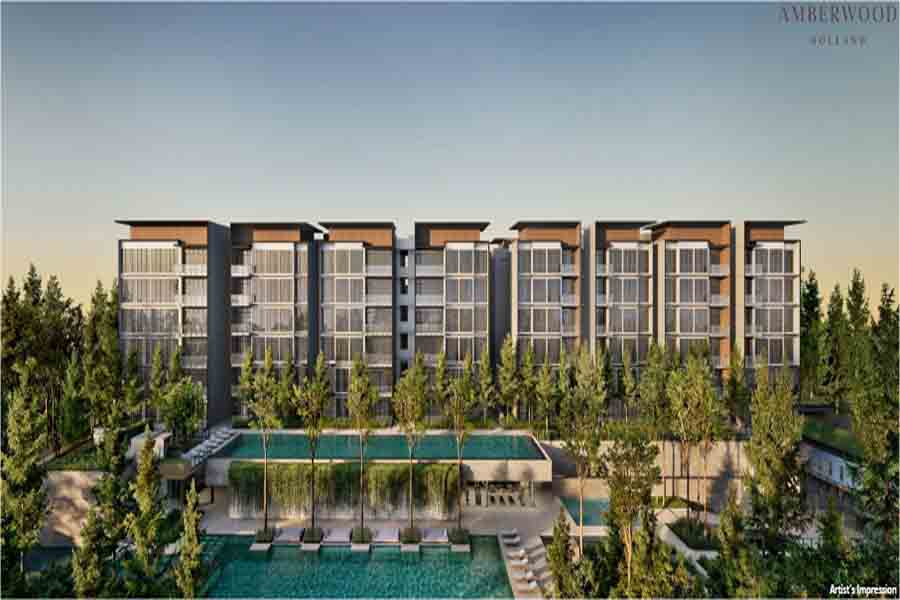
Amberwood at Holland has a proposition that sounds attractive on paper: buy into Holland Plain before the new neighbourhood is fully established.
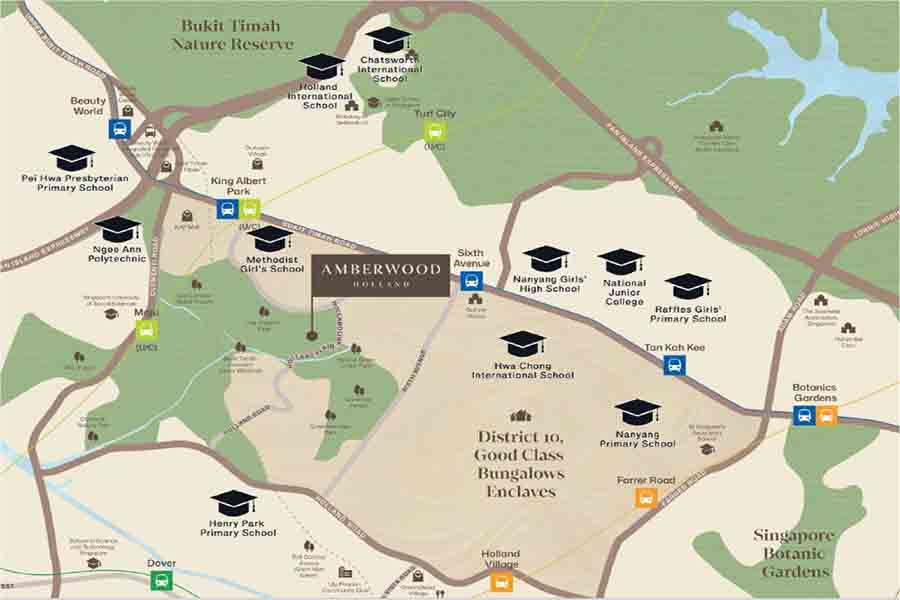
It is the first private residential project to emerge from the Holland Plain transformation, with just 212 homes, all in 3- to 5-bedroom configurations. It sits in District 10, within 1km of Methodist Girls’ School (Primary), beside planned green spaces and within walking distance of King Albert Park MRT — which will become a Downtown Line and Cross Island Line interchange.
But being first also means accepting what comes with an unfinished neighbourhood.
More homes will be built around Amberwood. Roads and pedestrian connections are still evolving. The future Community Plain is not completed. Cross Island Line Phase 2 is only scheduled to open in 2032. And unlike many established properties associated with prime District 10, Amberwood is a 99-year leasehold development.
That creates the central question for buyers:
Does Amberwood offer enough of a first-mover advantage to justify buying before Holland Plain is fully established — or are buyers simply taking the transformation risk earlier?
For me, the answer will ultimately depend on launch pricing.
Amberwood has several genuine strengths. But without the final price list, I would not call it either cheap or expensive yet.
Amberwood at Holland Review: NLR Quick Take
| NLR View | |
|---|---|
| Best suited for | Families wanting a low-rise District 10 home, particularly those who value MGS proximity, larger layouts, greenery and longer-term Holland Plain transformation |
| Biggest strength | A relatively unusual combination of District 10, low density, 3- to 5-bedroom-only unit mix and future park connectivity |
| Biggest concern | Buyers are entering an evolving precinct with substantial future residential supply and construction around them |
| Tenure | 99 years from 4 November 2025 |
| MRT | King Albert Park MRT today; future Downtown Line/Cross Island Line interchange |
| School appeal | Methodist Girls’ School (Primary) stated within 1km based on OneMap information used by the developer |
| Own-stay fit | Stronger |
| Investment fit | More price-sensitive; not an obvious yield-first project |
| Price verdict | Too early to call — launch pricing is still TBA |
| NLR watchpoint | The price gap against established Holland/Bukit Timah alternatives will matter more than the headline psf alone |
NLR Verdict
Amberwood looks more convincing as a family and long-term transformation play than as a straightforward investment product.
The project itself has several qualities I like: only 212 units, low-rise 4- and 6-storey blocks, larger family-focused homes, 1:1 residential parking, high ceilings, substantial greenery and future connectivity improvements.
What I would not do is buy merely because Amberwood is “the first project in Holland Plain”.
Being first only becomes an advantage when the entry price leaves room for the later transformation to benefit you.
That is the number I am waiting for.
Have a question about Amberwood, its pricing, layouts, location or how it compares with another project? Feel free to message me — whether you’re just starting your research or already weighing your options.
What Is Amberwood at Holland?
Amberwood at Holland is a new 99-year leasehold condominium at Holland Link/Holland Plain in District 10, developed by Sim Lian JV (Holland) Pte Ltd, a joint development by Sim Lian Land and Sim Lian Development.
The project comprises:
- 212 residential units
- 11 blocks
- 4- and 6-storey residential buildings
- approximately 17,069 sqm / 183,729 sq ft of land
- 3-, 4- and 5-bedroom homes only
- basement parking
- an Early Childhood Development Centre
- communal facilities and swimming pool
- expected vacant possession by 30 June 2030
The lease commenced on 4 November 2025.
The developer’s official website currently describes Amberwood as a 212-home collection of spacious 3- to 5-bedroom residences in District 10.
Amberwood at Holland Unit Mix
| Unit Type | Size | No. of Units |
| 3 Bedroom | 872 sq ft | 8 |
| 3 Bedroom Premium | 893 sq ft | 30 |
| 3 Bedroom Flexi | 958 sq ft | 18 |
| 3 Bedroom Study | 980 sq ft | 18 |
| 4 Bedroom | 1,076–1,087 sq ft | 24 |
| 4 Bedroom Flexi | 1,141 sq ft | 18 |
| 4 Bedroom Premium | 1,227–1,259 sq ft | 24 |
| 4 Bedroom Luxe | 1,313 sq ft | 8 |
| 5 Bedroom Premium | 1,324–1,335 sq ft | 24 |
| 5 Bedroom Luxe | 1,496–1,572 sq ft | 40 |
| Total | 212 |
The split is unusually balanced: approximately 35% 3-bedroom, 35% 4-bedroom and 30% 5-bedroom homes.
There are no 1- or 2-bedroom units.
That tells us quite a lot about what Amberwood is trying to be.
This is not a development built around small investor units. Its buyer pool is likely to lean towards families, larger households and affluent own-stay buyers looking for a quieter District 10 environment.
Why Is Holland Plain Important to the Amberwood Story?
This is probably the most important part of the Amberwood review.
Amberwood is not simply another condominium being inserted into an established neighbourhood.
It is the first residential GLS project within a larger new Holland Plain precinct.
URA has safeguarded Holland Plain for residential development and says the future neighbourhood will comprise approximately 2,500 homes together with parks and recreational spaces, with access to the future King Albert Park interchange.
That creates both the opportunity and the risk.
The opportunity: buying before the neighbourhood is complete
A future buyer may eventually be looking at:
- a more complete Holland Plain neighbourhood
- completed parks and landscaped connections
- an established Community Plain
- improved walking routes
- King Albert Park operating as a DTL/CRL interchange
- more amenities supported by a larger residential population
Today’s buyer is entering before all of that is fully visible.
That is the legitimate argument behind Amberwood’s first-mover advantage.
But there is another side.
The risk: today’s buyer is also buying before the neighbourhood is complete
The same future transformation means:
- more construction
- more GLS sites
- more competing condominiums
- changing roads and pedestrian routes
- several years before some of the infrastructure becomes fully usable
So I would not treat “first mover” as automatically positive.
First mover = earlier entry + more uncertainty.
Whether that trade-off works depends on price.
The Land Price Story Is Interesting — But It Needs Context
Sim Lian secured the Holland Link site that became Amberwood at approximately $1,432 psf ppr.
The bid was around 22% above the second-highest bidder, which tells us Sim Lian was prepared to compete aggressively for the first Holland Plain site.
That can be interpreted in two very different ways.
Bullish interpretation
The developer saw sufficient value in Holland Plain to pay materially more than competing bidders.
And there is another data point.
Sim Lian subsequently secured the neighbouring Holland Plain Plot 2 at approximately $1,491 psf ppr, about 4.1% higher than its Amberwood land rate.
Amberwood therefore has a lower land cost than the adjacent Sim Lian site.
That could eventually give the first project an entry-price advantage.
More cautious interpretation
Plot 2 received a sole bid.
So I would not interpret its $1,491 psf ppr result as proof that the entire developer market suddenly valued Holland Plain at that level.
Likewise, Sim Lian’s aggressive first bid does not automatically mean buyers should be equally aggressive when Amberwood launches.
Developer confidence is useful context.
It is not a substitute for buyer value.
The question remains:
What price does Sim Lian eventually ask Amberwood buyers to pay on top of that $1,432 psf ppr land cost?
That will be much more important than the land bid itself.
Amberwood’s Biggest Advantage May Actually Be Its Product, Not Its “First-Mover” Label
The marketing story will naturally focus heavily on Holland Plain.
But I think there is another reason some buyers may like Amberwood even if they don’t care about being first.
It is unusually low density.
URA’s approved cap could have accommodated up to 233 units, but Amberwood is being planned with 212 homes. The architect briefing attributes this to a desire for larger average homes, more greenery and lower-density living.
The development consists of low-rise blocks rather than high-rise towers.
The Luxe Collection in Blocks 48, 50 and 52 goes further: these are four-storey blocks with just two units per floor and private-lift access.
This is a very different product from the usual high-density suburban new launch.
3- to 5-Bedroom Homes Only: Good Decision or Limitation?
I actually see the absence of 1- and 2-bedroom units as one of Amberwood’s more interesting characteristics.
The smallest unit is already an 872 sq ft 3-bedroom.
At the other end, 5-bedroom Luxe homes reach 1,572 sq ft.
For own-stay buyers, this is attractive.
You are less likely to end up with a development dominated by compact investor units.
The resident profile could be more family-orientated, and the facilities will be shared among only 212 households.
For investors, however, it changes the equation.
A larger unit means a larger absolute quantum.
That reduces the number of buyers who can afford the property at resale and means rental performance cannot be judged simply from psf.
Amberwood therefore needs to make sense at quantum level, not merely look attractive against another project’s psf.
This is one reason our separate Amberwood at Holland Price Guide will matter once the official prices are released.
Are the Amberwood Floor Plans Good?
The detailed layout-by-layout assessment belongs in our separate Amberwood at Holland Floor Plan Analysis, but there are already a few notable design decisions.
All RC and air-conditioning ledges are excluded from strata area in the floor-plan material, while balconies and PES areas are included where applicable.
That is useful because buyers are not paying strata area for the RC and AC ledges.
The architect briefing also describes Amberwood as a non-PPVC development, which gives some layouts removable internal walls and greater flexibility. For example, the 958 sq ft 3-Bedroom Flexi is designed so that its flexi space can function as a study or extended dining area.
Homes are also planned with approximately 3.18m ceiling heights, while the building’s floor-to-floor height is stated at 3.5m.
Premium fittings and appliances include brands such as V-ZUG, LIEBHERR and Villeroy & Boch, although the exact provision varies by unit collection and type.
My early view
Amberwood’s floor plans appear to be designed around actual family occupation rather than maximising unit count.
That is positive.
But I would not choose a unit purely by bedroom count.
At Amberwood, the price premium between:
- standard
- Premium
- Flexi
- Study
- Luxe
could determine whether the extra space is genuinely worth buying.
We will assess that separately once prices are released.
MRT Today vs Connectivity Tomorrow
Amberwood is within walking distance of King Albert Park MRT (DT6) on the Downtown Line.
Developer material currently places the walking journey at roughly 7–8 minutes, depending on route and pace. Today, that already gives residents direct Downtown Line access towards areas such as Botanic Gardens, Stevens, Newton and the city.
The longer-term story is more interesting.
King Albert Park will become an interchange with Cross Island Line Phase 2, adding another major rail connection through stations including Turf City, Maju, Clementi, West Coast and Jurong Lake District. CRL Phase 2 is currently targeted to open in 2032.
Amberwood’s expected vacant possession is June 2030.
That means buyers could receive their homes roughly two years before the CRL interchange is scheduled to begin passenger service.
Good today, potentially much better later.
But buyers should separate what already exists from what still depends on future infrastructure.
The architect briefing also shows that part of Amberwood’s future pedestrian convenience will depend on the completion of the surrounding Holland Plain network. A resident side gate facing the future Community Plain, for example, is not intended to operate until the Community Plain is completed. Future road realignment works are also planned around the precinct.
So the accessibility proposition should not be viewed as:
“Amberwood already has everything the future Holland Plain will provide.”
It is more accurately:
“Amberwood already has access to King Albert Park MRT, while its walking environment and wider connectivity should improve as Holland Plain and the CRL are completed.”
For a long-term owner, that future improvement could be meaningful.
For someone expecting all of the connectivity benefits immediately at TOP, the timing matters.
Methodist Girls’ School: A Genuine Buyer Consideration
Amberwood’s developer material states that Methodist Girls’ School (Primary and Secondary) is within 1km, based on OneMap information as at July 2026.
For families with daughters approaching Primary 1 registration, that is likely to be one of Amberwood’s strongest practical attractions.
But buyers should understand what “within 1km” means.
Being located within the distance band does not guarantee admission.
The developer itself appropriately notes that actual home-school distance and eligibility for priority admission are ultimately determined by MOE/SLA during registration.
Other established schools in the wider Bukit Timah/Holland education belt include Henry Park Primary, Pei Hwa Presbyterian Primary, Nanyang Primary, Nanyang Girls’ High, Hwa Chong Institution, Singapore Chinese Girls’ School and National Junior College.
Who benefits most from this?
For me, MGS matters much more to:
a family that genuinely intends to use the school proximity
than to:
an investor assuming every future buyer will pay a premium simply because MGS is nearby.
The first is a lifestyle advantage.
The second still needs to be proven by price and resale demand.
Greenery Is More Than Just Marketing Here — But Some of It Is Future Greenery
Amberwood sits alongside a broader planned green network.
URA’s Holland Plain plans include parks and recreational spaces, and the project’s materials show connections towards:
- future Community Plain
- Holland Green Linear Park
- Rail Corridor
- Bukit Timah Canal park connectors
- wider nature areas around Bukit Timah
URA confirms that Holland Plain is intended to include parks and recreational spaces as part of its approximately 2,500-home neighbourhood.
Amberwood’s architect plans also position different blocks towards either the future Community Plain, Holland Green Linear Park or internal landscaping.
There is genuine potential here.
But don’t look at an artist’s impression of completed landscaping and assume that is the environment on Day One.
Some of the appeal arrives progressively.
That distinction matters.
What About Amberwood’s Facilities?
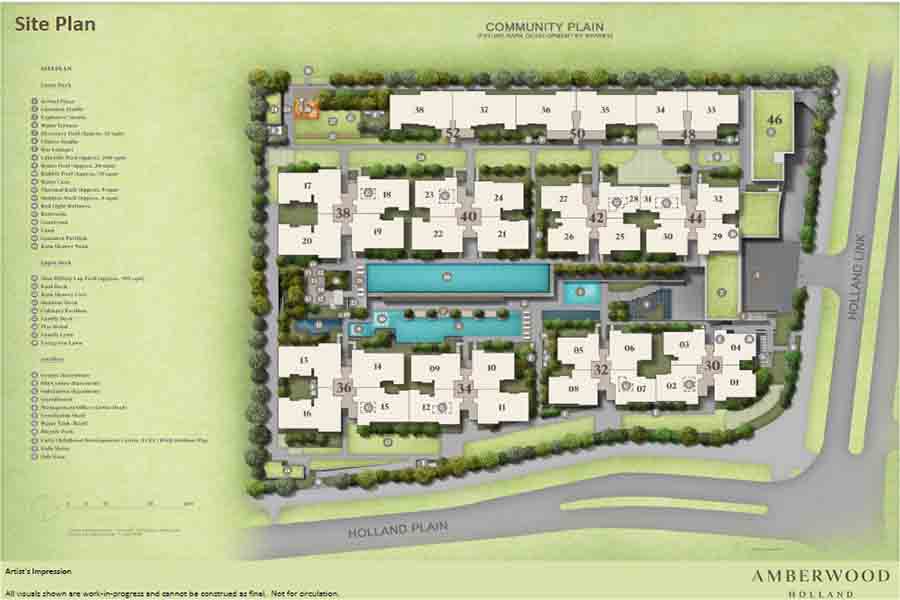
Amberwood is expected to include the usual major condominium facilities such as swimming pools, gym and landscaped recreational areas, but the developer is also positioning wellness as part of the project identity.
The briefing references thermal baths, outdoor baths, rain showers and a red-light therapy facility.
There is also 1:1 residential carpark provision, which is worth noting for a project targeted heavily at larger family households.
I wouldn’t buy a condo because it has a red-light therapy room.
But in a 212-unit low-density project, the combination of family-sized homes, landscaping, parking and facilities does reinforce Amberwood’s own-stay positioning.
Amberwood at Holland vs Established Holland Properties
This is where Amberwood becomes more complicated.
A buyer with a District 10 budget is not forced to buy Amberwood.
There are established alternatives around Holland and Bukit Timah, including both leasehold and freehold properties.
One Holland Village Residences, for example, recorded 2026 transactions around $2,980 to $3,221 psf for the transactions captured in May 2026, while a December 2025 resale was recorded at about $3,188 psf.
Those are not direct like-for-like comparisons: One Holland Village has a very different location, density, product and lifestyle proposition.
But that is precisely the point.
Amberwood cannot be judged only by:
“What are other D10 condos selling for per square foot?”
A buyer may be choosing between:
Amberwood’s larger, quieter, low-rise Holland Plain environment
and
an established project closer to existing shops, restaurants and daily conveniences.
The right comparison therefore depends on quantum and buyer lifestyle, not just postal district.
Once launch pricing is available, our Amberwood at Holland Price Guide will compare this properly.
The Future Supply Question Cannot Be Ignored
This is probably Amberwood’s biggest investment risk.
URA plans approximately 2,500 homes across Holland Plain.
Amberwood is only the beginning.
The adjacent second residential plot has already been acquired by Sim Lian, and further sites are coming through the GLS programme.
That can work both ways.
Why future supply may help Amberwood
More residents can support:
- stronger neighbourhood identity
- improved infrastructure
- greater activity
- completed parks
- better connectivity
- greater awareness of Holland Plain
A future buyer may recognise “Holland Plain” much more readily than a buyer does today.
Why future supply may hurt Amberwood
Every new project also becomes potential competition.
At resale, an Amberwood owner may be competing against:
- newer Holland Plain condos
- unsold developer stock
- recently completed units
- future launches with newer specifications
So the simplistic idea that:
“later launches will be more expensive, therefore Amberwood automatically makes money”
is not enough for me.
Future projects need to sell at higher prices and future buyers still need to see value in Amberwood.
That is the real test.
One Interesting Factor: Sim Lian Owns the Next Plot Too
Sim Lian has secured both the Amberwood site and neighbouring Holland Plain Plot 2.
That could create some continuity in how the first part of Holland Plain develops.
But I also see a commercial question.
If the next Sim Lian project launches while Amberwood owners are approaching completion or resale, buyers could eventually have a choice between:
the first Sim Lian project at a potentially lower entry price
and
a newer Sim Lian project built on a higher land cost.
Which one wins depends on the eventual pricing gap.
This is precisely why Amberwood’s entry price matters so much.
The lower $1,432 psf ppr land cost is only valuable to the buyer if enough of that advantage reaches the purchase price.
What Are the Main Weaknesses of Amberwood at Holland?
1. It is leasehold in an area where buyers have freehold alternatives
Amberwood has a fresh 99-year lease from November 2025, so lease decay is hardly an immediate issue.
But tenure still matters because District 10 buyers can choose from established freehold developments.
If Amberwood launches too close in quantum to a credible freehold alternative, buyers should compare carefully.
2. Holland Plain will remain a construction zone for years
Buying the first project in a new precinct means living through part of its development cycle.
Amberwood buyers should expect surrounding sites, roads, landscaping and infrastructure to evolve after purchase and potentially after TOP.
If you want a mature neighbourhood where everything you see today is essentially what you get, this is not that product.
3. Much of the strongest accessibility story is future-facing
KAP MRT exists today.
But the CRL interchange comes later.
The Community Plain comes later.
Some pedestrian connections come later.
Road realignment comes later.
That doesn’t invalidate the story.
It simply means buyers should not pay tomorrow’s fully completed neighbourhood price without examining whether the entry price compensates them for waiting.
4. Future Holland Plain supply will be substantial
Approximately 2,500 homes are planned.
That helps create the neighbourhood but also gives future buyers more choice.
This makes unit selection particularly important.
A mediocre stack bought at an aggressive launch premium may find it harder to stand out once more Holland Plain projects arrive.
5. There are no small-format entry units
The 872 sq ft 3-bedroom is the smallest product.
That suits Amberwood’s family positioning but raises the minimum entry quantum.
Investors looking for the cheapest possible District 10 ticket may find other projects easier to enter.
6. Launch pricing is still unknown
This is the most important weakness today because we cannot yet determine whether buyers are being adequately compensated for the trade-offs above.
A good development can still be a poor purchase at the wrong price.
What Are Amberwood’s Strongest Points?
1. Genuine low-density positioning
212 homes over a sizeable low-rise site is meaningfully different from a typical large new launch.
2. Family-focused unit mix
Every home is at least a 3-bedroom.
That gives the project a clearer resident profile.
3. MGS within 1km
For the right family, this is not merely a marketing bullet point — it can materially affect the shortlist.
4. Future KAP MRT interchange
The DTL is already useful, while CRL2 provides a second long-term connectivity catalyst.
5. Holland Plain transformation
Amberwood has the opportunity to enter before the wider precinct is complete.
The upside exists — provided buyers don’t overpay for it in advance.
6. Better-than-basic specifications
High ceilings, non-PPVC flexibility, recognised appliance and sanitary brands, plus more premium treatment in Luxe units help support Amberwood’s positioning above a standard mass-market product.
7. Green and low-rise surroundings
The planned Community Plain, linear park and wider green network are particularly relevant for own-stay buyers who place value on privacy and outdoor space.
Who Should Consider Amberwood at Holland?
Families prioritising MGS
This is probably one of the clearest buyer groups, provided the home-school distance works for the relevant registration year.
Buyers wanting a larger District 10 home
Amberwood starts at 3 bedrooms and goes up to 5 Bedroom Luxe.
Buyers who dislike high-rise, high-density projects
Its low-rise architecture and 212-unit scale are genuine differentiators.
Buyers willing to hold through Holland Plain’s development
The transformation story needs time.
A buyer intending to stay for many years can probably make better use of that than someone planning a short holding period.
Buyers who value greenery more than immediate doorstep retail
Amberwood’s strongest lifestyle proposition is nature, privacy and residential quietness — not having a shopping mall downstairs.
Who Should Think Twice?
Buyers who insist on freehold
Amberwood is clearly not going to solve that requirement.
Buyers wanting immediate neighbourhood maturity
Holland Plain is still evolving.
Investors focused mainly on rental yield
The large-unit-only product means higher quantum, and I would want to see actual launch prices before deciding whether rental returns make sense.
Buyers expecting an immediate CRL benefit
CRL Phase 2 is targeted for 2032.
Buyers uncomfortable with future construction and competing supply
There will be more Holland Plain projects.
Buyers stretching their budget purely for the District 10 label
The address is only one part of the decision. Unit efficiency, quantum and competing options matter more.
Is Amberwood at Holland Good for Own Stay?
Potentially yes — and this is where I think Amberwood looks strongest.
The project combines several characteristics that make sense for own stay:
- 3- to 5-bedroom-only unit mix
- low-rise environment
- only 212 homes
- school appeal
- greenery
- future park access
- family-sized layouts
- 1:1 parking
- future MRT interchange
- established Bukit Timah/Holland surroundings beyond the immediate new precinct
The biggest own-stay question is whether you are comfortable living through the gradual development of Holland Plain.
If you’re buying for ten years or longer, that may matter less.
If you want the neighbourhood to be completely finished the day you collect your keys, it matters considerably more.
Is Amberwood at Holland Good for Investment?
Possibly — but I would be much more price-sensitive.
There is an attractive investment thesis:
first project → lower land cost → Holland Plain develops → infrastructure improves → later projects establish higher benchmarks.
That is coherent.
But it is not guaranteed.
The counter-thesis is:
aggressive land bid → aggressive launch pricing → years of future competing supply → newer projects compete against Amberwood at resale.
Both scenarios are plausible.
Until we see pricing, I wouldn’t choose between them.
For an investor, the key number is not simply:
“What psf is Amberwood launching at?”
It is:
“How much cheaper or more expensive is my actual unit compared with the alternatives a future buyer will consider?”
That is what determines whether the first-mover advantage is real.
What Price Would Make Amberwood Attractive?
Official pricing has not been released as at 26 August 2026.
So I am deliberately not inventing a “fair value” range here.
Once the price list is available, I will look at three things:
1. Amberwood vs its own future neighbour
The second Sim Lian Holland Plain site was acquired at a higher land cost.
How much of an entry advantage is Amberwood actually giving buyers?
2. Amberwood vs established Holland/Bukit Timah projects
Are you saving enough to compensate for leasehold tenure, future construction and a less mature immediate neighbourhood?
3. Quantum, not just psf
A 1,300 sq ft unit at a superficially attractive psf can still require a very large absolute purchase price.
The buyer pool at resale ultimately pays dollars, not percentages.
Have a question about Amberwood’s expected pricing or how it may compare with other District 10 and Bukit Timah options? Send me a message and I’ll be happy to discuss it with you.
Amberwood at Holland: The Biggest Question Before You Buy
I don’t think the decision comes down to whether Holland Plain will improve.
It almost certainly will become more developed than it is today: URA has already planned the neighbourhood, residential sites are being released and CRL construction is progressing.
The more important question is:
How much of that future improvement are you being asked to pay for today?
If Amberwood launches with a meaningful entry advantage, its weaknesses become easier to accept:
- leasehold
- future construction
- incomplete pedestrian connections
- later competing supply
Because buyers are being compensated for entering early.
But if Amberwood is priced almost as though Holland Plain, the Community Plain and CRL interchange are already completed, the investment case becomes substantially less convincing.
That distinction will determine my final pricing verdict.
Amberwood at Holland Review: Final Verdict
Amberwood is one of the more interesting District 10 launches because its proposition is unusually clear.
It isn’t trying to appeal to everybody.
There are no 1-bedroom investment units.
There are no 2-bedroom units.
Instead, Sim Lian has created 212 predominantly family-sized homes in a low-rise development, surrounded by a future neighbourhood that is expected to become greener and better connected over time.
For an own-stay family — particularly one valuing MGS, space, greenery and a quieter residential environment — Amberwood deserves consideration.
For an investor, I am more cautious.
The Holland Plain first-mover argument is interesting, and the neighbouring Sim Lian land purchase at a higher $1,491 psf ppr gives us something tangible to watch. But future supply is also precisely why buyers must avoid entering at an excessive premium.
My view today:
Amberwood has a good project story. It has not yet proven that it is a good purchase.
You can follow the latest launch pricing and our unit-by-unit value assessment in the Amberwood at Holland Price Guide.
And when pricing is released, I would pay particular attention to the actual quantum difference between Amberwood and its established alternatives, rather than being distracted by whether the launch psf starts with a 2 or a 3.
That is where the real value — or lack of it — will show.
Amberwood at Holland FAQs
Is Amberwood at Holland worth buying?
Amberwood at Holland could be attractive for families seeking a low-density District 10 home near Methodist Girls’ School, greenery and the future King Albert Park MRT interchange. However, launch prices have not yet been released, so whether it represents good value cannot be determined purely from the project attributes.
Is Amberwood at Holland freehold?
No. Amberwood at Holland is a 99-year leasehold condominium, with the lease commencing from 4 November 2025.
How many units are there at Amberwood at Holland?
Amberwood at Holland has 212 residential units across 11 low-rise blocks.
What unit types are available at Amberwood at Holland?
Amberwood offers only 3-, 4- and 5-bedroom homes, ranging from approximately 872 sq ft to 1,572 sq ft. There are no 1- or 2-bedroom units.
Is Amberwood at Holland within 1km of Methodist Girls’ School?
Developer materials based on OneMap information as at July 2026 place Methodist Girls’ School within 1km. Actual home-school distance and Primary 1 eligibility should be verified with MOE/SLA for the relevant registration exercise.
Which MRT station is nearest to Amberwood at Holland?
The nearest MRT is King Albert Park MRT on the Downtown Line. King Albert Park will also become an interchange with Cross Island Line Phase 2, which LTA currently targets to open in 2032.
When is Amberwood at Holland expected to be completed?
Amberwood’s current project fact sheet states an expected vacant possession date of 30 June 2030.
Who is the developer of Amberwood at Holland?
Amberwood is developed by Sim Lian JV (Holland) Pte Ltd, jointly by Sim Lian Land Pte Ltd and Sim Lian Development Pte Ltd.
What is the main risk of buying Amberwood at Holland?
The main risk is paying too much upfront for a future transformation that is still developing. Holland Plain is planned for approximately 2,500 homes, meaning Amberwood buyers should expect future construction and competing residential supply even as the neighbourhood gains amenities and connectivity.
What is the main advantage of Amberwood at Holland?
Its strongest combination is low-density District 10 living, family-sized homes, MGS proximity, greenery and future transport improvements. Whether that translates into good value depends on the eventual launch price.
Should I wait for the next Holland Plain condo instead?
Not necessarily. Sim Lian’s adjacent Holland Plain site was acquired at a higher land cost than Amberwood’s site, but future project pricing, design and market conditions remain unknown. Buyers should compare the actual Amberwood entry price against what they receive rather than assuming either the first or later project must automatically be better.
Explore the Full Amberwood at Holland Analysis
This review forms part of the full Amberwood at Holland project cluster:
- Amberwood at Holland Price Guide – pricing logic, land-cost context, affordability analysis and comparable new launch positioning
- Amberwood at Holland Floor Plan Analysis – unit mix, layout efficiency, stack considerations and liveability factors
- Amberwood at Holland Showflat Guide – showroom visit preparation, viewing questions and buyer evaluation framework
Together, these articles provide a structured view of Amberwood at Holland’s pricing, layout strategy, location trade-offs, showflat considerations and long-term buyer suitability.
Amberwood at Holland Enquiry
If you would like to know more about Amberwood, its pricing, floor plans, location, showflat details or how it compares with other projects, leave your details below.
You can also let me know what you’re looking for or any questions you have, and I’ll get back to you personally.
Pingback: Amberwood at Holland Floor Plan Analysis: Best Layouts & Stacks