
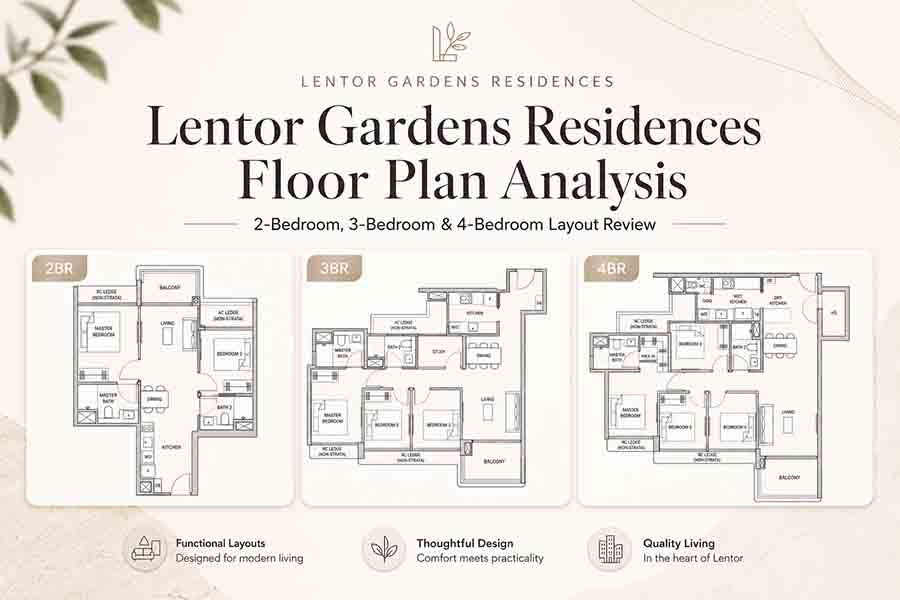
Lentor Gardens Residences Floor Plan Analysis (Quick Overview)
Lentor Gardens Residences offers a practical mix of 2-bedroom, 3-bedroom and 4-bedroom layouts, supported by 3 strata terrace houses and 3 commercial shops.
The key point is this:
Lentor Gardens Residences is not a 1-bedroom-heavy investor project. There are no 1-bedroom units in the current unit mix. Instead, the project is led by 2-bedroom layouts, while still offering a meaningful number of 3-bedroom and 4-bedroom family-sized units.
The current mix is led by 2-bedroom layouts, which make up 252 of the 499 residential units. The remaining supply is mainly split between 3-bedroom and 4-bedroom layouts, with only 3 strata terrace houses.
This means Lentor Gardens Residences is not positioned as a 1-bedroom-heavy rental play. It is more of a broad private residential project, with lower-quantum 2-bedroom options supported by a meaningful family-sized segment.
For buyers, the real question is not simply:
“Which Lentor Gardens Residences floor plan is the cheapest?”
The better question is:
“Which layout gives the best balance between quantum, liveability, stack exposure, floor level, future resale demand and long-term use within the Lentor cluster?”
That is why buyers should look at the floor plan, unit mix and site plan together — not separately.
Need help narrowing down which Lentor Gardens Residences layouts and stacks may make more sense?
Key Floor Plan Facts
Lentor Gardens Residences has a total of 499 residential units and 3 commercial shops.
The residential mix is made up of:
- 2 Bedroom + Study
- 2 Bedroom Premium
- 2 Bedroom Premium with Household Shelter
- 3 Bedroom Compact
- 3 Bedroom Compact + Study
- 3 Bedroom Premium
- 3 Bedroom Premium + Study
- 4 Bedroom Compact
- 4 Bedroom Premium
- Strata Terrace House
The project has a strong 2-bedroom base, but it is not purely an investor-style development. The 3-bedroom and 4-bedroom units together form a substantial family segment, which should appeal to HDB upgraders, family owner-occupiers and longer-term buyers looking within the Lentor / Ang Mo Kio / Upper Thomson area.
Explore the Full Lentor Gardens Residences Analysis
This floor plan analysis forms part of the full Lentor Gardens Residences cluster:
- Lentor Gardens Residences Review – project positioning, Lentor precinct context and buyer suitability
- Lentor Gardens Residences Price Guide – pricing logic, estimated affordability and Lentor comparison framework
- Lentor Gardens Residences Showflat Guide – viewing preparation, showflat location and stack evaluation
Together, these articles help buyers assess Lentor Gardens Residences from four angles: pricing, layouts, location suitability and practical buying strategy.
Buyers who are still learning how Singapore new launches are typically evaluated may also find the New Launch Condo Guide helpful before comparing individual projects.
Current Available Units, Layouts & Unit Types (Live Snapshot)
Official sales availability for Lentor Gardens Residences has not been released yet. The table below should therefore be treated as a unit-type snapshot, not a confirmed live availability chart.
Once balloting, booking or monthly sales updates are available, this section will be updated to reflect the latest available units, sold units and balance units.
| Type | Size(sqft) | Avail/Total |
| 2 BEDROOM + STUDY | 732 | 147/147 |
| 2 BEDROOM PREMIUM | 646-678 | 75/75 |
| 2 BEDROOM PREMIUM (HS) | 689 | 30/30 |
| 3 BEDROOM COMPACT | 872 | 15/15 |
| 3 BEDROOM COMPACT + STUDY | 936 | 15/15 |
| 3 BEDROOM PREMIUM | 1001-1012 | 77/77 |
| 3 BEDROOM PREMIUM + STUDY | 969 | 32/32 |
| 4 BEDROOM COMPACT | 1184 | 60/60 |
| 4 BEDROOM PREMIUM | 1346-1356 | 45/45 |
| STRATA TERRACE HOUSE | 1496 | 3/3 |
| Shop | 463 | 3/3 |
This unit mix gives Lentor Gardens Residences a broad residential positioning.
It is:
- not a 1-bedroom-heavy rental play
- not a pure investor project
- not a luxury-only family development
- not a boutique low-density project
- not purely a large-format upgrader condominium
Instead, it sits in the middle: a new launch with a strong 2-bedroom base, but enough 3-bedroom and 4-bedroom supply to remain relevant to families and owner-occupiers.
For buyers, the important question is not just which units are still available.
The better question is:
“Which available unit still makes sense after comparing layout type, facing, stack exposure, floor level and final quantum?”
Need the latest available unit breakdown before shortlisting?
Lentor Gardens Residences Unit Mix Breakdown
The more detailed unit mix gives a clearer picture of how Lentor Gardens Residences is likely to appeal to different buyer groups.
| Unit Type | Size Range | Total Units | Approx. % of 499 Residential Units | Buyer Positioning |
| 2 Bedroom + Study | 732 sqft | 147 | 29.46% | Main 2BR flexibility segment |
| 2 Bedroom Premium | 646–678 sqft | 75 | 15.03% | Lower-quantum 2BR entry |
| 2 Bedroom Premium (HS) | 689 sqft | 30 | 6.01% | 2BR with better storage practicality |
| 3 Bedroom Compact | 872 sqft | 15 | 3.01% | Lower-quantum family entry |
| 3 Bedroom Compact + Study | 936 sqft | 15 | 3.01% | Compact family layout with study flexibility |
| 3 Bedroom Premium | 1,001–1,012 sqft | 77 | 15.43% | Main family own-stay segment |
| 3 Bedroom Premium + Study | 969 sqft | 32 | 6.41% | Family layout with study flexibility |
| 4 Bedroom Compact | 1,184 sqft | 60 | 12.02% | Larger family entry |
| 4 Bedroom Premium | 1,346–1,356 sqft | 45 | 9.02% | Larger family / long-term own stay |
| Strata Terrace House | 1,496 sqft | 3 | 0.60% | Rare landed-like format |
The most important observation is that the 2-bedroom layouts form more than half of the residential supply.
That matters because future resale and rental performance in the 2-bedroom category may depend heavily on:
- stack selection
- facing
- floor level
- internal layout efficiency
- entry price
- view corridor
- noise exposure
- comparison against other Lentor projects
At the same time, the 3-bedroom and 4-bedroom units together form about 48.9% of the residential mix. This gives Lentor Gardens Residences a stronger family and owner-occupier angle than a project dominated only by compact units.
What the Lentor Gardens Residences Floor Plans Reveal
The floor plans suggest a practical layout strategy rather than a purely compact investor-led approach.
Most layouts focus on:
- straight living and dining spaces leading towards the balcony
- practical bedroom sizing
- separated kitchen zones or kitchen alcoves
- selected study or household shelter options
- stronger family usability in the 3-bedroom and 4-bedroom categories
The architecture briefing also highlights several useful design points, including a non-PPVC construction approach, selected internal wall flexibility, practical bedroom proportions and regular living/dining zones.
However, buyers should still check the official floor plan legend carefully. Some walls may be marked as not allowed to be hacked or altered, so buyers should not assume every internal wall can be changed.
This means the best Lentor Gardens Residences floor plan is not simply the biggest one.
It is the one that gives the right balance of:
- usable internal space
- sensible bedroom proportions
- practical kitchen placement
- balcony efficiency
- stack facing
- total quantum
- future resale audience
Lentor Gardens Residences 2-Bedroom Floor Plan Analysis
The 2-bedroom layouts form the largest part of Lentor Gardens Residences, with 252 units across the 2 Bedroom + Study, 2 Bedroom Premium and 2 Bedroom Premium (HS) categories.
This makes the 2-bedroom segment important for both entry-level buyers and future resale competition.
2 Bedroom Premium: 646–678 sqft
The 2 Bedroom Premium layouts are likely to form the more accessible 2-bedroom entry point at Lentor Gardens Residences.
These layouts may suit:
- singles or couples entering private ownership
- buyers who want lower total quantum
- investors looking for a more manageable unit size
- smaller households who do not need a study room
- buyers comparing Lentor Gardens Residences against other Lentor new launches
The main advantage is quantum control.
A smaller 2-bedroom layout can be easier to enter, easier to rent out and easier to compare against nearby alternatives.
However, buyers should check whether the living and dining space still feels comfortable after furniture placement. The second bedroom should also be assessed carefully because it needs to work not only as a bedroom, but also as a possible study, guest room or child’s room.
For this category, the best units are likely to be those that combine efficient internal space with a sensible stack facing and a realistic entry price.
2 Bedroom Premium (HS): 689 sqft
The 2 Bedroom Premium (HS) layout is slightly larger and includes a household shelter.
This may appeal to buyers who want a 2-bedroom unit but still need more practical storage. For own-stay buyers, the household shelter can be useful for luggage, bulky items, household supplies or long-term storage needs.
This layout may suit:
- owner-occupiers who want more storage
- couples planning longer-term use
- small families who value practicality
- right-sizers who do not want to compromise too much on storage
- buyers who prefer a 2-bedroom layout with better functional support
The trade-off is that the total quantum may be higher than the smaller 2 Bedroom Premium units. Buyers should therefore compare whether the additional storage and usability justify the price difference.
For own-stay buyers, this could be a more practical 2-bedroom option than the smallest layouts. For investors, the smaller 2-bedroom layouts may still be more quantum-efficient if rental yield is the main objective.
2 Bedroom + Study: 732 sqft
The 2 Bedroom + Study is the largest 2-bedroom category at Lentor Gardens Residences.
This layout may be attractive because it offers more flexibility than a standard 2-bedroom unit. The study area can support work-from-home use, a nursery, hobby space, storage or a more flexible household setup.
This may suit:
- couples who work from home
- small families with a young child
- buyers who want flexibility without moving into a 3-bedroom unit
- investors who want a broader tenant profile
- own-stay buyers who find a standard 2-bedroom too tight
The main advantage is flexibility.
In today’s market, a proper study area can make a 2-bedroom unit feel more useful, especially for buyers who are not ready to move into the 3-bedroom price tier.
The main risk is overpaying for the extra space.
Buyers should compare the price gap between the 2 Bedroom + Study and the smaller 2 Bedroom Premium layouts. If the gap is reasonable, the 2 Bedroom + Study may offer stronger liveability. If the gap is too wide, some buyers may prefer to move up to a compact 3-bedroom instead.
2-Bedroom Key Takeaway
Among the 2-bedroom layouts, the 2 Bedroom Premium units may appeal most to buyers focused on lower quantum.
The 2 Bedroom Premium (HS) may suit buyers who want better storage and own-stay practicality.
The 2 Bedroom + Study may be the most flexible 2-bedroom format, especially for buyers who need work-from-home space or longer-term usability.
The best 2-bedroom choice depends on whether the buyer prioritises lowest entry price, storage, flexibility or future resale appeal.
Lentor Gardens Residences 3-Bedroom Floor Plan Analysis
The 3-bedroom layouts form the core family segment at Lentor Gardens Residences, with 139 units across compact, compact + study, premium and premium + study types.
This is likely to be an important category for HDB upgraders and family buyers who want a new launch in the Lentor area without moving into the larger 4-bedroom quantum tier.
3 Bedroom Compact: 872 sqft
The 3 Bedroom Compact layout is the most quantum-controlled 3-bedroom format.
This may suit buyers who want three bedrooms but still need to keep the total price manageable.
It may appeal to:
- young families
- HDB upgraders entering private property
- buyers who find 2-bedroom units too small
- buyers who want 3 rooms but do not need a large family layout
- investors who want a family-sized rental product at a lower quantum
The key advantage is that it gives buyers a 3-bedroom format without moving immediately into the larger premium sizes.
The trade-off is space.
Buyers should check whether the common bedrooms, living area and dining area feel comfortable after furniture placement. A compact 3-bedroom can work well if the layout is efficient, but it may feel tight if too much space is taken up by corridor, balcony or awkward corners.
3 Bedroom Compact + Study: 936 sqft
The 3 Bedroom Compact + Study adds flexibility while still staying below the larger premium 3-bedroom sizes.
This can be useful for families who need a study area but do not want to move into the highest 3-bedroom quantum range.
It may suit:
- families with school-going children
- households with work-from-home needs
- buyers who want flexible space without buying a 4-bedroom unit
- HDB upgraders who want better long-term usability
- buyers who prefer a more functional family layout
The study area can improve daily liveability because it gives the household a dedicated space beyond the bedrooms. This can make the unit feel more practical for long-term own stay.
Buyers should compare this layout against both the 872 sqft compact 3-bedroom and the 969 sqft premium + study layout. The better choice will depend on price gap, actual layout efficiency and stack facing.
3 Bedroom Premium: 1,001–1,012 sqft
The 3 Bedroom Premium layouts are likely to form one of the main family own-stay categories at Lentor Gardens Residences.
These units offer more space than the compact 3-bedroom layouts and may appeal to buyers who want a more complete family home.
They may suit:
- HDB upgraders
- families with one or two children
- buyers planning a longer holding period
- households that want more comfortable bedroom and living spaces
- buyers who are comparing Lentor Gardens Residences against other Lentor family layouts
The main advantage is liveability.
A larger 3-bedroom unit can offer better space distribution, more comfortable furniture placement and stronger long-term usability.
The main consideration is quantum.
Buyers must compare whether the premium over the compact 3-bedroom layouts is justified by the additional space, stack quality and future resale appeal.
3 Bedroom Premium + Study: 969 sqft
The 3 Bedroom Premium + Study is an interesting category because it offers study flexibility while remaining slightly smaller than some of the larger 3 Bedroom Premium layouts.
This layout may appeal to buyers who value function over just headline size.
It may suit:
- families who need a study area
- buyers who want flexibility without jumping to a 4-bedroom unit
- households that need a child study area or work-from-home zone
- buyers who want family functionality at a controlled size
- own-stay buyers comparing layout efficiency closely
The key question is whether the study area improves the actual daily usability of the unit. If it does, this layout may feel more practical than a slightly larger but less flexible 3-bedroom.
Buyers should compare this category carefully against the 3 Bedroom Compact + Study and 3 Bedroom Premium layouts before deciding.
3-Bedroom Key Takeaway
The 3 Bedroom Compact may suit buyers who want the lowest 3-bedroom entry quantum.
The 3 Bedroom Compact + Study may suit buyers who want a practical family layout with extra flexibility.
The 3 Bedroom Premium may appeal to families who want a more complete own-stay layout.
The 3 Bedroom Premium + Study may be attractive for buyers who value study flexibility and efficient space use.
For many buyers, the 3-bedroom category may be the most balanced segment at Lentor Gardens Residences because it sits between lower-quantum 2-bedroom units and higher-commitment 4-bedroom layouts.
Lentor Gardens Residences 4-Bedroom Floor Plan Analysis
The 4-bedroom layouts at Lentor Gardens Residences are split between 4 Bedroom Compact and 4 Bedroom Premium formats.
This category is likely to appeal mainly to larger families, long-term owner-occupiers and HDB upgraders who need more future-proof space.
4 Bedroom Compact: 1,184 sqft
The 4 Bedroom Compact layout is the more accessible 4-bedroom format.
It may suit buyers who want four bedrooms but still need to control the total quantum.
This layout may appeal to:
- larger families
- buyers with multiple children
- households that need a study or guest room
- HDB upgraders who want more rooms
- buyers comparing premium 3-bedroom units against compact 4-bedroom units
The key advantage is that it gives buyers four bedrooms without necessarily entering the highest price tier in the project.
The main thing to check is whether the bedrooms, living area and dining area still feel proportionate. A compact 4-bedroom layout can be very useful if well planned, but buyers should avoid choosing it purely because it has four rooms.
It should still feel comfortable as a long-term home.
4 Bedroom Premium: 1,346–1,356 sqft
The 4 Bedroom Premium layouts are the larger family formats at Lentor Gardens Residences.
These layouts may appeal to buyers who want stronger long-term own-stay functionality, more service space and better household flexibility.
They may suit:
- larger families
- multi-generation households
- buyers who need more storage
- families with helper needs
- long-term owner-occupiers
- buyers who want to avoid upgrading again too soon
The larger 4-bedroom premium layouts may offer stronger family practicality, especially if the layout includes more complete kitchen, yard, service and bedroom zones.
However, the higher quantum means buyers must be more selective. At this price tier, stack facing, view, floor level, privacy and future resale demand become more important.
A good 4-bedroom premium unit should not just be large. It should feel efficient, well-zoned and suitable for long-term living.
4-Bedroom Key Takeaway
The 4 Bedroom Compact may appeal to buyers who want the function of four bedrooms while keeping quantum more controlled.
The 4 Bedroom Premium may suit long-term family buyers who value space, flexibility and more complete household functionality.
For this category, stack selection matters more because the financial commitment is higher. A weaker-facing 4-bedroom unit may be harder to justify if the price gap against a better-facing unit is not large.
Strata Terrace House Layouts: Rare, But Niche
Lentor Gardens Residences includes only 3 strata terrace houses of about 1,496 sqft each.
This makes them a rare format within the project, but also a niche choice.
These units may appeal to buyers who want a more landed-like feel while still enjoying condominium facilities. However, liquidity may be narrower than the standard 2-bedroom, 3-bedroom and 4-bedroom apartment layouts because the future buyer pool is more specific.
For most buyers, the core comparison will still sit within the 2-bedroom, 3-bedroom and 4-bedroom apartment stacks.
The terrace houses may be interesting, but they are unlikely to define the main resale or investment profile of Lentor Gardens Residences.
Lentor Gardens Residences Site Plan and Stack Considerations
The Lentor Gardens Residences site plan shows several different facing conditions.
Some stacks appear to face the Future Hillock Park / Green Link side. Some face the internal pool and facilities zone. Others sit closer to Lentor Garden, Linear Park or the site’s side boundaries.
This means stack selection should not be based only on floor plan type.
Two units with the same layout may feel very different depending on whether they face:
- greenery
- internal pool facilities
- neighbouring blocks
- road exposure
- lower-floor activity zones
- side gates or access points
- tennis court or facilities areas
- drop-off, bin centre or substation areas
For buyers, this is where the site plan becomes important.
A good floor plan in a weaker stack may not perform the same way as the same layout in a stronger-facing stack.
Future Hillock Park / Green Link Facing
Stacks facing towards the Future Hillock Park / Green Link side may appeal to buyers who prefer a calmer and greener outlook.
This type of facing may support the lifestyle story of Lentor Gardens Residences better than a more road-facing or internal-facing stack.
However, buyers should still check:
- whether the view is protected
- whether floor level makes a meaningful difference
- whether future surrounding development may affect the outlook
- whether the price premium is justified
A greenery-facing stack may be attractive, but it still has to make sense based on price and floor level.
Internal Pool and Facilities Facing
Some stacks appear to face the internal pool and facilities zone.
This may appeal to buyers who like a resort-style view and prefer looking into the development’s landscaped areas.
The potential trade-off is activity noise.
Lower-floor units facing the pool or facilities may experience more sound from swimming areas, children’s play zones, gathering spaces or clubhouse activity.
For buyers who value privacy and quietness, higher floors may be more suitable. For buyers who like facilities views, internal-facing stacks may still be attractive if the pricing is fair.
Linear Park / Side Boundary Facing
Stacks closer to the Linear Park or side boundary may appeal to buyers who prefer greener edge conditions or a less enclosed outlook.
However, buyers should check the exact location carefully.
Some lower-floor units may be closer to active facilities such as the tennis court, walkways or side access areas. This may affect privacy and noise levels, depending on the stack and floor level.
Lentor Garden / Road-Side Exposure
Some stacks may have more exposure towards Lentor Garden or road-side conditions.
These units may offer more open separation in certain cases, but buyers should assess:
- traffic noise
- road exposure
- proximity to drop-off points
- side gate movement
- substation location
- bin centre location
- lower-floor privacy
A road-side stack is not automatically bad. It depends on price, floor level, facing, distance and how it compares against other available choices.
Stack Selection Key Takeaway
For Lentor Gardens Residences, stack selection may matter as much as layout selection.
Buyers should avoid choosing based only on unit type.
A better framework is:
- Choose the right layout category.
- Compare stack facing.
- Check floor level.
- Assess view and privacy.
- Compare final quantum.
- Decide whether the unit still makes sense against other Lentor options.
Best Lentor Gardens Residences Layouts by Buyer Profile
There is no single best layout for every buyer.
The better choice depends on budget, household size, own-stay needs, investment plan, floor level, facing and final pricing.
| Buyer Profile | Layout To Start With | Why |
| Lowest quantum buyer | 2 Bedroom Premium | Smaller size and lower entry point |
| Investor / flexible own-stay buyer | 2 Bedroom + Study | Better flexibility than a basic 2BR |
| Storage-conscious 2BR buyer | 2 Bedroom Premium (HS) | Household shelter improves practicality |
| Young family | 3 Bedroom Compact | Lower-quantum family entry |
| Family needing study space | 3 Bedroom Compact + Study / 3 Bedroom Premium + Study | Better work-from-home or child-study flexibility |
| HDB upgrader | 3 Bedroom Premium | More complete family layout |
| Larger family | 4 Bedroom Compact | More rooms with better quantum control |
| Long-term own-stay family | 4 Bedroom Premium | Better space and household flexibility |
| Niche lifestyle buyer | Strata Terrace House | Rare landed-like format within the project |
The safest way to shortlist is not to ask only:
“Which layout is cheapest?”
A better question is:
“Which layout will still be easy to understand, live in and resell later?”
That is usually the better buying framework.
How to Choose the Right Unit at Lentor Gardens Residences
1. Start With Total Quantum
For many buyers, total price matters more than psf.
A lower-psf unit can still be too expensive if the size is large. A higher-psf unit can still be more manageable if the absolute quantum is controlled.
Before comparing stacks, buyers should first decide the comfortable budget range.
2. Choose the Right Layout Category
Most buyers should first decide whether they are realistically looking at:
- 2-bedroom
- 3-bedroom
- 4-bedroom
- strata terrace house
Only after that should they compare floor level, stack and facing.
3. Check Layout Efficiency
A good layout should be easy to furnish and easy to understand.
Buyers should check:
- whether bedrooms are usable after wardrobes
- whether the living and dining area feels practical
- whether the kitchen suits daily use
- whether the balcony is proportionate
- whether storage is sufficient
- whether there is too much corridor or wasted space
A smaller efficient layout can sometimes feel better than a larger but awkward one.
4. Study Stack Exposure
Stack selection affects daily comfort and future resale appeal.
Buyers should compare:
- greenery view
- pool view
- road exposure
- privacy
- block-to-block distance
- facilities noise
- side gate or access movement
- floor level
This is especially important for buyers planning a longer holding period.
5. Compare Against Other Lentor Projects
Lentor Gardens Residences is entering a precinct with several other Lentor projects.
That means buyers should not assess the floor plans in isolation.
A good unit should make sense not only within Lentor Gardens Residences, but also against the wider Lentor supply.
Buyers should compare:
- layout efficiency
- total quantum
- facing
- floor level
- resale audience
- future competition
- price gap against other Lentor units
The strongest unit may not be the cheapest one.
It is more likely to be the unit with the best balance of liveability, stack quality and price.
Need help comparing the layouts and stacks before shortlisting?
Lentor Gardens Residences Floor Plan FAQs
1. What floor plans are available at Lentor Gardens Residences?
Lentor Gardens Residences offers 2-bedroom, 3-bedroom and 4-bedroom layouts, together with 3 strata terrace houses.
The current unit mix includes 2 Bedroom + Study, 2 Bedroom Premium, 2 Bedroom Premium (HS), 3 Bedroom Compact, 3 Bedroom Compact + Study, 3 Bedroom Premium, 3 Bedroom Premium + Study, 4 Bedroom Compact and 4 Bedroom Premium layouts.
There are also 3 commercial shop units, but these are not residential units.
2. How many 2-bedroom units are there at Lentor Gardens Residences?
There are 252 two-bedroom units at Lentor Gardens Residences.
This includes:
- 147 units of 2 Bedroom + Study
- 75 units of 2 Bedroom Premium
- 30 units of 2 Bedroom Premium (HS)
This makes the 2-bedroom category the largest residential segment in the project. Buyers considering a 2-bedroom unit should compare not only price and size, but also layout efficiency, stack facing, floor level and future resale competition within the same unit type.
3. Are there 1-bedroom units at Lentor Gardens Residences?
Based on the current unit mix, Lentor Gardens Residences does not include 1-bedroom units.
This is important because the smallest residential category appears to be the 2-bedroom segment. As a result, buyers looking for the lowest quantum entry point will likely be comparing the 2 Bedroom Premium layouts and 2 Bedroom + Study layouts instead of 1-bedroom units.
4. Which Lentor Gardens Residences layout may suit investors?
The 2-bedroom layouts may be the most relevant starting point for investors because they are likely to offer the most manageable entry quantum within the residential mix.
The 2 Bedroom Premium layouts may appeal to investors focused on lower quantum, while the 2 Bedroom + Study layouts may appeal to buyers who want a more flexible unit that can suit both tenants and future owner-occupiers.
However, investors should not choose based on size alone. Entry price, rental demand, stack facing and future resale competition are still important.
5. Which Lentor Gardens Residences layout may suit families?
Families may want to start with the 3-bedroom and 4-bedroom layouts.
The 3 Bedroom Compact and 3 Bedroom Compact + Study layouts may suit smaller families or buyers trying to manage total quantum. The 3 Bedroom Premium layouts may suit families who want more comfortable long-term own-stay space.
For larger households, the 4 Bedroom Compact and 4 Bedroom Premium layouts may provide more flexibility for children, work-from-home needs, guests or helper arrangements.
6. Are the 4-bedroom layouts at Lentor Gardens Residences worth considering?
The 4-bedroom layouts may be worth considering for larger families and long-term owner-occupiers who need more space and future flexibility.
The 4 Bedroom Compact layout may appeal to buyers who want four bedrooms while keeping quantum more controlled. The 4 Bedroom Premium layouts may suit buyers who want more complete family functionality and a stronger long-term own-stay layout.
However, because the quantum is higher, buyers should compare stack facing, floor level, view, privacy and price gap carefully before deciding.
7. Does Lentor Gardens Residences have strata terrace houses?
Yes. Lentor Gardens Residences includes 3 strata terrace houses of about 1,496 sqft each.
These are a rare and niche format within the development. They may appeal to buyers who want a more landed-like living experience while still enjoying condominium facilities.
However, because there are only 3 such units, buyers should assess pricing, layout, resale liquidity and personal lifestyle needs carefully.
8. How important is stack selection at Lentor Gardens Residences?
Stack selection is important at Lentor Gardens Residences because different stacks may have different facing conditions.
Some stacks may face greenery, Future Hillock Park or Green Link. Others may face internal pools and facilities, Lentor Garden, Linear Park or side boundary areas. This can affect privacy, noise, view, afternoon sun exposure and long-term resale appeal.
A good floor plan in a weaker stack may not perform the same way as a similar layout in a stronger-facing stack. Buyers should therefore compare layout, stack, floor level and price together before shortlisting.
Conclusion: Which Lentor Gardens Residences Floor Plan Should You Choose?
Lentor Gardens Residences is a project where floor plan selection deserves careful attention.
The project has a strong 2-bedroom base, but it is not only about smaller units. The 3-bedroom and 4-bedroom layouts still form a meaningful family segment, while the strata terrace houses create a rare niche category.
For most buyers:
- 2 Bedroom Premium layouts may offer the most accessible entry point
- 2 Bedroom Premium (HS) layouts may offer better storage practicality
- 2 Bedroom + Study layouts may offer stronger flexibility
- 3 Bedroom Compact layouts may suit lower-quantum family buyers
- 3 Bedroom Premium layouts may suit more complete own-stay use
- 4 Bedroom Compact layouts may suit larger families who still want quantum control
- 4 Bedroom Premium layouts may suit long-term family own-stay buyers
- Strata Terrace Houses may appeal to a small group seeking a more distinctive format
But the best choice is not based only on floor plan type.
The better framework is:
layout + stack + floor level + facing + quantum + future resale audience.
That is the real buyer decision.
Need help narrowing down the better stacks and layouts?
If you want a structured breakdown of:
- best stacks versus weaker exposures
- 2-bedroom, 3-bedroom and 4-bedroom layout trade-offs
- family-friendly layouts
- which units may hold up better long term
- how Lentor Gardens Residences compares against other Lentor projects
- which layouts may align better with your budget and holding strategy
You may leave your details below to receive a structured walkthrough.