
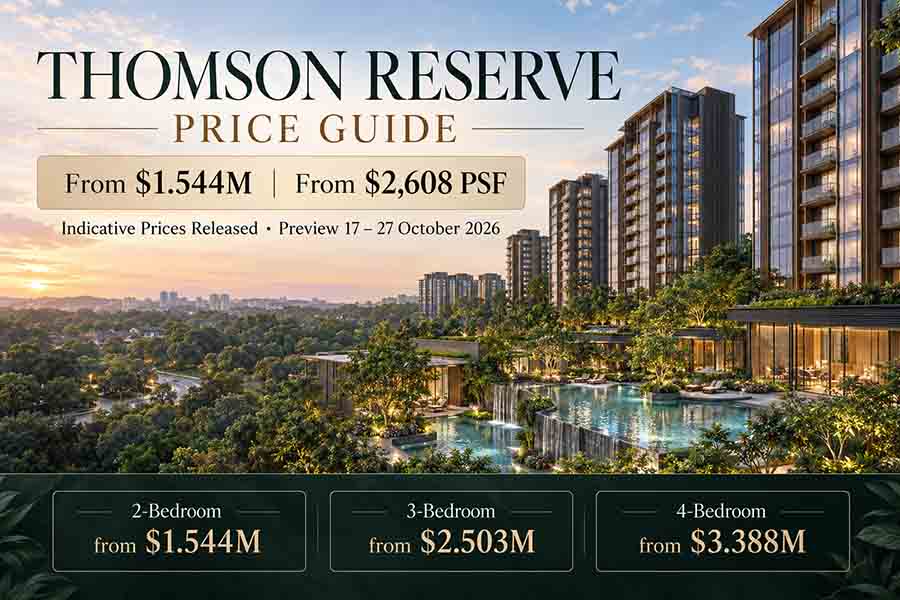
Thomson Reserve Price: Quick Overview
Thomson Reserve is expected to become one of the most closely watched District 20 pricing launches because buyers are not simply evaluating another large condominium.
They are evaluating whether a rare Upper Thomson / Bright Hill redevelopment, close to Upper Thomson MRT, within 1km of Ai Tong School, near Thomson Plaza and supported by a reputable UOL, Singapore Land Group and CapitaLand Development joint venture, can justify a meaningful pricing premium over other central-north and Thomson-East Coast Line alternatives.
Official pricing has not been released.
However, the former Thomson View site was acquired for S$810 million, with the land rate commonly referenced at approximately S$1,178 psf ppr. Based on estimated development cost and margin assumptions, the estimated breakeven has been discussed at around S$2,058 psf ppr.
This means Thomson Reserve is unlikely to be positioned as a low-entry launch.
The pricing question is therefore not simply:
Is Thomson Reserve expensive?
The more important question is:
Can the final launch pricing still make sense after factoring in Upper Thomson MRT access, Ai Tong School proximity, mature-estate scarcity, around 1,240 units, and future internal resale competition?
That is where the buyer decision becomes more nuanced.
Thomson Reserve may have strong structural appeal, but the price must still work for the future resale buyer pool.
What buyers are effectively evaluating is:
- whether Upper Thomson MRT access justifies the expected premium
- whether Ai Tong School proximity supports stronger family demand
- whether the total quantum remains realistic for central-north upgraders
- whether the premium over Lentor and Springleaf alternatives is reasonable
- whether Chuan Park provides a more established comparison point
- whether a 1,240-unit development can maintain resale pricing power over time
This makes Thomson Reserve most relevant for buyers evaluating long-term own-stay utility, school-driven family demand, mature-estate convenience and central-north positioning rather than purely short-term speculative upside.
You can request a clearer breakdown of estimated pricing tiers and unit positioning before preview.
Explore the Full Thomson Reserve Analysis
This price guide forms part of the full Thomson Reserve project cluster:
- Thomson Reserve Review – project positioning, Upper Thomson MRT access, Ai Tong School appeal and long-term buyer trade-offs
- Thomson Reserve Floor Plan Analysis – unit mix, layout efficiency, stack considerations and liveability factors
- Thomson Reserve Showflat Guide – showroom location, viewing process and what buyers should evaluate during a visit
Together, these articles provide a structured analysis of Thomson Reserve’s pricing framework, layout strategy, showroom evaluation and buyer decision factors.
Buyers who are still learning how Singapore new launches are typically evaluated may also find the New Launch Condo Guide helpful before comparing individual projects.
Thomson Reserve Entry Price and Indicative Pricing
Official pricing for Thomson Reserve has not been released.
However, based on:
- land acquisition cost
- estimated breakeven logic
- Upper Thomson MRT proximity
- Ai Tong School proximity
- mature District 20 location
- large-site redevelopment scale
- comparable new launch benchmarks
- current RCR / OCR fringe pricing psychology
Thomson Reserve is likely to be evaluated against a higher pricing threshold than many suburban TEL corridor launches.
Estimated Pricing Framework
| Item | Current Position |
|---|---|
| Official Launch Price | Not released |
| Acquisition Price | S$810 million |
| Land Rate | Approximately S$1,178 psf ppr |
| Estimated Breakeven | Around S$2,058 psf ppr, based on market estimate |
| Estimated Launch Positioning | Potentially above lower TEL corridor alternatives, subject to final strategy |
| Key Pricing Question | Whether the Upper Thomson / Ai Tong / MRT premium still leaves enough room for future resale demand |
These figures should be treated as early pricing context, not final launch pricing.
Final prices will depend on:
- unit type
- floor level
- stack orientation
- facing
- block position
- distance to MRT exits
- release phase
- market conditions
- final developer pricing strategy
Buyers should also be careful not to evaluate Thomson Reserve based only on psf.
For many households, especially HDB upgraders and family buyers, the more practical question is total quantum.
A 3-bedroom unit may appear acceptable on psf comparison but still become stretched if the absolute price moves beyond the comfort zone of the future resale buyer pool.
This is especially important for Thomson Reserve because its likely buyer base includes families from Bishan, Ang Mo Kio, Toa Payoh, Sin Ming and surrounding mature estates.
For this project, affordability is not just about whether buyers can qualify for a loan.
It is about whether future buyers can still afford to buy from them later.
Thomson Reserve Key Facts
- Best For: Central-north HDB upgraders, family buyers, school-driven buyers, MRT-focused owner-occupiers and long-term Upper Thomson residents
- Tenure: 99-year leasehold
- Location: Bright Hill Drive, District 20
- Planning Area: Bishan Planning Area
- Region: Rest of Central Region / Central-North
- Developer: UOL Group, Singapore Land Group and CapitaLand Development joint venture
- Site Type: Former Thomson View Condominium en bloc redevelopment
- Site Area: Approximately 50,208 sqm / about 5 hectares
- Plot Ratio: 2.1
- Total Units: Approximately 1,240 residential units, subject to final approved plans
- Nearest MRT: Upper Thomson MRT, with Bright Hill MRT also relevant depending on block position
- Nearby Mall: Thomson Plaza
- Nearby School Highlight: Ai Tong School within 1km, subject to official verification
- Estimated PSF: Official pricing not released
- Positioning: Upper Thomson / Bright Hill mega-redevelopment with MRT convenience, school appeal, mature amenities and nature adjacency
Thomson Reserve Latest Pricing and Available Units
Official pricing and availability have not been released yet.
The table below is a preliminary pricing framework based on expected buyer positioning and current market context.
| Unit Type | Size Range | Indicative Positioning |
| 1 Bedroom / 1 Bedroom + Study | To be confirmed | Entry private ownership / investors / singles / compact own-stay |
| 2 Bedroom | To be confirmed | Couples / investors / smaller households / lower-quantum buyers |
| 3 Bedroom | To be confirmed | Core family and HDB upgrader segment |
| 4 Bedroom | To be confirmed | Larger family owner-occupiers / right-sizers / long-term holding |
| 5 Bedroom / Larger Units | To be confirmed | Larger households / multi-generational buyers / higher-budget families |
Estimated Pricing Framework Before Launch
The above references are based on early market context, including:
- land cost positioning
- estimated breakeven assumptions
- nearby District 20 benchmarks
- TEL corridor comparisons
- Upper Thomson MRT convenience
- Ai Tong School proximity
- mature-estate scarcity
- broader affordability conditions
Official pricing, floor plans, unit mix and detailed stack-level price lists have not been released.
These estimates are intended for general comparison purposes and should not be treated as final pricing or contractual information.
Availability and pricing may change depending on release phases and market response.
For a full breakdown of layout strategy and stack considerations, refer to the Thomson Reserve Floor Plan Analysis once floor plans are available.
How to Interpret Thomson Reserve Pricing
Thomson Reserve pricing is unlikely to be evaluated purely through affordability alone.
Instead, buyers are likely evaluating:
- whether Upper Thomson MRT access justifies the expected premium
- whether Ai Tong School proximity supports long-term family demand
- whether the mature District 20 location has enough scarcity value
- whether the large site and full-facility scale improve long-term appeal
- whether around 1,240 units create internal resale competition later
- whether pricing remains realistic for HDB upgraders
- whether cheaper TEL alternatives offer better value
This creates a different decision framework from a standard OCR or TEL corridor launch.
Buyers are not simply asking:
“Is Thomson Reserve expensive?”
They are asking:
“Does the Upper Thomson location, Ai Tong School proximity and mature-estate convenience justify the expected premium over other options?”
That distinction matters.
A project can have a strong location but still become a difficult purchase if buyers enter at a price that leaves limited room for future resale demand.
For Thomson Reserve, the final pricing should be interpreted through buyer profile, not headline psf alone.
A family planning around Ai Tong School may value the location differently from an investor looking for rental yield.
A right-sizer from nearby landed housing may value mature-estate familiarity differently from a first-time upgrader comparing total quantum.
A buyer who needs MRT convenience may value Upper Thomson MRT access more than someone who drives daily.
This is why Thomson Reserve pricing needs to be judged according to household needs, not only market averages.
Comparable Projects Around Thomson Reserve
Thomson Reserve should not be evaluated in isolation.
Buyers are likely to compare it against mature-estate redevelopments, TEL corridor alternatives, District 20 benchmarks and nearby central-north projects based on:
- price
- tenure
- MRT access
- school proximity
- project scale
- unit quantum
- rental appeal
- future exit audience
- mature-estate convenience
- internal resale competition
New Launch and Recent Launch Comparison
| Project | Tenure | PSF Reference / Pricing Context | Positioning |
| Thomson Reserve | 99-year | Official pricing not released; land rate approx. S$1,178 psf ppr; estimated breakeven around S$2,058 psf ppr | Upper Thomson / Bright Hill redevelopment, close to MRT, Ai Tong School proximity, mature amenities |
| Chuan Park | 99-year | District 20 mature-estate redevelopment benchmark | Lorong Chuan MRT convenience, large-scale en bloc redevelopment, family-oriented positioning |
| Springleaf Residence | 99-year | Lower TEL corridor entry point compared with premium Upper Thomson positioning | Springleaf MRT / nature corridor / lower entry pricing context |
| Lentor Gardens Residences | 99-year | Lower land-cost Lentor precinct comparison | TEL corridor, newer private housing precinct, family-oriented affordability comparison |
| AMO Residence | 99-year | Modern Ang Mo Kio / District 20 resale or subsale benchmark | Mature estate, family demand, completed / near-completed price reference |
| Narra Residences | 99-year | Upper Bukit Timah / nature and education-belt comparison | Greenery-led family positioning and higher-budget owner-occupier profile |
The key comparison is not only psf.
For Thomson Reserve, the more important question is:
How much premium should buyers pay for Upper Thomson MRT access and Ai Tong School proximity compared with cheaper TEL corridor alternatives or other mature-estate new launches?
This is where buyer priorities will differ.
- A family planning around Ai Tong School may accept a stronger premium.
- A buyer focused on lower entry quantum may prefer Lentor or Springleaf.
- A buyer comparing mature District 20 projects may look closely at Chuan Park.
- A buyer wanting a completed or near-completed reference may compare against AMO Residence.
This is why Thomson Reserve pricing needs to be interpreted through buyer profile, not headline psf alone.
Narrowing Down Upper Thomson and Central-North Options
If you are comparing Thomson Reserve against nearby central-north projects and want a clearer breakdown of which pricing tiers and unit types may make more sense, you can request a structured comparison before preview.
Factors Influencing Thomson Reserve Pricing
Thomson Reserve pricing is likely influenced by:
- Upper Thomson MRT proximity
- Ai Tong School within 1km
- Thomson Plaza convenience
- mature District 20 location
- large 50,208 sqm site area
- limited large-scale new supply in the immediate Upper Thomson pocket
- UOL, Singapore Land Group and CapitaLand Development branding
- former Thomson View en bloc acquisition cost
- land rate of approximately S$1,178 psf ppr
- estimated breakeven of around S$2,058 psf ppr
- current RCR / OCR fringe pricing conditions
- demand from Bishan, Ang Mo Kio, Toa Payoh and Upper Thomson buyers
Within the project itself, pricing will likely vary based on:
- unit type
- floor level
- stack orientation
- block position
- MRT walking route
- road exposure
- internal-facing privacy
- facility-facing exposure
- potential greenery views
- layout efficiency
- release phase
This means buyers should not assume all units provide the same value.
For example, a unit closer to the most convenient MRT route may justify a premium for some buyers. Another buyer may prefer a quieter internal-facing stack even if the walking distance is slightly longer.
A lower-priced unit may not automatically be the better buy if it has weaker facing, poorer privacy or stronger noise exposure.
The best-value unit is usually the unit where pricing, stack quality, layout efficiency and future resale demand align most clearly.
Thomson Reserve Price Tiers by Unit Type
The final unit mix has not been released.
The unit categories below reflect typical buyer positioning expectations for a large mature-estate new launch.
| Unit Type | Expected Buyer Profile | Pricing Consideration |
| 1 Bedroom / 1 Bedroom + Study | Investors, singles, compact own-stay buyers | Entry quantum, rentability and yield sensitivity |
| 2 Bedroom | Couples, investors, small households | Layout efficiency, total quantum and tenant appeal |
| 3 Bedroom | Core family buyers and HDB upgraders | Most important affordability and resale segment |
| 4 Bedroom | Larger families and right-sizers | Layout quality, stack premium and long-term own-stay suitability |
| 5 Bedroom / Larger Units | Multi-generational households and higher-budget families | Absolute quantum, privacy, liveability and resale depth |
Buyers in Thomson Reserve are likely to evaluate:
- total quantum
- MRT convenience
- school proximity
- family practicality
- resale audience
- rental potential
- and long-term central-north positioning
rather than psf alone.
Unit Types and Buyer Direction
1 Bedroom / 1 Bedroom + Study
If Thomson Reserve includes 1-bedroom or 1-bedroom + study units, these may form the lowest quantum entry tier.
These units may appeal to investors, singles and buyers seeking exposure to the Upper Thomson location without committing to a larger unit.
The appeal may come from:
- MRT access
- mature amenities
- Thomson Plaza convenience
- Upper Thomson dining options
- rental demand from working professionals
- However, investors should evaluate yield carefully.
If entry prices are high, rental demand alone may not translate into strong returns.
2 Bedroom
The 2-bedroom layouts may appeal to couples, smaller households and selected investors.
These units may be relevant for buyers who want a more manageable quantum while still benefiting from the project’s mature-estate location.
- Important checks include:
- usable bedroom sizes
- kitchen practicality
- balcony efficiency
- storage space
- distance to MRT
- rental yield potential
- future resale audience
For investors, the question is not only whether the unit can be rented.
The question is whether the purchase price allows the yield and future exit to make sense.
3 Bedroom
The 3-bedroom layouts are likely to become one of Thomson Reserve’s most important pricing categories.
This is because 3-bedroom units usually sit at the centre of family and HDB upgrader demand.
For Thomson Reserve, this category may attract buyers who want:
- Ai Tong School proximity
- Upper Thomson MRT access
- mature amenities nearby
- family usability
- a familiar central-north location
- a new private condominium lifestyle
If the 3-bedroom pricing is calibrated well, it may form one of the strongest long-term segments of the project.
If the quantum becomes too stretched, some HDB upgraders may compare more seriously against Lentor, Springleaf or resale alternatives.
4 Bedroom
The 4-bedroom layouts may appeal more naturally to larger families, right-sizers and long-term owner-occupiers.
At this tier, buyers are less likely to make decisions based only on MRT convenience.
They may compare Thomson Reserve against:
- larger resale condos
- Chuan Park
- AMO Residence resale or subsale options
- landed right-sizing alternatives
- other family-sized central-north new launches
Because the quantum will likely be higher, layout efficiency, stack quality and long-term resale appeal become more important.
5 Bedroom / Larger Units
If larger formats are available, they may appeal to multi-generational households and higher-budget families who want to remain in the Upper Thomson / Bishan / Ang Mo Kio area.
For these buyers, key considerations include:
- privacy
- bedroom usability
- family storage
- yard and utility space
- parking convenience
- stack quality
- internal noise exposure
- resale depth for larger-format units
The buyer pool for larger units is usually narrower, so entry price discipline still matters.
Who Thomson Reserve Pricing Is Most Suitable For
Thomson Reserve pricing may appeal more naturally to buyers who:
- value Upper Thomson MRT access
- want to stay within the central-north region
- prioritise Ai Tong School proximity
- prefer mature amenities over a newly forming precinct
- want a large full-facility new launch
- are comfortable with a medium- to long-term holding horizon
- understand the trade-off between location strength and project density
It may align more strongly with:
- Bishan / Ang Mo Kio / Toa Payoh HDB upgraders
- school-driven families
- MRT-focused owner-occupiers
- right-sizers from nearby private or landed homes
- long-term central-north residents
- selected investors focusing on utility-led rental demand
It may align less strongly with:
- buyers focused purely on lowest psf
- buyers seeking boutique exclusivity
- buyers uncomfortable with 1,240-unit scale
- short-term speculators
- yield-first investors
- buyers needing larger space at lower quantum
- buyers who prefer lower-density private housing
Affordability Considerations
Affordability at Thomson Reserve is not simply about whether buyers can qualify for the loan.
The more important question is:
Does the pricing remain reasonable for the future resale buyer pool?
This is especially important because Thomson Reserve may attract HDB upgraders from Bishan, Ang Mo Kio, Toa Payoh and nearby mature estates.
If 3-bedroom and 4-bedroom quantums become too high, the buyer pool may narrow.
That does not mean the project cannot sell.
But it changes the risk profile because future resale demand may depend on buyers who are able and willing to pay a premium for:
- Upper Thomson location
- Ai Tong School proximity
- MRT access
- developer branding
- mature amenities
- large-site facilities
- nature-lifestyle appeal
This is why buyers should not look only at launch excitement.
They should ask whether future buyers are likely to understand and accept the same premium.
Pricing Structure and Market Positioning
Thomson Reserve is likely positioned as:
- a large Upper Thomson redevelopment
- a mature-estate District 20 project
- an MRT-convenient central-north launch
- a family and school-driven project
- a premium TEL corridor option
- a utility-led long-term holding asset
Pricing therefore reflects:
- land cost
- MRT proximity
- school proximity
- mature-estate scarcity
- new launch premium
- developer branding
- family buyer demand
- supply limitations in the immediate area
This is unlikely to be positioned as a pure value-driven launch.
Instead, it may become a pricing test for how much buyers are willing to pay for Upper Thomson convenience, Ai Tong School proximity and mature-estate familiarity.
That pricing psychology is important.
Thomson Reserve does not need to compete only by being cheap.
It needs to convince buyers that its premium is justified by daily utility, future resale clarity and long-term central-north relevance.
Thomson Reserve Pricing, Promotions and Release Structure
Pricing is usually released in phases rather than through simple across-the-board discounts.
What buyers often describe as:
- “early bird pricing”
- “discounts”
- “promotions”
- “star buys”
may reflect:
- launch-phase positioning
- selected unit releases
- stack exposure
- floor-level differences
- developer sales strategy
- and buyer response during preview
This means pricing advantages are often linked more closely to:
- unit choice
- release timing
- stack positioning
- quantum discipline
- and comparison against alternatives
- rather than headline promotional language.
For Thomson Reserve, this may matter because the site is large and different blocks may have very different liveability traits.
A lower-priced unit may not automatically be a better buy if it has weaker facing, longer MRT access, higher noise exposure or less long-term resale appeal.
Thomson Reserve Price FAQs
1. What is the expected price of Thomson Reserve?
Official Thomson Reserve pricing has not been released yet. Based on its land rate of approximately S$1,178 psf ppr and estimated breakeven of around S$2,058 psf ppr, the project is unlikely to be positioned as a low-entry launch. Final pricing will depend on unit type, floor level, stack position, release phase and market conditions. Buyers should treat all early pricing discussions as estimates rather than confirmed launch prices.
2. Why are buyers closely watching Thomson Reserve pricing?
Buyers are watching Thomson Reserve pricing closely because it combines several high-value attributes in one site: Upper Thomson MRT access, Ai Tong School proximity, Thomson Plaza convenience, mature District 20 location and reputable developer backing. At the same time, the project is expected to have around 1,240 units, which raises density and internal resale competition questions. This creates a key pricing issue: whether the premium can still make sense for long-term buyers. The final price will determine how wide or narrow the buyer pool becomes.
3. Is Thomson Reserve expected to be expensive?
Thomson Reserve is unlikely to be a low-entry project because of its site attributes, land cost, MRT proximity and mature-estate positioning. However, whether it feels expensive depends on how it is priced against Chuan Park, Lentor Gardens Residences, Springleaf Residence, AMO Residence and nearby resale options. Buyers should evaluate both psf and total quantum. A strong location can still require careful entry-price discipline.
4. How does Thomson Reserve compare with Chuan Park on pricing?
Chuan Park is likely to be one of the most relevant District 20 benchmarks because it is also a large mature-estate redevelopment with strong MRT access. Thomson Reserve’s pricing may be judged against whether Upper Thomson, Ai Tong School proximity and TEL access justify any premium or difference in positioning. Buyers should compare unit quantum, layout efficiency, stack quality, MRT convenience and future resale audience. The better-value project depends on the buyer’s actual household needs and holding period.
5. How does Thomson Reserve compare with Lentor and Springleaf on pricing?
Lentor and Springleaf projects may offer lower entry points along or near the Thomson-East Coast Line corridor. Thomson Reserve is likely to be evaluated as a more mature Upper Thomson / Bright Hill option with stronger school and amenity appeal. Buyers should ask whether the price gap is justified by Ai Tong School proximity, mature amenities and central-north familiarity. For many buyers, the comparison will depend more on total quantum than headline psf.
6. Who is Thomson Reserve pricing most suitable for?
Thomson Reserve pricing may suit buyers who value Upper Thomson MRT access, Ai Tong School proximity, mature amenities and long-term central-north positioning. It may be more suitable for owner-occupiers, family buyers, HDB upgraders and long-term holders than short-term speculators. Investors may still consider efficient units if pricing and rental yield make sense. Buyers focused purely on lowest psf may need to compare cheaper TEL corridor alternatives carefully.arby alternatives carefully.
Final Thoughts on Thomson Reserve Pricing
Thomson Reserve pricing is unlikely to be judged purely by affordability alone.
Instead, the project will probably be evaluated through:
- Upper Thomson MRT convenience
- Ai Tong School proximity
- mature District 20 location
- developer reputation
- large-site redevelopment scale
- internal resale competition
- central-north upgrader demand
- nearby new launch alternatives
- long-term exit positioning
For some buyers, the Upper Thomson location and Ai Tong School proximity may justify the pricing premium.
For others, the large 1,240-unit scale and potential premium over Lentor or Springleaf alternatives may create a higher expectation threshold.
Ultimately, Thomson Reserve is unlikely to become a purely value-driven launch.
It is more likely to become:
a mature-estate central-north positioning decision where buyers are paying for MRT access, school appeal, established amenities and long-term utility.
That means buyers should not ask only:
“What is the Thomson Reserve price?”
They should also ask:
“Does the price make sense for the unit, stack, layout and future resale buyer pool?”
That is the more important question.
Evaluating Thomson Reserve Against Other Options
If you are currently comparing Thomson Reserve against Chuan Park, Springleaf Residence, Lentor Gardens Residences, AMO Residence, older Upper Thomson resale condos or other central-north new launches, it may help to evaluate the pricing positioning, stack strategy, MRT access, Ai Tong School proximity, density trade-offs and long-term exit considerations more carefully before making a decision.
Details submitted below will receive the latest available pricing information once released.

