
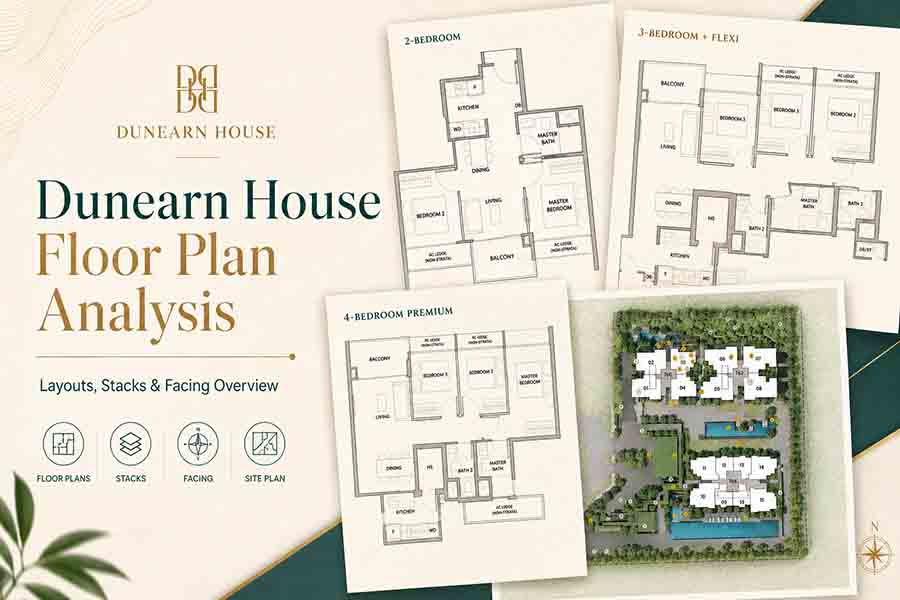
Dunearn House Floor Plan Analysis (Quick Overview)
Dunearn House offers a wide layout spread from 2-bedroom units at 527 sqft to 4-bedroom premium + study units at 1,378 sqft.
Based on the eBrochure layout inventory, the development is not only built around large family units. It also has a sizeable 2-bedroom and 2-bedroom + study segment, which means buyers are likely to compare very different use cases within the same project:
- 2BR: compact Bukit Timah entry layout
- 2BR Premium: compact layout with 2 bathrooms
- 2BR + Study: added work-from-home flexibility
- 3BR / 3BR + Flexi / 3BR + Study: family-oriented layouts with more functional separation
- 3BR Premium and 4BR types: larger layouts with wet/dry kitchen, yard, WC and household shelter
- 4BR Premium + Study: the largest layout category at 1,378 sqft
The main floor plan question is therefore not only which layout is biggest.
It is whether the layout, stack facing and surrounding exposure match the buyer’s actual living needs.
Need help narrowing down which layouts and stacks may make more sense before preview?
Key Floor Plan Facts
- Total units: 380
- Layout range: 2-bedroom to 4-bedroom premium + study
- Smallest layout: 2BR Type B1 / B1a at 527 sqft
- Largest layout: 4BR Premium + Study Type DPS1 at 1,378 sqft
- 2BR types include standard 2BR, 2BR Premium and 2BR + Study
- 3BR types include 3BR, 3BR + Flexi, 3BR + Study and 3BR Premium
- Larger 3BR Premium and 4BR layouts include wet/dry kitchen, yard, WC and household shelter
- Stacks 01–08 are likely oriented towards the future Turf City side, based on the site plan
- Stacks 17, 18, 23–26, 31 and 32 are likely oriented towards Dunearn Road / southern side
- Some stacks are internal / pool-facing, including 03, 04, 09, 10, 15, 16, 20, 21, 28 and 29
Explore the Full Dunearn House Analysis
This floor plan analysis forms part of the full Dunearn House cluster:
- Dunearn House Review – project positioning and Turf City considerations
- Dunearn House Price Guide – pricing psychology and Bukit Timah comparisons
- Dunearn House Showflat Guide – viewing strategy and stack evaluation framework
Together, these provide a structured decision framework across pricing, layouts, stack positioning and buyer suitability.
Buyers who are still learning how Singapore new launches are typically evaluated may also find the New Launch Condo Guide helpful before comparing individual projects.
Current Available Units, Layouts & Unit Types (Live Snapshot)
Availability and stack selection may change depending on take-up and release phases.
| Unit Type | Size Range | Available Units |
|---|---|---|
| 2 Bedroom / 2 Bedroom + Study | 530–680 sqft | 176/176 |
| 3 Bedroom / 3 Bedroom + Study | 870–1,010 sqft | 96/96 |
| 4 Bedroom / 4 Bedroom + Study | 1,180–1,380 sqft | 108/108 |
This inventory matters because Dunearn House does not rely on one dominant layout type. The project has compact 2-bedroom options, intermediate 2-bedroom + study layouts, several 3-bedroom variations, and larger 4-bedroom family formats. Buyers should therefore compare layouts by actual use case rather than bedroom count alone.
Unlike highly investor-led projects where smaller layouts dominate aggressively, Dunearn House allocates more than half of total supply towards larger 3-bedroom and 4-bedroom configurations. This strongly suggests the development is structurally designed around longer-term family owner-occupation rather than short-term rental optimisation alone.
At the same time, the sizeable 2-bedroom allocation still allows the project to maintain broader accessibility into the Bukit Timah market, especially for couples, right-sizers and buyers entering District 11 at lower quantums.
This creates a more balanced buyer profile than many compact city-fringe developments, because Dunearn House has both entry-sized 2-bedroom options and a meaningful spread of larger family layouts.
Dunearn House Unit Mix Breakdown
| Unit Type | Size Range (sqft) | Units | % | Positioning |
|---|---|---|---|---|
| 2 Bedroom / 2 Bedroom + Study | 530–680 | 176 | 46% | Entry Bukit Timah / Compact Own-Stay |
| 3 Bedroom / 3 Bedroom + Study | 870–1,010 | 96 | 25% | Core Family Segment |
| 4 Bedroom / 4 Bedroom + Study | 1,180–1,380 | 108 | 29% | Long-Term Family Own-Stay |
Total Units: 380
What the Unit Mix Reveals About Dunearn House
The first thing the unit mix reveals is that Dunearn House is not structured like a heavily investor-led city project.
Although 2-bedroom layouts still form the largest single segment, the overall allocation towards 3-bedroom and 4-bedroom units is substantial. This reinforces the project’s intended identity as a family-oriented Bukit Timah development tied closely to school accessibility, MRT connectivity and longer-term owner-occupation.
That distinction matters.
Because buyers evaluating Dunearn House are often not comparing it against compact OCR investor launches.
They are more likely comparing it against:
- nearby Bukit Timah projects
- freehold alternatives
- family-oriented owner-occupier developments
- future Turf City launches
The larger layouts therefore become important because they align with the likely long-term buyer pool within the district.
At the same time, the project still maintains a meaningful 2-bedroom allocation because accessibility into Bukit Timah pricing remains an important consideration.
This creates a middle-ground positioning:
not ultra-luxury,
not fully investor-led,
but strategically positioned between accessibility and long-term own-stay usability.
Layout Strategy and Positioning
Dunearn House layouts appear designed around:
- Efficiency over excessive luxury
- Family practicality over compact rental optimisation
- MRT-connected owner-occupation
- Long-term livability
This is different from:
- OCR projects focused heavily on maximising unit count
- CCR luxury projects prioritising prestige and lifestyle branding
Here, the layout strategy appears more focused on:
“Can families realistically live here long-term while still maintaining manageable Bukit Timah quantum?”
That may ultimately become one of the project’s strongest differentiators.
2-Bedroom Layout Analysis: B1 / B1a
The standard 2-bedroom layouts are Type B1 and B1a at 527 sqft.
These are the most compact layouts in Dunearn House and appear in stacks 17, 24, 25 and 32. The layouts include an open kitchen, 1 bathroom, balcony or PES, AC ledge and RC ledge.
Because these units have only 1 bathroom, they should be evaluated differently from the 2BR Premium and 2BR + Study layouts.
Key layout points:
- 527 sqft
- 2 bedrooms
- 1 bathroom
- open kitchen
- balcony or PES
- no study
- no yard / WC
- stacks 17, 24, 25, 32
- likely more compact internal living and dining zone compared with larger 2BR types
The key buyer question is whether the lower entry size is enough, or whether the 2BR Premium / 2BR + Study offers more practical long-term flexibility.
2-Bedroom Premium Layout Analysis: BP1 / BP1a / BP2
The 2-bedroom premium layouts are 614 sqft and appear in stacks 09, 12, 13, 16, 20, 21, 28 and 29.
The main difference from the standard 2BR layout is the provision of 2 bathrooms, including an ensuite master bathroom. This changes the usability of the unit, especially for buyers who may want more privacy between occupants.
Key layout points:
- 614 sqft
- 2 bedrooms
- 2 bathrooms
- ensuite master bathroom
- open kitchen
- balcony or PES
- AC ledge and RC ledge
- no study
- no yard / WC
- stacks 09, 12, 13, 16, 20, 21, 28, 29
Compared with the standard 2BR, this category offers a more complete 2-bedroom format, but without the additional study space found in the 2BR + Study layouts.
2-Bedroom + Study Layout Analysis: BS1 / BS2 / BS3
The 2-bedroom + study layouts range from 657 to 678 sqft and appear in stacks 18, 22, 23, 26, 27 and 31.
These layouts add a study space on top of the 2 bedrooms and 2 bathrooms. The study is important because it gives buyers another functional zone beyond the living and dining area.
Key layout points:
- 657–678 sqft
- 2 bedrooms
- study
- 2 bathrooms
- open kitchen
- balcony or PES
- AC ledge and RC ledge
- no yard / WC
- stacks 18, 22, 23, 26, 27, 31
This category is likely to attract buyers who want a Bukit Timah entry layout but do not want to rely only on a pure 2-bedroom format.
3-Bedroom Layout Analysis: C1
The standard 3-bedroom layout is Type C1 at 872 sqft, found in stacks 19 and 30.
This layout includes an enclosed kitchen, household shelter, 2 bathrooms and balcony or PES.
Key layout points:
- 872 sqft
- 3 bedrooms
- 2 bathrooms
- enclosed kitchen
- household shelter
- balcony or PES
- AC ledge and RC ledge
- stacks 19 and 30
This is the most compact 3-bedroom category in Dunearn House, so buyers should compare it carefully against the 3BR + Flexi and 3BR + Study layouts.
3-Bedroom + Flexi Layout Analysis: C2
The 3-bedroom + flexi layout is Type C2 at 936 sqft, found in stacks 11 and 14.
This layout adds a flexi room and includes an enclosed kitchen, yard and WC.
Key layout points:
- 936 sqft
- 3 bedrooms
- flexi room
- 2 bathrooms
- enclosed kitchen
- yard
- WC
- balcony or PES
- AC ledge and RC ledge
- stacks 11 and 14
The flexi room creates an additional functional area that may be used differently depending on household needs.
3-Bedroom + Study Layout Analysis: CS1 / CS2
The 3-bedroom + study layouts range from 947 to 969 sqft and are found in stacks 10 and 15.
These layouts include a study, enclosed kitchen, household shelter, yard and WC.
Key layout points:
- 947–969 sqft
- 3 bedrooms
- study
- 2 bathrooms
- enclosed kitchen
- household shelter
- yard
- WC
- balcony or PES
- AC ledge and RC ledge
- stacks 10 and 15
Compared with the standard 3BR, this category provides more functional separation for family use, work-from-home needs and household storage.
3-Bedroom Premium Layout Analysis: CP1
The 3-bedroom premium layout is Type CP1 at 1,001 sqft, found in stacks 03 and 04.
This is the first category where the layout includes wet and dry kitchen zones, together with yard, WC and household shelter.
Key layout points:
- 1,001 sqft
- 3 bedrooms
- wet and dry kitchen
- yard
- WC
- household shelter
- balcony
- AC ledge and RC ledge
- stacks 03 and 04
This layout sits between the regular 3-bedroom formats and the larger 4-bedroom layouts. It may be relevant for buyers who want a larger family layout but do not necessarily need a fourth bedroom.
4-Bedroom Layout Analysis: D1 / D2
The standard 4-bedroom layouts are Type D1 and D2 at 1,184 sqft, found in stacks 01 and 02.
These layouts include wet and dry kitchen zones, yard, WC and household shelter.
Key layout points:
- 1,184 sqft
- 4 bedrooms
- 2 bathrooms
- wet and dry kitchen
- yard
- WC
- household shelter
- balcony
- AC ledge and RC ledge
- stacks 01 and 02
This is the entry point into the 4-bedroom category at Dunearn House.
4-Bedroom Premium Layout Analysis: DP1 / DP2
The 4-bedroom premium layouts range from 1,302 to 1,313 sqft and are found in stacks 05 and 06.
These layouts include 3 bathrooms, wet and dry kitchen zones, yard, WC and household shelter.
Key layout points:
- 1,302–1,313 sqft
- 4 bedrooms
- 3 bathrooms
- wet and dry kitchen
- yard
- WC
- household shelter
- balcony
- AC ledge and RC ledge
- stacks 05 and 06
The additional bathroom provision separates this category from the standard 4-bedroom layouts.
4-Bedroom Premium + Study Layout Analysis: DPS1
The largest layout type shown is the 4-bedroom premium + study, Type DPS1, at 1,378 sqft.
It is found in stacks 07 and 08 and includes a study, 3 bathrooms, wet and dry kitchen, yard, WC and household shelter.
Key layout points:
- 1,378 sqft
- 4 bedrooms
- study
- 3 bathrooms
- wet and dry kitchen
- yard
- WC
- household shelter
- balcony
- AC ledge and RC ledge
- stacks 07 and 08
This is the most complete layout category in the brochure by size and room provision.
Dunearn House Stack Orientation & Facing Groups
Based on the site plan, the stacks can be broadly grouped into several facing categories. These should still be treated as inferred until confirmed against the final site plan and agent briefing.
| Facing / Orientation | Stacks | Unit Types | Certainty |
|---|---|---|---|
| North / North-West towards future Turf City | 01–08 | 3BR Premium, 4BR, 4BR Premium, 4BR Premium + Study | Inferred from site plan |
| South / South-East towards Dunearn Road | 17, 18, 23, 24, 25, 26, 31, 32 | 2BR, 2BR + Study | Inferred from site plan |
| Internal / Pool-facing | 03, 04, 09, 10, 15, 16, 20, 21, 28, 29 | Multiple layout types | Estimated from site plan |
The main point is that Dunearn House is unlikely to have a uniform stack profile. Some stacks may face future Turf City, some may face Dunearn Road, while others may have more internal-facing characteristics.
Site Context: What Each Side of Dunearn House Faces
| Direction | Surrounding Context |
|---|---|
| North | Future road, future Turf City redevelopment, future Turf City MRT station under construction |
| South | Dunearn Road, Bukit Timah-Rochor Green Corridor, Sixth Avenue MRT, Swiss Club Road GCB area |
| East | Future pedestrian thoroughfare, Mirage Walk, potential future residential plots |
| West | Grand arrival entrance, Guthrie House, Sixth Avenue Centre, Eng Neo Avenue forest |
This matters because the future environment around Dunearn House is still evolving. Buyers should not assess the floor plan in isolation from the stack facing and surrounding context.
Possible View and Exposure by Facing Group
| Facing Group | Stacks | May Face / Likely Overlook | Possible Exposure |
|---|---|---|---|
| Pinnacle Collection high-floor stacks | 01, 02, 05, 06, 07, 08 | likely to overlook the future Turf City precinct | potential view towards greenery and heritage structures |
| South-facing stacks | 17, 18, 23, 24, 25, 26, 31, 32 | may face Dunearn Road and landed / GCB areas | possible road exposure |
| North-facing / future precinct stacks | 01–08, 09–16 | likely to overlook future redevelopment areas | possible future construction exposure |
These points should be treated as preliminary until the final stack facing, height clearance and surrounding plot plans are verified.
Which Dunearn House Layout Category Should Buyers Shortlist?
There is no single best layout because the unit types serve different buyer profiles.
Based on the layout inventory:
| Buyer Need | Layouts to Compare |
|---|---|
| Lowest entry size | 2BR B1 / B1a |
| 2-bedroom with 2 bathrooms | 2BR Premium BP1 / BP1a / BP2 |
| 2-bedroom with work-from-home flexibility | 2BR + Study BS1 / BS2 / BS3 |
| Compact family layout | 3BR C1 |
| 3-bedroom with extra flexi space | 3BR + Flexi C2 |
| 3-bedroom with study, yard and WC | 3BR + Study CS1 / CS2 |
| Larger 3-bedroom format with wet/dry kitchen | 3BR Premium CP1 |
| Entry 4-bedroom category | 4BR D1 / D2 |
| 4-bedroom with 3 bathrooms | 4BR Premium DP1 / DP2 |
| Largest layout with study | 4BR Premium + Study DPS1 |
The better way to shortlist is not by bedroom count alone, but by identifying which functional spaces are actually needed: study, yard, WC, household shelter, wet/dry kitchen and number of bathrooms.
How to Choose the Right Unit
Buyers should focus on:
- Total quantum first
- Intended holding period
- Family planning needs
- MRT convenience vs privacy
- Stack exposure
- Long-term resale positioning
Most buyers should realistically shortlist:
- 2–3 layout categories maximum
rather than trying to compare every possible unit type.
Check the Unit Against the FYVE Framework
After shortlisting a layout, the next question is whether the actual unit still makes sense across Fair Value, Yield, Vacancy Risk and Exit Potential.
The Dunearn House FYVE Checklist gives a project-level view of pricing, rental support, vacancy risk, future Turf City supply and exit positioning before choosing a unit.

Already comparing a specific 2-bedroom, 3-bedroom or 4-bedroom unit?
Dunearn House Floor Plan FAQs
1. What unit types are available at Dunearn House?
Dunearn House offers 2-bedroom, 2-bedroom premium, 2-bedroom + study, 3-bedroom, 3-bedroom + flexi, 3-bedroom + study, 3-bedroom premium, 4-bedroom, 4-bedroom premium and 4-bedroom premium + study layouts. Sizes range from 527 sqft to 1,378 sqft.
2. What is the smallest layout at Dunearn House?
The smallest layout shown is the 2-bedroom Type B1 / B1a at 527 sqft. These layouts include 2 bedrooms, 1 bathroom, an open kitchen, balcony or PES, AC ledge and RC ledge.
3. Which Dunearn House layouts come with a study?
The layouts with a study include the 2BR + Study types BS1 / BS2 / BS3, the 3BR + Study types CS1 / CS2, and the 4BR Premium + Study type DPS1.
4. Which layouts include yard and WC?
The 3BR + Flexi, 3BR + Study, 3BR Premium, 4BR, 4BR Premium and 4BR Premium + Study layouts include yard and WC based on the eBrochure layout inventory.
5. Which stacks may face Dunearn Road?
Based on the site plan interpretation, stacks 17, 18, 23, 24, 25, 26, 31 and 32 may face towards the Dunearn Road / southern side. This should be verified against the final site plan and stack briefing.
6. Which stacks may face future Turf City?
Based on the site plan interpretation, stacks 01–08 are likely oriented towards the future Turf City side. Buyers should verify future construction exposure, view clearance and surrounding plot plans before selecting a unit.
Conclusion
Dunearn House has a wider layout spread than a simple 2BR-to-4BR summary suggests.
The 2BR segment itself is split into standard 2BR, 2BR Premium and 2BR + Study layouts. The 3BR segment includes standard, flexi, study and premium versions. The larger 4BR layouts then introduce more family-oriented features such as wet/dry kitchen, yard, WC, household shelter and additional bathrooms.
For buyers, the main comparison should be:
- whether a standard 2BR is sufficient, or whether 2 bathrooms / study space are needed
- whether a 3BR C1 is enough, or whether the flexi / study / premium versions are more practical
- whether the 4BR jump is justified by the additional family-use spaces
- whether the stack faces future Turf City, Dunearn Road or internal facilities
- whether future construction, road exposure and privacy affect the chosen stack
The official price list is not released yet, so the final layout decision should only be made after comparing price gaps between layout types, stack premiums and floor premiums.
Need Help Narrowing Down the Best Units?
If you want a structured breakdown of:
- Best stacks vs exposure
- Family-friendly layouts
- Which units may hold up better long-term
- How Dunearn compares against nearby Bukit Timah alternatives
- Which layouts may align better with your holding strategy
You may leave your details below to receive a structured walkthrough.