
UPPERHOUSE at Orchard Boulevard Floor Plan Analysis (Quick Overview)
UPPERHOUSE at Orchard Boulevard is structured as a compact, efficiency-driven CCR development, where layout design prioritises usable space, flexibility and manageable quantum rather than large-format living.
With current availability now concentrated in selected unit types, buyer decisions are no longer about “which unit type to pick” — but which specific layouts, stacks and facing directions still make sense.
The project’s layout strategy leans toward:
- Efficient internal planning
- Functional living-dining integration
- Flexible study configurations
- Strong alignment with urban living and rental demand
At this stage, the key decision factors shift toward:
- Layout efficiency (not size alone)
- Stack orientation (Orchard vs Chatsworth facing)
- Long-term suitability (own stay vs investment)
Most buyers will realistically shortlist 2–3 layouts, not the full range.
Want the latest stack list + best available layouts based on your budget and goals?
Key Floor Plan Facts
- Limited total unit count with curated layout mix
- Strong concentration in 2-bedroom configurations (core segment)
- Compact layouts with minimal circulation space
- Deep balconies and full-height glazing across units
- Larger units include private lift access and enhanced privacy
- Stack selection plays a critical role due to Orchard vs Chatsworth orientation
- Layouts prioritise efficiency, flexibility and usability over raw size
Explore the Full UPPERHOUSE Analysis
This article is part of the full UPPERHOUSE at Orchard Boulevard cluster:
- UPPERHOUSE Review – project positioning, buyer suitability, and planning context
- UPPERHOUSE Price Guide – pricing structure, market positioning, and buyer entry analysis
- UPPERHOUSE Showflat Guide – showroom location and what buyers should evaluate during a viewing
Together, these articles provide a structured analysis of the project’s positioning, pricing framework, layout strategy, and viewing considerations.
Buyers who are still learning how Singapore new launches are typically evaluated may also find the New Launch Condo Guide helpful before comparing individual projects.
Current Available Units, Layouts & Unit Types (Live Snapshot)
Availability may change depending on take-up and release phases.
| Unit Type | Size | Availability |
|---|---|---|
| 1 Bedroom + Study | 474 sqft | 28 units |
| 2 Bedroom Premium | 700 sqft | 23 units |
| 2 Bedroom Premium + Study | 764 sqft | Fully Sold |
| 3 Bedroom Premium | 1,012 sqft | Fully Sold |
| 4 Bedroom Suite (Private Lift + Carpark Lift) | 2,056 sqft | 12 units |
Total Remaining Units: 63
At this stage:
- Smaller and more flexible layouts are already absorbed
- Remaining units are more selective and stack-dependent
- Buyers are choosing from:
- Specific stacks
- Specific facing directions
- Limited layout options
This shifts decision-making toward:
Which exact unit still makes sense — not just which type
Want the latest available stacks and best-facing units right now?
UPPERHOUSE Unit Mix Breakdown
| Unit Type | Size | No. of Units | % | Positioning |
|---|---|---|---|---|
| 1 Bedroom + Study | 474 sqft | 67 | ~22% | Entry / Rental |
| 2 Bedroom Premium | 700 sqft | 102 | ~34% | Core Market |
| 2 Bedroom + Study | 764 sqft | 67 | ~22% | Flexible Core |
| 3 Bedroom Premium | 1,012 sqft | 34 | ~11% | Owner-Occupier |
| 4 Bedroom Suite | 2,056 sqft | 31 | ~10% | Luxury Own-Stay |
What the Unit Mix Reveals About UPPERHOUSE
The unit mix reflects a clear central-region positioning strategy:
- Heavy emphasis on 2-bedroom units → liquidity + flexibility
- Presence of 1-bedroom + study → rental alignment
- Limited larger units → exclusivity, not mass demand
This suggests the project is designed for:
- Urban households prioritising location
- Investors targeting Orchard/CBD demand
- Buyers entering CCR with manageable quantum
Rather than:
- Large family-oriented living
- Space-maximisation suburban buyers
Layout Strategy and Design Characteristics
UPPERHOUSE adopts a compact efficiency-first layout approach, supported by observable structural traits:
- Deep balconies extending living areas outward
- Full-height glazing improving natural light penetration
- Compact internal zoning with minimal wasted space
- Corner column placements influencing layout flow in certain stacks
This results in layouts that:
- Maximise usable internal area
- Support flexible lifestyle configurations
- Trade off absolute size for location efficiency
1 Bedroom + Study Layout Analysis
These units function as the entry point into District 10 private property.
Typical characteristics:
- Open-plan living and dining
- Integrated kitchen
- Study used as flexible space
Best suited for:
- Investors targeting rental demand
- Singles or couples prioritising location
Limitations:
- Limited long-term flexibility
- Less separation between zones
This layout is efficiency-driven, not lifestyle-driven.
2 Bedroom Premium Layout Analysis (Core Segment)
This is the primary segment of the project.
Typical features:
- Clear separation between bedrooms
- Functional living-dining layout
- Compact but usable proportions
Why this matters:
- Broadest buyer pool
- Balance between quantum and usability
- Works for both own-stay and investment
This segment typically forms:
The most liquid and decision-critical category
2 Bedroom + Study Layout Analysis (Sold Out Indicator)
Although fully sold, this layout reveals important demand signals:
- Buyers value flexibility (work-from-home space)
- Slight size increase improves usability significantly
This explains why:
These units tend to be absorbed earlier in urban developments
3 Bedroom Premium Layout Analysis
These units cater to owner-occupiers prioritising central living.
Key traits:
- Better separation between living and bedrooms
- More defined functional zones
- Improved long-term usability
However:
- Still compact relative to suburban alternatives
- Buyers must prioritise location over space
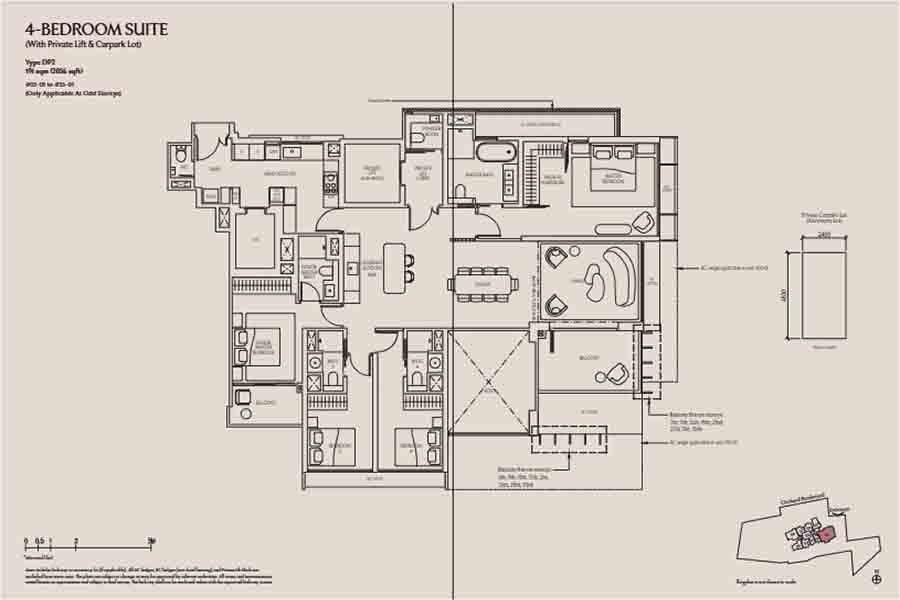
4 Bedroom Suite (Private Lift) Layout Analysis
This is the top-tier configuration within UPPERHOUSE.
Key features:
- Private lift access
- Larger internal space
- Strong separation between zones
Best suited for:
- Established households
- Long-term own-stay buyers
Constraints:
- Higher quantum
- More selective resale market
These units operate within:
A niche, long-horizon buyer segment
Best Layouts and Stack Considerations at UPPERHOUSE
There is no single “best stack” or “best layout” — it depends on priorities.
However, key distinctions emerge:
North-Facing (Orchard Boulevard)
- Facing: Orchard Boulevard / city direction
- Potential exposure to:
- Road activity
- Nearby high-rise developments
Positioning:
- More aligned with urban skyline orientation
- Suitable for buyers prioritising:
- City-facing outlook
- Connectivity proximity
South-Facing (Chatsworth / GCB)
- Facing: Chatsworth landed enclave
- Potential characteristics:
- More open outlook
- Lower surrounding density
Positioning:
- More aligned with:
- Privacy
- Greenery-facing views
Trade-off:
- May overlook landed properties
What Buyers Typically Prioritise
- Openness vs privacy
- City exposure vs quieter environment
- Floor level impact on views
- Layout efficiency within stack
At this stage:
Stack selection matters as much as layout selection
How to Choose the Right Unit at UPPERHOUSE
Most buyers narrow down based on:
1. Budget Comfort
- Determines entry point (1BR vs 2BR vs 4BR)
2. Intended Use
- Investment → smaller units
- Own stay → larger layouts
3. Layout Efficiency
- Usable space matters more than size
4. Stack Orientation
- Orchard vs Chatsworth facing
5. Holding Period
- Shorter hold → liquidity focus
- Longer hold → liveability focus
Buyers who shortlist 2–3 realistic options and compare them properly tend to make better decisions.
Need Help Narrowing Down the Best Units?
If you are considering UPPERHOUSE and want clarity on:
- Which stacks currently offer better openness or privacy
- Which layouts still make sense based on remaining availability
- How different unit types compare in real usage
- Whether current options align with your budget and plans
Most buyers don’t need every unit — they just need 2–3 that actually make sense.
Get a clear breakdown based on your situation
UPPERHOUSE Floor Plan FAQs
1. What unit types are available at UPPERHOUSE at Orchard Boulevard?
UPPERHOUSE offers a mix of 1-bedroom plus study, 2-bedroom premium, 3-bedroom premium and 4-bedroom suite layouts. The unit mix is heavily concentrated in smaller and mid-sized units, reflecting its central location positioning. Larger units form a limited portion of the project. Buyers typically evaluate both layout type and remaining availability.
2. Which UPPERHOUSE layout is best for own stay?
Most own-stay buyers tend to focus on 2-bedroom and 3-bedroom layouts as they offer a balance between space and usability. These configurations provide better separation between living and sleeping areas compared to smaller units. Larger households may consider 4-bedroom suites where available. The final decision depends on budget, stack and long-term needs.
3. Are UPPERHOUSE floor plans efficient?
Yes, the layouts are designed with a strong emphasis on efficiency, featuring minimal circulation space and functional living arrangements. This allows units to maximise usable space despite compact sizes. Such efficiency is typical for central developments where space optimisation is critical. Buyers should evaluate how the layout functions rather than just total size.
4. Does stack orientation matter at UPPERHOUSE?
Stack orientation plays a significant role due to differences between Orchard-facing and Chatsworth-facing units. Orchard-facing stacks may have more urban exposure, while Chatsworth-facing units may offer more openness and greenery. Floor level also affects how these factors are experienced. Buyers typically assess layout and facing together.
5. Are smaller units better for investment at UPPERHOUSE?
Smaller units such as 1-bedroom and 2-bedroom layouts generally align better with rental demand due to lower quantum and broader tenant appeal. These units tend to be more liquid and easier to rent out. However, long-term performance still depends on entry price and overall market conditions. Investors typically prioritise flexibility and affordability.
6. Are larger units harder to resell?
Larger units typically have a more selective buyer pool due to higher purchase quantum. This can affect resale liquidity compared to smaller units. However, they offer stronger liveability and are more suitable for long-term own-stay buyers. The decision depends on holding horizon and financial comfort.
Conclusion
UPPERHOUSE is structured as a location-first, efficiency-driven CCR development.
At its current stage:
- Smaller flexible units are largely absorbed
- Remaining options are more selective
- Stack and layout selection becomes critical
For most buyers:
- 2-bedroom units → entry + flexibility
- 3-bedroom → better long-term usability
- 4-bedroom → exclusivity and space
The key shift is:
From “what unit type to buy”
To “which remaining unit still makes sense”
Buyers who approach this with a structured comparison tend to make clearer decisions.
Need a Clear Breakdown of the Best Units?
If you are considering UPPERHOUSE at Orchard Boulevard and want a clearer breakdown of:
- Which stacks currently offer better openness or privacy
- Which layouts still make sense based on remaining availability
- How different unit types compare in terms of liveability and flexibility
- Whether current options fit your budget and holding plans
You may leave your details below and receive a structured walkthrough tailored to your situation.