

Summary
ELTA is a school-belt–anchored condominium in Clementi designed for buyers who prioritise long-term residence, proximity to education clusters, and modern high-efficiency layouts over immediate MRT convenience or lifestyle density.
The project sits at the higher end of OCR pricing benchmarks, reflecting both its location within a proven educational catchment and the limited availability of new GLS supply in this enclave. Demand is driven primarily by families planning around schooling timelines and owner-occupiers seeking a new-build option within a mature estate.
ELTA is not a convenience-led or momentum-driven project. Its value proposition is structural, not speculative. Buyers expecting immediate upside, seamless MRT access, or flexible layouts may find the trade-offs difficult to justify.
From an investment perspective, ELTA functions as a long-horizon, stability-oriented asset supported by recurring demand from school-driven buyers and nearby institutional employment. Performance is likely to be selective rather than broad-based.
The key decision is not whether ELTA is expensive, but whether its trade-offs align with your lifestyle needs, holding horizon, and expectations.
Key Takeaways
- Best for: School-focused families planning long-term stay
- Less suitable for: MRT-dependent buyers and short-term investors
- Investment profile: Stability-oriented, not momentum-driven
- Key risks: Expressway exposure, pricing premium, layout rigidity
- Liquidity: Selective demand, not mass-market appeal
Explore the Full ELTA Analysis
This review forms part of a complete project cluster:
• ELTA Price Guide – pricing structure, entry quantum, and buyer positioning
• ELTA Floor Plan Analysis – layout efficiency, dual-key strategy, and unit mix
• ELTA Maxwell Showflat Guide – showroom location and what buyers should evaluate during a viewing
Together, these provide a structured framework for evaluating pricing, layouts, and real-world usability before making a decision.
Buyers often review the pricing and layout analysis first to determine whether the project fits their budget and usage requirements before visiting the showflat.
If you’re considering this project, you might want to check how it actually compares and what most buyers tend to overlook — before deciding.
Key Details (At a Glance)
99-year leasehold private condominium
Clementi Avenue 1, Clementi Planning Area
Outside Central Region (OCR)
Two high-rise residential towers (39 storeys)
Positioned primarily for school-led owner-occupiers rather than short-cycle buyers
Project Factsheet
| Item | Details |
|---|---|
| Official Project Name | ELTA |
| Location | 10, 12 Clementi Avenue 1 |
| District / Planning Area | District 5 / Clementi |
| Region | Outside Central Region (OCR) |
| Tenure | 99-year leasehold (from 13 February 2024) |
| Site Type | GLS |
| Developer | Joint venture between MCL Land & CSC Land |
| Development Type | Pure residential |
| Site Area | Approximately 13,451.10 sqm |
| Plot Ratio | 3.5 |
| Total Units | 501 residential units |
| Building Configuration | 2 blocks of 39-storey residential towers with podium parking |
| Nearest MRT | Clementi MRT (mixed walk + bus access) |
| Launch Status | Launched |
| Launch Absorption | Approximately 63% sold on launch |
| Estimated TOP | 31 March 2029 |
Location Context: Clementi as a School-Anchored Mature Estate
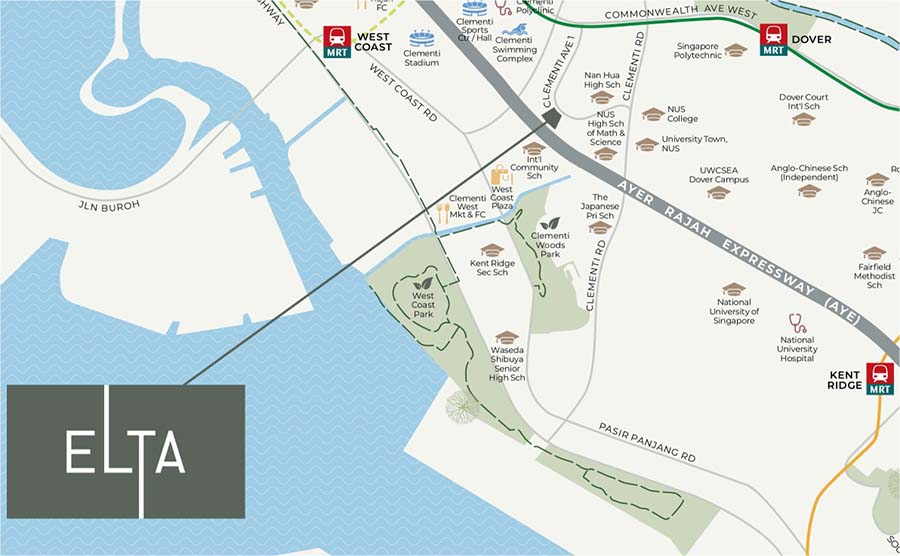
Clementi is a structurally different OCR location. Its value proposition is not centred on lifestyle spectacle or new-town transformation, but on educational infrastructure, institutional employment, and long-established residential demand. Daily convenience is anchored around Clementi Mall, neighbourhood centres, and a comprehensive bus network rather than doorstep MRT access.
ELTA sits along Clementi Avenue 1, within a dense academic and institutional belt that includes NUS, NUH, and multiple secondary and international schools. While Clementi MRT is not doorstep-adjacent, connectivity is functional through feeder buses and arterial road access. For drivers, AYE connectivity is a clear advantage; for car-lite households, this is a known compromise rather than an incidental inconvenience.
Importantly, ELTA’s school narrative must be read accurately. Nan Hua Primary School lies at approximately 1.49km from the site depending on block, placing the entire development within the 1–2km band, not within 1km. This supports long-term resale relevance for families but does not confer enrolment priority.
Development Scale and Configuration: Height as Differentiation
ELTA’s two 39-storey towers are an intentional response to a constrained site with a high plot ratio. Height is used to unlock views, light, and ventilation rather than to create a resort-style sprawl. High-floor units benefit from clearer sightlines toward the Wessex estate and beyond, which is uncommon in a mature Clementi streetscape.
The podium configuration elevates residential units away from road level, serving both as a buffer against traffic conditions and as a practical response to the site’s expressway adjacency. This is a functional design choice rather than a lifestyle flourish, and buyers should read it as such.
Planning Constraints Buyers Must Understand
ELTA’s constraints are explicit and permanent.
Expressway Adjacency:
Stacks facing the AYE will experience higher ambient noise and dust. Mitigation measures—such as acoustic ceilings and blinds—reduce impact but do not eliminate it. Stack orientation is therefore a primary decision variable, not a cosmetic preference.
PPVC Construction:
The project adopts PPVC, resulting in a higher proportion of structural walls. This limits future hacking and layout reconfiguration. Buyers seeking bespoke or highly flexible internal layouts should treat this as a hard constraint rather than a negotiable trade-off.
These factors explain why buyer sentiment is bifurcated: strong interest in well-oriented stacks, visible hesitation elsewhere.
Buyer Acceptances: What Actually Drives Demand
School-Belt Proximity
Demand is anchored by families planning ahead for primary and secondary education. While ELTA is not within 1km of Nan Hua Primary School, being within the 1–2km band remains a durable resale support factor in Clementi, particularly when paired with modern layouts and new-build condition.
Final GLS Opportunity Narrative
Buyers view ELTA as one of the last remaining GLS launches in this specific Clementi Avenue 1 enclave. Whether or not this proves absolute, the perception of tightening supply has clearly influenced early decision-making among long-time West-side residents.
High-Floor, Long-View Appeal
In a high-density district, unblocked or elevated views materially differentiate units. High-floor stacks have attracted stronger interest precisely because this attribute is difficult to replicate in future developments nearby.
Post-Harmonisation Layout Efficiency
GFA harmonisation has improved usable space efficiency. Buyers respond positively to layouts that feel more generous despite compact stated sizes, particularly for smaller and mid-sized units.
Buyer Objections: Where Resistance Is Concentrated
Price Leadership in the Immediate Enclave
ELTA sets a new pricing benchmark for Clementi Avenue 1. Resistance intensifies as psf levels approach the high-$2,000s and absolute quantums cross key psychological thresholds, especially for larger family units.
MRT Convenience Gap
Compared with fully integrated projects, the walk-and-bus commute to Clementi MRT is less seamless. For daily commuters, this becomes a quality-of-life consideration rather than a theoretical drawback.
Fixed Layout Constraints
PPVC-driven structural walls reduce renovation optionality. For buyers who value future reconfiguration, this is a meaningful limitation.
Pricing Context: Entry Validation vs Decision-Stage Reality
Launch Context:
Approximately 63% of units were taken up on launch, validating underlying demand for the location and product type. This reflects school-led and West-side loyalty rather than price softness.
Decision-Stage Reality:
Remaining inventory faces sharper scrutiny. Buyers now benchmark against resale projects such as Clavon and Clement Canopy, as well as newer Pine Grove alternatives. The decision hinge is not psf optics but absolute quantum and long-term holding comfort.
Amenities: What ELTA Provides in Daily Use
ELTA’s facilities are designed to support functional, family-oriented living rather than resort-style lifestyle positioning.
Given the project’s emphasis on long-term owner-occupation, the amenity mix prioritises usability, circulation efficiency, and communal spaces that integrate into daily routines rather than purely aesthetic features.
Core Facilities
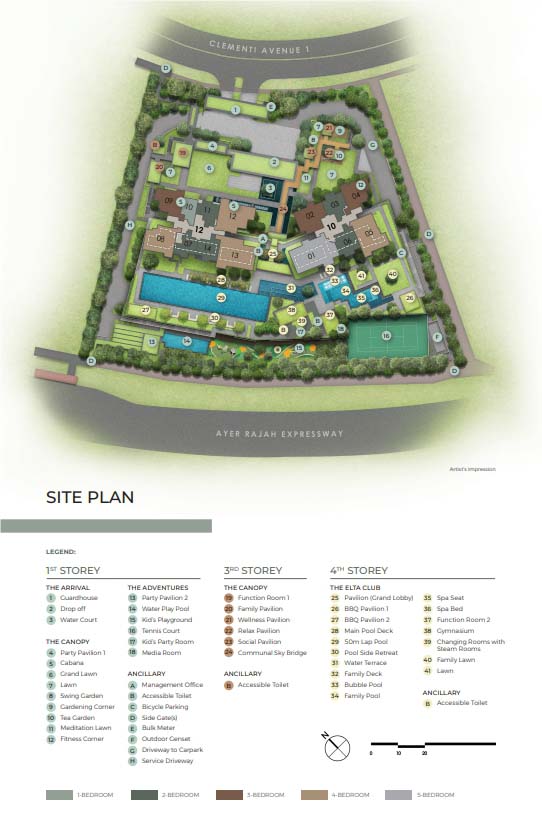
- 50m lap pool and leisure pool zones
- Children’s pool and family-friendly water features
- Indoor and outdoor gym facilities
- unction rooms and clubhouse spaces
- BBQ pavilions and social gathering areas
Landscape & Spatial Planning
The development adopts a podium-based layout, elevating facilities above road level to improve privacy and reduce direct exposure to surrounding traffic conditions.
Landscaped zones are distributed across the podium deck, creating separation between active and quiet spaces while maintaining efficient circulation across the site.
Practical Living Considerations
Amenities at ELTA should be viewed as supportive rather than defining.
Daily convenience remains anchored around Clementi’s existing infrastructure — including Clementi Mall, neighbourhood centres, and nearby institutions — rather than within the development itself.
For buyers, the facilities complement the core proposition of location and layout efficiency rather than act as the primary driver of value.
Buyer Suitability: Who This Works For—and Who It Does Not
Most Suitable For
School-prioritising families planning long-term residence
Owner-occupiers seeking a modern build in a mature estate
Academics and professionals tied to NUS, NUH, and One-North
Buyers comfortable paying a premium for location certainty
Least Suitable For
Buyers requiring doorstep MRT convenience
Those seeking flexible, hackable layouts
Short-cycle investors sensitive to near-term repricing
Noise-sensitive households considering expressway-facing stacks
Buyers comparing ELTA against other upcoming launches may find it helpful to frame their decision using the New Launch Condo Guide, which outlines how pricing logic, buyer intent, and holding horizon differ across project types.
Takeaway
ELTA is not a compromise project—it is a selective one.
It rewards buyers who understand the value of school-belt proximity and limited new supply in Clementi, and it penalises those who underestimate price leadership, expressway realities, or layout rigidity. For aligned buyers, it offers long-term defensibility in a proven location. For misaligned buyers, it will feel expensive, constrained, and unforgiving.
Clarity of intent matters more here than timing.
If you’re seriously considering this project, it’s worth checking how it actually compares and what most buyers tend to overlook — before deciding.
FAQs (Decision-Stage)
1) Is ELTA considered expensive for OCR standards?
Yes. ELTA prices meaningfully ahead of immediate Clementi resale benchmarks. This premium is justified only for buyers who anchor value to school-belt proximity, new-build condition, and the scarcity of remaining GLS sites in this enclave. For price-led buyers benchmarking purely on psf or quantum, the valuation gap will feel structurally uncomfortable rather than temporarily mispriced.
2) Does ELTA’s proximity to Nan Hua Primary School materially change buyer outcomes?
It supports long-term relevance but does not confer enrolment priority. Being within the 1–2km band helps preserve resale demand among school-planning families, but it does not eliminate competition or guarantee placement. Buyers who treat this as a near-equivalent to a 1km advantage risk over-anchoring on a benefit that is supportive, not decisive.
3) How significant is the AYE noise and dust exposure in real terms?
For expressway-facing stacks, it is a permanent environmental condition rather than a marginal inconvenience. Acoustic treatments reduce impact but do not neutralise it. Buyers must select stacks deliberately; failure to do so affects both liveability and resale liquidity, particularly for family buyers sensitive to environmental comfort.
4) Does PPVC materially limit long-term flexibility?
Yes. PPVC introduces a higher proportion of structural walls, constraining future layout reconfiguration. This is not a cosmetic limitation. Buyers who anticipate hacking, room merging, or open-plan conversions should treat ELTA as misaligned rather than assume flexibility can be engineered later.
5) Why did smaller units absorb faster than larger configurations?
Smaller units sit within more accessible absolute quantums and appeal to investors and academics tied to nearby institutions. Larger family units face sharper resistance once prices cross key psychological thresholds. This pattern reflects affordability ceilings, not weak demand for the project as a whole.
6) Is ELTA suitable as an investment property?
Only selectively. Rental demand exists due to proximity to NUS, NUH, and One-North, but high entry prices cap yield expansion. ELTA functions better as a long-term, stability-oriented hold rather than a yield-maximisation or short-cycle investment.
7) How does ELTA compare with Pine Grove or West Coast alternatives?
ELTA’s advantage lies in its specific Clementi Avenue 1 positioning and school adjacency. Pine Grove and West Coast options offer different trade-offs around greenery, future supply, and pricing. Buyers should compare based on holding horizon and daily lifestyle tolerance, not psf optics alone.
8) Who is most likely to regret buying ELTA?
Buyers who underestimate expressway exposure, over-rely on school proximity without recognising enrolment realities, or expect layout flexibility that PPVC cannot provide. Regret risk here is driven by expectation mismatch rather than project execution.
PRICING LOGIC, URA PLANNING INTENT & BUYER SEGMENTATION
Summary
This section examines how ELTA’s pricing behaves across different market phases, how URA planning intent for Clementi frames long-term outcomes, and which buyer segments are actually converting versus hesitating. The central question is not whether ELTA is expensive, but who the pricing works for and under what holding assumptions.
Pricing Logic: Benchmark Leadership with Narrow Justification
Entry Pricing: Scarcity-Led, Not Convenience-Led
ELTA entered the market at pricing levels that set a new benchmark for Clementi Avenue 1. This was not driven by transport integration or lifestyle intensity, but by a combination of school-belt proximity, modern build condition, and the perception of limited remaining GLS supply in this pocket.
Early buyers were less focused on resale comparables and more anchored to replacement difficulty: the belief that similar new supply in this exact catchment would be rare. This explains the strong launch absorption despite visible price discussion.
Resistance Zone: Absolute Quantum, Not psf Optics
As the sales cycle progresses, resistance emerges primarily at the absolute price level, especially for 4- and 5-bedroom units. Once quantums move beyond psychologically comfortable thresholds, buyers begin cross-shopping against freehold resale options in West Coast and older but larger developments.
This resistance is structural. It is not resolved by time or marketing, but only by alignment with buyer intent.
Price Sustainability: Defensible, Not Accelerative
ELTA’s pricing is defensible for buyers who:
value school adjacency over transport convenience,
prioritise new-build efficiency over layout flexibility, and
plan to hold through a full schooling cycle or longer.
It is not positioned for price acceleration driven by lifestyle transformation or transport catalysts. Price behaviour is therefore more likely to be range-bound with selective liquidity rather than momentum-led.
URA Planning Intent: Supportive Backdrop, Not a Catalyst
Clementi’s Role in Regional Planning
URA planning for Clementi reinforces its role as a mature residential and educational node rather than a growth-stage transformation area. Enhancements focus on healthcare, green connectivity, and incremental housing additions rather than wholesale redevelopment.
This matters for ELTA because:
the area’s desirability is institutional, not speculative,
demand is recurring rather than event-driven, and
planning intent supports long-term relevance rather than short-term repricing.
Transport Improvements: Incremental Gains
Future transport projects improve regional connectivity but do not materially change ELTA’s immediate convenience profile. Clementi remains a bus-anchored town for most residents, with MRT access requiring a short walk or feeder ride.
Buyers should therefore treat URA and transport plans as defensive support, not upside drivers.
Buyer Segmentation: Who Converts — and Who Hesitates
Primary Segment: School-Prioritising Owner-Occupiers
These buyers plan around primary and secondary schooling timelines. They accept pricing premiums and environmental trade-offs in exchange for location certainty and long holding horizons.
Secondary Segment: Academic and Institutional Investors
This group targets stable rental demand from NUS, NUH, and One-North. They are selective, focusing on efficient layouts and acceptable entry prices rather than yield maximisation.
Tertiary Segment: Multi-Generational Families
Families purchasing with long-term legacy considerations value modern layouts and proximity to established amenities. However, high absolute prices limit participation to higher-income households.
Absent Segments
Notably absent are short-term traders and buyers seeking flexible layouts. This absence explains why absorption becomes selective after the initial launch phase.
EXIT, LIQUIDITY & RISK SCENARIOS
Summary
This section models how ELTA behaves across different exit horizons, identifies liquidity constraints, and outlines the key risks buyers must consciously accept. ELTA rewards clarity of intent and penalises expectation mismatch more than most OCR projects.
Exit Behaviour: School-Led Liquidity, Stack-Specific Outcomes
Early Post-TOP (0–3 Years)
Liquidity is strongest for:
well-oriented stacks,
mid-sized units within comfortable quantums, and
layouts appealing to school-planning families.
Exit demand is driven by new-build appeal and school proximity rather than market momentum.
Mid-Cycle (3–8 Years)
Competition increases as newer launches enter the broader West region. Buyer scrutiny intensifies around noise exposure and layout rigidity. Liquidity becomes unit-specific rather than project-wide.
Long-Term (8+ Years)
School adjacency becomes a more meaningful differentiator as newer supply ages. However, resale success depends on realistic pricing rather than tenure or branding alone.
Structural Risks Buyers Must Model
1) Noise and Environmental Exposure
AYE-facing stacks face permanent exposure. This does not self-correct over time and affects both liveability and resale appeal.
2) Layout Inflexibility Risk
PPVC limits reconfiguration. Buyers cannot rely on renovation to “fix” layout dissatisfaction later.
3) Quantum Sensitivity
High absolute prices narrow the buyer pool, particularly during periods of tighter financing conditions.
4) Liquidity Compression Risk
ELTA’s buyer pool is specialised. In weaker markets, this results in longer selling periods rather than sharp price cuts.
5) Interest Rate Sensitivity
Higher rates disproportionately affect larger units, compressing demand among leveraged family buyers.
Final Assessment
ELTA behaves exactly as its structure suggests.
It trades transport convenience and layout flexibility for school adjacency, modern efficiency, and location certainty. Buyers aligned with these priorities are likely to find it coherent and defensible across market cycles. Buyers expecting lifestyle completeness, flexibility, or rapid repricing are likely to encounter friction rather than underperformance.
This is a project that rewards alignment, not optimism.
FAQs
1) Is ELTA a “safe” long-term purchase?
ELTA is safe only for buyers whose expectations align with its structural realities. Safety here means demand continuity from school-prioritising families, not price acceleration or liquidity ease. Buyers expecting flexibility, quiet living, or short-cycle exits will experience friction even if prices hold. The project rewards long holding horizons and clarity of purpose rather than optionality. Misalignment, not market downturns, is the primary risk.
2) How liquid will ELTA be on resale?
Resale liquidity at ELTA will be selective rather than broad-based. Well-oriented stacks with manageable absolute quantums are likely to attract steady interest from families planning around schools. Expressway-facing stacks and high-quantum units will face longer marketing periods, particularly in neutral or weaker markets. Liquidity risk manifests as time-to-exit, not sudden price collapse. Sellers must price realistically rather than rely on headline benchmarks.
3) Does proximity to Nan Hua Primary School guarantee resale demand?
No. School proximity supports demand, but it does not override pricing discipline or environmental considerations. Being within the 1–2km band provides relevance, not entitlement. Buyers still benchmark against newer alternatives, resale options, and noise exposure. School adjacency is a supporting pillar, not a substitute for value alignment. Over-reliance on this factor is a common buyer mistake.
4) Will expressway noise become less relevant over time?
No. Expressway adjacency is a permanent site condition. While traffic patterns may evolve marginally, noise and dust exposure for affected stacks does not disappear with time. Acoustic mitigation reduces impact but does not neutralise it. This affects both liveability and resale appeal consistently across market cycles. Buyers must assume this condition persists for the full holding period.
5) Can renovation overcome PPVC layout limitations?
No. PPVC introduces structural walls that cannot be meaningfully altered. Buyers who assume future renovation can “fix” layout dissatisfaction are likely to be disappointed. This constraint is most visible when family needs change over time. ELTA suits buyers who are comfortable with the original layout rather than those planning significant reconfiguration later.
6) Is ELTA suitable for leveraged buyers?
Only with caution. High entry prices combined with capped rental yields increase holding pressure during higher interest-rate environments. Larger units are especially sensitive, as financing costs scale faster than rental support. ELTA favours buyers with moderate leverage and income resilience rather than highly stretched financing strategies. Leverage amplifies friction more than returns here.
7) How does ELTA compare with freehold resale alternatives in the West?
Freehold resale options often offer lower entry prices and larger layouts but lack new-build efficiency and school-belt immediacy. ELTA trades tenure advantage for modern design, warranty coverage, and location certainty. Buyers must decide whether new-build clarity outweighs freehold optionality. This is a philosophical trade-off, not a numerical one.
8) Are larger unit types riskier at ELTA?
Yes. Larger units face narrower buyer pools due to high absolute quantums and financing constraints. Demand exists, but it is thinner and more price-sensitive. Exit timelines are likely longer, particularly outside strong market cycles. Buyers of larger units must be comfortable with slower liquidity and longer holding periods.
9) Is ELTA likely to outperform other OCR projects?
Outperformance is unlikely in the short to medium term. ELTA is positioned for defensibility rather than acceleration. Returns depend more on holding duration and entry discipline than on timing or market momentum. Buyers expecting ELTA to lead OCR price growth may be misaligned with its fundamentals.
10) Does URA planning materially change ELTA’s exit prospects?
URA planning supports long-term residential relevance but does not introduce catalytic upside for ELTA. Clementi’s evolution is incremental, not transformative. Exit outcomes depend more on unit selection, pricing realism, and buyer alignment than on planning announcements. Buyers should treat URA intent as a stabilising backdrop, not a repricing trigger.
11) How sensitive is ELTA to interest-rate cycles?
ELTA is moderately sensitive, particularly for larger units. Higher rates compress affordability and reduce the pool of leveraged family buyers. This does not usually force sharp repricing, but it extends selling timelines. Interest-rate risk here appears as liquidity drag, not volatility.
12) What is the most common mistake buyers make with ELTA?
Over-anchoring on school proximity while underestimating pricing, noise exposure, and layout rigidity. Buyers sometimes assume one strong attribute compensates for multiple trade-offs. This leads to dissatisfaction even when the asset performs as expected. ELTA demands holistic acceptance, not selective optimism.
13) Is ELTA better suited for own-stay or investment?
ELTA is primarily an own-stay project with secondary investment appeal. Rental demand exists, but yield expansion is capped by high entry prices. It works best as a long-term hold with rental serving as a buffer rather than a return driver. Investors seeking aggressive yield or rapid turnover should look elsewhere.
14) How important is stack selection at ELTA?
Stack selection is critical. Orientation materially affects noise exposure, daylight quality, and resale appeal. Differences between stacks can outweigh differences between unit sizes. Poor stack selection can underperform even if the overall project behaves predictably. Buyers should prioritise orientation over headline size or floor level.
15) Will future launches dilute ELTA’s appeal?
Future launches may dilute attention but not eliminate relevance. ELTA’s school adjacency remains a durable differentiator, but buyers will benchmark more aggressively as alternatives emerge. Pricing discipline becomes increasingly important over time. ELTA competes on clarity and location, not novelty.
16) Who should decisively avoid ELTA?
Buyers requiring doorstep MRT access, flexible layouts, quiet living environments, or short-term capital appreciation should eliminate ELTA early. These expectations conflict with the project’s structural design and pricing logic. Avoidance here is rational, not negative. ELTA rewards alignment, not compromise.
If you prefer a more structured walkthrough, you can leave your details below and we’ll follow up with you.