

Summary
Parktown Residence is a 1,193-unit, 99-year leasehold integrated development in Tampines North designed for buyers who prioritise transport integration, daily convenience, and self-contained living over privacy, scarcity, or low-density exclusivity.
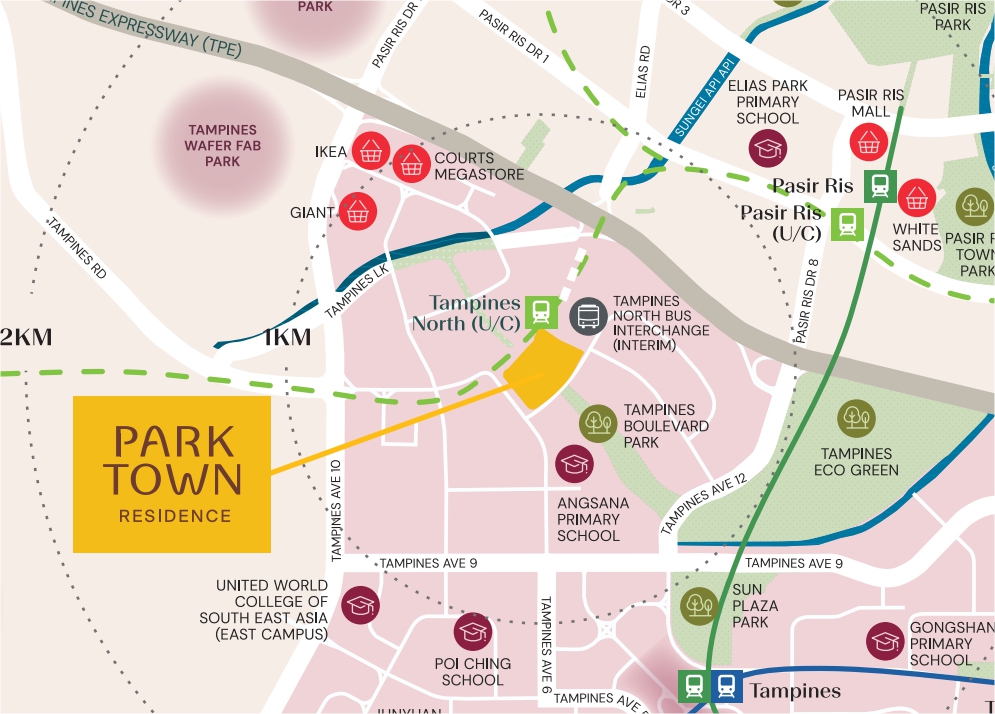
Its value proposition is anchored by direct sheltered access to the future Tampines North MRT station on the Cross Island Line, an on-site bus interchange, integrated retail, hawker centre, and community infrastructure. This makes it structurally different from a typical OCR condominium, where daily convenience depends more heavily on surrounding neighbourhood amenities.
The trade-off is equally clear. Parktown Residence is large-scale, high-density, and reliant on shared infrastructure. Buyers should not evaluate it as a boutique condominium or scarcity-led asset. It performs best when viewed as a convenience-first, transport-anchored residential hub designed for long-term usability rather than exclusivity.
For aligned buyers, the project offers a coherent and defensible long-term proposition. For misaligned buyers, the same strengths may feel like constraints.
Parktown Residence at a Glance
Best suited for:
HDB upgraders, convenience-driven families, and long-term own-stay buyers who value integrated transport and daily amenities
Less suitable for:
Buyers seeking privacy, low density, boutique living, or scarcity-driven upside
Core strength:
Direct MRT integration and self-contained daily infrastructure
Key trade-offs:
High density, shared environments, internal resale competition, and lower scarcity
Investment profile:
More resilience-driven than momentum-driven, with gradual rather than sharp upside
Explore the Full Parktown Residence Analysis
This article is part of the full project cluster:
- Parktown Residence Price Guide – pricing structure, market positioning, and buyer entry analysis
- Parktown Residence Floor Plan Analysis – layout efficiency, unit mix, and configuration differences
- Parktown Residence Showflat Guide – viewing strategy, location context, and buyer evaluation framework
Together, these articles provide a structured breakdown of the project’s positioning, pricing logic, layout strategy, and decision-stage considerations.
If you’re considering this project, you might want to check how it actually compares and what most buyers tend to overlook — before deciding.
Key Details (At a Glance)
-
99-year leasehold integrated development
-
Located at Tampines North, District 18 (OCR)
-
1,193 residential units above retail, transport, and community infrastructure
-
Direct, sheltered access to future Tampines North MRT station (Cross Island Line)
-
Designed for convenience-first families, HDB upgraders, and commuter-centric households
Project Factsheet
| Item | Details |
|---|---|
| Project Name | Parktown Residence |
| Location | 1–23 Tampines Street 62 |
| District / Region | District 18 / OCR (Tampines Planning Area) |
| Tenure | 99 years from 9 October 2023 |
| Developer | CapitaLand Development, UOL Group Limited, Singapore Land Group Limited |
| Site Type | GLS |
| Development Type | Integrated mixed-use development |
| Site Area | 50,679.7 sqm |
| Plot Ratio | 2.5 |
| Residential Units | 1,193 |
| MRT Access | Tampines North MRT (CRL) — direct, sheltered |
| Launch Reference | Launched 22 February 2025 (historical) |
| Expected TOP | 30 June 2030 |
Location Context: Tampines North as an Emerging Regional Node
Tampines North differs structurally from mature town centres like Tampines Central. Rather than organic, incremental development, it is being shaped through large-format planning parcels and infrastructure-led growth. Parktown Residence sits at the centre of this strategy, acting as a consolidated residential, transport, and amenities hub rather than relying on surrounding street-level vibrancy.
In practical terms, this means residents are expected to rely heavily on on-site infrastructure in the early years. Retail, food options, public transport, and community facilities are brought directly into the project, reducing dependence on external nodes. For buyers comfortable with self-contained living environments, this is a feature. For those who prefer layered neighbourhood texture and organic street activity, it can feel imposed.
Over the long term, the viability of Parktown Residence is tied less to short-term transformation narratives and more to whether Tampines North matures into a genuine secondary town centre rather than remaining a dormitory extension. The project’s scale positions it as a foundational anchor rather than a peripheral beneficiary.
Development Character: Scale as a Feature, Not a Flaw
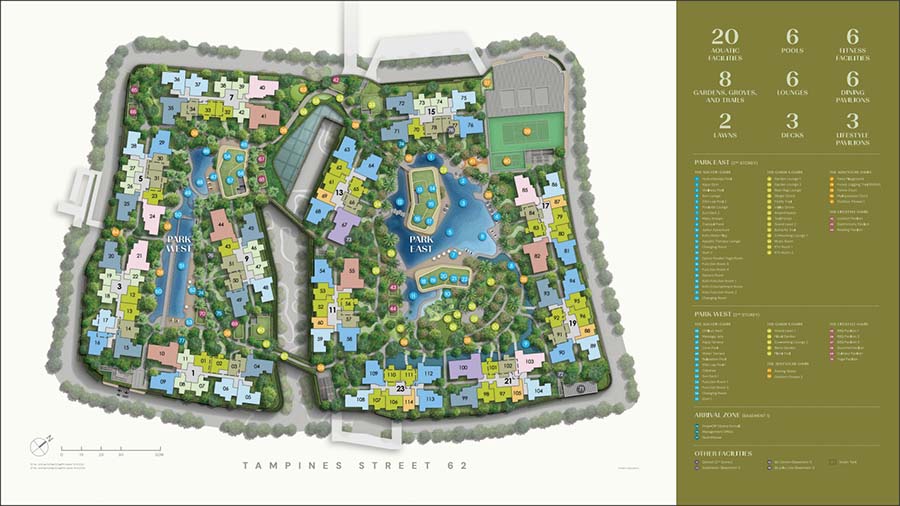
With 1,193 units, Parktown Residence operates at a scale that fundamentally changes how residents experience space, facilities, and community. Density is managed not by reducing unit count, but by distributing activity across a wide site footprint, multiple residential blocks, and layered amenity decks.
This approach has two implications. First, facilities are abundant and diverse, reducing pressure on any single amenity despite the high unit count. Second, resident experience becomes more horizontal and decentralised, particularly for blocks located further from the transport and retail core.
This is not a boutique environment. Privacy, exclusivity, and intimacy are intentionally traded for throughput, accessibility, and capacity. Buyers who expect low-density tranquillity are likely to feel misaligned; buyers who value frictionless daily routines may find the scale reassuring rather than overwhelming.
Integrated Living: Convenience as the Primary Currency
Parktown Residence internalises functions that are typically external to private residential developments. The inclusion of a retail mall, hawker centre, bus interchange, and community club within the same footprint reshapes daily behaviour patterns. Errands, meals, commuting, and childcare are consolidated into a single node.
For families and time-pressed households, this model significantly reduces coordination friction. Travel time is compressed, contingency planning is simplified, and lifestyle logistics become more predictable. This convenience premium explains buyer willingness to accept higher density and shared usage environments.
However, integrated living also introduces shared dependency. Peak-hour congestion, delivery flows, and public access to communal infrastructure are structural realities. Buyers should therefore view integration as a lifestyle commitment rather than a universal upgrade.
What Parktown Residence Is — and Is Not
What It Is
-
A large-scale, infrastructure-anchored residential hub
-
Designed for convenience-first, commuter-centric households
-
Structured for long-term district maturity rather than scarcity-driven appreciation
-
Suitable for buyers comfortable with density and shared environments
What It Is Not
-
Not a low-density or privacy-led development
-
Not a boutique or lifestyle-curated residential enclave
-
Not designed for short-cycle trading or scarcity-based resale strategies
-
Not suited for buyers who prioritise exclusivity over accessibility
Clarity on this distinction is critical to avoiding expectation mismatch.
Amenities: What You Actually Get
Parktown Residence is designed as a large-scale integrated living environment, where facilities are not just recreational but also functional extensions of daily life.
### Integrated Infrastructure (Core Differentiator)
Unlike typical condominiums, Parktown Residence includes:
– Direct sheltered access to Tampines North MRT (CRL)
– On-site bus interchange
– Retail mall with daily necessities
– Hawker centre
– Community club
These elements are structurally embedded into the development, forming the backbone of its convenience-first positioning.
### Residential Facilities
Within the residential component, facilities are distributed across multiple zones to reduce congestion:
– Multiple swimming pools across different decks
– Fitness gyms and wellness spaces
– Landscaped gardens and open lawns
– Children’s play areas
– Function rooms and communal spaces
Due to the scale of the project, facilities are decentralised rather than concentrated in a single podium.
What This Means in Reality
Facilities at Parktown Residence are designed to absorb high resident volume rather than create exclusivity.
This results in:
– Better availability across multiple facility zones
– Less reliance on any single amenity
– More consistent usability despite high unit count
However, it also means:
– Shared usage is unavoidable
– Peak-hour crowding is part of daily reality
– Facilities function more as infrastructure than luxury features
Buyers should therefore evaluate amenities not by quantity alone, but by how they support long-term daily living within a high-density environment.
Buyer Suitability: Who This Project Works For
Most Suitable For
-
HDB upgraders prioritising convenience and internal amenities
-
Families seeking transport-anchored, self-sufficient living
-
Buyers aligned with long-term regional growth rather than short-term price optics
-
Households comfortable with high-density residential environments
Least Suitable For
-
Buyers seeking privacy, quietness, or boutique living dynamics
-
Those sensitive to shared infrastructure and public interfaces
-
Buyers who rely on scarcity and low unit count for resale confidence
Buyers comparing Parktown Residence against other upcoming launches may find it helpful to frame their decision using the New Launch Condo Guide, which explains how pricing logic, buyer intent, and holding horizon differ across integrated, boutique, and mass-market developments.
What This Means for Buyers
Parktown Residence requires a different evaluation framework from typical new launches.
Buyers are not choosing between layout types alone, but between living models. The decision is fundamentally about whether integrated, high-density living improves or complicates daily life over the long term.
For aligned buyers, the project offers:
– Reduced commuting friction through direct MRT integration
– Immediate access to retail, food, and daily amenities
– A self-contained environment that supports predictable routines
For misaligned buyers, the same features can become constraints:
– High-density living reduces privacy and exclusivity
– Shared infrastructure introduces peak-hour congestion
– Internal competition affects resale differentiation
The project performs best when buyers prioritise usability over scarcity, and long-term practicality over short-term positioning.
Takeaway
Parktown Residence succeeds because it is unapologetically what it is.
It does not dilute its integrated-hub thesis to appeal to boutique buyers, nor does it attempt to manufacture exclusivity within a mass-scale framework. For buyers aligned with its convenience-first, transit-oriented model, it offers a coherent and defensible long-term proposition. For those seeking privacy, scarcity, or intimacy, misalignment is structural rather than fixable.
The project rewards buyers who choose it for what it is, not for what they hope it might become.
If you’re seriously considering this project, it’s worth checking how it actually compares and what most buyers tend to overlook — before deciding.
FAQs (Decision-Stage)
1) 1) Is Parktown Residence too dense to live comfortably?
Density is high by design, but comfort is managed through scale, distributed facilities, and decentralised circulation across multiple blocks. Residents experience the development horizontally rather than as a single concentrated tower. Liveability depends less on unit count and more on individual tolerance for shared environments and activity levels. Buyers expecting boutique quietness or low-traffic surroundings should reassess alignment early.
2) Does Parktown Residence being an integrated development guarantee better long-term value?
No. Integration improves daily usability and supports broader buyer demand, but it does not guarantee superior resale outcomes. Value retention depends on district maturity, unit selection, and buyer acceptance of density. Integrated developments tend to be more resilient due to functional demand, but resilience should not be confused with price outperformance.
3) How does Parktown Residence differ from typical OCR condominiums?
Typical OCR developments rely on surrounding amenities and neighbourhood infrastructure. Parktown Residence internalises these functions within a single integrated site, reducing reliance on external nodes. This shifts the value proposition from location-based convenience to system-based efficiency. Buyers must decide whether they prefer decentralised neighbourhood living or a consolidated, self-contained environment.
4) Will Parktown Residence’s high unit count affect resale liquidity?
High unit count increases internal competition, particularly among similar layouts and stacks. As a result, resale performance becomes more unit-specific rather than project-wide. Well-positioned units with practical layouts and reasonable pricing tend to transact more consistently. Scarcity-driven pricing dynamics are less applicable in large integrated developments.
5) Is Parktown Residence suitable for long-term own-stay?
Yes, for buyers who prioritise convenience, transport integration, and access to daily amenities. The project is designed to support long-term usability rather than exclusivity or privacy. Over time, suitability improves as Tampines North matures into a functional regional node. However, buyers sensitive to density, shared spaces, or public interfaces may experience friction during extended ownership.
6) How important is the MRT integration to Parktown Residence?
The MRT integration is a core structural component, not an added benefit. It anchors commuting patterns, supports rental demand, and reinforces long-term relevance within the district. Without this integration, the trade-offs associated with density and scale would be significantly harder to justify. Buyers should treat MRT connectivity as central to the project’s value proposition.
7) Does Parktown Residence’s scale increase management and maintenance risk?
Large developments require more structured estate management but benefit from cost distribution across a larger resident base. This allows for broader facilities and operational capacity, but reduces the level of personalisation typically found in smaller projects. Management quality and governance standards ultimately determine long-term experience. Scale amplifies both good and poor management outcomes.
8) Who should avoid buying Parktown Residence?
Buyers seeking exclusivity, low density, or scarcity-driven appreciation should eliminate the project early. Those uncomfortable with shared infrastructure, public access, or high activity levels may also find daily living misaligned. The project is not flawed, but highly specific in its positioning. Avoidance is driven by mismatch, not by inherent weakness.
Pricing Behaviour, Planning Logic & Buyer Segmentation
Summary
This section explains how Parktown Residence behaves as a mega integrated OCR asset, why buyer resistance emerges at certain decision points despite strong demand, and how Tampines North’s planning structure supports long-term relevance without guaranteeing short-cycle performance.
Integrated Pricing Logic: Paying for Friction Reduction, Not Scarcity
Parktown Residence does not price like a conventional OCR condominium. Buyer acceptance is driven less by comparative scarcity and more by the willingness to pay for friction removal — daily commuting, errands, childcare, and transport are consolidated into a single node.
This explains why many buyers focus on the integrated ecosystem rather than unit-level finesse. Decisions are anchored on lifestyle efficiency rather than resale optics. However, this also means pricing tolerance is highest when buyers remain aligned with the integrated thesis, and weakens once they begin benchmarking against non-integrated alternatives.
As the buyer pool matures, resistance typically appears when buyers ask not “Is this convenient?” but “What am I giving up for this convenience?” Density, shared spaces, and internal competition then become more prominent considerations.
Absolute Quantum Sensitivity in Large Integrated Projects
In large integrated developments, buyer sensitivity is often driven more by absolute commitment than by relative metrics. As unit sizes increase, buyers expect not just convenience, but also stronger internal differentiation, privacy, and flexibility.
Where this expectation is not met, decision cycles lengthen rather than collapse. This creates selective absorption rather than broad rejection. Smaller, more practical units tend to transact more consistently because they sit within wider acceptance bands and appeal to both own-stay and rental demand.
This behaviour is structural, not cyclical. It reflects how buyers evaluate large-scale integrated living rather than short-term market sentiment.
Integrated Development Risk: Convenience vs Dependency
Integrated developments introduce a structural dependency that buyers must acknowledge.
While convenience is significantly enhanced, residents become more exposed to:
– public footfall within shared spaces
– operational performance of retail and transport components
– peak-hour congestion across both residential and commercial interfaces
This differs from standalone condominiums, where residential environments remain more insulated.
For Parktown Residence, this trade-off is not temporary. It is embedded in the project’s design and persists throughout the ownership period. Buyers should therefore evaluate whether convenience outweighs the reduced separation between public and private environments.
Planning Context: Structural Support, Not Instant Uplift
Tampines North is being shaped as a planned secondary regional node, anchored by transport infrastructure and large residential parcels. Parktown Residence sits at the centre of this strategy, not as a beneficiary on the edge.
Planning support here works by sustaining relevance over time rather than by creating immediate repricing events. The integrated hub model ensures daily usability from the outset, while broader district maturity determines long-term comfort and resale perception.
Buyers should therefore treat planning intent as defensive infrastructure, not a speculative catalyst. The project’s success depends on lived functionality rather than external transformation milestones.
Buyer Segmentation: Who Converts, Who Hesitates
Primary Segment — Convenience-Driven HDB Upgraders
These buyers prioritise daily efficiency, transport access, and internal amenities. They are willing to accept density in exchange for predictability and reduced coordination friction. Conversion is strongest when expectations are aligned upfront.
Secondary Segment — Long-Horizon Owner-Occupiers
This group values self-sufficiency and long-term district maturity. They are less concerned with short-term resale velocity and more focused on whether the environment remains workable over a decade or more.
Lower-Conversion Segment — Privacy-Seeking Buyers
Buyers seeking low density, exclusivity, or boutique living often disengage during later evaluation stages. Their hesitation reflects misalignment rather than pricing alone.
Exit, Liquidity, Risk Scenarios & Buyer Reality Checks
Summary
This section models Parktown Residence’s exit behaviour, liquidity profile, and structural risks, helping buyers understand how large integrated developments perform across different holding phases — and where expectations commonly break down.
Exit Reality: Liquidity Exists, But It Is Not Scarcity-Driven
Parktown Residence is unlikely to face demand collapse, but it will not benefit from scarcity-led exits. With a large number of similar units, resale behaviour becomes unit-specific rather than project-wide.
Liquidity tends to surface in waves rather than continuously. Units with practical layouts, reasonable quantum, and favourable positioning transact more consistently. Higher-commitment units require patience and realistic pricing alignment.
Exit success here depends more on timing and positioning than on headline demand.
Integrated Living Cuts Both Ways
Integration strengthens baseline demand by anchoring daily life within the project. This supports rental interest and owner-occupier relevance even when surrounding supply increases.
However, integration also creates shared dependency. Peak-hour congestion, public access, and maintenance coordination are permanent features rather than teething issues. Buyers must be comfortable trading privacy for convenience not just at purchase, but throughout ownership.
This trade-off does not diminish over time — it becomes more visible.
Structural Risks Buyers Must Accept
1) Density Normalisation Risk
As Tampines North matures, high density becomes the norm rather than a differentiator. Parktown Residence must then compete on execution quality rather than novelty.
2) Internal Competition Risk
A large number of similar units increases substitution risk during resale. This places greater emphasis on unit selection and price realism.
3) Convenience Dependency Risk
The project’s value proposition is tightly linked to its integrated ecosystem. Any disruption or dissatisfaction with shared infrastructure has an outsized impact on perception.
4) Expectation Mismatch Risk
Buyers who underestimate the lived experience of scale often face regret unrelated to market performance.
Holding Phases: What to Expect Over Time
Early Occupation Phase
Usability and convenience dominate perception. Integrated features are most appreciated during this phase.
Mid-Cycle Phase
Comparison increases as surrounding supply grows. Unit-level differences become more important than project branding.
Long-Term Phase
The project behaves like a self-contained town fragment. Satisfaction depends on governance quality and resident tolerance for scale.
FAQs (Advanced Decision-Stage)
1) Is Parktown Residence a good investment property in Tampines North?
Parktown Residence is more aligned with long-term, stability-focused investors rather than short-term or speculative strategies. Its integrated nature supports consistent rental demand due to MRT connectivity and daily amenities. However, price growth is typically gradual rather than explosive due to high supply. Investors should prioritise entry price and unit selection over timing.
2) What are the main risks of buying Parktown Residence?
The main risks include high-density living, internal resale competition, and reliance on shared infrastructure. Buyers may also face pricing pressure if future supply enters Tampines North at competitive levels. These risks are structural rather than temporary. Proper expectation alignment is critical.
3) How does Parktown Residence compare to other integrated developments in Singapore?
Parktown Residence differs in scale and positioning as a mega OCR integrated hub rather than a city-fringe or central integrated development. It prioritises affordability and accessibility over exclusivity. Compared to smaller or central integrated projects, it trades prestige for practicality. Buyers must evaluate based on lifestyle alignment rather than direct comparison.
4) Which unit types are more liquid at Parktown Residence?
Smaller and mid-sized units typically see stronger demand due to lower quantum and broader affordability. Larger units face a narrower buyer pool and longer decision cycles. Liquidity is therefore uneven across unit types. Entry price remains a key determinant of resale success.
5) Is Parktown Residence suitable for HDB upgraders?
Yes, particularly for HDB upgraders prioritising convenience, transport connectivity, and access to daily amenities. The integrated model aligns well with households transitioning from HDB environments. However, buyers must be comfortable with higher density and shared infrastructure. Suitability depends on lifestyle expectations.
6) Will future developments in Tampines North affect Parktown Residence?
Yes, as Tampines North continues to develop, additional residential supply may increase competition. However, Parktown Residence benefits from being an early integrated anchor within the district. Its relevance is supported by infrastructure rather than timing. Future developments affect pricing dynamics but not fundamental usability.
7) How important is unit selection in Parktown Residence?
Unit selection is critical due to the scale of the project. Differences in facing, proximity to transport nodes, and layout efficiency directly affect both liveability and resale performance. Not all units will perform equally. Buyers should evaluate beyond project branding.
8) Is Parktown Residence better for own-stay or investment?
It leans more towards own-stay due to its convenience-driven design and integrated environment. While rental demand exists, yields are typically defensive rather than high-growth. Investors should not rely on rapid appreciation. The project performs best when aligned with long-term usability.
9) Will rental demand be strong for Parktown Residence?
Rental demand is expected to be stable due to MRT connectivity, integrated amenities, and proximity to employment nodes such as Changi Business Park and Tampines Regional Centre. However, rental yields may be moderated by higher entry prices. The project functions as a defensive rental asset rather than a yield-maximising one.
10) Does high density reduce long-term capital appreciation?
High density reduces scarcity-driven price growth, which can limit sharp upside. However, it does not eliminate long-term appreciation, especially when supported by strong infrastructure and sustained demand. Growth tends to be gradual and functional rather than speculative. Buyers should align expectations accordingly.
11) How does Parktown Residence compare to nearby Tampines launches?
Parktown Residence differentiates itself through full integration with transport and retail infrastructure, unlike typical standalone developments. While nearby projects may offer lower density or different pricing structures, they lack the same level of internalised convenience. The comparison depends on whether buyers prioritise lifestyle efficiency or spatial exclusivity.
12) Is Parktown Residence too reliant on the MRT?
The MRT is a core component of the project’s value proposition, not an optional feature. It anchors commuting patterns, supports tenant demand, and enhances long-term relevance. However, reliance on MRT connectivity also means that any perceived inconvenience or congestion around the station directly affects liveability. Buyers must be comfortable with this trade-off.
13) Are larger units harder to sell in Parktown Residence?
Yes, larger units typically face a smaller buyer pool due to higher quantum and more limited demand. This can result in longer holding periods and greater price sensitivity during resale. Smaller units generally move more consistently due to affordability. Exit strategy should be considered before purchase.
14) What is the biggest mistake buyers make when buying Parktown Residence?
The biggest mistake is assuming convenience automatically offsets all trade-offs. High density, shared infrastructure, and internal competition remain structural realities. Buyers who ignore these factors may experience dissatisfaction despite stable pricing. Clear expectation alignment is essential.
15) Will management quality impact long-term value?
Yes, management quality plays a critical role in large integrated developments. Effective maintenance and governance sustain usability, resident experience, and long-term perception. Poor management can amplify issues related to density and shared infrastructure. Over time, management standards directly influence value retention.
16) Is Parktown Residence a long-term hold asset?
Yes, it is more suited for long-term holding rather than short-term trading. The project’s strength lies in sustained usability, infrastructure support, and consistent demand rather than rapid price movement. Buyers who enter with a long holding horizon are more likely to benefit. Short-term expectations may lead to misalignment.
If you prefer a more structured walkthrough, you can leave your details below and we’ll follow up with you.