

Summary
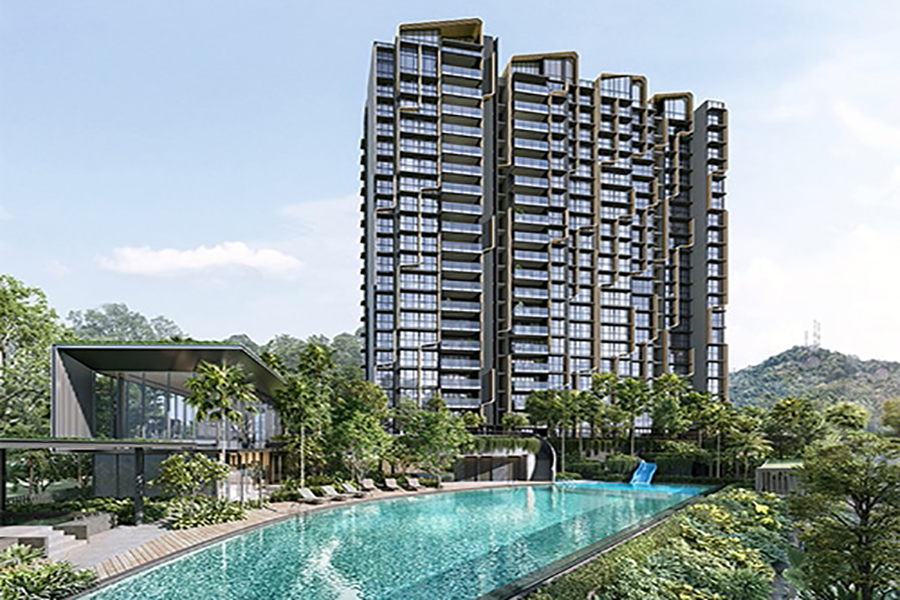
8@BT is a 99-year leasehold private condominium located at Bukit Timah Link in District 21, positioned approximately 0.2 km (about a two-minute walk) from Beauty World MRT on the Downtown Line. Developed by Bukit Sembawang, the project comprises 158 residential units across two 20-storey blocks and is structured as a low-density, pure residential alternative within the Beauty World precinct.
The project is best understood as a boutique MRT-adjacent development that prioritises residential privacy, school-belt proximity, and commute efficiency over integrated convenience, tenure longevity, or large-scale facilities. It tends to suit school-driven families and MRT-reliant owner-occupiers more than buyers seeking freehold positioning, mixed-use integration, or lifestyle-heavy environments.
From a structural standpoint, 8@BT is best understood as a deliberately restrained project. It sits beside one of the most actively transforming nodes in Bukit Timah, yet it is not an integrated or mixed-use development. There is no retail podium, no bus interchange, and no public footfall passing through the site. Instead, the project positions itself as a quieter, lower-density residential counterpoint to the integrated hub nearby, appealing to buyers who want MRT proximity without living directly above or within a transport-centric lifestyle complex.
Buyer suitability at 8@BT is therefore narrower than that of its neighbours. Demand is anchored primarily by school-driven families, MRT-reliant owner-occupiers, and privacy-seeking households who value a pure residential environment. Conversely, buyers prioritising freehold tenure, large-scale lifestyle amenities, or integrated convenience tend to hesitate early, particularly at higher quantum levels for larger units.
8@BT is best suited for buyers who prioritise MRT proximity, Bukit Timah school access, and a low-density residential environment over tenure strength, integrated convenience, or large-scale facilities. It functions as a selective, alignment-driven project rather than a broad-market offering.
This review analyses whether 8@BT is worth buying, its pricing logic, buyer suitability, investment potential, and long-term risks within the Beauty World transformation.
Explore the Full 8@BT Analysis
This article is part of the full 8@BT cluster:
- 8@BT Price Guide – pricing structure, market positioning, and buyer entry analysis
- 8@BT Floor Plan Analysis – layout efficiency, unit mix, and stack considerations
- 8@BT Showflat Guide – viewing strategy, location context, and buyer evaluation framework
Together, these articles provide a structured analysis of the project’s positioning, pricing framework, layout strategy, and viewing considerations.ns.
If you’re considering this project, you might want to check how it actually compares and what most buyers tend to overlook — before deciding.
Key Details (At a Glance)
99-year leasehold | 158 units | Beauty World MRT (~0.2 km / ~2-minute walk, Downtown Line) | Launched Sep 2024 (≈53% sold on launch day; ≈63% sold as of early 2026) | TOP Q4 2027 | Low-density, pure residential alternative next to Beauty World MRT
Project Factsheet
| Item | Details |
|---|---|
| Project Name | 8@BT |
| Location | Bukit Timah Link |
| District / Region | District 21 / OCR |
| Tenure | 99-year leasehold (from 13 Feb 2023) |
| Developer | Bukit Sembawang |
| Site Type | GLS |
| Development Type | Pure private residential |
| Site Area | 4,611.1 sqm |
| Plot Ratio | 3.0 |
| Total Units | 158 |
| Nearest MRT | Beauty World MRT (Downtown Line) |
| Launch Status | Launched |
| Expected TOP | Q4 2027 |
Pricing Context (Decision-Stage Orientation)
Pricing at 8@BT reflects payment for immediacy and specificity rather than breadth. Buyers are paying for walk-to-MRT convenience, access to the Bukit Timah school belt, and a low-density residential environment, rather than freehold tenure or integrated mixed-use convenience. As a result, price acceptance tends to be strongest among buyers who value location efficiency and privacy, and weakest among those benchmarking primarily against tenure or large-scale lifestyle offerings.
Location Context
Beauty World MRT on the Downtown Line is the closest station at approximately 0.2 km, translating to a realistic two-minute walk for most residents. This is not a symbolic proximity; daily commuting at 8@BT is genuinely MRT-led rather than dependent on feeder buses or driving. The Downtown Line provides direct connectivity through the Bukit Timah education corridor and into the city, reinforcing the project’s appeal to school-going families and city-bound professionals.
However, it is important to recognise that Beauty World is a single-line MRT station. There is no interchange functionality, and connectivity relies on the Downtown Line alone. For many owner-occupiers, this is sufficient and even preferable due to the line’s direct routing. For others who prioritise interchange flexibility, this becomes a quiet but real trade-off when compared against nodes with multi-line access.
Beyond transport, Bukit Timah Link itself is a transitional street within the wider Bukit Timah planning area. It sits close to the commercial energy of the Beauty World precinct, yet slightly removed from the heavier traffic flows of Upper Bukit Timah Road and Dunearn Road. This positioning contributes to the project’s “tucked-away” residential character, which is valued by some buyers but less compelling to those seeking a more vibrant, doorstep lifestyle environment.
Structural Value Considerations
As a 99-year leasehold development commencing from February 2023, 8@BT’s long-term value profile is shaped more by entry price discipline and owner-occupier demand than by tenure scarcity. In Bukit Timah, where many surrounding developments are freehold, leasehold status becomes a more visible psychological factor, particularly for buyers planning long holding horizons.
That said, leasehold dynamics at 8@BT are not uniform across all unit types. Smaller units tend to face less resistance due to lower absolute quantum and stronger rental or transitional demand. Larger family-sized units, by contrast, encounter greater scrutiny as buyers begin comparing them against older freehold alternatives within the same district. This creates a natural segmentation in buyer behaviour that is visible even during the initial sales phase.
Scale & Design Reality
With only 158 units on a 4,611.1 sqm site, 8@BT is objectively low-density by modern new-launch standards in this precinct. Fewer residents translate into less competition for shared facilities and a quieter day-to-day living environment. For buyers sensitive to crowding and foot traffic, this scale is a meaningful advantage.
The trade-off is that a compact site limits the breadth and scale of facilities. While core lifestyle amenities are provided, buyers accustomed to expansive grounds, multiple pools, or full sports facilities in larger developments may find the offering restrained. This is not a flaw, but a direct consequence of the project’s boutique positioning.
Project Positioning — What It Is and Is Not
8@BT IS:
-
A low-density, pure residential condominium within walking distance of Beauty World MRT
-
A school-centric project aligned with Bukit Timah’s education corridor
-
A quieter residential alternative to integrated developments in the same precinct
8@BT IS NOT:
-
A freehold or generational holding asset
-
An integrated development with in-house retail or transport interchange
-
A facilities-heavy lifestyle project designed for large resident populations
Amenities: What You Actually Get at 8@BT
Amenities at 8@BT are intentionally curated rather than extensive, reflecting the project’s boutique scale and low-density positioning.
The development provides core lifestyle facilities designed for daily usability rather than variety or spectacle.
Key facilities include:
- 25m lap pool (Quarry Pool)
- Fitness pool and gymnasium
- Furo bath and relaxation zones
- BBQ pavilion and communal gathering spaces
- Function room and meeting spaces
- Children’s play area
From a practical standpoint, this translates to:
- Less crowding across shared spaces
- Shorter waiting time for facilities
- A quieter, more private environment overall
However, the trade-off is equally clear:
- No full-scale sports facilities (e.g. tennis courts)
- Limited recreational diversity compared to larger projects
- Less appeal for buyers seeking a lifestyle-driven environment
This is not a facilities-heavy development. It is a deliberately restrained one.
Buyers choosing 8@BT are prioritising MRT proximity, school access, and residential privacy over lifestyle scale.
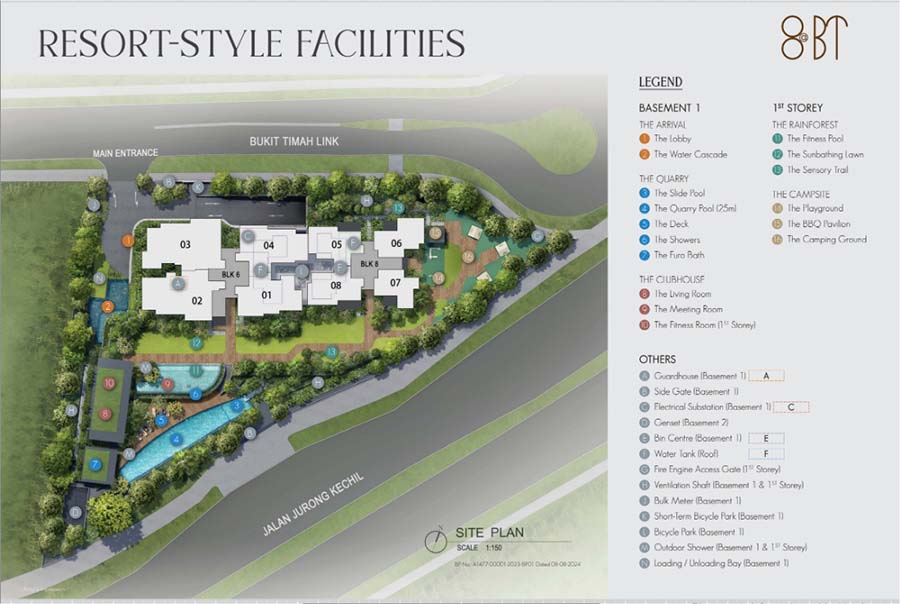
8@BT facilities plan illustrating residential blocks, pool layout, and internal amenity zones
Buyer Suitability
8@BT tends to suit families prioritising proximity to Pei Hwa Presbyterian Primary School and other Bukit Timah schools, particularly those planning ahead for primary school registration. It also appeals to owner-occupiers who rely on MRT connectivity for daily commuting but prefer a residential environment that is insulated from public foot traffic.
Downsizers from older, larger developments may also find the project suitable if they value modern layouts and manageability over expansive grounds. On the other hand, buyers whose decision-making is driven primarily by tenure longevity, integrated convenience, or recreational depth should assess fit carefully before proceeding.
Buyers Who Should Eliminate Early
Buyers who require freehold tenure, expect integrated retail convenience within the same plot, or prioritise large-scale sports and lifestyle facilities should eliminate 8@BT early, as these are structural limitations rather than gaps that can be remedied later.
Buyers comparing 8@BT against other upcoming launches may find it helpful to frame their decision using the New Launch Condo Guide, which outlines how pricing logic, buyer intent, and holding horizon differ across project type
Takeaway
8@BT occupies a clear but selective niche within the Beauty World transformation story. It offers MRT immediacy, school-belt relevance, and residential privacy in a low-density format, while consciously forgoing integration, tenure longevity, and scale. For the right buyer profile, this trade-off makes sense; for others, it becomes a quiet but decisive reason to look elsewhere.
If you’re seriously considering this project, it’s worth checking how it actually compares and what most buyers tend to overlook — before deciding.
FAQs (Decision-Stage)
1) Is 8@BT genuinely a walk-to-MRT project?
Yes. Beauty World MRT on the Downtown Line is approximately 0.2 km away, translating to about a two-minute walk in practical terms. This supports daily MRT-led commuting rather than reliance on feeder transport or driving. In the OCR context, this level of proximity is considered true walkability. It directly supports both own-stay convenience and long-term resale liquidity.
2) How does 8@BT differ from integrated developments nearby?
8@BT is a pure residential project without retail podiums, transport interchanges, or public footfall passing through the site. This results in a quieter and more private living environment compared to integrated developments in Beauty World. However, it also means residents rely on nearby amenities rather than having them within the same development. The trade-off is between privacy and immediate convenience.
3) Does the 99-year tenure significantly affect buyer demand?
Yes, particularly in a Bukit Timah context where many surrounding developments are freehold. Leasehold tenure becomes more visible when buyers compare long-term holding potential. This effect is more pronounced for larger units with higher quantum. Smaller units tend to face less resistance due to affordability and rental flexibility.
4) Who is the typical buyer profile at 8@BT?
Demand is primarily driven by owner-occupiers, especially families targeting the Bukit Timah education belt and MRT-dependent professionals. A secondary segment consists of school-driven buyers planning for primary school registration. Investor participation exists but remains selective and price-sensitive. The project naturally filters out short-term or speculative buyers.
5) Are facilities limited due to the smaller site?
Yes. The compact site results in a more curated facilities offering compared to larger developments. While core amenities are present, the overall scale and variety are more restrained. This aligns with the project’s low-density positioning. Buyers must decide whether they value privacy or recreational diversity more.
6) How important is proximity to Pei Hwa Presbyterian Primary School?
School proximity is a major structural demand driver. Properties within 1km of oversubscribed primary schools often see consistent owner-occupier demand. This supports baseline resale interest rather than speculative price spikes. For many families, this factor alone justifies location prioritisation.
7) Does road proximity affect liveability?
Yes, for certain stacks. Units closer to major roads may experience traffic noise, particularly at lower floors. This is a unit-specific factor rather than a project-wide issue. Buyers sensitive to noise typically prioritise higher floors or inward-facing stacks.
8) Who should think twice before buying 8@BT?
Buyers prioritising freehold tenure, integrated convenience, or large-scale facilities should reconsider early. The project is not designed to meet those expectations. It is best suited for buyers aligned with MRT convenience and low-density living.
Pricing Logic, URA Planning Intent, Buyer Segmentation
Summary
Pricing behaviour at 8@BT is best described as selectively rational rather than emotionally driven. Buyers who proceed are consciously paying for MRT immediacy, school-belt certainty, and a low-density residential environment, while explicitly accepting trade-offs in tenure, facilities scale, and long-term appreciation profile. Understanding these trade-offs explains both the steady take-up and the visible resistance at higher quantums.
Pricing Logic
Pricing at 8@BT is anchored around location efficiency, not tenure strength. Buyers justify entry prices primarily through daily usability — walking to Beauty World MRT, predictable commute times, and proximity to Bukit Timah’s education corridor — rather than through long-term land scarcity or freehold premium narratives.
Acceptance is strongest in smaller unit types, where absolute quantum remains within reach for upgrader households and comparisons are made against other MRT-adjacent new launches. In this segment, buyers tend to accept leasehold tenure as a functional compromise rather than a structural flaw, particularly when purchase horizons are aligned with schooling timelines.
As unit sizes increase, pricing resistance becomes more pronounced. Larger 3- and 4-bedroom units are increasingly benchmarked against older freehold developments nearby, even when those alternatives lack modern layouts or MRT proximity. At this point, buyers begin questioning whether paying a premium for a leasehold asset aligns with long-term holding intentions, resulting in slower decision cycles and narrower demand.
URA Planning Intent
From an urban planning perspective, 8@BT sits within URA’s long-term vision to reinforce Beauty World as a transport-led residential node rather than a high-intensity commercial centre. The strategy focuses on improving connectivity, liveability, and housing supply while preserving Bukit Timah’s educational and low-rise residential character.
The redevelopment of the former Bukit Timah Turf City into a large residential and lifestyle precinct over the next 20 to 30 years underlines this intent. Increased housing supply, pedestrian connectivity, and integration with green corridors are designed to support sustained owner-occupier demand rather than short-term speculative activity.
Within this framework, 8@BT benefits indirectly from precinct rejuvenation while remaining physically insulated from the highest-intensity components of the area. Its positioning complements nearby integrated developments by offering a quieter residential option within the same transport and planning ecosystem.
Buyer Segmentation
Buyer demand at 8@BT is clearly segmented by motivation, time horizon, and unit type.
The primary buyer group consists of local owner-occupiers upgrading from nearby HDB estates in Districts 21 and 23. These buyers typically prioritise school access, MRT convenience, and a calmer residential environment, and are less focused on maximising rental yield or holding indefinitely across generations.
A secondary segment comprises “school-seekers” relocating specifically to Bukit Timah for primary school registration. For this group, proximity to Pei Hwa Presbyterian Primary School and the wider education belt often outweighs concerns about tenure, particularly when purchase timing aligns with family planning milestones.
Investor participation exists but remains selective. Investors tend to focus on smaller units with clearer rental demand linked to the education corridor and employment nodes accessible via the Downtown Line. Larger units attract limited investor interest due to higher quantum and weaker yield alignment.
Exit & Liquidity, Risk Scenarios, Pros & Cons, FAQs
Summary
The long-term performance of 8@BT is likely to be defined by unit-level liquidity rather than uniform appreciation. Its low-density structure supports price stability, but leasehold tenure and buyer pool narrowing over time introduce specific exit considerations that buyers should understand upfront rather than discover later.
Exit & Liquidity
Exit liquidity at 8@BT is expected to vary significantly by unit size. The limited total unit count reduces the risk of internal price competition during resale, which helps prevent aggressive undercutting in normal market conditions.
In the early post-TOP years, resale demand is likely to be supported by school-driven families and owner-occupiers seeking entry into Bukit Timah with MRT convenience. Over longer holding periods, however, leasehold tenure becomes increasingly visible in buyer comparisons, particularly against nearby freehold developments, which may slow resale velocity for larger units.
Smaller units are likely to retain broader appeal due to lower absolute quantum and stronger rental fallback options. Larger family units face a narrower buyer pool, making exit timing and pricing discipline more critical.
Risk Scenarios
-
Leasehold Perception Risk
As the lease ages, buyers may place increasing emphasis on tenure when comparing resale options, particularly in a district with many freehold alternatives. This can narrow demand for larger units earlier than expected. -
Pricing Ceiling Risk
If resale pricing approaches levels comparable to freehold properties in Bukit Timah, buyer resistance may intensify. At that point, transaction velocity may slow even if underlying demand remains. -
Infrastructure Noise Sensitivity
Units facing major roads or expressway infrastructure may experience softer demand due to noise sensitivity. This creates differentiation within the project that can affect resale pricing. -
Upgrader Market Sensitivity
A significant portion of demand comes from upgrader households, which are more exposed to macroeconomic shifts and policy cooling measures. Changes in financing conditions can therefore impact liquidity.
Pros & Cons
Pros
-
Genuine walk-to-MRT proximity on the Downtown Line
-
Low-density, pure residential environment with limited internal competition
-
Strong school-belt relevance within Bukit Timah
Cons
-
99-year leasehold tenure in a predominantly freehold enclave
-
Limited facilities scale due to compact site footprint
-
Narrower resale buyer pool for larger units over time
FAQs
1) How liquid is 8@BT compared to nearby developments?
Liquidity is supported by the project’s low unit count, which limits internal resale competition. However, liquidity is not uniform across all unit types. Smaller units typically attract broader buyer pools and transact more efficiently, while larger units face narrower demand. Liquidity here is a function of unit type rather than overall project appeal.
2) Does the 99-year tenure materially affect resale value?
Yes, particularly over longer holding periods. As the lease ages, buyers become more sensitive to tenure when comparing against nearby freehold properties. This effect tends to appear earlier for larger units with higher quantums. Smaller units are less affected due to stronger affordability and rental fallback.
3) Who is the most likely resale buyer profile?
Future resale buyers are likely to be school-driven families and owner-occupiers seeking MRT access within Bukit Timah. These buyers prioritise location efficiency and school proximity over tenure. Investor demand is expected to remain selective rather than dominant. The resale pool is therefore usage-driven rather than speculative.
4) Are investors active in this project?
Investor participation exists but is concentrated in smaller units with clearer rental demand. Larger units attract limited investor interest due to higher quantum and lower yield efficiency. As a result, the project is not investor-led in its demand structure. Owner-occupier demand remains the primary driver.
5) How does low density influence long-term value?
Low density reduces internal competition during resale and supports a quieter living environment. This can enhance perceived exclusivity and buyer appeal among certain segments. However, it does not automatically translate into price outperformance. Its impact is more defensive than growth-driven.
6) Will nearby integrated developments cap upside potential?
Integrated developments offer stronger convenience and footfall-driven appeal, which can influence buyer comparisons. However, 8@BT positions itself as a quieter residential alternative within the same precinct. The two product types serve different buyer preferences. Upside is therefore moderated by positioning rather than directly capped.
7) Is exit timing more important for leasehold projects?
Yes, timing becomes more relevant as lease decay becomes more visible over time. Early-cycle resale typically benefits from newer-condition premium and broader buyer acceptance. Later exits require more pricing discipline and alignment with buyer expectations. Timing affects liquidity more than valuation direction.
8) Does MRT proximity offset leasehold concerns?
MRT proximity helps sustain demand and improves resale liquidity in the medium term. It reduces dependence on car ownership and supports daily usability. However, it does not eliminate tenure considerations entirely. Over longer horizons, leasehold comparisons still emerge.
9) Are larger units harder to resell?
Yes, primarily due to higher absolute prices and narrower buyer pools. Buyers at this price range often compare against freehold alternatives or larger resale properties. This introduces additional friction during resale. Larger units require stronger alignment and longer holding horizons.
10) How sensitive is demand to government cooling measures?
Demand is moderately sensitive due to its reliance on upgrader households. Financing restrictions and policy changes can affect affordability and transaction volume. This impact is more visible in mid-to-large unit segments. Smaller units tend to remain more resilient.
11) Will school demand continue to support prices?
School demand tends to be cyclical but persistent over time. It provides a steady base of owner-occupier interest rather than speculative upside. This helps support transaction activity during softer market conditions. However, it does not guarantee price growth.
12) Does 8@BT appeal to downsizers?
Yes, particularly downsizers seeking manageable layouts and MRT access within Bukit Timah. However, tenure may still be a consideration for some. The appeal depends on whether buyers prioritise convenience over long-term land value. It is a selective fit rather than a universal one.
13) How does the Beauty World location affect exit prospects?
Beauty World MRT proximity supports consistent resale interest due to strong connectivity. However, comparisons with nearby freehold properties remain inevitable. Buyers must therefore balance convenience against tenure considerations. Location supports demand but does not remove pricing discipline.
14) Is rental a viable fallback strategy?
Rental demand exists, especially from education-linked tenants and professionals using the Downtown Line. However, yields are generally moderate due to higher entry pricing. Rental should be viewed as a holding buffer rather than a primary return driver. Expectations should remain conservative.
15) Will future GLS supply dilute resale demand?
Additional supply increases competition but also reinforces the precinct’s long-term relevance. The impact depends on timing, pricing, and positioning of future launches. 8@BT’s low density helps differentiate it within this supply pipeline. Demand remains segmented rather than diluted uniformly.
16) What is the biggest exit risk buyers should accept upfront?
That long-term performance depends more on entry price discipline and buyer alignment than on tenure or transformation narratives. Buyers expecting broad market-driven upside may face disappointment. The project rewards clarity of intent rather than speculative positioning. Misalignment is the primary risk.
If you prefer a more structured walkthrough, you can leave your details below and we’ll follow up with you.