
Summary
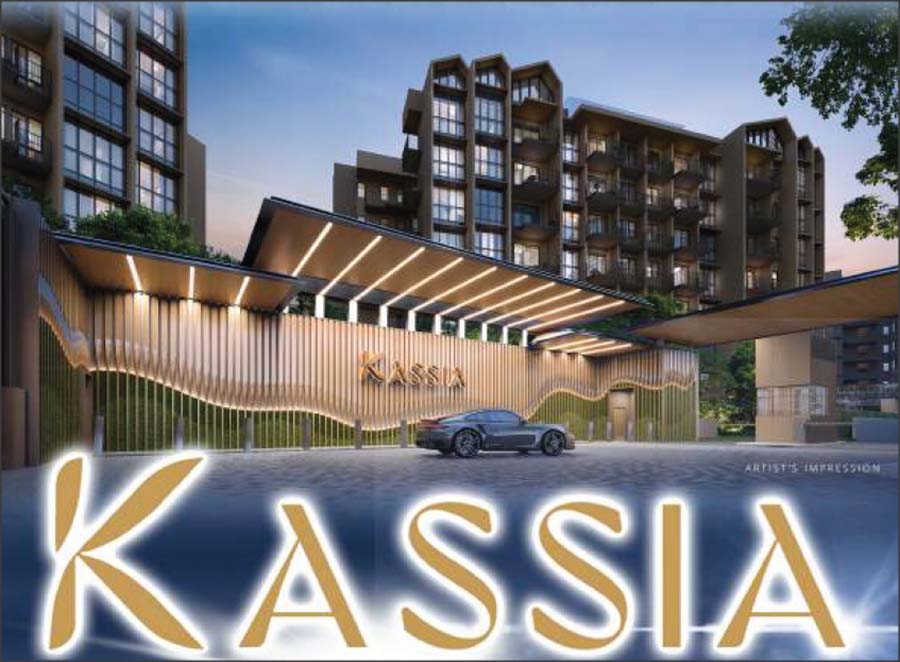
Kassia is a 276-unit freehold residential development along Flora Drive in District 17, positioned as the final freehold parcel within a mature private enclave near Upper Changi. Its value proposition is not driven by MRT proximity, retail integration, or lifestyle scale, but by a structural triad: freehold tenure, low-rise form, and comparatively defensive entry pricing within the OCR.
Located in the Pasir Ris Planning Area, Kassia occupies a quiet, inward-facing residential pocket with limited walkable amenities and indirect MRT access. These constraints are not incidental; they shape both liveability and buyer demand. As a result, Kassia filters strongly for car-owning households and long-horizon buyers who prioritise tenure security and controlled living conditions over convenience or short-term liquidity.
Kassia should therefore be assessed as a long-horizon, asset-preservation project, not a lifestyle-ready estate or a momentum-driven new launch.
Kassia is a freehold, low-rise residential development designed for buyers who prioritise long-term tenure security and price defensiveness over MRT adjacency, lifestyle density, and short-cycle liquidity.
Explore the Full Kassia Analysis
This article is part of the full Kassia cluster:
- Kassia Price Guide – pricing structure, entry positioning, and comparative benchmarks
- Kassia Floor Plan Analysis – layout efficiency, unit mix, and configuration differences
- Kassia Showflat Guide – location, viewing strategy, and buyer evaluation approach
Together, these provide a complete decision-stage breakdown of Kassia’s positioning, pricing logic, layout strategy, and real-world suitability.
If you’re considering this project, you might want to check how it actually compares and what most buyers tend to overlook — before deciding.
Key Details (At a Glance)
Freehold residential development
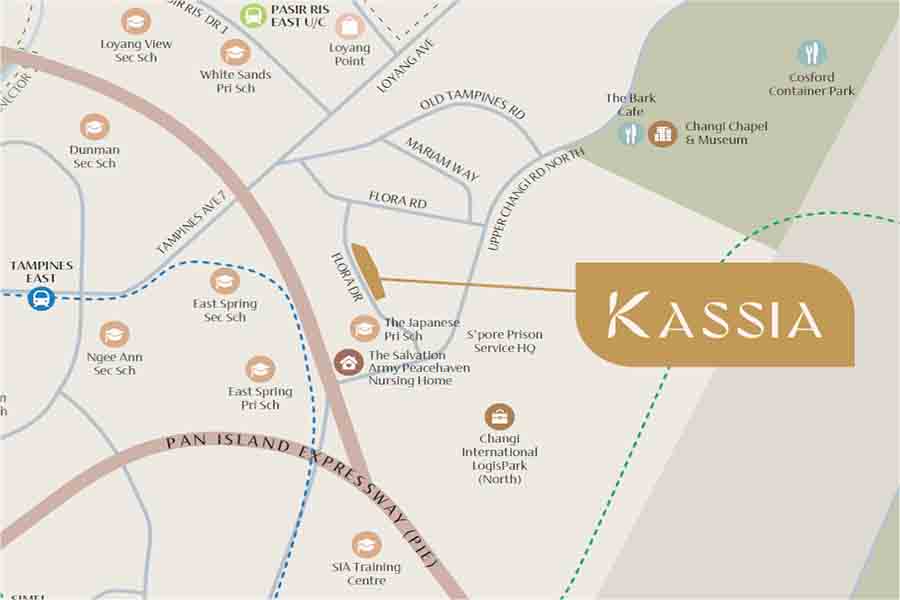
Flora Drive, District 17 (Pasir Ris Planning Area)
Outside Central Region (OCR)
Final residential parcel within the Flora Drive private enclave
Targeted at long-term owner-occupiers and capital-preservation buyers
Project Factsheet
| Item | Details |
|---|---|
| Project Name | Kassia |
| Location | 31–39 Flora Drive, Singapore |
| District / Region | District 17 / OCR (Pasir Ris Planning Area) |
| Tenure | Freehold |
| Developer | Hong Leong Holdings, CDL & TID (Tripartite JV) |
| Site Type | Final residential parcel from Upper Changi Road North land bank |
| Development Type | 4 blocks of 8-storey residential apartments |
| Site Area | ~14,013.4 sqm |
| Plot Ratio | 1.53 |
| Total Units | 276 residential units |
| Unit Mix | 1BR to 4BR (473–1,345 sq ft) |
| Launch Status | Launched; actively selling |
| Expected TOP | Market guidance: ~Nov 2027 (non-commitment) |
| Legal TOP Deadline | No later than 1 Nov 2029 |
Location Context: Flora Drive Enclave (Not MRT-Driven)
Flora Drive functions as a private residential cul-de-sac, defined by low-rise private condominiums and minimal commercial activity. It is not a transit-led or mixed-use corridor, and this distinction is critical.
Daily amenities are not within immediate walking distance. Retail and supermarket access typically requires a short drive or feeder bus to Tampines Mart, Loyang Point, or Tampines Central. MRT access is similarly indirect, with Tampines East MRT and the future Pasir Ris East CRL station requiring bus connections or extended walks.
This creates a clear lifestyle trade-off. Kassia works for buyers who are comfortable with planned mobility and private transport. It does not work for car-lite households or tenants who require walk-to-MRT convenience as a baseline.
Development Character: Low-Rise Freehold Living in Flora Drive
Kassia is capped at eight storeys across four residential blocks due to aviation height controls near Changi Airport. Rather than treating this as a limitation, the development leans into a low-rise, resort-style suburban form.
The result is a development with:
more predictable light, airflow, and privacy,
lower perceived congestion than high-rise OCR launches, and
a calmer internal living environment.
Facilities are consolidated and functional rather than expansive, reinforcing Kassia’s identity as a residential retreat rather than a destination project.
Freehold Positioning: Defensiveness Over Performance
Freehold tenure anchors Kassia’s value proposition, particularly within the OCR where most new supply is leasehold.
For long-horizon buyers, freehold reduces exposure to lease-decay perception and preserves optionality across extended holding periods. However, freehold does not eliminate liquidity friction. Kassia’s transport dependence and niche positioning mean resale demand will remain selective rather than broad-based.
In practical terms, Kassia behaves more like a capital-preservation asset than a performance-driven investment. It rewards patience and alignment, not timing or speculation.
Pricing Context: Kassia Price Acceptance and Buyer Resistance
Market response to Kassia has been steady but selective, consistent with its positioning.
Acceptance has been strongest where buyers benchmark Kassia against:
leasehold OCR launches with higher psf levels, and
freehold alternatives with materially higher absolute quantums.
Resistance becomes clearer as psf levels approach higher thresholds for smaller units, where comparisons shift toward RCR projects with superior transport connectivity. Larger units have encountered relatively less resistance due to lower psf entry points and the defensiveness of freehold at higher quantums.
This pricing behaviour reflects rational buyer calibration, not market rejection.
What Kassia Is — and Is Not
What It Is
A freehold, low-rise residential project in a private enclave
Structured for long-term ownership and tenure security
Suited for car-owning households seeking quiet living
A defensive alternative to leasehold OCR launches
What It Is Not
Not MRT-integrated or transit-oriented
Not lifestyle-led or amenity-dense
Not a yield-maximisation vehicle
Not designed for short-term trading or flipping
Expectation alignment is decisive here.
Amenities: What Living at Kassia Actually Feels Like
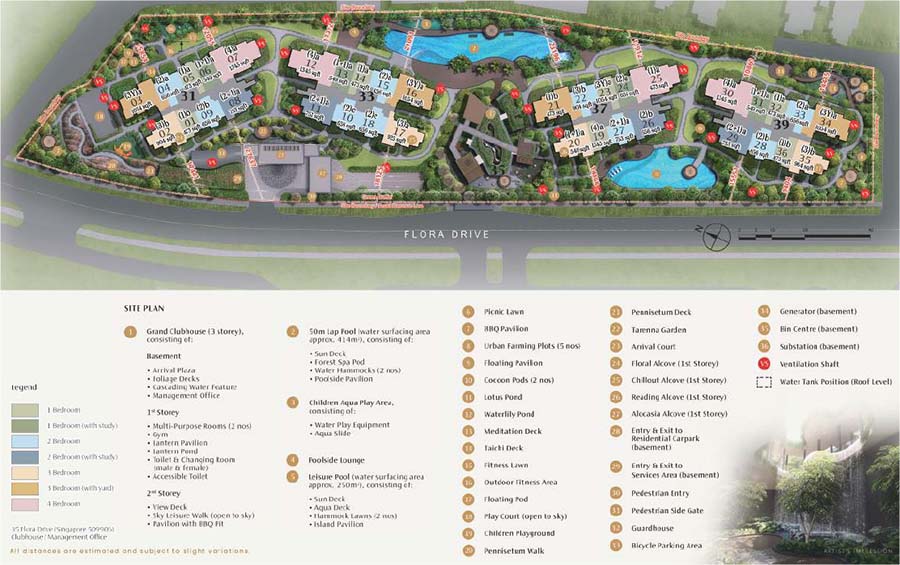
Kassia’s facilities are designed around a low-rise, low-density living environment rather than a large-scale lifestyle development.
Unlike mega projects that emphasise extensive facilities or retail integration, Kassia adopts a more restrained and functional approach. The focus is on providing essential amenities that support day-to-day living within a quieter residential setting.
Residents can expect:
- A central swimming pool and leisure water features
- Gym and fitness areas for basic daily use
- Clubhouse and function rooms for small gatherings
- Landscaped gardens and internal walking paths
- Children’s play areas within a controlled environment
Because of the project’s scale and height limitation, facilities are not designed to impress visually or compete with larger developments. Instead, they support a more predictable and less crowded living experience.
This aligns with Kassia’s broader positioning as a low-rise, long-term residential enclave rather than a lifestyle-driven project.
Buyer Suitability: Alignment Determines Outcomes
Most Suitable For
Owner-occupiers prioritising freehold tenure and calm living
East-side buyers seeking to remain within the district
Parents purchasing for children with long holding horizons
Investors targeting stable, niche tenant pools near Changi and SUTD
Least Suitable For
Car-lite households, where daily friction compounds
Buyers requiring walk-to-MRT convenience
Yield-driven investors sensitive to carrying costs
Short-cycle or momentum-oriented buyers
Buyers comparing Kassia against other upcoming launches may find it helpful to frame their decision using the New Launch Condo Guide, which outlines how pricing logic, buyer intent, and holding horizon differ across project type
Takeaway
Kassia is not a compromise project — it is a filtering project.
It rewards buyers who are clear about why they want freehold in this specific enclave and penalises those expecting convenience, vibrancy, or rapid upside. For aligned buyers, Kassia offers tenure security, price defensiveness, and controlled living conditions that are increasingly scarce in new launches. For misaligned buyers, it will feel remote, quiet, and structurally inconvenient.
Here, clarity of intent matters more than timing.
If you’re seriously considering this project, it’s worth checking how it actually compares and what most buyers tend to overlook — before deciding.
FAQs (Decision-Stage)
1) Is Kassia condo considered good value for a freehold new launch in District 17 (Flora Drive)?
Kassia is generally perceived as good value when benchmarked against leasehold OCR launches that have crossed higher psf thresholds. The value proposition lies less in upside potential and more in tenure defensiveness and absolute quantum control. Buyers who proceed typically accept the trade-off between transport convenience and long-term ownership clarity. The value equation works best for those planning extended holding periods rather than early resale.
2) How much does MRT distance affect liveability at Kassia Flora Drive?
MRT distance is a structural factor rather than a marginal inconvenience. Most residents will rely on private transport or feeder buses for daily commuting. For car-owning households, this is manageable; for car-lite residents, it can become a daily friction point. Buyers should assess lifestyle fit honestly rather than assuming future transport improvements will fully offset this constraint.
3) Does freehold tenure at Kassia materially improve long-term outcomes?
Freehold removes lease-decay considerations, which become meaningful only over long horizons. It does not guarantee higher resale prices or faster exits in the short term. In Kassia’s case, freehold primarily functions as a risk-mitigation feature, supporting long-term value stability rather than accelerating appreciation. Buyers relying on tenure alone for performance may overestimate its impact.
4) Why are Kassia condo sales steady rather than fast-moving?
Kassia sits in a narrow decision band. It appeals strongly to a specific buyer profile but filters out a large portion of the mass market due to transport and amenity constraints. This results in conviction-led absorption rather than broad-based momentum. Such projects tend to sell through patience rather than hype.
5) Is Kassia condo suitable for families?
It depends on family priorities. Families valuing quiet surroundings and tenure security may find Kassia suitable, especially with car access. Families seeking activity-driven facilities, walkable amenities, or school-anchored neighbourhoods may find it less aligned. The project is more environment-driven than family-centric.
6) Is Kassia a good rental investment property?
Rental demand is supported by nearby employment nodes such as Changi Business Park, SUTD, and aviation-related industries. However, higher entry prices and transport reliance cap yield potential. Kassia works better as a defensive rental hold rather than a yield-maximisation strategy.
7) How does Kassia compare to nearby leasehold OCR launches in exit risk?
Compared to leasehold OCR projects, Kassia carries lower long-term exit risk tied to tenure perception, especially beyond the first resale cycle. While leasehold projects may enjoy stronger early liquidity due to MRT proximity or integrated amenities, they face increasing buyer sensitivity to remaining lease over time. Kassia trades early liquidity for longer-term defensiveness.
8) Are larger units at Kassia harder to resell in the future?
Larger units face higher absolute quantum sensitivity, particularly in a location without MRT adjacency or family-centric infrastructure. However, Kassia’s larger formats benefit from relatively lower psf levels and freehold tenure. Resale demand will be narrower but not absent, with outcomes driven more by pricing realism than project-wide momentum.
PRICING LOGIC, URA PLANNING INTENT & BUYER SEGMENTATION
Pricing Logic: Why Kassia Clears Early — Then Slows
Kassia’s pricing behaviour follows a two-phase pattern commonly seen in defensively positioned freehold OCR projects.
Early Phase: Freehold Discount Recognition
At launch, Kassia benefited from a clear comparative narrative: freehold pricing that sat at or below many leasehold OCR launches during the same cycle. This created a “freehold discount” perception, especially for 1- and 2-bedroom units where absolute quantums remained manageable. Early buyers focused on tenure defensiveness and long-term optionality rather than transport convenience.
This explains the strong initial absorption, particularly among smaller formats and value-anchored buyers.
Mid-Cycle Phase: Transport Benchmarking Resistance
As sales progressed, buyer behaviour shifted from tenure recognition to lifestyle and transport benchmarking. When psf levels for smaller units approached the low-$2,100s, buyers began comparing Kassia against RCR projects with superior MRT access. This introduced natural resistance, not because pricing became irrational, but because the comparison set changed.
Larger units, however, experienced relatively less resistance due to lower psf entry points and fewer direct substitutes in the freehold segment.
Mature Phase Outlook: Range-Bound, Not Momentum-Driven
Kassia is unlikely to experience sharp repricing driven by hype or scarcity narratives. Instead, pricing behaviour is expected to be range-bound, supported by tenure and limited new freehold supply in the East. This supports capital preservation but caps acceleration. Buyers should expect stability over volatility.
URA Planning Intent: Pasir Ris as a Long-Dated Structural Story
URA’s Draft Master Plan and Remaking Our Heartland framework position Pasir Ris as an “Urban Sanctuary”, balancing residential growth with lifestyle and connectivity upgrades over a 10–15 year horizon.
What This Means for Kassia
Kassia is not located within a transformation core, but it sits within the broader structural uplift zone. Key initiatives — including the Cross Island Line interchange at Pasir Ris, town centre rejuvenation, and Changi East employment expansion — enhance district relevance over time rather than create near-term catalysts.
Importantly, these plans improve district resilience, not immediate walkability. For Kassia, URA intent functions as long-term support, not a pricing trigger.
Buyers expecting visible change shortly after TOP are likely to be disappointed. Buyers aligned with long holding horizons benefit more from the gradual maturation effect.
Buyer Segmentation: Who Converts — and Who Hesitates
Primary Segment: Long-Horizon Owner-Occupiers
These buyers prioritise tenure security, quiet living environments, and long-term suitability. They are comfortable trading convenience for stability and are less sensitive to short-term resale velocity. This group forms the backbone of Kassia’s absorption.
Secondary Segment: Capital Preservation Investors
This segment views Kassia as a defensive hold rather than a growth asset. Freehold tenure and price discipline matter more than rental yield or exit timing. They accept slower liquidity in exchange for long-term downside protection.
Tertiary Segment: Parents Buying for Children
Parents purchasing for future occupation value new-build condition and freehold optionality. Immediate lifestyle completeness is secondary to long-term flexibility. This segment is particularly relevant for larger units.
Notably Absent Segments
Short-term investors
Yield-maximisation buyers
Car-lite professionals
Their absence explains Kassia’s selective, conviction-driven sales profile.
PART 3 — EXIT, LIQUIDITY & RISK SCENARIOS
Exit Behaviour: Freehold Helps Stability, Not Speed
Kassia’s exit profile is shaped by three structural factors: freehold tenure, transport dependence, and buyer-pool selectivity.
Resale liquidity is expected to be episodic rather than continuous. Transactions will occur when market conditions favour owner-occupiers and capital-preservation buyers. During weaker cycles, liquidity friction manifests as longer holding periods, not sharp price corrections.
This is typical of non-MRT-centric freehold projects.
Time-Phased Exit Scenarios
Early Post-TOP (0–3 Years)
Limited direct competition from new freehold supply
Exit supported mainly by new-build condition and tenure
Smaller units likely to transact more easily
Mid-Cycle (3–8 Years)
Increased competition from newer OCR and RCR launches
Buyer focus shifts to pricing realism and transport trade-offs
Unit-specific attributes matter more than project branding
Long Term (8+ Years)
Freehold tenure becomes a stronger differentiator
Leasehold alternatives face increasing tenure perception drag
Exit favours buyers aligned with long holding horizons
Key Risk Scenarios Buyers Must Accept
Liquidity Timing Risk
Kassia’s buyer pool is narrower by design. In softer markets, this results in longer time-to-exit rather than forced repricing. Buyers must be comfortable with patience.Transport Permanence Risk
Distance from MRT stations is structural. While district connectivity improves, Kassia will remain car-dependent. This constraint does not self-correct over time.Quantum Sensitivity for Larger Units
Higher absolute prices amplify buyer hesitation, particularly in a non-family-centric location. Larger units require realistic pricing and longer exit horizons.Yield Compression Risk
Rental yields are capped by entry prices and maintenance costs. Rising interest rates disproportionately affect leveraged strategies. Kassia is not designed for yield expansion.Opportunity Cost Risk
Capital tied up in a defensive asset may underperform more dynamic, transit-oriented projects during strong market cycles. Kassia trades upside optionality for stability.
Freehold Reality Check
Freehold tenure protects against long-term erosion, not short-term disappointment.
At Kassia, freehold functions as a risk-management tool, supporting value preservation across cycles. It does not override location constraints or guarantee liquidity. Buyers who understand this distinction tend to be satisfied; those who do not often misjudge exit expectations.
PROS & CONS (Decision-Stage)
Pros
Freehold tenure in an OCR new launch
Kassia offers permanent tenure in a segment dominated by 99-year supply, providing long-term defensiveness against lease decay and tenure perception risk.Low-rise, controlled-density living
The 8-storey height cap and four-block layout create a quieter, more predictable living environment compared to high-rise OCR projects.Relatively defensive entry pricing for freehold
Entry psf remains competitive versus newer leasehold OCR and RCR launches, particularly for larger units where psf compression is meaningful.Established East-side rental catchment
Proximity to Changi Business Park, SUTD, and aviation-related employment supports stable, niche rental demand.Final residential parcel in Flora Drive enclave
No future residential supply within the immediate enclave reduces internal competition over time.
Cons
Structural distance from MRT stations
Kassia is not transit-oriented. Reliance on private transport or feeder buses is permanent, not transitional.Limited walkable amenities
Daily conveniences require travel to Tampines or Loyang Point, reducing lifestyle convenience for car-lite households.Selective resale liquidity
Buyer pool is narrower by design, leading to longer time-to-exit during weaker market cycles.Yield compression risk
Higher entry prices and maintenance costs cap rental yield, particularly in higher interest rate environments.Opportunity cost in strong upcycles
Capital tied in a defensive asset may underperform more dynamic, MRT-led projects during bull markets.
Final Assessment
Kassia behaves exactly as its structure predicts.
It sacrifices convenience, velocity, and upside optionality in exchange for tenure security, pricing discipline, and long-term defensiveness. Buyers aligned with this logic may find it coherent and resilient across cycles. Buyers expecting momentum or lifestyle completeness are likely to feel constrained.
This is not a project that rewards optimism.
It rewards alignment.
FAQs (Decision-Stage Deep Dive)
1) What is the Kassia condo price in Singapore?
Kassia condo price in Singapore varies depending on unit type, floor level, and stack positioning. Smaller units are typically evaluated based on entry quantum, while larger units tend to show lower psf relative to size. Pricing reflects its freehold positioning within District 17 but is moderated by transport limitations and lack of MRT adjacency.
2) What is the psf for Kassia Flora Drive?
Kassia Flora Drive psf generally falls within the OCR new launch range, with some compression for larger units. While freehold status supports pricing defensiveness, buyers often benchmark against both OCR and RCR alternatives depending on psf levels. This creates a shifting comparison framework rather than a fixed pricing band.
Is Kassia condo overpriced for its location?
Kassia condo is not typically considered overpriced when evaluated within the freehold segment, but perception changes depending on comparison basis. When benchmarked against leasehold OCR projects, pricing appears justified. However, when compared to RCR projects with MRT access, buyers may perceive a value gap due to transport limitations.
4) Is Kassia worth buying for long-term investment?
Kassia is more suited for long-term holding rather than short-term investment strategies. Freehold tenure supports value preservation over extended periods, particularly beyond the first resale cycle. However, appreciation is expected to be gradual rather than driven by market momentum or rapid repricing.
5) Is Kassia a good investment property in Singapore?
Kassia functions more as a defensive investment rather than a yield-driven asset. Rental demand is supported by nearby employment nodes such as Changi Business Park and SUTD, but yields are moderated by entry price and transport reliance. It suits investors prioritising stability over aggressive returns.
6) Is Kassia location at Flora Drive good or not?
Kassia location at Flora Drive is suitable for buyers who prioritise quiet residential living over convenience. The area is a private enclave with limited walkable amenities and indirect MRT access. It works well for car-owning households but may not suit buyers who rely on walkability or transit connectivity.
7) Will Kassia benefit from future MRT developments?
Future MRT developments improve overall district connectivity but do not significantly change Kassia’s immediate accessibility. The project remains dependent on feeder transport or private vehicles. Any benefits from infrastructure upgrades are gradual and long-term rather than immediate.
8) Is Kassia suitable for own-stay buyers?
Kassia is suitable for own-stay buyers who prioritise low-rise living, privacy, and freehold tenure. It is less suitable for those who expect integrated amenities, walkable retail, or MRT convenience. Lifestyle expectations must align with its quieter, residential positioning.
9) How liquid will Kassia be in the resale market?
Kassia resale liquidity is expected to be selective rather than broad-based. Transactions will depend on pricing realism and buyer alignment rather than continuous market demand. In weaker cycles, this may result in longer time-to-exit rather than sharp price adjustments.
10) Does freehold guarantee better resale value for Kassia?
Freehold tenure does not guarantee higher resale value but supports long-term price stability. It reduces exposure to lease decay concerns, especially over extended holding periods. However, resale outcomes still depend on location, demand, and broader market conditions.
11) Are Kassia units easy to rent out?
Kassia units can be rented out, supported by nearby employment hubs, but tenant demand is more niche. Transport dependence may limit appeal for tenants prioritising MRT access. Rental performance is likely stable but not optimised for maximum yield.
12) How does Kassia compare to other District 17 new launches?
Compared to other District 17 new launches, Kassia differentiates itself through freehold tenure and low-rise design. In contrast, many alternatives focus on connectivity or integrated amenities. The trade-off is between long-term defensiveness and immediate convenience.
13) What are the main risks of buying Kassia condo?
The main risks of buying Kassia condo include MRT distance, limited walkable amenities, selective resale demand, and yield compression. These are structural factors that do not change over time. Buyers should assess whether these constraints align with their lifestyle and investment expectations.
14) Is Kassia affected by interest rate changes?
Kassia is affected by interest rate changes through affordability and holding cost pressures. Higher rates reduce leveraged demand and may slow resale activity. The impact is more visible in transaction speed rather than immediate price correction.
15) How important is unit selection at Kassia?
Unit selection at Kassia is critical, as factors such as orientation, internal layout, and noise exposure affect both liveability and resale appeal. Not all units perform equally within the same project. Buyers should evaluate unit-level attributes carefully rather than relying on project-level positioning.
16) Who should avoid buying Kassia condo?
Buyers who prioritise MRT proximity, high rental yield, or short-term capital gains should avoid Kassia condo. The project is not designed for momentum-driven demand or convenience-led living. Misalignment between expectations and project structure is the primary source of dissatisfaction.
If you prefer a more structured walkthrough, you can leave your details below and we’ll follow up with you.