
Summary
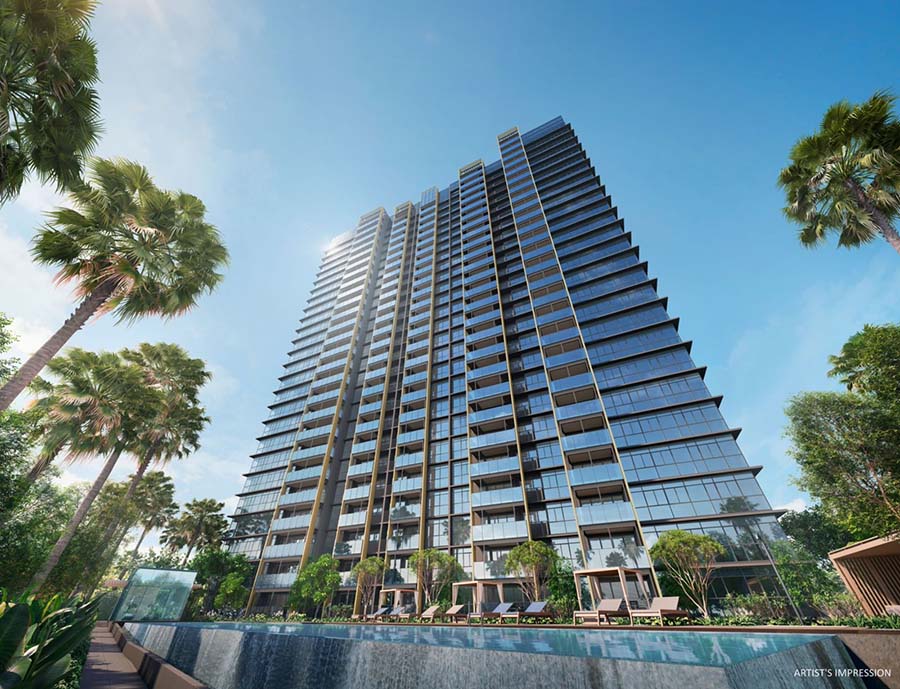
Meyer Blue is a 226-unit, freehold residential development along Meyer Road in Singapore’s East Coast, positioned firmly at the premium end of District 15. It is not a mass-market family project nor a yield-driven investment play. Instead, it targets buyers who value tenure permanence, architectural branding, and long-term asset preservation over price efficiency or short-cycle upside.
The project’s early sales performance demonstrates that demand for ultra-premium freehold homes in the Meyer enclave remains deep, but selective. Buyers who convert tend to be highly intentional, comfortable with high absolute quantum, and less concerned with near-term appreciation. At the same time, price resistance has emerged for larger units as buyers benchmark against both older freehold neighbours and lower-PSF alternatives elsewhere in the Rest of Central Region.
Meyer Blue therefore operates as a filtering project. It rewards buyers who are clear about why they want freehold in this specific coastal belt, and it penalises those expecting momentum-driven gains, broad resale liquidity, or long-term certainty around sea views.
The project sits within the broader context of East Coast transformation and long-term coastal planning, but its investment logic is anchored more in scarcity and holding power than in any single future catalyst.
Meyer Blue is a high-rise freehold development along Meyer Road designed for buyers prioritising long-term tenure security, architectural pedigree, and coastal address prestige over price efficiency, liquidity, or short-term upside.
Meyer Blue Pricing, PSF and Investment Positioning (Quick Answers)
What is the price of Meyer Blue?
Meyer Blue is positioned at the premium end of District 15, with pricing reflecting freehold tenure, coastal address, and developer positioning rather than entry-level affordability. Buyers evaluate it based on absolute quantum rather than purely PSF comparison.
What is the PSF of Meyer Blue?
PSF levels are generally higher than older freehold neighbours but reflect newer build quality and branding. However, PSF alone is not the main decision driver due to larger unit sizes and higher overall quantum.
Is Meyer Blue worth buying?
Meyer Blue makes sense for buyers prioritising long-term holding, freehold ownership, and coastal living. It is less suitable for buyers seeking price efficiency or short-term capital gains.
Is Meyer Blue a good investment?
It functions more as a capital preservation asset rather than a growth-driven investment. Returns are likely to be stable but moderate, depending on entry price and holding horizon.
Explore the Full Meyer Blue Analysis
This article is part of the full Meyer Blue cluster:
- Meyer Blue Price Guide – pricing structure, market positioning, and buyer entry analysis
- Meyer Blue Floor Plan Analysis – layout efficiency, unit mix, and stack considerations
- Meyer Blue Showflat Guide – viewing strategy, location context, and buyer evaluation framework
Together, these articles provide a structured analysis of the project’s positioning, pricing frame
If you’re considering this project, you might want to check how it actually compares and what most buyers tend to overlook — before deciding.
Key Details (At a Glance)
-
Freehold, high-rise residential development along Meyer Road
-
District 15 (Marine Parade Planning Area), Rest of Central Region
-
226 units in a single 26-storey tower
-
Positioned primarily for long-horizon owner-occupiers and legacy-driven buyers
Project Factsheet
| Item | Details |
|---|---|
| Project Name | Meyer Blue |
| Location | 81, 83 Meyer Road |
| District / Region | District 15 / RCR (Marine Parade Planning Area) |
| Tenure | Freehold |
| Developer | UOL Group Limited & Singapore Land Group Limited |
| Site Type | En-bloc redevelopment (former Meyer Park) |
| Development Type | Pure residential |
| Site Area | 8,981.1 sqm (96,672 sq ft) |
| Plot Ratio | 2.8 |
| Total Units | 226 residential units |
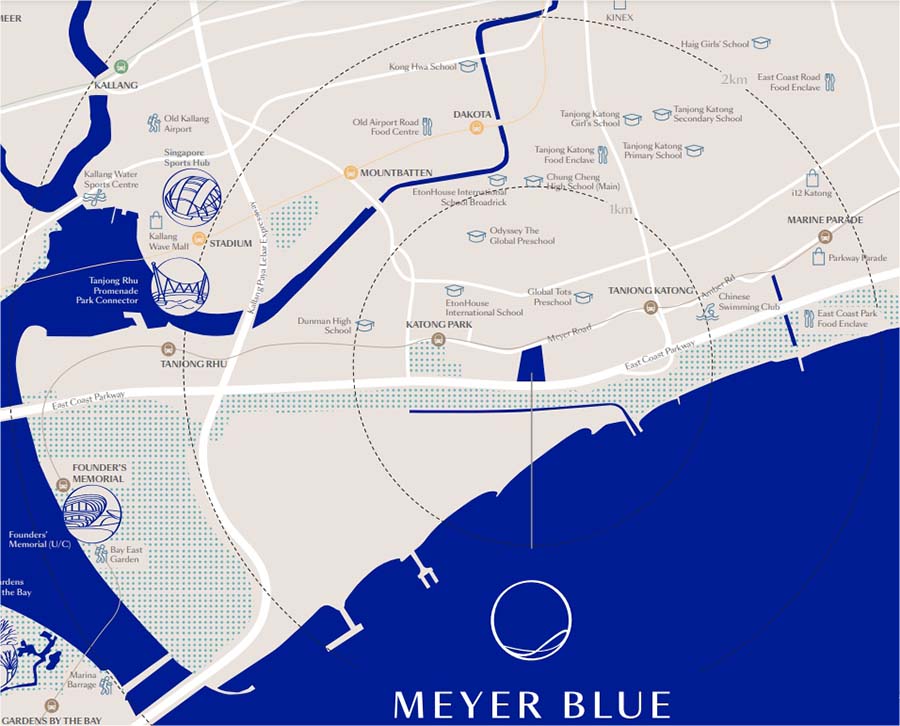
| Nearest MRT | Katong Park MRT (TEL), ~0.3 km, walkable |
| Launch Status | Launched |
| Expected TOP | 31 Dec 2028 |
Location Context: Meyer Road as a Legacy Coastal Enclave
Meyer Road occupies a distinctive position within District 15. Unlike lifestyle-centric Katong or Joo Chiat, the Meyer enclave functions as a quiet, low-traffic coastal belt defined by exclusivity rather than vibrancy. Residential developments here are typically large-format, owner-occupied, and oriented toward long-term holding rather than turnover.
Daily convenience is not the primary draw. Amenities such as Parkway Parade, Katong’s dining strip, and Kallang leisure nodes are accessible but not immediately walkable. This shapes the resident profile: buyers tend to be car-owning households, retirees, or high-income professionals who prioritise privacy and address prestige over street-level activity.
Connectivity has improved structurally with the Thomson-East Coast Line. Katong Park MRT provides a direct rail link to the CBD and Orchard corridor, reducing the historic car-dependency of Meyer Road. While this does not transform the area into a transit-oriented lifestyle hub, it materially improves liveability and long-term relevance.
Development Character: High-Rise Density with Luxury Signalling
Meyer Blue is unapologetically vertical.
With 226 units on a 2.8 plot ratio site, the development adopts a high-rise, high-density format relative to some of its low-rise freehold neighbours. This allows the project to deliver elevated sea-facing views and stacked sky greenery, but it also means buyers are trading absolute exclusivity for height, branding, and architectural presence.
The development’s luxury narrative is anchored in three elements: scale, elevation, and design language. High-floor units offer expansive outward views, while the tower configuration enables landscaped sky terraces that reinforce the “coastal high-rise” positioning. This appeals strongly to lifestyle-driven owner-occupiers who value outlook and privacy within their own units more than shared amenity sprawl.
However, higher density also introduces sharper buyer scrutiny. In this price band, buyers are not only comparing tenure and location, but also questioning whether the hardware and internal layouts sufficiently justify the premium over both resale freehold options and newer 99-year launches nearby.
Amenities & Facilities: Meyer Blue Condo Facilities and Living Experience
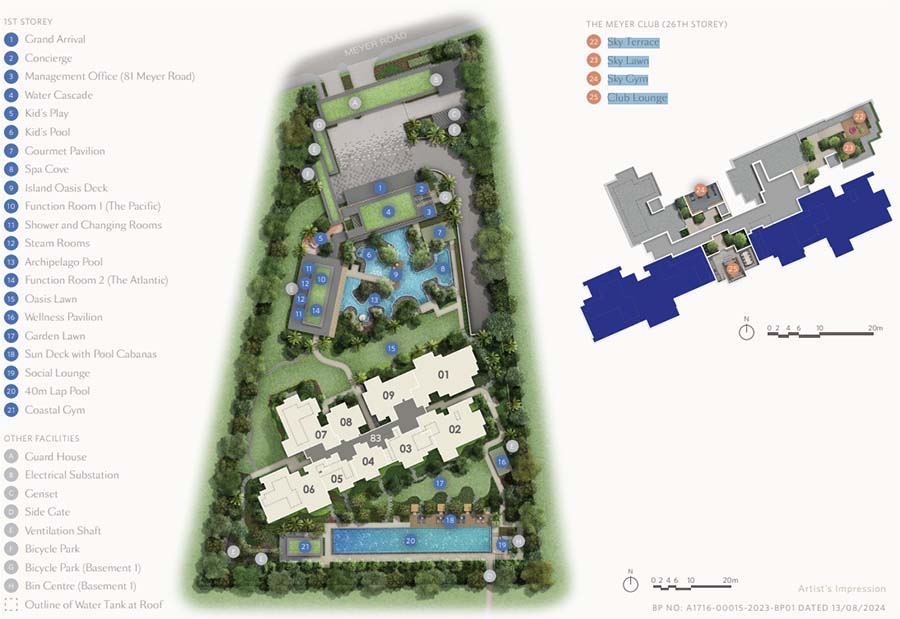
Meyer Blue’s facilities are designed around a high-rise coastal lifestyle, focusing on privacy, elevation, and controlled density rather than large-scale resort programming.
Core Facilities
- 40-metre lap pool supporting both leisure and functional swimming
- Leisure pool and water features integrated within landscaped decks
- Sky terraces and elevated garden decks extending the vertical living concept
- Clubhouse and lounge spaces designed for private hosting and small-group use
- Gymnasium and wellness areas supporting everyday fitness and recovery
Lifestyle Positioning of Facilities
Unlike larger suburban developments, Meyer Blue does not emphasise high-volume, family-centric facilities such as extensive playground clusters or activity zones.
Instead, the facilities are positioned around:
- Privacy over activity density
- Vertical integration rather than horizontal sprawl
- Lifestyle quality over facility quantity
What Buyers Should Evaluate
When assessing Meyer Blue’s facilities, buyers typically focus on:
- Whether the scale of facilities matches their daily usage habits
- The balance between privacy and shared spaces
- How the vertical design affects accessibility and experience
This makes the facilities less about variety, and more about whether the quality and environment align with long-term own-stay expectations.
Freehold Logic: Preservation First, Performance Second
Freehold tenure is the cornerstone of Meyer Blue’s positioning.
For buyers planning multi-decade holds, freehold removes lease decay from the equation and provides long-term optionality, particularly relevant in a district dominated by newer 99-year launches. This is the primary reason Meyer Blue is often shortlisted against projects like Tembusu Grand or Grand Dunman, even at significantly higher PSF levels.
However, freehold does not eliminate price sensitivity. At Meyer Blue’s launch pricing, buyers are effectively pre-paying for long-term security. This makes the project less forgiving for those expecting near-term capital appreciation or easy resale liquidity. The trade-off is deliberate: stability and legacy value in exchange for patience.
Greater Southern Waterfront & Long-Island Context: Expectations Must Be Managed
While Meyer Blue benefits from long-term coastal planning narratives, it is not a direct beneficiary of immediate waterfront activation.
The proposed Long Island reclamation introduces both opportunity and risk. Over the very long term, the East Coast is likely to see enhanced coastal protection and new recreational spaces. At the same time, this plan creates uncertainty around view longevity for today’s unblocked sea-facing stacks. Buyers paying a significant premium for southern views must be comfortable with this long-dated ambiguity.
This reinforces a key point: Meyer Blue should be evaluated primarily on its present-day attributes — tenure, design, address — rather than on speculative future transformation.
How Buyers Actually Evaluate Meyer Blue
In practice, buyers rarely assess Meyer Blue in isolation.
One comparison set includes immediate freehold neighbours such as Meyer Mansion or MeyerHouse. These projects offer lower density and, in some cases, lower PSF entry points, but lack the verticality, branding, and scale of facilities that Meyer Blue provides.
Another comparison set comprises new-generation 99-year launches in the broader East Coast and city-fringe. These compete strongly on price efficiency and facilities but lose on tenure and long-term scarcity.
Buyers who convert tend to accept Meyer Blue’s pricing because they are not looking for the “best deal” — they are looking for the “last home” or a long-term family asset.
Buyer Suitability: Who This Project Is — and Is Not — For
Most suitable for
Long-horizon owner-occupiers prioritising freehold tenure
Affluent local families or retirees seeking a quiet coastal address
Buyers comfortable with high absolute quantum and lower liquidity
Least suitable for
Yield-driven or short-cycle investors
Buyers sensitive to PSF comparisons and resale velocity
Those expecting permanent, guaranteed sea views
Buyers comparing Meyer Blue against other upcoming launches may find it helpful to frame their decision using the New Launch Condo Guide, which outlines how pricing logic, buyer intent, and holding horizon differ across project types.
Takeaway
Meyer Blue is not a project that needs to be sold — it needs to be understood.
Its value proposition is coherent but narrow: freehold tenure, Meyer Road scarcity, architectural signalling, and long-horizon holding logic. For buyers aligned with these priorities, the pricing can be rationalised as the cost of permanence in a shrinking coastal enclave. For buyers expecting flexibility, momentum, or guaranteed long-term views, the same attributes quickly become friction points.
This is why Meyer Blue functions best as a filtering decision, not a negotiation exercise. If your intent, holding horizon, and tolerance for trade-offs are clear, the project is defensible. If not, it will always feel expensive — regardless of price movement.
If you’re seriously considering this project, it’s worth checking how it actually compares and what most buyers tend to overlook — before deciding.
The questions below reflect how serious, decision-stage buyers typically pressure-test Meyer Blue before deciding whether it belongs on their final shortlist.
FAQs (Decision-Stage)
1) Is Meyer Blue fundamentally an own-stay project or an investment project?
Meyer Blue is best understood as a long-horizon own-stay asset rather than a yield-driven investment property. Its pricing and absolute quantum naturally filter out short-cycle investors, with demand anchored instead in freehold tenure and Meyer Road address positioning. Buyers approaching it from a rental yield or quick resale perspective will typically find the project misaligned. The decision is driven more by lifestyle fit and capital preservation.
2) What is the real reason buyers pay a premium here — and when does it stop making sense?
The premium reflects freehold tenure, Meyer Road scarcity, coastal positioning, and developer credibility. Buyers are paying for long-term defensibility rather than price efficiency. It stops making sense when the decision depends on assumptions beyond control, such as guaranteed sea views or broad resale demand at similar quantum levels. Entry discipline matters more than headline PSF.
3) How should buyers think about Long Island reclamation when paying for sea views?
Long Island introduces long-term uncertainty around sea-facing views. While coastal protection and new recreational spaces may improve the broader environment, view permanence cannot be guaranteed. Buyers paying a premium for sea views should treat them as a current lifestyle benefit, not a permanent investment feature. This shifts the decision toward use-value rather than speculative upside.
4) How material is East Coast Parkway (ECP) noise?
ECP noise can be a meaningful factor depending on stack orientation and floor level. Lower floors or expressway-facing units may experience consistent background noise. Buyers sensitive to noise should prioritise stack selection early in the decision process. This is a structural factor, not something that improves over time.
5) Why compare Meyer Blue with Meyer Mansion or MeyerHouse?
These are immediate freehold benchmarks within the same enclave. Meyer Mansion and MeyerHouse offer lower density and sometimes lower entry PSF, but differ in scale, height, and facilities. Buyers use them to benchmark whether Meyer Blue’s premium for vertical living and newer design is justified.
6) Are larger units harder to exit?
Yes. Larger units face a narrower resale pool due to higher absolute quantum. Buyers at this level often compare landed homes or older freehold options. This leads to longer exit timelines and more selective demand. These units are better suited for long-term own-stay rather than liquidity.
7) Does the single-tower design help or hurt?
The single-tower format supports elevation, views, and a modern vertical lifestyle. However, some buyers associate luxury with low density and may prefer boutique developments. The format works well for buyers aligned with high-rise coastal living, but not for those seeking exclusivity through fewer units.
8) Who should eliminate Meyer Blue early?
Buyers focused on rental yield, quick resale, or price efficiency should eliminate it early. It is also unsuitable for those relying on guaranteed sea views. Meyer Blue is designed for conviction-driven buyers with long holding horizons.
PRICING LOGIC, URA PLANNING INTENT & BUYER SEGMENTATION
Pricing Logic: Why Meyer Blue Clears Early — Then Slows
Meyer Blue’s pricing behaviour reflects a two-phase pattern: conviction-led absorption followed by selective resistance. Early buyers accepted high absolute quantum in exchange for freehold tenure, Meyer Road scarcity, and long-horizon asset defensibility. As this cohort was absorbed, subsequent demand became narrower, more unit-specific, and increasingly comparative.
At this stage, Meyer Blue is most often benchmarked against two reference sets:
-
older freehold neighbours offering lower entry PSF but less new-build clarity, and
-
newer 99-year launches that provide stronger lifestyle completeness at lower absolute quantum.
This transition marks the natural resistance zone for premium freehold projects. Sales velocity slows not because pricing is indefensible, but because the number of buyers willing to pay for this exact combination of tenure, address, and trade-offs declines sharply once early conviction demand is satisfied.
Launch vs Balance Pricing: What Actually Changes
Launch pricing at Meyer Blue established the project as a top-tier freehold benchmark within District 15 rather than a value-led alternative. Early buyers were effectively paying for certainty — in unit choice, orientation, and long-term holding logic — rather than short-term pricing advantage.
Balance units are evaluated differently. Buyer scrutiny shifts toward:
-
orientation and expressway noise exposure,
-
long-term view assumptions tied to coastal planning, and
-
exit realism at high absolute prices.
As a result, pricing discussions are less about headline PSF and more about whether a specific unit still makes sense relative to the buyer’s holding horizon. Negotiation leverage exists, but it is unit-specific rather than project-wide.
URA Planning Intent: East Coast as Stability, Not a Catalyst
URA planning intent for the Marine Parade Planning Area supports long-term residential stability rather than near-term repricing. Infrastructure upgrades and coastal adaptation initiatives improve liveability and long-term defensibility, but they are not designed to function as investment catalysts.
The area is being shaped around improved connectivity, aging-in-place infrastructure, and incremental quality-of-life upgrades. These changes reinforce residential relevance over time, but they do not introduce discrete events that typically drive sharp repricing.
The proposed Long Island project further reinforces this dynamic. While it enhances long-term coastal resilience and recreational potential, it also introduces uncertainty around future seafront configuration and view permanence. Planning intent here is defensive and adaptive, not speculative.
For Meyer Blue, this means URA context supports preservation rather than acceleration. Long-term value is anchored more to tenure and scarcity than to neighbourhood transformation.
Buyer Segmentation: Who Converts — and Who Hesitates
Primary Segment: Long-Horizon Owner-Occupiers
These buyers prioritise freehold tenure, coastal address prestige, and modern living conditions. They are less sensitive to short-term price movements and more focused on whether the home remains suitable across decades. Conversion is driven by alignment rather than urgency.
Secondary Segment: Capital-Preservation Buyers
This group views Meyer Blue as a defensive asset. They accept lower liquidity and modest rental yields in exchange for tenure certainty and long-term optionality. Their concern is downside protection, not outperformance.
Marginal Segment: High-Quantum Upgraders
Upgraders from other prime districts or landed homes evaluate Meyer Blue opportunistically. They convert only when a specific unit aligns with their spatial preferences, noise tolerance, and orientation requirements. This group contributes to intermittent sales rather than sustained momentum.
Largely Absent Segment
Yield-led investors and short-cycle traders are structurally filtered out. Pricing, quantum, and long-dated uncertainty around views make Meyer Blue unsuitable for strategies dependent on fast exits or rental yield optimisation.
EXIT, LIQUIDITY, RISK SCENARIOS & LONG-TERM REALISM
Exit Behaviour: Why Liquidity Is Unit-Specific, Not Project-Wide
Exit behaviour at Meyer Blue is unit-specific rather than project-wide. Liquidity depends on alignment between unit attributes, buyer intent, and holding horizon rather than general market momentum. Freehold tenure supports long-term defensibility, but it does not eliminate time-to-exit risk at high quantum levels.
In early post-TOP years, resale demand is anchored by new-build clarity and limited direct competition. Over the mid-cycle, exit outcomes diverge sharply based on unit attributes. Over the long term, freehold tenure becomes more relevant as leasehold alternatives age, improving structural defensibility but not transaction speed.
Smaller units with favourable orientation are likely to transact more smoothly. Larger units — particularly those affected by noise or view uncertainty — will require patience and realistic pricing expectations.
Time-Phased Exit Scenarios
Early Post-TOP Phase
-
Limited direct competition from new freehold launches
-
Buyer interest anchored in new-build condition and clarity
-
Exit viability strongest for mid-sized units
Mid-Cycle Phase
-
Increased competition from newer launches in other districts
-
Buyers become more comparative and value-conscious
-
Exit outcomes diverge sharply by unit attributes
Long-Term Phase
-
Freehold advantage becomes more salient as leasehold projects age
-
Buyer focus shifts toward tenure security and legacy considerations
-
Liquidity improves structurally, but remains selective
Risk Scenarios Buyers Must Acknowledge
View Longevity Risk
Southern-facing premiums are vulnerable to long-term coastal reconfiguration. This does not invalidate the purchase, but reframes the proposition as use-value first and resale optionality second.
Noise & Liveability Risk
Expressway adjacency is permanent. Units affected by ambient noise will always face a narrower buyer pool, regardless of market cycle.
Quantum Compression Risk
High absolute prices reduce buyer flexibility during resale, particularly in tighter credit environments. This risk manifests as longer holding periods rather than forced repricing.
Policy & Macro Sensitivity
Higher interest rates disproportionately affect high-quantum assets with moderate yields. While this limits speculative volatility, it slows transactional velocity.
Freehold Reality Check: Protection, Not Acceleration
Freehold tenure at Meyer Blue functions as a risk-mitigation attribute rather than a performance driver. It protects against lease decay and supports long-term relevance, but it does not override buyer sensitivity to price, layout efficiency, and liveability.
Buyers who approach Meyer Blue with a use-first mindset are more likely to remain satisfied across cycles. Those expecting tenure alone to drive appreciation are likely to face expectation mismatch.
FAQs
1) What kind of buyer profile is Meyer Blue most suitable for?
Meyer Blue is most naturally aligned with affluent owner-occupiers, legacy-driven buyers, and long-horizon households who place high value on freehold tenure and coastal address prestige. These buyers are usually less concerned about short-term resale momentum and more focused on asset preservation, use quality, and long-term relevance. The project also appeals to buyers who prefer a quieter, more established East Coast enclave rather than a higher-traffic, lifestyle-heavy district. In other words, it tends to suit conviction buyers rather than opportunistic ones.
2) Is Meyer Blue more about capital preservation or capital growth?
Meyer Blue is better framed as a capital-preservation asset than a capital-growth play. Its strongest attributes are freehold tenure, scarcity along Meyer Road, and long-term defensibility rather than aggressive upside or rapid repricing. Buyers who enter with expectations of steady value retention are more likely to remain aligned with the project than those hoping for sharp near-term gains. This is fundamentally a preservation-first proposition with selective upside rather than a momentum-driven buy.
3) How should buyers think about Meyer Blue’s pricing versus 99-year launches nearby?
The comparison should start with product type rather than price alone. Nearby 99-year launches may offer lower entry quantum, more extensive facilities, or stronger headline affordability, but they do not provide the same tenure profile or Meyer Road address positioning. Meyer Blue is asking buyers to pay for permanence and scarcity rather than value-led convenience. The key question is not whether it is cheaper or more expensive, but whether the buyer specifically wants what only this product type offers.
4) Is Meyer Blue too expensive on an absolute quantum basis?
For many buyers, absolute quantum will be the real filter rather than psf. Meyer Blue sits in a segment where financing comfort, capital allocation, and opportunity cost matter far more than headline marketing narratives. Buyers may be able to afford it on paper but still find the overall commitment too concentrated relative to their broader portfolio or family plans. That is why affordability here is not just about qualification, but about long-term comfort and conviction.
5) Does Meyer Blue have strong resale potential in the future?
Meyer Blue’s resale potential is likely to be selective rather than broad-based. The project benefits from freehold tenure, a strong Meyer Road address, and relatively scarce new-build competition within the same immediate enclave. However, resale outcomes will still depend heavily on entry pricing, unit type, orientation, and future buyer sentiment toward coastal uncertainty and high-quantum homes. It can remain resale-relevant, but not every unit will enjoy the same depth of demand.
6) Which unit types are likely to have the best long-term liquidity?
Mid-sized units typically offer the broadest long-term liquidity because they appeal to both affluent owner-occupiers and buyers seeking a more manageable absolute quantum. Very large units can still perform well, but their resale audience is naturally smaller and more price-sensitive. Smaller units may benefit from lower entry pricing, but the overall positioning of Meyer Blue is not strongly rental-led. In practice, the most balanced units tend to sit in the middle rather than at the extremes.
7) Is Meyer Blue suitable for rental demand?
Rental demand exists, but Meyer Blue is not fundamentally a yield-driven project. It may appeal to a niche tenant pool that values East Coast prestige, sea-facing living, and freehold-style address quality, but rental demand is unlikely to be as broad as more transit-led or city-core alternatives. This means investors should not base the investment case primarily on leasing assumptions. The project is stronger as an own-stay or capital-preservation asset than as a rental optimisation play.
8) How important is stack selection at Meyer Blue?
Stack selection is critical because the project’s value proposition is closely tied to view quality, noise exposure, privacy, and daily liveability. Not all stacks will experience the same outlook, light quality, or level of expressway influence. In a premium project, these differences can significantly affect both owner satisfaction and eventual resale appeal. Buyers should therefore treat stack choice as a core decision variable, not a minor refinement.
9) Will all units enjoy the same value from sea-facing positioning?
No. Sea-facing positioning may support the project’s premium, but the benefit is not uniform across all units. Floor height, exact orientation, neighbouring structures, and long-term coastal planning all influence how much practical value that view actually holds over time. Buyers paying up for a view should be clear whether they are buying present enjoyment or assuming lasting investment differentiation. The further that assumption stretches into the future, the more caution is needed.
10) Is Meyer Blue competitive against older freehold resale options?
It can be competitive, but only for buyers who specifically want a new-build freehold product in the Meyer enclave. Older freehold developments may offer lower psf entry, larger floor plates, or lower density, but they may lack the same modern build standard, branding, and current design language. Meyer Blue therefore competes on freshness, presentation, and vertical living rather than on pure value. Buyers choosing between them are often deciding between condition and space rather than simply comparing price.
11) How should buyers think about holding period for Meyer Blue?
A longer holding horizon makes much more sense here than a short one. Meyer Blue is not structured like a flip-oriented or momentum-led project, and the advantages of freehold tenure become more meaningful over time rather than immediately. Buyers entering with a short holding expectation may become overly sensitive to market cycles, resale competition, or the lack of rapid repricing. A patient, use-first mindset is therefore the more suitable framework.
12) Does the Katong Park MRT connection meaningfully improve Meyer Blue?
Yes, but it should be treated as a supporting strength rather than the main reason to buy. The MRT improves accessibility and reduces the historic dependence on private transport, which helps long-term liveability and broadens the project’s practical appeal. At the same time, Meyer Blue remains fundamentally a premium freehold coastal project, not a transit-led convenience play. The station helps the story, but it does not redefine the product.
13) What are the biggest risks buyers should acknowledge before purchasing?
The main risks are high absolute quantum, selective future liquidity, uncertainty around long-term sea-view assumptions, and possible liveability differences caused by stack and orientation. These are not short-term issues that disappear with market improvement, but structural factors embedded in the project’s proposition. Buyers who ignore them usually do so because they are overly focused on the prestige of the address or the appeal of freehold tenure. The project works best when these trade-offs are accepted upfront rather than rationalised after purchase.
14) Is Meyer Blue a good choice for families?
It can work well for affluent families who value East Coast living, tenure permanence, and a quieter residential environment over price efficiency or maximum facility sprawl. The project is less about mass-market family convenience and more about long-term quality of residence in a premium enclave. Families should still assess layout suitability, commuting habits, and whether the high-quantum commitment aligns with their priorities. It is therefore suitable for a narrower, more selective family profile rather than for broad-based upgrader demand.
15) How should buyers compare Meyer Blue with other District 15 launches?
Buyers should first separate tenure-led products from convenience-led products. Some District 15 launches may offer stronger affordability, more extensive family programming, or easier comparison on price, but they do not necessarily compete on the same ownership logic as Meyer Blue. Meyer Blue is positioned around freehold permanence, Meyer Road prestige, and long-horizon defensibility. The right comparison is therefore based on buyer intent, not just district or psf.
16) What is the biggest mistake buyers make when assessing Meyer Blue?
The biggest mistake is assuming that freehold status alone guarantees superior investment performance. Freehold helps with long-term defensibility, but it does not override pricing discipline, unit selection, noise exposure, or future resale realities. Buyers who simplify the decision into “freehold equals safe” usually miss the project-specific trade-offs that matter most. Meyer Blue should be evaluated as a premium, selective product rather than a universally superior one.
If you prefer a more structured walkthrough, you can leave your details below and we’ll follow up with you.