
The Continuum Floor Plan Analysis (Quick Overview)
The Continuum floor plans are structured around family-scale liveability, tenure-led ownership and long-term usability rather than compact optimisation. This aligns with the project’s broader positioning as a large freehold development for long-horizon owner-occupiers, not a yield-first or convenience-led product.
Unlike smaller city-fringe launches where layouts are compressed for affordability, The Continuum adopts a more residential planning logic. Units generally prioritise clearer zoning between living and private spaces, more complete kitchen arrangements, and a wider spread of family-oriented formats. The project’s non-PPVC construction also matters because it supports greater layout flexibility than many newer developments built around tighter modular constraints.
Because of this, layout selection here is not just about “efficiency” in the abstract. It is about whether the unit remains coherent over time for actual household use, especially within a high-quantum, freehold holding framework.
Key Floor Plan Facts
- 816 total units in a large-scale freehold residential development.
- Unit types range from 1 Bedroom + Study to 5 Bedroom, with selected private lift layouts.
- Development is split across North and South plots and connected by an overhead bridge.
- Layout strategy is clearly family-led and upgrader-oriented, not investor-led.
- Non-PPVC construction supports more flexibility in layout planning.
- Premium and larger layouts introduce:
- foyer entry
- stronger spatial separation
- private lift access in selected types
- more complete kitchen and support-space planning
- Stack choice matters because buyers are evaluating:
- landed-facing openness
- road exposure
- split-plot context
- family usability over time
Explore the Full The Continuum Analysis
This article is part of the full The Continuum cluster:
- The Continuum Review – project positioning, buyer suitability, and planning context
- The Continuum Price Guide – pricing structure, market positioning, and buyer entry analysis
- The Continuum Showflat Guide – viewing strategy, location context, and buyer evaluation framework
Together, these articles provide a structured breakdown of how The Continuum performs across pricing, layout design, buyer suitability, and long-term holding considerations.
Buyers who are still learning how Singapore new launches are typically evaluated may also find the New Launch Condo Guide helpful before comparing individual projects.
Current Available Units, Layouts & Unit Types (Live Snapshot)
Availability and stack selection may change depending on remaining inventory, with current options increasingly limited to selected premium family layouts within the development.
| Unit Type | Size | Availability |
| 1 Bedroom + Study | 560 sqft | 12 units |
| 2 Bedroom | 646–807 sqft | Fully Sold |
| 2 Bedroom + Study | 700–721 sqft | Fully Sold |
| 3 Bedroom | 872–1141 sqft | 1 units |
| 3 Bedroom Premium | 1066–1302 sqft | 8 units |
| 3 Bedroom + Study | 1227–1464 sqft | 11 units |
| 4 Bedroom | 1227–1518 sqft | 1 unit |
| 4 Bedroom Premium | 1690–2034 sqft | 20 units |
| 5 Bedroom | 2260 sqft | 26 units |
Total Remaining Units: 79
At this stage, Smaller and mid-sized unit types, including all 2-bedroom configurations, have now been fully absorbed, with even standard 3-bedroom and 4-bedroom layouts reduced to minimal availability.
Current supply is increasingly concentrated in premium family formats, particularly 3-bedroom premium, 3-bedroom + study, 4-bedroom premium and 5-bedroom units, which form the majority of realistic options at this stage.
This reflects a clear late-stage transition where buyers are no longer comparing across a full range of unit types, but are instead evaluating whether the remaining higher-quantum layouts align with their household needs, lifestyle preferences and long-term ownership plans.
As availability continues to narrow, selection is now largely driven by stack positioning, facing and internal layout quality rather than unit category alone, with most buyers working within a much smaller and more selective set of options.
The Continuum Unit Mix Breakdown
| Unit Type | Size Range (sqft) | Units | % | Positioning |
|---|---|---|---|---|
| 1 Bedroom + Study | 560 | 68 | 8.3% | Entry / Lower Quantum |
| 2 Bedroom | 646–807 | 170 | 20.8% | Broad Market |
| 2 Bedroom + Study | 700–721 | 136 | 16.7% | Flexible Core |
| 3 Bedroom | 872–1141 | 102 | 12.5% | Family |
| 3 Bedroom Premium | 1066–1302 | 136 | 16.7% | Strong Own-Stay |
| 3 Bedroom + Study | 1227–1464 | 72 | 8.8% | Family Premium |
| 4 Bedroom | 1227–1518 | 68 | 8.3% | Upgrader |
| 4 Bedroom Premium | 1690–2034 | 32 | 3.9% | Large Family |
| 5 Bedroom | 2260 | 32 | 3.9% | Legacy / Multi-Gen |
Total Units: 816
What the Unit Mix Reveals About The Continuum
The unit mix makes The Continuum’s positioning very clear: this is not an investor-compressed development. While smaller formats exist, the project is meaningfully weighted toward 2-bedroom + study, 3-bedroom, 3-bedroom premium, 3-bedroom + study and larger family-oriented layouts, which reinforces its upgrader and legacy-hold identity.
That matters because buyer behaviour here is shaped less by yield logic and more by household suitability, tenure permanence and long-term defensibility. In practical terms, this means the project works best when buyers are intentionally choosing freehold family ownership rather than simply chasing a city-fringe entry point.
It also means the better units are not always the smallest or cheapest. The more coherent segments are usually the ones that best express the project’s family-led planning logic.
Layout Strategy and Positioning
The Continuum adopts a layout strategy centred on:
- family liveability
- spatial separation
- more complete internal planning
- longer-term usability across life stages
Rather than focusing on aggressive compactness, the layouts are designed to support daily family routines, clearer distinction between living and private areas, and better internal comfort over time. That is why the project feels structurally different from smaller leasehold launches where unit design is often driven more by affordability and exit fluidity.
In short, layout choice here is not just about what looks efficient on paper. It is about whether the space remains workable after the first few years of ownership.
1-Bedroom + Study Layout Analysis
The 1-bedroom + study format functions as the project’s entry layer.
Typical characteristics include:
- corridor layout
- integrated kitchen along entrance
- study zone
- balcony
- bathroom with dual access
The key strength here is that it offers more functional resilience than a plain 1-bedroom unit. The study adds flexibility for remote work, storage or occasional spillover use, which makes the layout more usable than a simpler compact format. However, this remains slightly outside the project’s core identity. These units work best for singles, couples or lower-quantum buyers who want entry into a freehold development without stretching into family-sized quantum.
2-Bedroom Layout Analysis
The 2-bedroom layouts form the first genuinely broad-market segment within the project.
Typical characteristics include:
- dumbbell or corridor layout logic
- open concept kitchen
- master bedroom with ensuite
- common bathroom
- clearer separation between living and sleeping areas
These layouts usually strike a decent balance between usability and affordability. They are more practical than compact city-fringe 2-bedders that feel overly compressed, but they still remain transitional rather than fully family-scaled. They work well for couples, compact households and buyers prioritising manageable freehold entry, though they are less future-proof once household needs expand more materially.
2-Bedroom + Study Layout Analysis
The 2-bedroom + study layouts improve meaningfully on the standard 2-bedroom because the additional room shifts the format from merely adequate to more adaptable.
Typical characteristics include:
- corridor or more flexible planning
- study zone for work-from-home or child use
- better life-stage adaptability
- stronger long-term defensiveness than plain 2-bedroom units
This is often one of the most balanced segments in the project for buyers who want future flexibility without stepping immediately into 3-bedroom pricing. The trade-off is that some layouts may slightly compress either the common bedroom or the living zone to accommodate the study. Even so, this remains one of the most defensible formats for smaller households planning ahead.
3-Bedroom Layout Analysis
The 3-bedroom layouts form a major part of the project’s functional centre.
Typical characteristics include:
- corridor planning
- enclosed kitchen
- yard + WC + HS
- clearer bedroom separation
- more practical daily family use
These layouts are usually where The Continuum starts to feel most coherent. They balance real family usability with still-manageable quantum and align naturally with upgrader demand. However, because the size range is relatively wide, not every 3-bedroom performs equally. Some will feel meaningfully stronger than others in room proportions, living-area generosity and overall daily comfort.
3-Bedroom Premium Layout Analysis
3-bedroom premium units introduce a stronger own-stay proposition.
Typical characteristics include:
- foyer entrance
- enclosed kitchen
- better room proportions
- stronger separation between public and private zones
- structural columns at balcony perimeter
These layouts are often the “safe middle ground” in large freehold family developments. They improve meaningfully on standard 3-bedders without crossing too quickly into the highest quantum tiers. For many buyers, this is where price, liveability and long-term comfort start to come into better balance.
3-Bedroom + Study Layout Analysis
The 3-bedroom + study format sits in the premium family band and is often one of the strongest layouts in the project.
Its advantages usually include:
- more flexible household planning
- additional work-from-home or child-use space
- better long-term resilience
- more premium internal zoning
This format is especially coherent for families who want practical everyday flexibility without moving into much higher 4-bedroom premium or 5-bedroom quantum. In a family-led freehold project, that added room can materially improve long-term usability.
4-Bedroom Layout Analysis
The 4-bedroom layouts push The Continuum more decisively into upgrader-family territory.
Typical characteristics include:
- winged layout logic
- larger communal zones
- better separation between master and common bedrooms
- more complete kitchen arrangements
The key strength here is not simply “one more room,” but a more resolved household experience. These units feel more aligned with the project’s freehold premise because the added space improves privacy, family routines and long-term liveability. The obvious trade-off is higher quantum and a narrower buyer pool, which means these formats work best for buyers making an intentional own-stay decision rather than a low-friction purchase.
4-Bedroom Premium Layout Analysis
4-bedroom premium units sit among the most complete premium family formats in the development.
Typical characteristics include:
- larger internal footprint
- dry and wet kitchen separation
- stronger support-space planning
- more premium family-scale living experience
These layouts are for buyers who are not merely upgrading bedroom count, but upgrading the overall household experience. They suit larger families or buyers who place strong importance on internal completeness. The trade-off is sharper resale selectivity later because the buyer pool narrows materially as quantum rises.
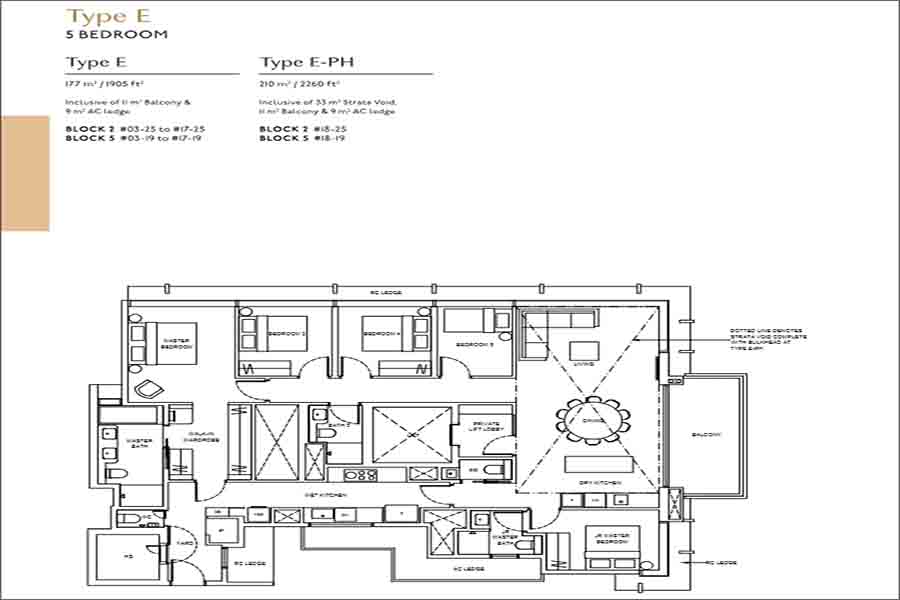
5-Bedroom Layout Analysis
The 5-bedroom layouts represent the most conviction-driven, legacy-oriented format in the project.
Typical characteristics include:
- largest internal footprint
- strongest spatial separation
- multi-generational suitability
- long-horizon family-scale planning
These are not simply “bigger units.” They are a fundamentally different ownership proposition. They work best for buyers who already know they want a large freehold home and are not relying on broad resale liquidity later. Once pricing reaches this level, comparisons broaden significantly, so these units are most coherent when permanence and family scale matter more than flexibility.
Best Layouts and Stack Considerations at The Continuum
There is no single “best stack” at The Continuum. The right answer depends on whether the buyer prioritises:
- landed-facing openness
- quieter outlook
- stronger city-fringe energy
- future-facing potential
- or lower exposure to arterial roads
North-Northeast Facing
These stacks generally orient toward:
- Thiam Siew Avenue
- lower-rise landed housing enclave
Possible characteristics:
- more open or further-facing feel due to lower-rise surroundings
- stronger sense of spatial breathing room
- potentially more defensive long-term view profile
Potential trade-offs:
- road exposure from Thiam Siew Avenue
- varying levels of setback depending on block and position
South-Southwest Facing
These stacks generally orient toward:
- Tanjong Katong area
- broader residential / commercial city-fringe context
Possible characteristics:
- more active urban-facing environment
- mid-distance outlook toward surrounding residential fabric
- different visual energy versus landed-facing stacks
Potential trade-offs:
- road exposure from Tanjong Katong Road side
- possible future redevelopment changes in the wider area
North Plot vs South Plot
Because The Continuum is a dual-plot development connected by an overhead bridge, stack selection is not just about direction. Buyers also need to consider:
- which plot they prefer for daily movement
- whether the split-plot arrangement affects perceived convenience
- how much estate cohesion matters to them in real life
At this project, the best stack is the one that best aligns layout quality, facing, plot preference and long-term household use.
How to Choose the Right Unit
Most buyers narrow down based on:
- Budget comfort
The higher family and premium formats require real conviction, not just aspirational stretching. - Household size
The difference between 2-bedroom + study, 3-bedroom premium and 4-bedroom layouts is often a different daily life pattern, not just one additional room. - Holding horizon
Larger and premium formats make more sense when buyers are prepared to hold longer. - Facing preference
Landed-facing and road / urban-facing stacks create different living experiences and risk profiles. - Plot preference
Because the estate is split across North and South plots, some buyers will care more than others about that physical separation.
At this stage, the most effective approach is usually to shortlist 2–3 realistic units and compare them properly rather than continue reviewing the project at a broad level.
Filtering What Still Makes Sense
At this stage, availability is about selection, not choice.
The Continuum Floor Plan FAQs
1. What unit types are available at The Continuum?
The Continuum offers a mix ranging from 1-bedroom + study to 5-bedroom layouts, with a strong tilt toward family-sized and premium formats. This is consistent with its positioning as a freehold, long-horizon development rather than a compact investor-led project. Smaller units exist, but they do not define the project’s core identity. Buyers typically evaluate the development through a family-living and tenure-preservation lens.
2. Which The Continuum layout is best for own-stay buyers?
For most own-stay buyers, the 3-bedroom, 3-bedroom premium and 3-bedroom + study layouts tend to offer the most balanced mix of usability, space and long-term comfort. They provide stronger household functionality without moving too aggressively into the highest quantum tiers. Larger households may prefer 4-bedroom premium or 5-bedroom units where budget allows. The right answer depends on household needs, holding horizon and conviction around freehold ownership.
3. Are The Continuum layouts efficient or spacious?
The Continuum prioritises spaciousness and internal separation more than aggressive compact efficiency. Layouts are designed around family liveability, clearer zoning and longer-term adaptability, which often makes them feel more usable in practice. On paper, some buyers may view them as less “efficient” than compact leasehold launches, but that usually reflects a different design intent. Here, efficiency should be judged by usability rather than compression.
4. Does stack and facing matter at The Continuum?
Yes, stack and facing matter significantly because the project sits within a mixed city-fringe residential context and spans two separate plots. Different orientations can produce different levels of openness, road exposure and long-term view defensiveness. Buyers also need to consider whether they prefer the North or South plot beyond just the direction of the stack. Layout and stack should always be evaluated together.
5. Are larger units at The Continuum harder to resell?
Larger units generally face a narrower buyer pool because the absolute quantum is higher and buyers compare them against a wider range of alternatives. This does not make them poor units, but it does mean resale tends to be more conviction-driven rather than broad-based. Their appeal is strongest when the buyer fully values family scale, private-lift planning or long-horizon freehold ownership. The right expectation is stability and selectivity, not frictionless exit.
6. What should buyers focus on when choosing a unit at The Continuum?
Buyers should focus on household suitability, long-term usability, stack orientation and whether the selected unit truly fits a freehold holding strategy. This is not a project where the cheapest available unit is automatically the best choice. The stronger outcomes usually come from selecting a layout that remains coherent over time rather than one that only works at entry. Budget, family needs and plot preference all matter more here than generic “best stack” shortcuts.
Conclusion
The Continuum is now at a stage where:
- smaller entry-led formats are largely absorbed
- remaining units are more selective
- layout choice is increasingly stack- and suitability-dependent
For most buyers:
- 1-bedroom + study functions as lower-quantum access
- 3-bedroom and 3-bedroom premium layouts provide stronger long-term usability
- 3-bedroom + study often offers one of the best balances in the project
- 4-bedroom premium and 5-bedroom units are more conviction-driven family formats
At this stage, the decision is no longer just about choosing a layout.
It becomes about:
- which stacks remain
- which layouts still make sense
- how the unit fits long-term plans
- whether the buyer is aligned with the project’s freehold, family-led and split-plot realities
Buyers who narrow down to a few realistic options and compare them properly tend to make more confident decisions.
Need a Clear Breakdown of the Best Units?
If you are considering The Continuum and want a clearer breakdown of:
- Which stacks currently offer better openness or privacy
- Which layouts still make sense based on remaining availability
- How different unit types compare in real usage
- Whether current options fit your budget and holding plans
You can leave your details below and receive a structured walkthrough based on your situation.