
Summary
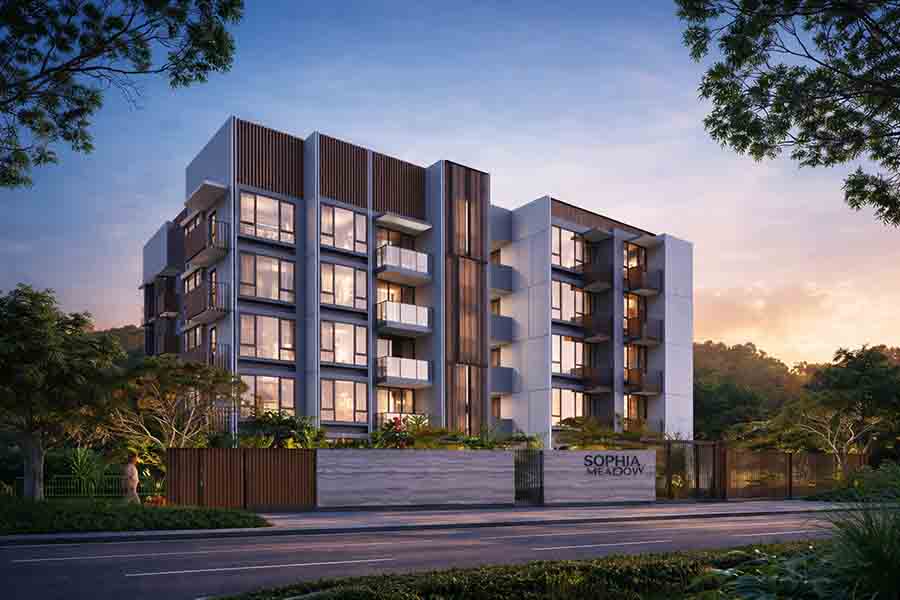
Sophia Meadow (commonly referred to as Sophia Meadows) is a 103-year leasehold, low-rise boutique residential development located at 132 Sophia Road within District 9 (Core Central Region), developed by Sin Thai Hin Development Pte Ltd. as an en-bloc redevelopment. With an estimated 41 residential units, height controls linked to its proximity to the Istana, and a plot ratio of 2.1, the project is structurally constrained to remain intimate and low density.
This Sophia Meadow review assesses likely pricing behaviour for a low-turnover boutique CCR project, layout efficiency trade-offs typical of small-scale developments, and who the project is realistically designed for — especially self-stay buyers who value Mount Sophia serenity more than MRT-at-doorstep convenience.
Sophia Meadow should be understood as a self-stay-first, affinity-driven city residence rather than a convenience-led or momentum-driven CCR project. Its appeal is strongest among buyers who already understand — and actively prefer — Mount Sophia / Mount Emily living: elevated, quieter, greenery-adjacent, and deliberately removed from the immediate bustle of MRTs and retail clusters, despite being located squarely within the city centre.
This review examines Sophia Meadow from a decision-stage perspective, focusing on who the project is realistically designed for, how its positioning aligns with URA’s long-term planning intent for Rochor and the Central Area, and what buyers should expect — without relying on promotional narratives or short-term upside assumptions.
Sophia Meadow is best understood as a boutique, self-stay-oriented District 9 (Core Central Region) residence. Core Central Region (CCR) residence designed for buyers who already value Mount Sophia living, rather than a momentum-driven or convenience-led city launch. Located at 132 Sophia Road in District 9, the project’s appeal is shaped by structural constraints—low-rise height controls near the Istana, a limited unit count of approximately 41 homes, and an elevated, quieter micro-location removed from MRT doorstep intensity. Its pricing and resale behaviour are therefore expected to be gradual and selective, driven by buyer familiarity, long holding horizons, and planning-enforced scarcity, making it most suitable for affinity-driven owner-occupiers rather than short-term investors or buyers relying on broad CCR demand.
Buyers searching for Sophia Meadow price, showflat location, or whether this District 9 boutique development is suitable for own-stay or investment should understand that this is not a mass-market CCR launch. Its positioning is shaped by low-density planning constraints, elevated terrain, and a highly selective buyer profile.
Explore the Full Sophia Meadow Analysis
This review forms part of the full project cluster:
- Sophia Meadow Price Guide – pricing structure, launch positioning, and price ranges
- Sophia Meadow Floor Plan Analysis – unit mix, layout efficiency, and stack considerations
- Sophia Meadow Showflat Guide – showroom location, viewing process, and what buyers should evaluate during a visit
Together, these articles provide a structured analysis of the project’s pricing framework, layout strategy, showroom viewing considerations, and buyer decision factors.
If you’re considering this project, you might want to check how it actually compares and what most buyers tend to overlook — before deciding.
Key details (at a glance):
103-year leasehold | 41 units | Low-rise (Istana height controls) | Dhoby Ghaut MRT ~0.4 km (uphill access) | Quiet Mount Sophia / Mount Emily pocket (CCR) | November 2029 TOP
Project Factsheet
| Item | Details |
|---|---|
| Project Name | Sophia Meadow |
| Location | 132 Sophia Road, Singapore |
| District / Region | District 9 (Core Central Region / Rochor Planning Area) |
| Tenure | 103 years |
| Developer | Sin Thai Hin Development Pte Ltd. |
| Site Type | En-bloc redevelopment |
| Development Type | Low-rise boutique residential (residential-only) |
| Site Area | Approx. 13,783 sq ft (≈1,280.5 sqm) |
| Plot Ratio | 2.1 |
| No. of Units | 41 residential units |
| Height Control | 5 storeys (Istana proximity) |
| Nearest MRT | Dhoby Ghaut MRT (~0.4 km, uphill access) |
| Expected Launch | 9 May 2026 |
| TOP | November 2029 |
Sophia Meadow is best understood as a quiet, low-turnover CCR residence, where scarcity is created by planning controls and micro-location, not by scale or marketing intensity.
Sophia Meadow is a boutique CCR home for buyers who already know and value Mount Sophia living — prioritising serenity and familiarity over doorstep convenience or short-term momentum.
Location Context: Sophia Road within the Rochor Planning Area
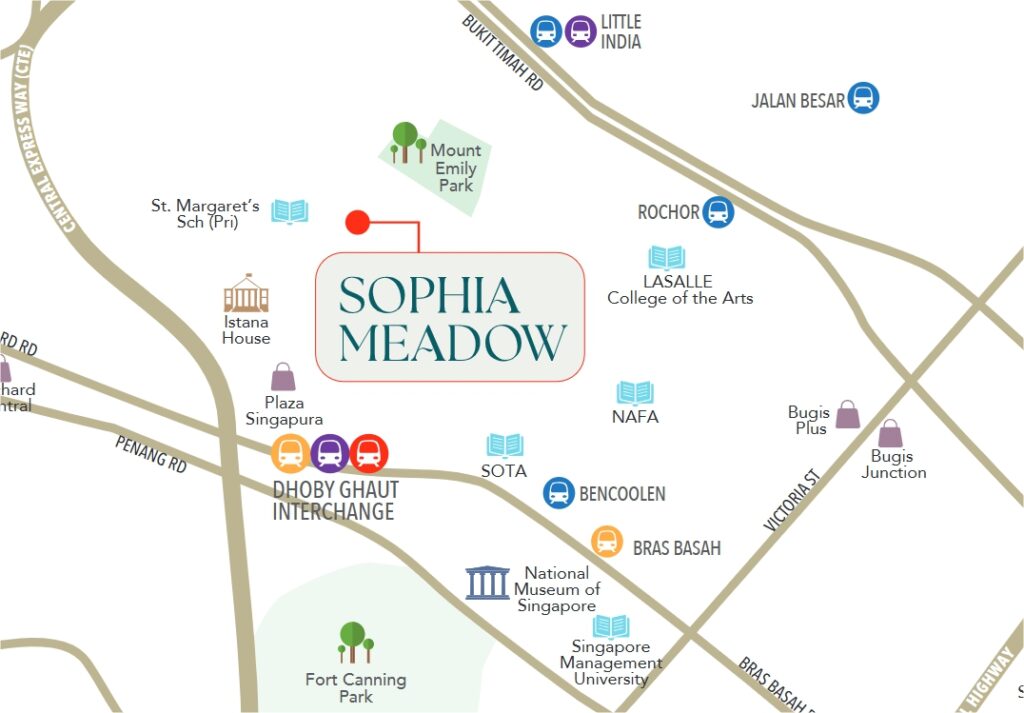
Sophia Road sits within the Rochor Planning Area, at the edge of Orchard and Bras Basah–Bugis, yet distinctly elevated along Mount Sophia / Mount Emily. This elevation is not incidental: it physically and psychologically separates the neighbourhood from surrounding retail corridors, shaping a calmer residential environment despite its city-centre address.
This Mount Sophia / Mount Emily enclave is one of the few elevated residential pockets within the Core Central Region, characterised by low-rise zoning, limited redevelopment plots, and proximity to Orchard, Dhoby Ghaut, and the Bras Basah–Bugis cultural district.
While Dhoby Ghaut MRT is approximately 400 metres away, access involves an uphill walk. This is a critical detail. Sophia Meadow is not designed for buyers who define convenience as “MRT at the doorstep.” Instead, the uphill approach acts as a natural filter, favouring residents who value quietness, greenery, and separation from through-traffic over immediacy.
Buyers intending to visit the showroom should refer to the Sophia Meadow Showflat Guide for the exact location, map, and viewing process.
Daily amenities remain readily accessible — Plaza Singapura, The Centrepoint, and Orchard’s retail belt are all within a short walk or drive — but the lived experience is intentionally removed from the intensity of those nodes. This distinction matters more than the District 9 label alone, as it shapes everyday livability rather than perceived prestige.
Although located within District 9, Sophia Meadow should be assessed within the broader context of the Core Central Region (CCR), where buyer expectations, pricing behaviour, and liquidity dynamics differ materially from suburban and OCR developments.
Project Positioning: What Sophia Meadow Is — and Is Not
What Sophia Meadow Is
-
A low-rise, boutique CCR residence with structural scarcity (41 units)
-
Self-stay-oriented, driven by place familiarity and emotional affinity
-
Suited for buyers who already appreciate Mount Sophia / Mount Emily living
-
Designed for quiet city living with greenery and elevation
What Sophia Meadow Is Not
-
Not a mass-appeal CCR launch
-
Not an MRT-at-doorstep or retail-fronting project
-
Not a momentum-driven or trader-oriented opportunity
-
Not easily understood by buyers unfamiliar with the micro-location
This distinction is critical. Sophia Meadow trades immediacy and broad appeal for calm, intimacy, and localised demand, which will shape both its buyer pool and long-term value behaviour.
Amenities & Everyday Reality (Selective)
Sophia Meadow benefits from a dense cultural, educational, and lifestyle network typical of the Rochor and Orchard fringe:
-
Education & Arts: SOTA, LASALLE, NAFA, SMU within close proximity
-
Retail: Plaza Singapura, The Centrepoint, Orchard Road nodes nearby
-
Lifestyle & Clubs: Multiple city clubs and cultural institutions within a short drive
However, convenience here is available rather than immediate. The project is designed for residents who are comfortable with a short walk or drive, valuing tranquillity over frictionless access.
Buyer Suitability: Who Sophia Meadow Is For
1. Localised CCR Self-Stay Buyers (Primary)
Buyers who already know the Mount Sophia / Mount Emily area, appreciate its elevation and quietness, and intend to stay long term. For these buyers, familiarity is a prerequisite — not a bonus.
2. Long-Horizon, Low-Turnover Owners
Owners comfortable with gradual capital behaviour, low transaction volumes, and selective resale demand rather than fast repricing.
3. Rental Buyers (Secondary, Selective)
Rental demand exists and has historically been resilient, but this is not a yield-maximisation project. Vacancy risk is mitigated by location quality rather than price compression.
4. Buyers Who May Want to Reconsider
Buyers seeking absolute convenience, short holding periods, or broad resale appeal may find better alignment in larger, more accessible CCR projects.
Buyers comparing Sophia Meadow against other new launches may refer to the New Launch Condo Guide, which explains how pricing, tenure, and buyer intent differ across CCR, RCR, and OCR developments.
Takeaway
Sophia Meadow is a filtering project. It does not attempt to appeal to everyone, nor should it be evaluated using mass-market CCR metrics. Its relevance lies in boutique scale, planning-enforced scarcity, and affinity-driven self-stay demand within a quiet city-centre pocket.
For buyers who already understand and value Mount Sophia living, the project’s positioning is coherent. For those encountering the area for the first time, expectations should be calibrated carefully. As more details on pricing and unit mix emerge, Sophia Meadow’ competitiveness will hinge on pricing discipline, unit efficiency, and how effectively serenity is preserved alongside city access.
Pending Approval for Sale
If you’re seriously considering this project, it’s worth checking how it actually compares and what most buyers tend to overlook — before deciding.
FAQs (Decision-Stage)
1) Where exactly is Sophia Meadow located?
Sophia Meadow is located at 132 Sophia Road within the Mount Sophia / Mount Emily enclave in District 9 (Core Central Region). It sits within the Rochor Planning Area, positioned between Orchard Road and the Bras Basah–Bugis district. The site is slightly elevated above the Dhoby Ghaut and Plaza Singapura area, which creates a quieter residential environment. This micro-location is defined more by elevation and low density than by immediate MRT proximity.
2) How “boutique” is Sophia Meadow in practical terms?
Sophia Meadow is structurally boutique, with only 41 residential units in total. This creates a low-density living environment with fewer neighbours and limited internal competition. However, it also results in lower transaction volume and more selective resale activity. Buyers should understand that boutique scale enhances exclusivity but reduces liquidity.
3) Is Sophia Meadow walkable to Dhoby Ghaut MRT in real life?
Sophia Meadow is within walking distance to Dhoby Ghaut MRT, but the route involves an uphill walk. This affects real-life convenience compared to flat-ground developments with direct access. For some buyers, this elevation is a drawback, while others see it as a benefit that reduces noise and foot traffic. It should be treated as a defining lifestyle filter rather than a minor detail.
4) What is the biggest trade-off of buying into Mount Sophia living?
The main trade-off is convenience versus serenity. Buyers gain a quieter, low-density environment within District 9 but give up immediate MRT and retail doorstep access. While amenities remain nearby, they are not instantly accessible at ground level. This trade-off shapes both daily living experience and long-term buyer appeal.
5) What should buyers check first when evaluating layouts and pricing?
Buyers should first evaluate layout efficiency, entry quantum, and unit orientation. In boutique developments, layout inconsistencies can be more pronounced due to limited standardisation. Pricing should be assessed based on overall affordability rather than PSF alone. Ultimately, Sophia Meadow will be judged on practical liveability rather than marketing positioning.
6) Is Sophia Meadow the kind of project that attracts “must-sell fast” owners?
Sophia Meadow is unlikely to attract short-term or forced sellers. Buyers in this type of District 9 boutique development tend to be long-horizon and familiarity-driven. This reduces resale churn and contributes to price stability over time. However, it also means resale activity is more selective and less frequent.
7) Is the small unit count a positive or a risk?
The small unit count is both a strength and a limitation. It creates genuine scarcity and reduces internal competition within the development. However, it also narrows the buyer pool during resale and limits transaction data. The overall outcome depends heavily on whether the project is priced appropriately at launch.
8) Who is the “ideal buyer” for Sophia Meadow?
The ideal buyer is a self-stay owner or long-horizon investor who already understands the Mount Sophia micro-location. This includes buyers who value quiet, low-density city living over convenience and accessibility. It is particularly suited for those comfortable with elevation and selective resale dynamics. It is less suitable for buyers seeking high liquidity or short-term gains.
Pricing Logic, URA Planning Intent & Buyer Segmentation
Summary
Sophia Meadow is not positioned to compete on speed, scale, or headline momentum. Its value logic is anchored in boutique scarcity, planning-enforced limits, and affinity-driven demand, rather than broad CCR appeal or convenience-led pricing power. As a low-rise en-bloc redevelopment within the Rochor Planning Area, its competitiveness will depend heavily on pricing discipline and buyer self-selection, not market exuberance.
This section evaluates whether Sophia Meadow’ positioning holds up when pricing structure, URA planning intent, and buyer segmentation are assessed together — without assuming short-term catalysts or relying on District 9 optics alone.
Pricing Logic: Why Sophia Meadow Competes on Scarcity and Selectivity
Land Cost Context and Structural Implications
Sophia Meadow was acquired at an estimated $1,172 psf per plot ratio (psf ppr), inclusive of a nominal land betterment charge. For a 103-year leasehold, low-rise CCR site with a plot ratio of 2.1, this land cost sets clear constraints on achievable pricing — but also limits overbuilding pressure.
With only 41 units, land cost recovery is distributed across a small number of homes. This typically leads to higher absolute quantum sensitivity, especially when compared with larger GLS developments where density allows for more aggressive unit pricing strategies.
However, Sophia Meadow’ pricing logic is not volume-driven. It does not need to appeal to a broad buyer base to succeed; instead, it relies on depth of conviction among a narrow audience.
Absolute Quantum vs PSF: The More Relevant Lens Here
A detailed breakdown of pricing, entry quantum scenarios, and PSF positioning is covered in the Sophia Meadow Price Guide. The following section focuses on structural pricing behaviour rather than indicative figures.
For boutique CCR developments like Sophia Meadow, absolute quantum matters more than headline PSF, particularly for own-stay buyers.
Key reasons include:
-
Buyers are not trading on price momentum, but on personal fit
-
Smaller unit counts reduce urgency to match market-wide PSF benchmarks
-
Buyers are typically less price-elastic but more expectation-sensitive
As a result, Sophia Meadow must avoid two pricing traps:
-
Overpricing on CCR branding alone, ignoring buyer selectivity
-
Underpricing to chase volume, which undermines boutique positioning
The viable pricing band will likely sit within, but not above, nearby boutique benchmarks — especially freehold comparables that already exist in the Mount Sophia and Wilkie Road vicinity.
Contextual Comparison: Why Boutique ≠ Faster Appreciation
Compared to nearby freehold boutique developments within the Mount Sophia and Wilkie Road enclave, Sophia Meadow is expected to position itself through entry quantum rather than tenure premium.
Nearby boutique developments such as Sophia Regency (FH), Orchard Sophia (FH), and The Collective at One Sophia (99-year) illustrate a critical reality of this micro-market:
-
Capital appreciation is incremental
-
Transaction volumes are thin
-
Buyers are repeat or referral-driven, not speculative
Sophia Meadow fits squarely into this behavioural pattern. While scarcity exists, demand is selective, and resale liquidity depends more on finding the right buyer than on market cycles.
URA Planning Analysis: Stability Through Constraint, Not Transformation
Rochor Planning Area: Lifestyle Enhancement Over Density
URA’s long-term vision for the Rochor Planning Area emphasises:
-
Walkability and active mobility
-
Heritage-sensitive rejuvenation
-
Street-level vibrancy
-
Integration with broader Central Area strategies
Crucially, these plans do not prioritise aggressive residential intensification in Mount Sophia and Mount Emily. Instead, the area functions as a buffer zone between Orchard, Bras Basah–Bugis, and Little India.
For Sophia Meadow, this means:
-
Limited risk of future high-density encroachment
-
Preservation of low-rise character
-
Enhancement of surrounding lifestyle infrastructure without crowding
Height Control and Istana Proximity: A Structural Filter
Sophia Meadow's height restriction (approximately 5–8 storeys) is not a temporary guideline; it is tied to long-standing planning sensitivities near the Istana. This has two long-term implications:
-
Supply is structurally capped — future projects nearby will face similar constraints
-
The “quiet CCR enclave” character is policy-enforced, not marketing-driven
While this limits redevelopment upside, it strengthens environmental consistency, which is central to Sophia Meadow’ self-stay appeal.
Buyer Segmentation: Who Sophia Meadow Truly Serves
1. Affinity-Driven CCR Self-Stay Buyers (Primary Segment)
Profile
-
Already familiar with Mount Sophia / Mount Emily
-
Comfortable with elevation and uphill access
-
Seeking serenity within the city
Why Sophia Meadow Works
-
Low-rise, low-turnover environment
-
Familiar neighbourhood character
-
No pressure to conform to mass CCR expectations
This buyer group is not price-insensitive, but is less influenced by market sentiment than by personal alignment.
2. Long-Horizon Owners (Secondary Segment)
Profile
-
Planning extended holding periods
-
Comfortable with gradual capital behaviour
-
Low reliance on resale timing
Why Sophia Meadow Works
-
Structural scarcity supports long-term value stability
-
Limited competing supply of similar scale
-
Planning constraints reduce downside risk
3. Rental Buyers (Selective, Secondary)
Profile
-
Focused on location quality rather than yield maximisation
-
Targeting professional or expatriate tenants
-
Accepting moderate yields in exchange for stability
Limitations
-
Rental demand exists, but pricing caps yields
-
Vacancy risk is low, but upside is limited
4. Buyers Who May Want to Reconsider
-
Short-term traders
-
Buyers prioritising MRT-at-doorstep convenience
-
Buyers unfamiliar with the micro-location
-
Those expecting rapid repricing based on CCR branding alone
Sophia Meadow does not reward unfamiliarity.
Interim Assessment
Sophia Meados should be evaluated as:
A boutique CCR home where value is preserved through selectivity, planning constraint, and buyer familiarity — not through scale or momentum.
Its pricing success will depend less on market cycles and more on alignment between buyer expectations and lived reality.
Exit & Liquidity, Risk Scenarios, Pros & Cons, and Buyer FAQs
Summary
Sophia Meadow performs best when assessed as a low-turnover, self-stay-oriented CCR residence rather than a trading asset. Its exit profile is shaped by limited unit count, buyer familiarity, and planning-enforced stability, creating resilience but capping velocity.
Exit & Liquidity Analysis
Liquidity Profile of Boutique CCR Developments
For developments like Sophia Meadow:
-
Resale activity is infrequent but deliberate
-
Buyers are typically pre-qualified through familiarity
-
Liquidity exists, but timing matters
Unlike mass-market CCR projects, exit success depends more on buyer matching than market conditions.
Unit-Type Liquidity Considerations
With only 41 units and unknown final unit mix:
-
Smaller units may see broader interest
-
Larger units require patient exits
-
Pricing discipline is critical across all types
Sophia Meadow is not a project where discounts force liquidity; pricing misalignment risks prolonged holding periods.
Multi-Scenario Risk Analysis
Scenario 1: Prolonged High Interest Rates
-
Affinity-driven buyers less affected
-
Transaction volumes slow, but pricing remains sticky
Scenario 2: Increased Boutique Supply Nearby
-
Competition exists, but buyer pools overlap minimally
-
Familiarity continues to filter demand
Scenario 3: Strong CCR Rental Cycle
-
Rental stability improves
-
Yield remains moderate, not aggressive
Scenario 4: City Lifestyle Demand Softens
-
Short-term demand slows
-
Long-horizon owners remain insulated
Final Investment & Own-Stay Assessment
Sophia Meadow condo works best when viewed as:
A quiet, boutique city residence designed for buyers who already understand the place — not a discovery project for the broader market.
For buyers evaluating multiple District 9 new launches, Sophia Meadow should not be assessed purely on price or tenure. Its suitability depends heavily on familiarity with the Mount Sophia enclave and willingness to prioritise environment over convenience.
Its strengths are structural:
-
Low-rise planning
-
Limited supply
-
Environmental consistency
-
CCR location without intensity
Its constraints are equally structural:
-
Gradual capital appreciation
-
Selective liquidity
-
Narrow buyer pool
Pros & Cons Summary
Pros
-
Boutique scale (41 units)
-
Planning-enforced low density
-
Quiet CCR micro-location
-
Strong self-stay alignment
-
Stable rental demand
Cons
-
103-year tenure
-
Uphill access
-
Not MRT-at-doorstep
-
Limited short-term upside
-
Requires buyer familiarity
Frequently Asked Questions
1. Is Sophia Meadow suitable for first-time buyers?
Sophia Meadow is only suitable for first-time buyers who are already familiar with Mount Sophia and comfortable with its elevated, quieter environment. It does not function like a typical convenience-driven new launch with MRT-at-doorstep access. Buyers must be prepared for a more selective resale pool and slower transaction pace. It is therefore better suited for those prioritising long-term own-stay over flexibility.
2. Is this a good project for short-term investment?
Sophia Meadow is not structured for short-term investment or flipping strategies. Its boutique scale, limited unit count, and selective buyer pool reduce the likelihood of rapid price movement. Investors relying on momentum or broad market demand may find limited alignment. It performs better as a long-horizon hold rather than a trading asset.
3. Does uphill access affect resale?
Yes, uphill access is a defining factor that influences buyer perception and resale liquidity. While it reduces walkability compared to flat-ground developments, it also preserves a quieter and less congested environment. This creates a filtering effect where only buyers comfortable with the terrain will consider the project. As a result, resale depends more on matching the right buyer rather than broad market appeal.
4. Is Sophia Meadow considered a luxury project?
Sophia Meadow is better described as a boutique District 9 condo rather than a conventional luxury development. It does not compete on scale, facilities, or branded positioning typically associated with luxury projects. Instead, its value lies in low-density living, location, and environmental consistency. Buyers should evaluate it as a refined, niche residence rather than a prestige-led asset.
5. How does tenure affect long-term value?
The 103-year leasehold tenure will influence long-term depreciation, but it is not the only determining factor of value. In this case, planning constraints and limited supply within the Mount Sophia enclave play a more significant role in preserving stability. Buyers should focus on entry price and holding horizon rather than tenure alone. Over time, micro-location and buyer demand will matter more than lease length in isolation.
6. Will URA plans increase density nearby?
Significant increases in density within the Mount Sophia and Mount Emily area are unlikely. The area is subject to planning controls linked to its proximity to the Istana, which limits building height and redevelopment intensity. This helps preserve the low-rise character of the neighbourhood. As a result, the surrounding environment is expected to remain relatively stable over time.
7. Is rental demand reliable?
Rental demand in this area is generally stable due to proximity to Orchard, Dhoby Ghaut, and nearby educational institutions. However, Sophia Meadow is not positioned as a yield-maximisation project. Rental returns are likely to be moderate rather than high, reflecting its boutique nature and smaller unit base. Investors should prioritise tenant profile stability over rental yield optimisation.
8. Who should avoid this project?
Buyers who prioritise MRT convenience, high liquidity, or short holding periods may find Sophia Meadow unsuitable. It is not designed for broad market appeal or rapid resale cycles. Those unfamiliar with the Mount Sophia micro-location may also struggle to fully appreciate its value. The project is better suited for buyers with clear intent and long-term expectations.
9. How liquid will resale be?
Resale liquidity for Sophia Meadow is expected to be selective rather than active. With only 41 units, transaction volume will naturally be low, and buyers tend to be highly targeted. This means units may take longer to sell if pricing is not aligned with market expectations. However, well-positioned units should still find buyers over time.
10. Does CCR location guarantee appreciation?
A Core Central Region (CCR) address alone does not guarantee capital appreciation. Within District 9, micro-location, buyer demand, and project positioning play a larger role than the district label itself. Sophia Meadow’s performance will depend on how well it aligns with its niche buyer pool. Buyers should avoid relying solely on CCR branding as a driver of value.
11. Is this family-oriented?
Sophia Meadow is not primarily designed as a family-oriented development. Its boutique scale and limited facilities may not meet the needs of larger households. However, smaller families who prioritise location and a quieter environment may still find it suitable. It is more aligned with couples or individuals than multi-generational households.
12. What holding period makes sense?
A longer holding period is generally more suitable for Sophia Meadow. Buyers should be prepared to hold through market cycles rather than rely on short-term gains. The project’s value is expected to unfold gradually due to its selective demand profile. A medium- to long-term horizon provides greater flexibility and stability.
13. Is this comparable to freehold boutique projects nearby?
Sophia Meadow behaves similarly to nearby freehold boutique developments in terms of buyer profile and transaction patterns. However, the key difference lies in tenure, which may influence long-term perception and pricing. Buyers typically compare entry quantum rather than tenure alone. The project competes more on affordability within District 9 than on legacy value.
14. Does small scale increase risk?
Small scale does not inherently increase risk, but it does increase selectivity. With fewer units, there is less transaction data and fewer comparable sales. This can make pricing more sensitive and less predictable. However, it also reduces internal competition within the development, which can support value stability over time.
15. Should buyers wait for pricing details?
Yes, pricing will be a decisive factor for Sophia Meadow. Given its positioning, entry quantum relative to nearby District 9 developments will determine its competitiveness. Buyers should assess whether pricing reflects the trade-offs between tenure, location, and density. Making a decision without pricing clarity may lead to misalignment.
16. How should Sophia Meadow be evaluated overall?
Sophia Meadow should be evaluated as a boutique, low-density District 9 residence defined by its micro-location and planning constraints. It is not a momentum-driven or broadly appealing project, but rather one that rewards familiarity and long-term holding. Buyers should focus on fit, environment, and expectations rather than market narratives. Its value lies in alignment, not hype.
If you prefer a more structured walkthrough, you can leave your details below and we’ll follow up with you.