
Midtown Bay Floor Plan Analysis (Quick Overview)
Midtown Bay floor plans are designed around compact efficiency, vertical living, and city-core practicality, rather than traditional family-oriented layouts.
This creates a very specific decision framework:
- Smaller units prioritise rental alignment and efficiency
- Duplex units introduce spatial separation rather than larger footprint
- Layout choice directly affects daily usability and exit flexibility
With current availability increasingly concentrated in duplex and selective unit types, buyers are no longer choosing from the full range — but from what still makes sense.
Most buyers narrow down to 2–3 viable layouts before making a decision.
Want a breakdown of the best remaining layouts and stacks at Midtown Bay?
Key Floor Plan Facts
- 219 residential units within an integrated mixed-use development
- Strong weighting towards 1-bedroom and compact 2-bedroom layouts
- Duplex units form the project’s main layout differentiation
- Layouts prioritise internal efficiency over spaciousness
- Designed for urban living, not family-oriented space planning
- Stack selection is important due to surrounding high-rise context and road exposure
- Remaining units are more concentrated in duplex configurations
- Layout suitability depends on investment vs own-stay intent
Explore the Full Midtown Bay Analysis
This article is part of the full Midtown Bay cluster:
- Midtown Bay Review – project positioning, buyer suitability, and planning context
- Midtown Bay Price Guide – pricing structure, market positioning, and buyer entry analysis
- Midtown Bay Showflat Guide – viewing strategy, location context, and buyer evaluation framework
Together, these articles provide a structured breakdown of pricing, layouts, investor positioning, and long-term holding considerations.erations.
Buyers who are still learning how Singapore new launches are typically evaluated may also find the New Launch Condo Guide helpful before comparing individual projects.
Current Available Units, Layouts & Unit Types (Live Snapshot)
Availability and stack selection may change depending on take-up and release phases.
| Unit Type | Size | Reserved | Available |
|---|---|---|---|
| 1 Bedroom | 409–527 sqft | 8 | 29 |
| 2 Bedroom | 732–775 sqft | 4 | 3 |
| 2 Bedroom Duplex | 990–1152 sqft | – | 23 |
| 3 Bedroom Duplex | 1324 sqft | – | 4 |
Total Available Units:~59
At this stage:
- 2-bedroom units are almost fully absorbed
- Duplex units form the majority of remaining supply
- Selection is increasingly stack- and floor-dependent
Want the latest available stacks and best-positioned units?
Midtown Bay Unit Mix Breakdown
| Unit Type | Units | Percentage | Positioning |
|---|---|---|---|
| 1 Bedroom | 107 | 48.9% | Entry / Rental |
| 2 Bedroom | 72 | 32.9% | Couples / Flexible |
| 2 Bedroom Duplex | 32 | 14.6% | Spatial Differentiation |
| 3 Bedroom Duplex | 8 | 3.7% | Premium / Niche |
| Total | 219 | 100% | — |
What the Unit Mix Reveals
Midtown Bay is structured around investment-led demand rather than family occupation.
Key takeaways:
- Majority of supply targets rental and investor segment
- Limited true family-sized layouts
- Duplex units introduced to create perceived space rather than actual size increase
This creates a key decision trade-off:
Efficiency vs spatial experience
- Standard layouts → efficient, practical
- Duplex layouts → visually larger but less efficient
Layout Strategy and Positioning
Midtown Bay’s layouts are designed around:
- Minimal circulation waste
- Integrated living and kitchen zones
- Compact urban living
Instead of increasing size, the project:
- Uses duplex concepts to create separation
- Prioritises location over space
This means:
- Layout effectiveness depends heavily on lifestyle
- Not all layouts improve actual usability
1 Bedroom Layout Analysis
Key Characteristics
- 409–527 sqft
- Open kitchenette
- Combined living and dining
What Works
- Efficient layout
- Lower entry quantum
- Strong rental alignment
Limitations
- Limited flexibility
- Minimal separation
- Not suited for long-term living
Positioning
Best for:
- Investors
- Singles
- Short-term or flexible holding
2 Bedroom Layout Analysis
Key Characteristics
- 732–775 sqft
- Linear or corridor layouts
- Side-by-side bedrooms
What Works
- Better functionality vs 1BR
- Suitable for couples
- More flexibility
Limitations
- Compact secondary bedroom
- Limited long-term adaptability
Positioning
Best for:
- Couples
- Hybrid own-stay + investment
2 Bedroom Duplex Layout Analysis
Key Characteristics
- Split-level layout
- Living below, bedrooms above
- Internal staircase
What Works
- Clear separation of zones
- More privacy
- Unique spatial experience
Limitations
- Staircase reduces usable space
- Less efficient overall
- Not ideal for all buyers
Positioning
Best for:
- Buyers prioritising separation
- Niche rental appeal
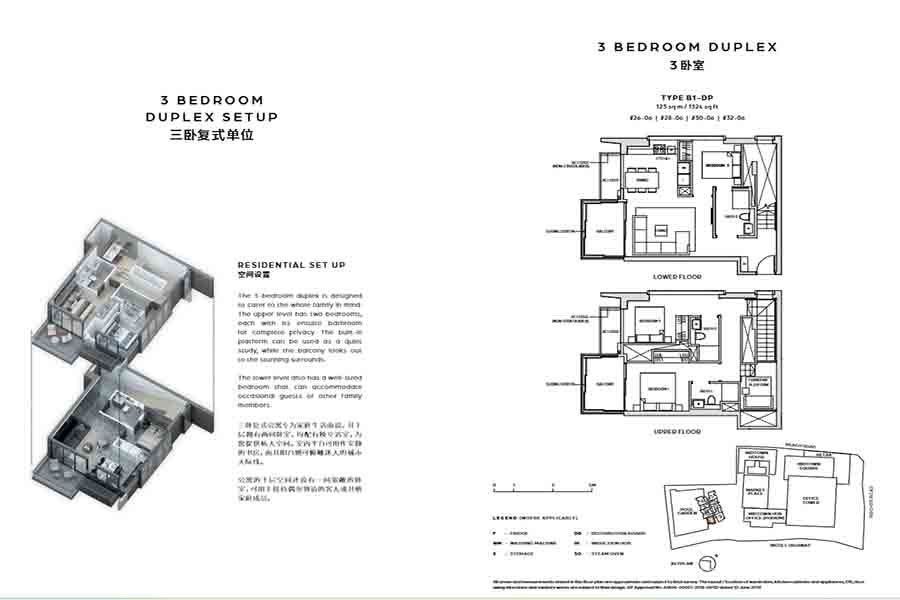
3 Bedroom Duplex Layout Analysis
Key Characteristics
- Larger footprint
- Enclosed kitchen + yard
- Utility WC
What Works
- More complete functionality
- Better zoning
- Stronger own-stay usability
Limitations
- Limited supply
- Higher quantum
- Smaller buyer pool
Positioning
Best for:
- Niche own-stay buyers
- Long-term holding
Best Layouts and Stack Considerations at Midtown Bay
Midtown Bay stacks fall into two groups:
North-West (NW / WNW) Stacks
(Stacks 06–09)
- Facing Beach Road / Bugis skyline
- Potentially more urban-facing
- Possible building proximity
South-East (SE / ESE) Stacks
(Stacks 01–05)
- Facing Nicoll Highway / Suntec
- Higher floors may offer more openness
- Road exposure risk
What Defines “Best Stack”
There is no single best stack.
Buyers typically evaluate:
- Openness vs obstruction
- Road exposure vs internal view
- Floor level impact
- Future surrounding development
At Midtown Bay:
Stack choice can influence liveability as much as layout.
How to Choose the Right Layout at Midtown Bay
Most buyers filter based on:
1. Purpose
- Investment → 1BR / compact units
- Own stay → duplex or larger units
2. Efficiency vs Experience
- Standard → efficient
- Duplex → experiential
3. Daily Usability
- Layout flow
- Staircase practicality
- Kitchen placement
4. Exit Strategy
- Smaller units → broader demand
- Duplex → niche segment
Practical Decision Guide
- Lowest friction → 1BR
- Balanced flexibility → 2BR
- Spatial separation → duplex
- Full usability → 3BR duplex
Need help narrowing down the best stacks and layouts?
Midtown Bay Floor Plan FAQs
1. Are Midtown Bay floor plans efficient?
Midtown Bay layouts are designed to maximise internal efficiency, especially for smaller units. Space is used carefully with minimal wasted areas, which supports urban living. However, this comes at the expense of spaciousness and flexibility. Buyers should assess whether compact efficiency aligns with their lifestyle or investment objectives.
2. Are duplex units worth considering at Midtown Bay?
Duplex units provide better separation between living and sleeping areas, which improves privacy. However, they introduce stairs and reduce usable floor area, which may not suit all buyers. Their value depends on whether spatial experience is prioritised over efficiency. They are more suitable for specific buyer profiles rather than general use.
3. Which layout is best for investment at Midtown Bay?
1-bedroom units are generally the most aligned with rental demand due to lower quantum and broader tenant appeal. They are easier to lease and manage compared to larger units. However, with limited availability, compact 2-bedroom units may also be considered. Entry price and efficiency remain key considerations.
4. Are Midtown Bay layouts suitable for own stay?
Midtown Bay layouts can work for individuals or couples who prioritise city living. However, they are not designed for traditional family living due to compact sizes and limited flexibility. Duplex units may offer better separation but still require trade-offs. Suitability depends on lifestyle alignment rather than space expectations.
5. Does stack selection matter at Midtown Bay?
Yes, stack selection plays a significant role due to surrounding buildings, road exposure, and view differences. Some stacks may offer better openness or privacy, while others may face more urban density. Floor level also affects the experience. Layout and stack should be evaluated together.
6. What is the main trade-off in Midtown Bay layouts?
The key trade-off is between efficiency and spatial experience. Smaller units maximise usable space but lack flexibility, while duplex units offer separation at the cost of efficiency. Buyers need to prioritise based on their intended use. This decision defines overall satisfaction.
Conclusion
8@BT floor plans reflect a practicality-driven, MRT-led design approach rather than a luxury or space-maximisation strategy.
They prioritise usability, functional zoning, and alignment with daily commuting needs, making them suitable for owner-occupiers focused on long-term living in the Beauty World area.
For aligned buyers, the layouts provide a coherent and efficient solution.
For buyers seeking expansive space or lifestyle-driven layouts, some units may feel compact.
In this project, layout selection is not secondary.
The right unit supports long-term comfort.
The wrong one creates limitations.
If you are comparing 8@BT layouts and want to understand which unit types and stacks best match your needs:
Request a structured breakdown of layout suitability, stack selection, and long-term fit via WhatsApp.