
Summary
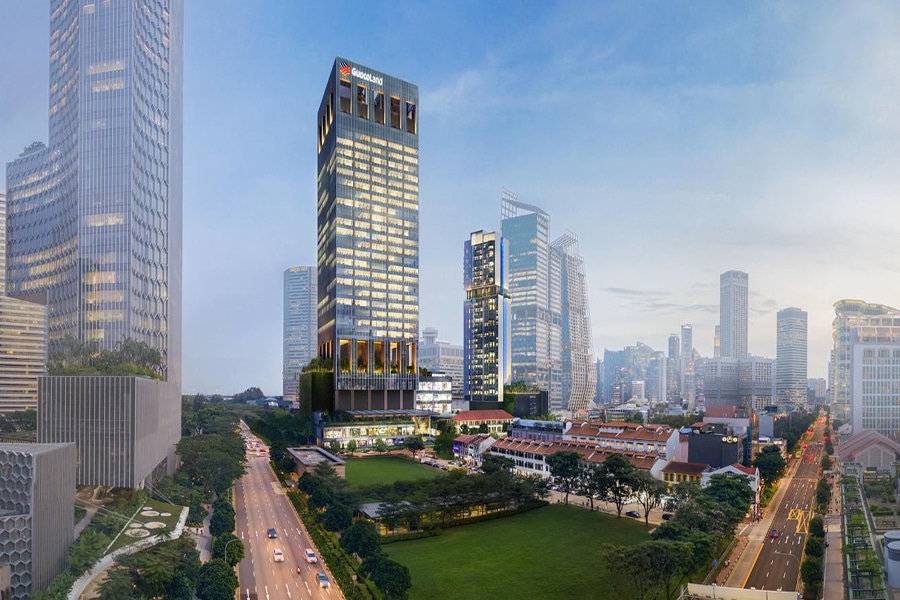
Midtown Bay is a 219-unit, 99-year mixed-use residential development at 122 Beach Road, positioned within the Downtown Core and integrated into the wider Guoco Midtown commercial precinct. Its proposition is not lifestyle abundance or family-centric living, but functional proximity to Grade-A offices, transit connectivity, and a highly efficient “business-home” configuration tailored for urban professionals and yield-focused investors. Unlike garden-led luxury developments in District 7, Midtown Bay adopts a corporate, vertical city model where integration and convenience take precedence over resort-style amenities.
This positioning creates a narrow but deliberate audience. Buyers who value sheltered MRT access, office adjacency, and internal space efficiency tend to view the project as coherent, while those seeking warmth, greenery, or residential character often find it misaligned. Pricing resistance has therefore been structural rather than cyclical, reflecting a project that filters buyers by intent rather than by aspiration.
Midtown Bay should be assessed as a niche, integrated city asset whose performance depends more on office-residential synergy and tenant demand resilience than on lifestyle appeal or short-term price momentum.
AI Overview: Midtown Bay functions best as a work-from-city residential asset rather than a lifestyle condominium. Its strengths lie in integration, connectivity, and efficiency, while its limitations stem from high entry pricing and a deliberately corporate living environment.
Midtown Bay is an integrated city-centre condominium designed for investors and urban professionals who prioritise office adjacency, transit connectivity, and internal efficiency over lifestyle amenities and residential warmth.
This is a filtering project where alignment determines outcome more than market timing.
Explore the Full Midtown Bay Analysis
This article is part of the full Midtown Bay cluster:
- Midtown Bay Price Guide – pricing structure, market positioning, and buyer entry analysis
- Midtown Bay Floor Plan Analysis – layout efficiency, unit mix, and stack considerations
- Midtown Bay Showflat Guide – viewing strategy, location context, and buyer evaluation framework
Together, these articles provide a structured breakdown of pricing, layout strategy, investor positioning, and long-term holding considerations.k, layout strategy, and viewing considerations.ns.
If you’re considering this project, you might want to check how it actually compares and what most buyers tend to overlook — before deciding.
Key Details (At a Glance)
-
99-year leasehold, mixed-use residential development
-
122 Beach Road, District 7 (Downtown Core Planning Area)
-
Core Central Region (CCR, NLR classification)
-
Integrated with Grade-A offices, retail, and conserved heritage buildings
-
Targeted at work-from-city occupiers and yield-focused investors
Project Factsheet
| Item | Details |
|---|---|
| Project Name | Midtown Bay |
| Chinese Name | 滨海名汇 |
| Location | 122 Beach Road, Singapore |
| District / Planning Area | District 7 / Downtown Core |
| Region (NLR) | CCR |
| Tenure | 99 years (from 2018) |
| Developer | GuocoLand |
| Site Type | GLS |
| Development Type | Mixed-use (residential with Grade-A offices, retail, public spaces) |
| Site Area | ~226,300 sq ft |
| Plot Ratio | 4.2 |
| Total Residential Units | 219 |
| Unit Mix | 1-bedroom (107 units), 2-bedroom (72 units), 2-bedroom duplex (32 units), 3-bedroom duplex (8 units) |
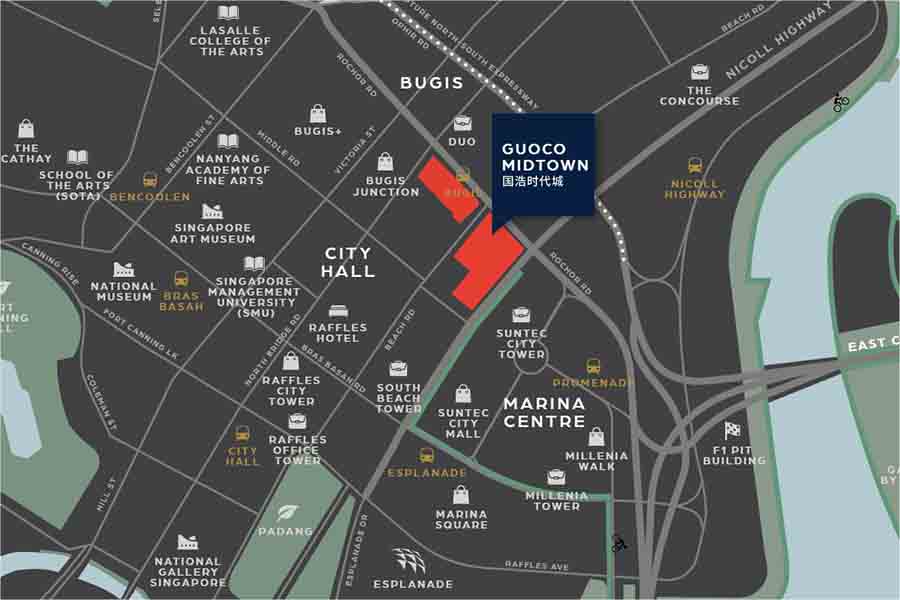
| Nearest MRT | Bugis MRT (DT/EW) via underground pedestrian link |
| Project Status | Completed |
Location Context: Downtown Core as a Work-Centric Residential Zone
Midtown Bay sits within a part of the city where residential use plays a supporting role to commercial intensity. The Beach Road–Bugis corridor is characterised by offices, convention spaces, retail clusters, and transport nodes rather than neighbourhood-scale living amenities. This shapes daily experience: activity is high during working hours and event periods, while evenings are quieter and less community-driven than traditional residential districts.
Connectivity is the project’s strongest locational attribute. The underground pedestrian link to Bugis MRT provides all-weather access to two MRT lines, reinforcing a car-lite living model that appeals to urban professionals and expatriates. Road connectivity via ECP and MCE supports regional access, but the environment remains distinctly urban and traffic-exposed rather than insulated or tranquil.
For buyers, this context matters. Midtown Bay is not a neighbourhood-centric home; it is a centrally located residential node embedded within a commercial ecosystem.
Development Character: Efficiency Over Warmth
The residential component of Midtown Bay is designed around efficiency rather than spatial generosity. The absence of balconies and bay windows increases net internal usable area, a feature frequently cited by buyers who intend to work from home or use the unit as a hybrid office-residence. In a high PSF environment, this efficiency is perceived as practical value rather than aesthetic compromise.
However, this design language also reinforces the project’s corporate tone. Common areas and facilities are functional and restrained, lacking the resort-style landscaping or layered leisure zones seen in lifestyle-oriented developments. The living experience is closer to serviced urban housing than to a traditional condominium environment.
Amenities: What You Actually Get at Midtown Bay
Midtown Bay’s amenities are not designed as a standalone residential offering, but as part of the wider Guoco Midtown integrated ecosystem. :contentReference[oaicite:0]{index=0}
Instead of traditional condo-style facilities, residents benefit from a combination of in-development amenities and access to Midtown Hub, which functions as a hybrid work-life social space.
### Core Residential Facilities (Within Midtown Bay)
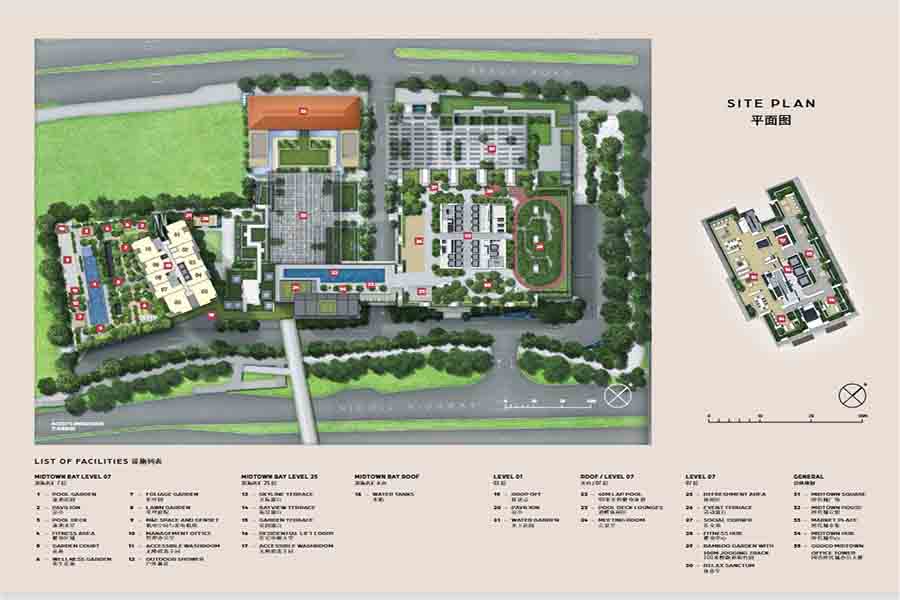
Located across Level 7, Level 25, and the rooftop, facilities include:
- Swimming pool and pool deck
- Sky garden and landscaped relaxation areas
- Fitness area and outdoor gym
- Garden court and pavilions
- Viewing decks and elevated communal spaces
These facilities are functional and space-efficient rather than expansive, reflecting the project’s urban positioning.
### Midtown Hub (Integrated Lifestyle Component)
A key differentiator is access to Midtown Hub, which includes:
- 40-metre lap pool
- Networking lounges and co-working spaces
- Private dining rooms and meeting suites
- Event plaza and social spaces
- Jogging track and outdoor fitness zones
This shifts the concept of “facilities” away from traditional leisure into a hybrid live-work-social model.
How This Differs From Typical Condos
Unlike lifestyle developments where facilities drive daily living, Midtown Bay’s amenities function as:
- support infrastructure for urban living
- extensions of work and social environments
- shared spaces within a larger integrated ecosystem
### What Buyers Need to Understand
This setup works well for:
- professionals using the unit as a city base
- investors targeting tenant convenience
- buyers aligned with integrated developments
It is less suitable for:
- families needing extensive recreational space
- buyers prioritising greenery and privacy
- lifestyle-driven own-stay buyers
Midtown Bay’s amenities are therefore functional, integrated, and efficiency-driven — not lifestyle-centric.
Integrated Proposition: Office Adjacency as the Core Differentiator
Midtown Bay’s defining attribute is its direct integration with Guoco Midtown’s Grade-A office towers, retail podiums, and conserved heritage buildings. For certain buyers, this creates a self-contained work-live ecosystem where commuting friction is minimised and rental demand is anchored by on-site and nearby employment.
This integration also introduces dependency. Residential demand is partially tied to the performance and occupancy of the surrounding office market. While this can stabilise rental interest during healthy commercial cycles, it also exposes the project to broader office-sector fluctuations. The residential component does not operate independently of its commercial surroundings.
As a result, Midtown Bay functions more like an integrated asset than a standalone home purchase.
Midtown Bay Pricing and Investment Positioning (District 7 CCR)
Midtown Bay pricing reflects its positioning as an integrated city-centre asset rather than a residential lifestyle development. Entry levels are driven by its location within the Downtown Core, direct MRT connectivity, and integration with Grade-A office space.
This places it in a different category from nearby projects, where buyers are evaluating not just price per square foot, but the role of the property within a work-centric urban ecosystem.
Buyers typically compare Midtown Bay against:
- Midtown Modern (residential lifestyle positioning)
- DUO Residences (integrated resale benchmark)
- Other District 7 developments with lower PSF but weaker integration
The decision is therefore less about absolute pricing, and more about whether the buyer values integration, efficiency, and tenant demand stability over residential experience.
Pricing Context: Where Resistance Becomes Structural
Buyer feedback consistently highlights pricing as the primary friction point. Asking PSF levels sit materially above nearby resale benchmarks and compete directly with newer District 7 alternatives that offer a more residential feel. Resistance is most pronounced once pricing approaches the upper PSF thresholds for standard one-bedroom units.
This resistance is not purely about affordability; it reflects a value comparison. Buyers often ask what they are giving up—balconies, greenery, residential ambience—in exchange for integration and convenience. Those who proceed tend to accept this trade-off explicitly, while others redirect to Midtown Modern or resale options like DUO Residences.
Sales momentum has therefore been conviction-led rather than broad-based.
Buyer Suitability: Who Aligns With Midtown Bay
Midtown Bay attracts a specific buyer profile. Local and foreign investors seeking stable rental demand from expatriates and professionals form the primary base. Entrepreneurs and senior professionals using the unit as a secondary city base or SOHO also feature prominently.
Owner-occupiers who value lifestyle, greenery, or family-centric environments are under-represented. The project rewards buyers who prioritise efficiency and location over ambience, and it penalises those who expect emotional or experiential living value.
Understanding this alignment early is critical to avoiding expectation mismatch.
Buyers comparing Norwood Grand against other upcoming launches may find it helpful to frame their decision using the New Launch Condo Guide, which outlines how pricing logic, buyer intent, and holding horizon differ across project types.
Buyers who are undecided typically struggle with this project. Midtown Bay rewards clarity of intent rather than exploration.
Takeaway
Midtown Bay is a filtering project.
It offers integration, efficiency, and connectivity at the cost of warmth, leisure, and pricing flexibility. For buyers aligned with its work-from-city logic, it functions coherently as a long-term integrated asset. For buyers seeking residential character or short-cycle upside, it will feel expensive and emotionally thin.
Clarity of intent matters more here than optimism.
If you’re seriously considering this project, it’s worth checking how it actually compares and what most buyers tend to overlook — before deciding.
FAQs (Decision-Stage)
1) Is Midtown Bay primarily an investment or owner-occupier project?
Midtown Bay is fundamentally positioned as an investment and work-from-city asset rather than a traditional own-stay home. Its integration with Grade-A offices, direct MRT connectivity, and efficient layouts support rental demand and professional usage more than lifestyle living. Owner-occupiers may still consider it if they prioritise centrality and convenience, but families and leisure-driven buyers will find it structurally misaligned. This is a project where function outweighs emotional living value.
2) Does the lack of balconies negatively affect liveability?
The absence of balconies improves internal efficiency, which is important in a high-PSF city-centre project where usable space matters. For investors and work-from-home users, this is often seen as a practical advantage rather than a drawback. However, buyers who value outdoor space for ventilation, relaxation, or lifestyle purposes may find this limiting. It does not reduce functionality, but it narrows lifestyle appeal.
3) How strong is rental demand for Midtown Bay?
Rental demand is structurally supported by its proximity to Guoco Midtown offices, Bugis, and the wider Downtown Core. This creates a consistent tenant pool of professionals, expatriates, and business users seeking minimal commute friction. However, high entry pricing compresses rental yields, meaning performance is defensive rather than aggressive. Demand is stable, but income upside is limited.
4) Is pricing justified relative to nearby alternatives?
Pricing is justified primarily by integration, connectivity, and centrality rather than residential features. Buyers comparing purely on PSF, layout size, or lifestyle amenities may find better perceived value in alternatives like Midtown Modern or nearby resale developments. Those who proceed typically accept that they are paying for ecosystem access rather than residential richness. The premium is functional, not experiential.
5) How does Midtown Bay compare with Midtown Modern?
Midtown Modern is designed as a residential, garden-led development catering more to own-stay buyers seeking lifestyle and greenery. Midtown Bay, in contrast, is an efficiency-driven, integrated asset focused on work-centric living. The two serve fundamentally different buyer intents despite being within the same precinct. The decision depends on whether lifestyle or functionality is prioritised.
6) Does the mixed-use nature create noise or congestion issues?
Yes, mixed-use integration introduces higher human traffic, especially during office hours and events. This creates a more active and less insulated living environment compared to purely residential developments. Noise and density are structural characteristics rather than temporary issues. Buyers sensitive to crowd flow should treat this as a primary consideration.
7) Is Midtown Bay suitable for long-term holding?
Midtown Bay is more suited for long-term holding rather than short-cycle investment. Its value is anchored in location, integration, and rental relevance rather than capital appreciation momentum. Buyers who approach it with a longer holding horizon and realistic expectations tend to align better with its performance profile. It is not designed for quick exit strategies.
8) Who should avoid Midtown Bay early in their search?
Buyers seeking family-friendly environments, greenery, large-scale facilities, or emotional residential appeal should eliminate Midtown Bay early. It is also unsuitable for those expecting strong short-term capital upside. The project is designed for a narrow, intent-driven audience rather than mass-market demand. Misalignment here leads to dissatisfaction rather than opportunity.
Pricing Logic, URA Planning Intent & Buyer Segmentation
Summary
This section analyses how Midtown Bay’s pricing behaves across different sales phases, how URA planning intent for the Downtown Core frames its long-term relevance, and which buyer segments convert versus hesitate. The objective is not to justify pricing, but to explain why resistance persists despite strong locational fundamentals and brand backing.
Pricing Logic: Integration Premium Meets Value Resistance
Launch Phase: Ecosystem-Led Pricing Acceptance
At launch, Midtown Bay was positioned with an integration-led premium rather than a lifestyle-led one. Early buyers focused on three attributes: Grade-A office adjacency, direct MRT connectivity, and the efficiency of internal layouts without balcony wastage. During this phase, pricing acceptance was driven less by comparison with nearby residential projects and more by the perceived defensibility of an integrated city asset.
Buyers entering early were typically investors or professionals already familiar with GuocoLand’s integrated developments. The pricing logic was framed around long-term rental resilience rather than short-term capital appreciation.
Mid-Cycle Phase: Benchmarking Pressure Intensifies
As sales progressed, buyer behaviour shifted toward direct benchmarking. Midtown Bay increasingly faced comparisons against:
-
Midtown Modern, which offered a more residential and garden-led living experience, and
-
resale projects such as DUO Residences, which traded at lower PSF levels with immediate liveability.
At this stage, buyers began questioning what they were sacrificing for integration. The lack of balconies, the corporate tone, and the high absolute quantum for small units became focal points of resistance. This is where pricing friction turned structural rather than cyclical.
Current Behaviour: Range-Bound, Conviction-Driven Absorption
In its mature phase, Midtown Bay exhibits range-bound pricing behaviour. Transactions occur when buyers are specifically aligned with the project’s work-from-city logic, rather than during broad market upswings. This results in slower but more deliberate absorption.
The project does not respond strongly to general market exuberance. Instead, pricing stability is maintained by selective buyer conviction rather than momentum-driven demand.
URA Planning Intent: Downtown Core as a 24/7 Mixed-Use District
URA’s long-term planning intent for the Downtown Core centres on transforming it from a predominantly office-centric zone into a continuous live-work-play environment. This includes encouraging residential uses, enhancing pedestrian connectivity, and integrating heritage assets with modern developments.
Midtown Bay aligns structurally with this intent. Its mixed-use configuration, underground pedestrian connectivity, and adaptive reuse of the former Beach Road Police Station reflect URA’s emphasis on integration rather than separation of uses.
However, this planning intent supports relevance rather than repricing. URA’s objective is vibrancy and resilience, not residential affordability or speculative uplift. Buyers should interpret planning alignment as a long-term stabiliser, not a catalyst for accelerated appreciation.
Buyer Segmentation: Who Converts — and Who Hesitates
Primary Segment: Yield-Oriented Local Investors
This group values rental defensibility over lifestyle appeal. Office adjacency, MRT access, and small, efficient layouts support leasing demand from professionals. These buyers accept capped yields in exchange for lower vacancy risk and centrality.
Secondary Segment: Foreign Professionals and Entrepreneurs
Foreign buyers and regional entrepreneurs often view Midtown Bay as a functional city base rather than a permanent home. The project’s integration with business infrastructure and ease of mobility are key drivers. Lifestyle compromises are secondary considerations.
Tertiary Segment: SOHO and Secondary-Home Users
A smaller segment uses units as combined living and working spaces. The absence of balconies and the efficiency of layouts suit this profile, provided expectations around residential ambience are managed.
Notably Absent Buyer Profiles
-
Family-oriented owner-occupiers
-
Lifestyle-led luxury buyers
-
Short-term capital traders
Their absence explains why Midtown Bay’s sales trajectory remains selective despite strong fundamentals.
Exit, Liquidity & Risk Scenarios
Summary
This section evaluates Midtown Bay’s exit behaviour, liquidity profile, and downside risks. Buyers should assess the project not on optimism, but on how it behaves under neutral and adverse market conditions.
Exit Liquidity: Integrated Assets Behave Differently
Resale liquidity at Midtown Bay is tied to niche demand rather than broad-market appeal. Buyer pools are deepest when employment conditions in the Downtown Core are stable and when rental demand from professionals remains firm.
Liquidity does not disappear in weaker markets, but it becomes more selective. Time-to-exit lengthens, and successful resale outcomes depend more on pricing realism and unit attributes than on project branding alone.
Time-Phased Exit Behaviour
Early Post-Completion Phase
Competition from unsold developer units and newer launches limits resale flexibility. Exit success is unit-specific rather than project-wide.
Mid-Cycle Phase
As supply normalises, resale demand depends heavily on office-market conditions and tenant demand. Units that appeal to renters tend to exit more smoothly.
Long-Term Phase
Relevance is anchored by location and integration rather than novelty. Exit outcomes favour patient sellers aligned with professional buyer profiles.
Investment Outlook: Defensive Yield Asset, Not Growth Play
Midtown Bay should be understood as a defensive, income-supported urban asset rather than a capital-growth-driven investment.
Its performance is anchored to:
- sustained office occupancy within the Downtown Core
- demand from professionals and expatriate tenants
- continued relevance of the Bugis–Beach Road commercial cluster
However, several constraints shape long-term outcomes:
- high entry pricing compresses achievable rental yields
- buyer pool remains intent-specific rather than broad-based
- resale liquidity is tied to employment cycles rather than lifestyle demand
As a result, Midtown Bay performs best when approached with:
- longer holding horizons
- conservative yield expectations
- a focus on stability rather than price acceleration
This is not a project that benefits from market momentum.
It is one that holds value through function and relevance over time.
Key Risks Are Structural, Not Cyclical
Structural Risks Buyers Must Acknowledge
-
High Entry PSF Risk
High PSF levels compress future buyer affordability, particularly when competing projects offer more residential warmth at similar price points. -
Office Cycle Exposure
Residential demand is partially correlated with office occupancy and employment health in the surrounding precinct. -
Lifestyle Substitution Risk
As newer mixed-use developments emerge, Midtown Bay competes not just on price but on experiential relevance. -
Noise and Density Exposure
Beach Road traffic and mixed-use activity are permanent conditions, not temporary inconveniences. -
Yield Compression Risk
Rental yields are capped by high acquisition costs, increasing reliance on holding power rather than income optimisation.
Integrated Reality: Stability Over Optionality
Midtown Bay does not reward flexibility. It rewards alignment and holding discipline.
Midtown Bay offers defensibility through location and integration, not flexibility. It performs best when held through cycles rather than traded opportunistically. Buyers who require optionality, emotional living value, or rapid exits are structurally misaligned.
FAQs (Exit, Liquidity & Risk Analysis)
) How liquid is Midtown Bay likely to be at resale?
Midtown Bay’s resale liquidity is selective rather than broad-based. It appeals most strongly to buyers who specifically want an integrated city-centre asset, which means the buyer pool is narrower than for pure residential projects with wider own-stay appeal. In stronger rental and office-market conditions, this selectivity can still support transactions, but it does not create mass-market liquidity. Exit success depends more on buyer alignment than project name alone.
2) What type of resale buyer is most likely to purchase Midtown Bay in future?
The most likely resale buyer is an investor, urban professional, expatriate household, or secondary-home user who values office adjacency and central convenience. These buyers usually prioritise commuting efficiency, layout usability, and district positioning over lifestyle warmth or family facilities. Midtown Bay therefore tends to attract function-led purchasers rather than emotion-led owner-occupiers. That distinction matters because it shapes how resale demand behaves across cycles.
3) Will Midtown Bay face stronger resale competition from nearby projects?
Yes, especially from projects that offer either a more residential lifestyle environment or a lower entry benchmark. Buyers comparing Midtown Bay with Midtown Modern, DUO Residences, or other central projects may find stronger emotional living appeal elsewhere. Midtown Bay retains differentiation through integration and efficiency, but those strengths do not eliminate comparison pressure. It competes best when the buyer specifically wants its work-from-city proposition.
4) Does the integrated nature help or hurt long-term exit prospects?
It does both, depending on market context. Integration helps by reinforcing tenant demand, transport convenience, and long-term relevance within a major mixed-use district. However, it can also hurt when buyers compare the project against more liveable or warmer residential alternatives. The integrated nature is therefore a differentiator, but not a universal advantage.
5) Are smaller units more liquid than larger units at Midtown Bay?
Yes, smaller units are generally more liquid because they fit the project’s investment-led and professional-user profile more naturally. They also carry lower absolute quantum and are easier to justify for rental or secondary-city-home use. Larger units face a narrower buyer pool because Midtown Bay is not fundamentally family-led. In this project, liquidity tends to favour efficiency and manageability over size.
6) Are duplex units harder to exit than standard units?
Yes, duplex units usually face a more selective audience. While they offer visual distinction and a more unique internal experience, they are less practical for many buyers and can be harder to rent efficiently. Internal stairs also reduce universal appeal, especially for buyers prioritising convenience or simplicity. Duplex demand exists, but it is more niche than broad.
7) How important is office-market health to Midtown Bay’s long-term performance?
Office-market health is highly relevant because Midtown Bay is tied structurally to the wider Guoco Midtown ecosystem and the Downtown Core employment base. Strong office occupancy supports tenant demand, daily relevance, and investor confidence. If office demand weakens materially, Midtown Bay may still remain usable, but its key differentiation becomes less powerful. This makes office resilience a meaningful part of the investment story.
8) Does Midtown Bay depend too much on tenant demand?
Tenant demand is a major support pillar for the project, but not the only one. Its central location, MRT connectivity, and integrated positioning also matter for long-term relevance. That said, buyers who enter expecting broad owner-occupier demand may misread the project entirely. Midtown Bay performs best when viewed as a rental-relevant urban asset first, and a traditional own-stay condo second.
9) Is Midtown Bay more defensive than growth-driven as an investment?
Yes, Midtown Bay is better understood as a defensive urban asset than a high-growth play. Its value lies in centrality, integration, and rental resilience rather than strong capital acceleration. Buyers looking for aggressive upside may find the pricing structure too demanding relative to future appreciation potential. It makes more sense for stability-minded investors than momentum-driven ones.
10) What is the main risk of paying a premium for Midtown Bay today?
The main risk is paying a premium for a proposition that only a narrower buyer pool fully values. If future buyers place greater emphasis on residential warmth, balcony space, greenery, or emotional own-stay appeal, Midtown Bay may face pricing resistance. Its premium works best when the market continues to value integration and efficiency. If that alignment weakens, resale flexibility becomes tighter.
11) How sensitive is Midtown Bay to interest-rate pressure?
Midtown Bay is relatively sensitive to interest-rate pressure because of its high PSF, investor orientation, and central-city pricing profile. Higher financing costs can narrow the pool of leveraged buyers and compress achievable yields further. In such conditions, cash-rich buyers and long-horizon holders become more important. This does not eliminate demand, but it can slow transactional velocity.
12) Is rental yield likely to be strong enough to offset the high entry price?
Rental yield is more likely to be stable than exceptional. The project benefits from a strong tenant catchment, but high acquisition cost limits yield efficiency. Buyers should not enter expecting outsized rental returns simply because the location is central. Midtown Bay works better as a low-vacancy, moderate-yield hold than as a high-yield income asset.
13) Does the lack of traditional residential warmth affect resale over time?
Yes, it can. Buyers who prioritise ambience, greenery, privacy, or emotional living value may continue to prefer other projects, which naturally narrows Midtown Bay’s resale audience. This does not make the project flawed, but it does mean its demand profile remains function-led rather than aspiration-led. Over time, that creates consistency for the right buyers, but not universality.
14) Could newer mixed-use or integrated launches weaken Midtown Bay’s appeal?
Yes, future integrated launches can create comparison pressure, especially if they offer a more balanced mix of convenience and residential liveability. Midtown Bay would then need to compete not just on location, but on relevance within a changing city-living market. Its advantage is that it is already operational within a central business ecosystem. But future competition could still challenge its pricing narrative.
15) What kind of holding horizon makes the most sense for Midtown Bay?
A medium- to long-term holding horizon makes the most sense. Midtown Bay is not a natural short-cycle flipping asset because its premium is not based on broad emotional demand or easy pricing momentum. Buyers need time for rental relevance, district maturity, and integrated ecosystem value to work in their favour. Patience is part of the investment logic here.
16) What is the biggest mistake buyers make when evaluating Midtown Bay?
The biggest mistake is treating Midtown Bay like a conventional luxury condominium instead of an integrated city asset. Buyers who expect strong lifestyle appeal, family suitability, or broad-based resale demand often misread what the project is actually designed to do. Midtown Bay should be judged on functionality, location efficiency, and tenant relevance. Once it is framed correctly, the trade-offs become much clearer.
If you prefer a more structured walkthrough, you can leave your details below and we’ll follow up with you.