
Summary
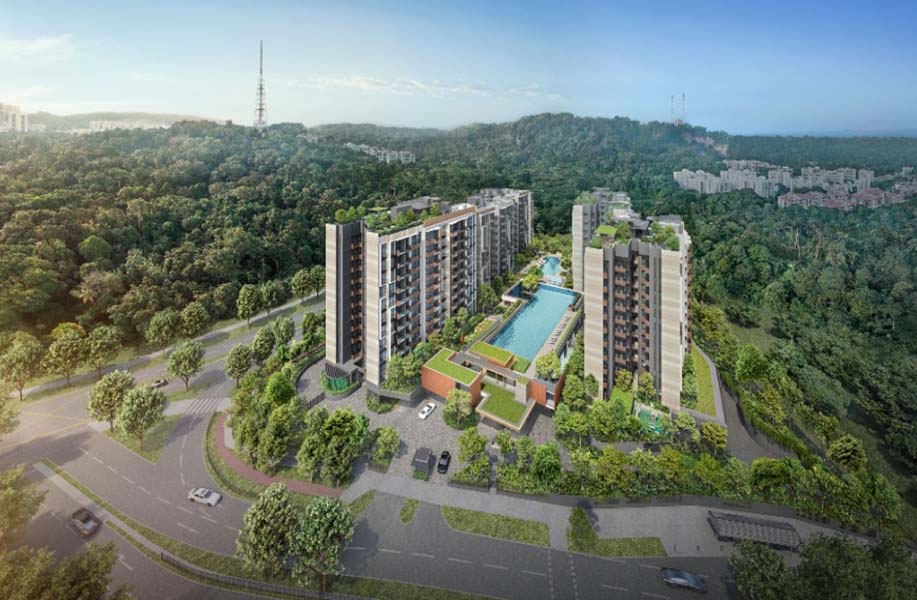
The Sen is a 99-year leasehold private residential development located along Jalan Jurong Kechil in District 21, within Singapore’s Bukit Timah planning area. Developed by Sustained Land via a Government Land Sales (GLS) site, the project comprises five 10-storey residential towers with a total of 347 units, positioned in a traditionally low-rise, greenery-fringed residential corridor rather than a transport-anchored node.
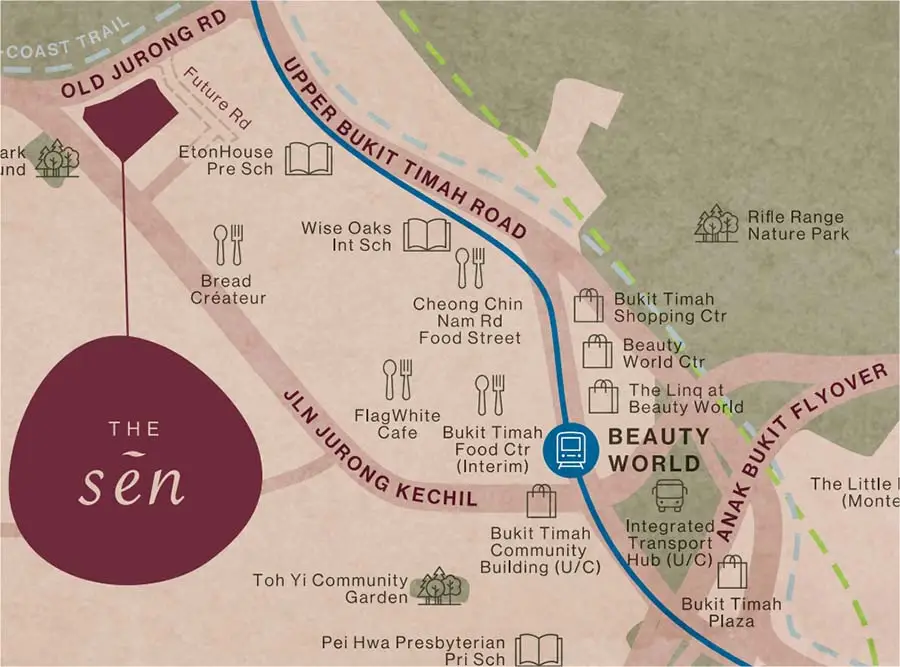
Unlike many recent District 21 launches clustered around Beauty World or Hillview MRT, The Sen does not derive its value proposition from immediate rail proximity. With Beauty World MRT approximately 1.08km away, the project is realistically bus- and car-dependent. Instead, its structural appeal lies in relative affordability for the district, adjacency to nature parks and the Rail Corridor, and a lower-density planning outcome constrained by a 1.6 plot ratio.
From a buyer-fit perspective, The Sen is clearly structured for owner-occupiers who prioritise unit efficiency, environmental surroundings, and entry pricing over daily MRT convenience or lifestyle density. Buyers seeking car-lite routines, school-centric catchments, or integrated amenities are likely to find the trade-offs difficult to justify.
The Sen is a value-led District 21 development that deliberately trades transport immediacy and tenure prestige for price accessibility and nature-oriented liveability, positioning it firmly as an own-stay-first proposition rather than an investor-driven launch.
The Sen is a 99-year leasehold residential development in District 21 positioned as a value-led entry into the Bukit Timah planning area. Located along Jalan Jurong Kechil and around 1.08km from Beauty World MRT, the project prioritises unit efficiency, natural surroundings, and affordability over MRT-centric convenience. Its appeal is strongest among owner-occupiers willing to trade transport immediacy for lower entry pricing and a quieter, lower-rise residential environment.
A lower-density, nature-adjacent District 21 launch offering one of the most affordable new-build entry points in Bukit Timah, at the expense of MRT convenience.
For buyers assessing whether The Sen aligns with their financing comfort, holding horizon, and exit assumptions, a structured project breakdown covering entry positioning, pricing logic, stack considerations, and buyer suitability may provide additional clarity before arranging any viewing.
Key Details (At a Glance)
99-year leasehold | 347 residential units | Approx. 19,245.4 sqm GLS site | District 21 (Bukit Timah Planning Area) | Beauty World MRT ~1.08 km | Launched 15 Nov 2025 (≈23% launch take-up) | Est. TOP Aug 2030 | Value-led, nature-centric own-stay development
Project Factsheet
| Item | Details |
|---|---|
| Project Name | The Sen |
| Location | Jalan Jurong Kechil |
| District / Region | District 21 / RCR |
| Tenure | 99-year leasehold (from 20 Jan 2025) |
| Developer | Sustained Land Pte Ltd |
| Site Type | GLS |
| Development Type | 5 towers of 10-storey private residential buildings with basement carpark |
| Site Area | 19,245.4 sqm |
| Plot Ratio | 1.6 |
| Total Units | 347 |
| Nearest MRT | Beauty World MRT (~1.08 km) |
| Launch Status | Launched |
| Expected TOP | August 2030 |
Pricing Context (Decision-Stage Orientation)
Buyers considering The Sen are paying for district entry, unit efficiency, and environmental surroundings rather than transport convenience or tenure prestige. Pricing is typically benchmarked against MRT-centric new launches and older resale options nearby, with buyers consciously accepting higher reliance on buses or private transport in exchange for lower absolute quantum.
Location Context
The Sen sits along Jalan Jurong Kechil, a residential arterial road linking Bukit Timah to Bukit Batok, rather than within a walk-to-MRT catchment. Although Beauty World MRT is the nearest station, the distance places it outside comfortable daily walking range for most households, making feeder buses and driving the dominant transport modes.
This location logic aligns more closely with a traditional Bukit Timah residential enclave than with a transit-oriented development. Daily convenience is shaped by road connectivity, bus services, and access to surrounding green spaces rather than by immediate access to commercial clusters or transport hubs. Buyers accustomed to driving-centric routines may find this acceptable, while car-lite households may not.
Structural Value
As a 99-year leasehold GLS development, The Sen’s value proposition is anchored in entry pricing discipline rather than long-term land scarcity. In a district where many boutique developments carry freehold tenure and corresponding price premiums, the leasehold structure creates a clear affordability wedge for buyers willing to compromise on tenure and MRT access.
For owner-occupiers with a defined holding horizon, this trade-off can be rational if personal use and liveability are prioritised over legacy ownership. However, buyers who associate Bukit Timah addresses with long-term capital preservation and tenure security should recalibrate expectations accordingly.
Scale & Design Reality
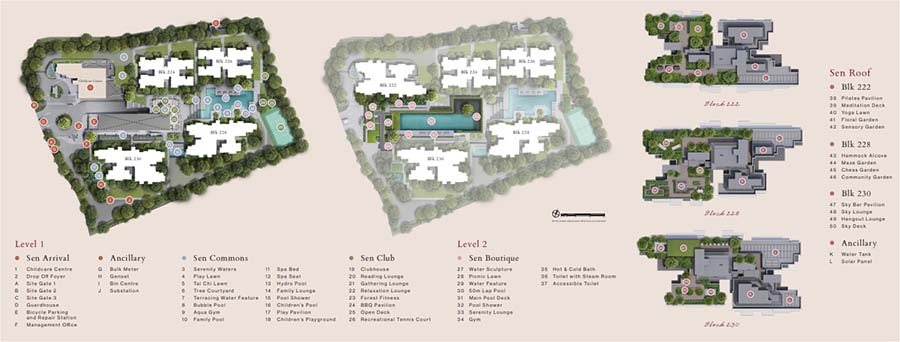
With 347 units spread across five 10-storey towers, The Sen occupies a middle ground between boutique low-density projects and large suburban estates. The scale allows for communal facilities and a mandatory on-site childcare centre without reaching the congestion levels associated with mega-developments.
That said, the finite site area and block clustering mean some internal stacks will face each other, and privacy will vary by unit selection. The project is designed around efficiency and practicality rather than architectural drama or landmark presence.
Project Positioning — What The Sen Is, and Is Not
The Sen IS:
A price-led entry into a new District 21 development
Nature-adjacent, with proximity to parks and the Rail Corridor
Structured for long-term own-stay households comfortable with driving
The Sen IS NOT:
An MRT-centric or car-lite development
A freehold or prestige-driven Bukit Timah address
An integrated, retail-anchored, or lifestyle-led project
Buyer Suitability
Most suitable for:
HDB upgraders from Bukit Batok, Bukit Panjang, and Jurong areas seeking a Bukit Timah address
Owner-occupiers who drive and value greenery over MRT access
Buyers prioritising efficient layouts and lower entry quantum within District 21
Buyers who should reconsider:
Car-less households dependent on daily rail commuting
Buyers focused on elite primary school catchments within 1km
Investors seeking MRT-driven rental liquidity
Buyers Who Should Eliminate Early
Buyers who require walk-to-MRT convenience, freehold tenure, or strong short-term rental narratives should exclude The Sen early. These are structural mismatches that pricing alone cannot fully offset.
Buyers comparing The Sen against other upcoming launches may find it helpful to frame their decision using the New Launch Condo Guide, which outlines how pricing logic, buyer intent, and holding horizon differ across project types.
Takeaway
The Sen is best understood as a pragmatic, value-oriented District 21 launch that prioritises affordability, unit efficiency, and environmental surroundings over transport convenience. For the right own-stay buyer profile, the trade-offs are explicit and manageable; for others, they are deal-breakers that should be recognised early.
If The Sen is on your shortlist and being compared against nearby alternatives, a structured review of capital commitment differences, downside exposure scenarios, liquidity positioning, and realistic exit pool dynamics may help clarify the decision framework before any commitment is made.
FAQs (Decision-Stage)
1) Is The Sen suitable for buyers who rely on MRT commuting?
Not ideally. With Beauty World MRT about 1.08km away, daily commuting is more realistically handled via buses or private transport. Buyers seeking a car-lite lifestyle may find this a structural disadvantage rather than a minor inconvenience.
2) Why is The Sen priced lower than some other District 21 launches?
Pricing reflects a combination of leasehold tenure, non-MRT-centric location, and value-led positioning. Buyers are effectively trading transport convenience and tenure prestige for lower entry quantum and larger usable space.
3) Who is the primary target buyer for this project?
The Sen mainly targets owner-occupiers, particularly families upgrading from nearby estates who are comfortable with driving-based routines. It is not structured primarily for rental-led or short-term investment demand.
4) Does proximity to nature meaningfully improve liveability?
For buyers who value quiet surroundings and access to green spaces, adjacency to parks and the Rail Corridor can materially enhance daily living. However, this benefit is lifestyle-dependent and does not replace transport convenience.
5) How does the 99-year tenure affect long-term holding considerations?
Leasehold tenure places greater emphasis on holding horizon and exit timing. Buyers planning long-term personal use may be comfortable, while those seeking legacy ownership or multi-generational holding may find the structure limiting.
6) Is the project considered low-density?
Relative to many suburban launches, yes, due to its 1.6 plot ratio and mid-rise height. However, internal facing stacks mean privacy varies by unit selection and should be assessed carefully.
7) Does the mandatory childcare centre change the living environment?
The childcare centre is a planning requirement and part of the common property, reinforcing the family-oriented nature of the development. It does not introduce retail or commercial activity.
8) How should buyers benchmark The Sen against nearby alternatives?
Buyers typically compare it against resale projects and higher-priced MRT-centric launches in the Beauty World area, weighing price savings and layout efficiency against transport convenience and tenure differences.
Pricing Logic, URA Planning Intent & Buyer Segmentation
Pricing Logic — Why The Sen Is Cheaper (and Where the Floor Is)
The Sen’s pricing behaviour is best understood as price-led by constraint, not by ambition. While it carries a Bukit Timah (District 21) address, the project does not benefit from MRT adjacency, freehold tenure, or an integrated amenity cluster — three attributes that typically justify premium pricing in this district.
Buyers are therefore paying for district entry and usable space, rather than transport convenience or prestige signalling. The market has consistently benchmarked The Sen against two reference points: MRT-centric new launches around Beauty World, and resale projects offering larger units but older stock. The pricing gap reflects a conscious trade-off rather than a mispricing anomaly.
Importantly, resistance emerges clearly once pricing approaches levels associated with MRT-linked or mixed-use developments. Buyer feedback indicates that beyond a certain threshold, purchasers would rather redirect budgets toward better-connected alternatives, even if that means accepting smaller layouts or older stock. This creates a pricing ceiling that is behaviourally enforced, not just developer-controlled.
At the same time, the relatively low land acquisition cost is widely discussed among buyers as providing a perceived buffer. While this does not guarantee future appreciation, it reduces fears of aggressive pricing inflation during later sales phases, anchoring expectations around incremental rather than speculative price movement.
URA Planning Intent — Why This Is Not a Transit-Oriented Project
The Sen sits squarely within URA’s long-standing planning approach for the Bukit Timah corridor: lower-rise residential character, environmental integration, and gradual densification rather than transit-led intensity. Unlike areas earmarked for transport hubs or mixed-use transformation, Jalan Jurong Kechil remains classified as a residential artery rather than a growth node.
The mandatory inclusion of an Early Childhood Development Centre (ECDC) further reinforces this intent. Rather than introducing retail or commercial components, the planning requirement directs the development toward community-serving residential use, supporting families already living in or moving into the area.
Looking ahead, URA’s Draft Master Plan 2025 outlines significant transformation around Turf City and Beauty World, but these initiatives are spatially and functionally distinct from The Sen’s immediate location. While infrastructure upgrades and new housing supply may gradually change the wider district, they do not convert The Sen into a transport-led or lifestyle-driven address.
As a result, buyers should interpret future planning improvements as incremental support to liveability, not a catalyst for sudden repricing. The project’s long-term relevance remains tied to its role as a quieter residential option within a gradually densifying Bukit Timah environment.
Buyer Segmentation — Who Actually Buys The Sen
Buyer behaviour to date reflects self-selection rather than broad-based demand.
The primary buyer group consists of HDB upgraders from Bukit Batok, Bukit Panjang, and Jurong East who are familiar with driving-centric lifestyles and value a Bukit Timah address at a manageable quantum. For these buyers, the lack of MRT proximity is acknowledged but tolerated, especially when balanced against unit efficiency and pricing.
A secondary group includes owner-occupiers downsizing from nearby landed or older private estates. These buyers prioritise greenery, lower-rise surroundings, and internal layout efficiency over connectivity, and often view The Sen as a practical consolidation move rather than an aspirational upgrade.
Investor participation is noticeably restrained. Rental-focused buyers express caution due to weaker MRT appeal, car dependency, and leasehold tenure in a district with abundant freehold alternatives. As a result, investor demand tends to be opportunistic rather than foundational to sales momentum.
Exit, Liquidity, Risk Scenarios, Pros & Cons, FAQs
Exit & Liquidity Outlook
Exit liquidity for The Sen is expected to be functional but selective. Resale demand is likely to come primarily from families priced out of MRT-centric or freehold Bukit Timah options who are willing to compromise on transport convenience in exchange for space and environment.
However, the buyer pool narrows significantly for car-less households and rental investors, which limits liquidity during weaker market cycles. This places greater importance on entry price discipline and realistic holding horizons.
Compared to MRT-linked projects, resale velocity may be slower, but the lower entry quantum provides some insulation against sharp downside corrections, assuming broader market stability.
Risk Scenarios
1) Transport Relevance Risk
If buyer preferences continue shifting toward car-lite living, projects without walkable MRT access may face sustained demand pressure, especially among younger households.
2) Competing Supply Risk
Future GLS launches nearby could introduce newer alternatives with similar pricing, increasing competition for resale attention and limiting price expansion.
3) Tenure Perception Risk
As the lease decays, comparison against freehold boutique developments in District 21 may become less favourable, particularly for long-term capital-focused buyers.
4) Construction & Environment Risk
Ongoing or future construction in the surrounding area could temporarily affect liveability, noise levels, and perceived tranquillity during the early holding years.
Pros & Cons Summary
Pros
Lower entry pricing relative to other District 21 launches
Efficient, post-harmonisation layouts maximise usable space
Nature-adjacent environment appealing to own-stay families
Lower-rise planning aligned with Bukit Timah character
Cons
Not within comfortable walking distance to MRT
Leasehold tenure in a freehold-heavy district
Limited immediate amenities at street level
Narrower resale and rental buyer pool
FAQs
1) Is The Sen mainly an own-stay or investment project?
The Sen is structurally positioned as an own-stay–first development, not an investment-led one. Its distance from MRT stations, reliance on buses or private transport, and 99-year leasehold tenure reduce its attractiveness to yield-focused or short-cycle investors. While some opportunistic investors may enter at lower price points, they are not the core demand driver for this project.
2) How does the MRT distance affect long-term resale prospects?
MRT distance materially narrows the resale buyer pool, particularly among younger households and car-lite families. Future buyers are more likely to be owner-occupiers who drive rather than tenants or investors seeking convenience-led locations. This typically translates into slower resale velocity compared to MRT-centric projects, even if pricing remains competitive.
3) Does a lower entry price provide downside protection?
A lower entry price helps reduce downside risk but does not eliminate it. Market conditions, interest rate cycles, and competing supply will still influence resale outcomes. Price discipline at entry matters more here than speculative expectations of rapid appreciation.
4) Which buyers are least suited for The Sen?
Car-less households, daily CBD commuters dependent on rail, and buyers who prioritise freehold tenure are structurally misaligned with this project. Similarly, investors seeking strong rental demand driven by MRT proximity should eliminate The Sen early. These mismatches tend to persist regardless of pricing incentives.
5) Can future URA planning initiatives materially uplift value?
URA planning initiatives in Bukit Timah are expected to improve liveability and infrastructure over time rather than trigger sharp price re-rating. The Sen’s location is not designated as a transport hub or mixed-use node, limiting upside from planning catalysts. Buyers should view future plans as supportive, not transformational.
6) Is the mandatory childcare centre a positive or a negative?
The childcare centre is generally neutral to positive for families with young children, reinforcing the project’s residential intent. Because it is part of the common property and not a commercial component, it does not introduce retail noise or foot traffic. For non-family households, its presence is unlikely to materially affect daily living.
7) How important is unit selection within The Sen?
Unit selection is particularly important due to block clustering and internal facing stacks. Orientation, distance from internal roads, and proximity to communal areas can materially affect privacy and noise levels. Buyers who treat all stacks as equivalent risk lower long-term satisfaction and resale appeal.
8) Will rental demand be stable despite MRT distance?
Rental demand exists but is selective rather than broad-based. Likely tenants include driving expatriates or faculty working in nearby institutions, rather than MRT-dependent renters. This limits depth of demand and places a ceiling on achievable rents compared to better-connected developments.
9) How does The Sen compare to resale projects nearby?
Resale projects may offer freehold tenure or larger unit sizes but typically lack new-build condition and GFA-harmonised efficiency. Buyers must weigh the trade-off between tenure and age versus layout efficiency and maintenance certainty. The Sen appeals to those who prioritise newer construction over tenure length.
10) Is District 21 still attractive without MRT proximity?
District 21 remains attractive primarily to families who value environment, space, and lower density over convenience. However, its appeal becomes buyer-specific rather than universal when MRT access is not immediate. The district’s prestige alone does not override transport considerations for all buyers.
11) Does the lease commencement date matter?
Yes, the lease commencement date matters when comparing against older leasehold stock. A later lease start marginally supports longer holding horizons and resale comparability. However, it does not change the fundamental leasehold dynamics over time.
12) Is The Sen suitable for short holding periods?
The Sen is not ideal for short holding strategies. Price appreciation is expected to be gradual rather than event-driven, and resale liquidity may be slower due to buyer selectivity. Buyers should be prepared for medium- to long-term holding horizons.
13) How sensitive is buyer demand to interest rate conditions?
Buyer demand is relatively sensitive to interest rate movements because many purchasers operate within tight affordability bands. Rising rates can quickly dampen sentiment and slow take-up, especially for buyers stretching budgets. This sensitivity reinforces the importance of conservative financial planning.
14) Are aggressive future price increases likely?
Aggressive price increases are unlikely given the project’s positioning and buyer resistance levels. Market behaviour suggests incremental pricing adjustments rather than speculative surges. This supports stability but limits upside potential.
15) Does the “West Region” perception affect demand?
Yes, regional perception subtly influences buyer expectations around pricing and growth. The West Region label reinforces affordability and practicality rather than centrality or prestige. For some buyers this is a positive, while for others it lowers aspirational appeal.
16) What is the single biggest decision factor for buyers?
The key decision factor is whether the price savings and liveability benefits justify the lack of MRT convenience. Buyers who are comfortable driving and value space and environment tend to answer yes. Buyers who prioritise transport efficiency usually do not.
If a structured discussion is preferred over WhatsApp, or if detailed floor plans, pricing breakdowns, or showflat arrangements are required, your details may be left below for a follow-up.