
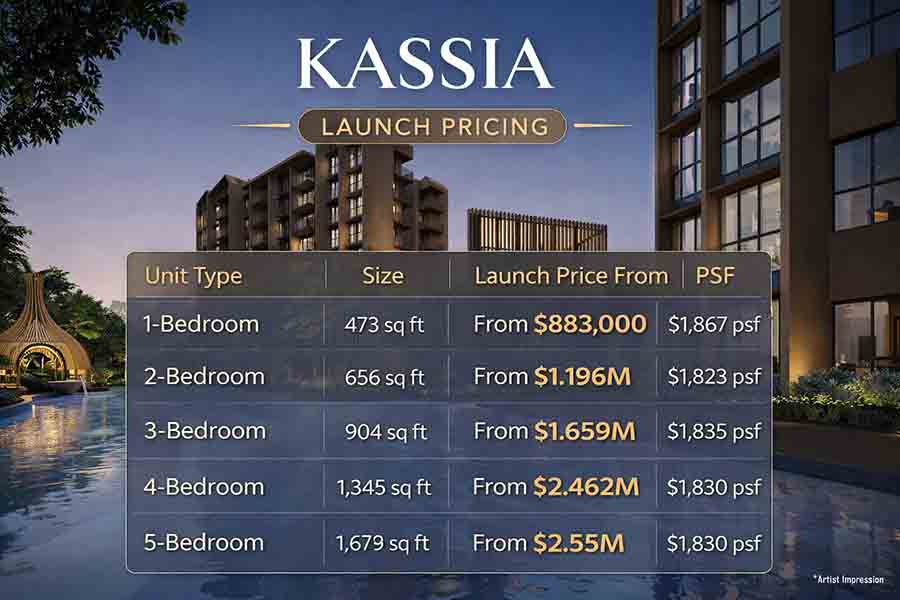
Kassia Price Guide (Quick Overview)
Kassia’s pricing sits within a relatively narrow but clearly defined band, reflecting its positioning as a freehold, low-rise development in a non-MRT-centric enclave. Buyers are not paying for transport convenience or integrated living, but for tenure permanence, controlled density, and long-horizon defensiveness.
Kassia pricing typically starts from around $883K for 1-bedroom units, from about $1.19M for 2-bedroom units, and exceeds $2.5M for larger 4- and 5-bedroom layouts, with psf generally around ~$1,820 to $2,100+ depending on unit type and positioning.
Unlike MRT-led or integrated developments, Kassia is priced around its freehold tenure, low-rise environment and controlled density, rather than transport convenience or lifestyle integration.
What buyers are paying for is long-term defensiveness and ownership permanence, not accessibility or short-term momentum.
This means pricing tends to make sense for buyers who prioritise tenure and long holding, but may feel less aligned for those comparing based on MRT access, liquidity or rental yield.
A breakdown of available units and pricing tiers can be shared to help with comparison.
Explore the Full Kassia Analysis
This article is part of the full Kassia cluster:
- Kassia Review – project positioning, buyer suitability, and long-horizon asset logic
- Kassia Floor Plan Analysis – layout efficiency, unit mix, and configuration differences
- Kassia Showflat Guide – location, viewing strategy, and buyer evaluation approach
Together, these provide a complete framework for evaluating Kassia across pricing, layout, and long-term fit.
Buyers who are still learning how Singapore new launches are typically assessed may also find the New Launch Condo Guide useful before comparing individual projects.
Kassia Entry Price and Indicative Pricing
Entry prices vary depending on unit type, with different pricing tiers reflecting layout size, stack positioning and remaining availability.
Indicative pricing is not fixed across all units, as psf and total price can differ based on floor level, facing and unit configuration.
Buyers typically assess both entry price and indicative pricing ranges together, rather than relying on a single price point.
Kassia Key Facts
- Tenure: Freehold
- Location: Flora Drive (District 17)
- MRT: Not within walking distance (non-MRT-centric)
- Unit Types: 1 to 5 Bedroom
- Entry Price: ~$883K+
- Price Range: ~$883K – $2.7M+
- PSF: ~$1,820 – $2,100+ psf
- Positioning: Freehold, low-rise enclave development
- Best For: Buyers prioritising tenure, privacy and long-term holding
Kassia Latest Pricing and Available Units (Live Snapshot)
The table below reflects the latest available units, pricing ranges and psf variation based on current remaining inventory.
| Type | Size (sqft) | PSF Range | Price Range | Available |
|---|---|---|---|---|
| 2 Bedroom (with study) | 753-775 | $2,068 – $2,153 | $1,557,000 – $1,649,000 | 8/36 |
| 3 Bedroom (with yard) | 1055 | $2,033 – $2,106 | $2,145,000 – $2,222,000 | 19/32 |
| 4 Bedroom | 1345 | $1,875 – $2,056 | $2,522,000 – $2,765,000 | 25/32 |
Current availability at Kassia is no longer evenly distributed across unit types, with smaller and standard layouts fully absorbed and remaining supply concentrated in mid- to larger-format units.
The majority of remaining options sit within 3-bedroom + yard and 4-bedroom layouts, with a limited number of 2-bedroom + study units forming the final entry point into the development.
This reflects a transition into a more selective phase where buyers are no longer comparing across a full range of unit types, but are instead evaluating whether the remaining layouts align with their household needs, lifestyle preferences and long-term plans.
As a result, pricing decisions are increasingly driven by layout completeness, internal usability and long-term own-stay suitability, rather than entry affordability or broad unit choice.
Availability and pricing may change depending on remaining inventory, with current options increasingly limited to selected mid- and larger-format layouts within the development.
For a full breakdown of unit mix, layout distribution and stack considerations, refer to the Kassia Floor Plan Analysis.
How to Interpret Kassia Pricing
Kassia pricing should be interpreted through freehold tenure, low-density living and long-term ownership value, rather than MRT access or short-term market movement.
While psf may appear attractive compared to newer leasehold launches, the key difference is that Kassia is priced without transport convenience, integrated amenities or strong rental drivers.
This means comparisons against MRT-linked or integrated developments can be misleading, as the value here is tied to ownership permanence and stability rather than accessibility or liquidity.
In practice, buyers are weighing whether the advantages of freehold ownership — long-term defensiveness, lower density and ownership permanence — justify the trade-off in connectivity and resale liquidity.
Kassia pricing is best understood as a defensive entry into freehold ownership, where buyers gain lower psf relative to many freehold developments but accept structural limitations in accessibility and rental demand
For buyers aligned with long-horizon holding and enclave living, pricing tends to feel coherent. For those prioritising convenience, rental demand or faster exit flexibility, it may feel restrictive.
Nearby Project Comparison (Pricing Context)
| Project | Tenure | Positioning | Pricing Character |
|---|---|---|---|
| Kassia | Freehold | Enclave, low-rise | Lower psf, no MRT premium |
| Parktown Residence | 99-year | Integrated, MRT-linked | Higher psf, convenience-driven |
| Pinery Residences | 99-year | OCR private condo | Mid-range, balanced |
| Rivelle Tampines (EC) | 99-year EC | Entry-level upgrader | Lowest quantum |
| Bagnall Haus | Freehold | East Coast, TEL access | Higher psf, stronger location |
Narrowing Down East-Side Options
If you are comparing Kassia with other District 17 or East-side developments and want a clearer breakdown of which units and price tiers are still worth considering, you can request a structured comparison before visiting.
Factors Influencing Kassia Pricing
Kassia pricing is driven by three key factors:
- Freehold tenure – Primary driver supporting long-term value defensiveness.
- Low-rise density – Controlled environment with quieter living conditions.
- Transport trade-off – Lack of MRT access creates a natural pricing ceiling.
Within the project, pricing varies based on stack orientation, internal-facing units and proximity to access roads.
Kassia Price Tiers by Unit Type
| Unit Type | Size Range | Entry Price | Typical Buyer |
|---|---|---|---|
| 1 Bedroom | 473 sqft | From ~$883K | Singles / investors |
| 2 Bedroom | 656 sqft | From ~$1.19M | Couples |
| 3 Bedroom | 904 sqft | From ~$1.65M | Small families |
| 4 Bedroom | 1,345 sqft | From ~$2.46M | Families |
| 5 Bedroom | 1,679 sqft | From ~$2.55M+ | Multi-generational buyers |
Buyers typically evaluate Kassia based on total quantum, tenure value and long-term holding potential, rather than psf alone.
Unit Types and Buyer Direction
1 Bedroom
Entry-level access to freehold ownership, but faces stronger competition from MRT-linked alternatives.
2 Bedroom
The core segment balancing affordability and usability, but still compared heavily against better-connected leasehold projects.
3 Bedroom
The most practical family entry point, where value improves as psf stabilises across larger layouts.
4 Bedroom
Targets families prioritising space and tenure over accessibility, with stronger long-term alignment.
5 Bedroom
A niche segment suited for multi-generational households and long-horizon buyers prioritising ownership permanence.
Kassia tends to suit buyers who:
- want entry into freehold at a lower psf
- prioritise long-term holding over short-term movement
- are comfortable with a non-MRT location
It is more aligned with:
- budget-conscious freehold buyers
- owner-occupiers planning long holding
- buyers comparing freehold alternatives rather than MRT projects
It is less aligned with:
- investors seeking rental demand
- buyers prioritising MRT convenience
- buyers needing strong exit liquidity
Affordability Considerations
Affordability at Kassia is driven more by total quantum and psf positioning than by rental potential.
Buyers are effectively deciding:
Is lower psf freehold worth giving up connectivity?
This makes affordability a trade-off decision rather than a pure budget calculation.
Pricing Structure
Kassia is positioned as:
- a defensive freehold entry project
- within a low-density enclave
- without MRT-driven premium
Pricing reflects:
long-term holding orientation
lower psf vs other freehold projects
absence of transport premium
Kassia Pricing, Promotions and Release Structure
Pricing is typically structured in phases rather than direct discounts.
What buyers often refer to as “discounts” or “promotions” usually reflects differences in entry positioning and unit selection, rather than explicit price reductions.
This means pricing advantages are generally linked to availability and unit choice, rather than headline discounts.
Frequently Asked Questions About Kassia Pricing
1) What is the latest price of Kassia?
Kassia prices typically start from around $883K and can exceed $2.5M depending on unit type and availability. Pricing varies based on stack and layout positioning. Buyers usually evaluate based on long-term ownership rather than short-term price movement.
2) Why is Kassia psf lower than some freehold projects?
Kassia psf is generally lower because it is not MRT-centric and does not carry a transport premium. This creates a more accessible entry point into freehold ownership. Buyers are effectively trading accessibility for lower psf. The pricing reflects this structural trade-off.
3) Are there units still available at Kassia?
Unit availability depends on sales progress and demand across layouts. Two- and three-bedroom units typically see stronger demand. Buyers should focus on whether remaining units still offer good long-term usability. Availability alone is not the key factor.
4) Is Kassia worth buying compared to leasehold projects?
Kassia may make sense for buyers prioritising freehold ownership and long-term stability. However, leasehold projects may offer stronger connectivity and rental demand. The decision depends on whether tenure or convenience matters more. It is a trade-off rather than a direct comparison.
5) What is the main trade-off at Kassia?
The main trade-off is between tenure and accessibility. Buyers gain freehold ownership but give up MRT convenience and rental demand strength. This affects both daily living and exit flexibility. It is a structural trade-off.
6) Who is Kassia most suitable for?
Kassia is generally suited for buyers who want a lower-entry freehold option and are comfortable with a non-MRT location. These buyers typically prioritise long-term holding over liquidity. It is less aligned with investors or convenience-driven buyers.
Final Thoughts on Kassia Pricing
Kassia is best understood as a defensive freehold entry, rather than a convenience-driven or momentum-driven project.
Its pricing makes the most sense when viewed through:
- lower psf access to freehold ownership
- long-term holding defensiveness
- a quieter, low-density enclave environment
rather than MRT access, rental demand or short-term capital movement.
Buyers who prioritise tenure and long-horizon ownership are more likely to find the pricing rational. Those focused on connectivity, liquidity or rental yield may find it less compelling.
Ultimately, Kassia is not about chasing growth or convenience.
It is about entering freehold at a lower price point — with clear trade-offs attached.
Evaluating Kassia Against Other Options
You can request a structured comparison of available units, pricing tiers and stack options for easier evaluation.
Details submitted below will receive the latest available units and pricing information.