
Summary
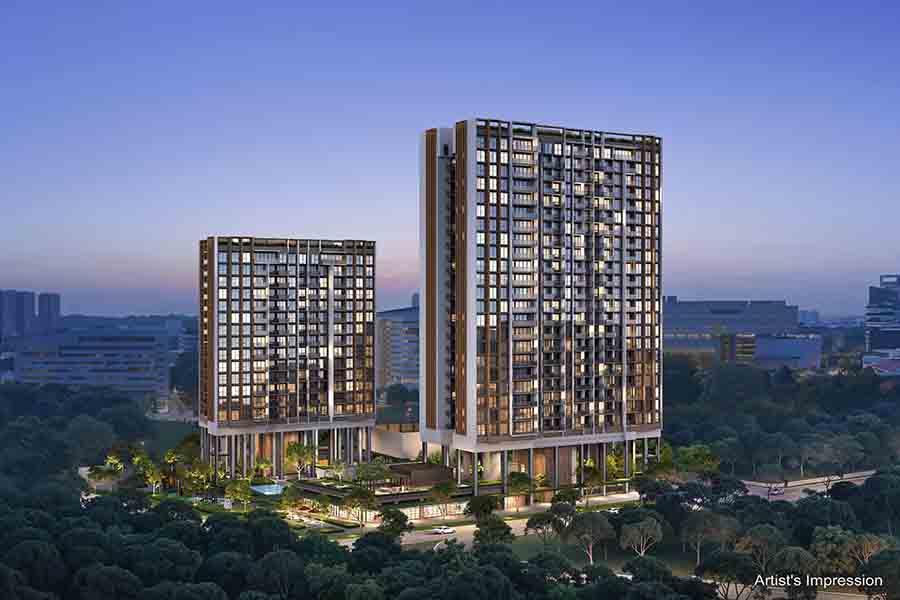
Hudson Place Residences is a 99-year leasehold private residential development located at Media Circle in District 5 (Queenstown Planning Area), developed by Qingjian Realty, Forsea Holdings, and Hoovasun Holding under the GLS programme. With approximately 327 residential units and a small first-storey commercial component, the project forms part of Media Circle’s transition from a media-industrial zone into a high-density residential enclave serving the one-north ecosystem.
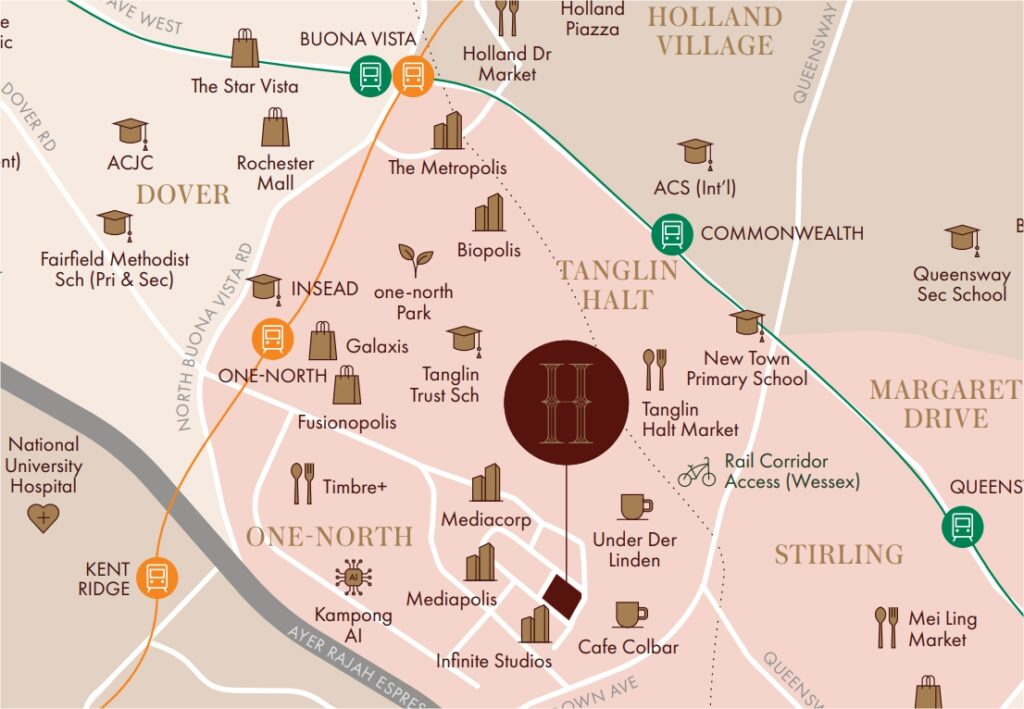
Unlike MRT-fronting projects in Buona Vista or Clementi, Hudson Place Residences is positioned as a work-adjacent, yield-oriented development rather than a transport-led lifestyle project. Its value proposition is built around proximity to Mediapolis, Biopolis, Fusionopolis, and NUH, targeting tenants and buyers who prioritise walking or short commutes to work over doorstep MRT access.
This review assesses Hudson Place Residences from a decision-stage perspective, focusing on who the project realistically works for, what buyers and investors are actually paying for, and the structural trade-offs involved in choosing a Media Circle address over MRT-centric one-north alternatives.
Hudson Place Residences is a yield-first, work-adjacent private condominium designed for buyers and investors targeting the one-north employment cluster rather than MRT-led convenience. It suits professionals and long-horizon investors who prioritise proximity to Mediapolis and Biopolis, while buyers expecting MRT-centric living or broad family appeal may find its trade-offs limiting.
Post-Launch Update
Hudson Place Residences officially launched on 16 May 2026 and sold 201 of its 327 units over launch weekend, representing approximately 61.5% take-up at an average price of around $2,458 psf.
The launch response suggests that buyers were willing to trade MRT adjacency for newer product, lower relative entry pricing within the one-north ecosystem, and proximity to Media Circle’s employment cluster.
Interestingly, all 14 three-bedroom deluxe units were reportedly fully sold during the initial launch phase, indicating stronger-than-expected demand for selected family-oriented layouts despite the project’s predominantly rental-led positioning.
From a broader market perspective, the launch performance also reinforces how one-north and Media Circle projects are increasingly being evaluated through employment proximity, affordability relative to MRT-fronting RCR projects, and long-term rental resilience rather than purely transport-led convenience.
Explore the Full Hudson Place Residences Analysis
This review forms part of the full project cluster:
• Hudson Place Residences Price Guide – pricing positioning, land-cost logic, and entry quantum analysis
• Hudson Place Residences Floor Plan Analysis – unit mix, layout efficiency, and stack considerations
• Hudson Place Residences Showflat Guide – showroom location, viewing process, and what buyers should evaluate during a visit
Together, these articles provide a structured analysis of the project’s pricing framework, layout strategy, showroom considerations, and buyer decision factors.
If you’re considering this project, you might want to check how it actually compares and what most buyers tend to overlook — before deciding.
Key details (at a glance)
99-year leasehold | 327 units | Private residential with first-storey commercial
Located at Media Circle (Parcel A) | Estimated TOP: 30 September 2029 | District 5 (RCR / Queenstown)
Project Factsheet
| Item | Details |
|---|---|
| Project Name | Hudson Place Residences |
| Location | 18, 20 Media Circle |
| District / Region | District 5 / RCR (Queenstown) |
| Tenure | 99 years |
| Developer | Qingjian Realty, Forsea Holdings & Hoovasun Holding |
| Site Type | GLS – Media Circle (Parcel A) |
| Development Type | Private Residential with 1st-storey commercial |
| Site Area | 7629.7 sqm |
| Plot Ratio | 3.7 |
| Total Units | 327 |
| Nearest MRT | One-north MRT (CC23), approx. 1.0–1.1 km |
| Launch Date | 16 May 2026 |
| Estimated TOP | 30 September 2029 |
Hudson Place Residences is a yield-first, work-adjacent private condominium for one-north professionals and investors, not an MRT-centric lifestyle project or family-led suburban development.
Hudson Place Residences is a yield-first, work-adjacent private condominium for one-north professionals and investors, not an MRT-centric lifestyle project or family-led suburban development.
Location Context: The Media Circle Pivot
Hudson Place Residences sits within Media Circle, an area undergoing a deliberate shift from a media-industrial zone into a residential support enclave for one-north. This is not organic gentrification; it is a planned, supply-driven transformation, with multiple GLS plots intended to inject over 1,500 new homes into this micro-district.
The key distinction buyers must understand is that Media Circle is employment-first, not transport-first. The project is approximately 1.0–1.1 km from one-north MRT, which places it outside convenient doorstep-MRT positioning for most residents. As a result, Hudson Place functions as a bus-reliant or walk-to-work address, depending on where occupants are employed within the Mediapolis and Biopolis clusters.
This positioning immediately narrows — and clarifies — the buyer and tenant profile.
Work-Adjacency Over MRT Adjacency
For projects around one-north, proximity to employment nodes often matters more than proximity to MRT stations. Hudson Place Residences leans fully into this logic.
Its immediate adjacency to Mediapolis, and short travel times to Biopolis, Fusionopolis, and NUH, make it effectively an on-campus housing solution for professionals in media, tech, research, and healthcare. For these occupants, eliminating a daily commute can outweigh the inconvenience of not being next to an MRT station.
This is a functional, not aspirational, advantage — and it shapes both rental demand and buyer satisfaction.
Amenities at Hudson Place Residences
Hudson Place Residences is designed as a compact, efficiency-led development, with facilities that prioritise daily usability and tenant appeal rather than large-scale resort-style living.
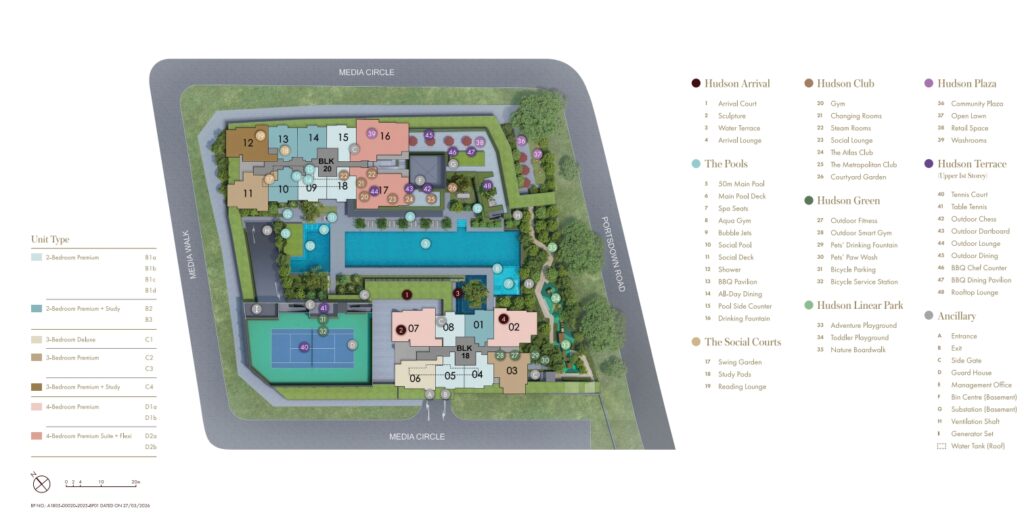
The site plan reflects a practical layout anchored by a central pool deck, supported by essential recreational and social spaces suited for working professionals and smaller households.
Core Facilities and Layout Strategy
Based on the site configuration, facilities are organised into several key zones:
- Central Pool Deck
A 50m main pool forms the visual and functional centre of the development, supported by sun decks and lounging areas. This acts as the primary communal space for residents. - Clubhouse & Social Spaces
Indoor and semi-outdoor lounges, function rooms, and social areas are positioned to support casual gatherings, remote work, and small group interactions. - Fitness & Wellness Facilities
Gym spaces, outdoor fitness areas, and wellness zones cater to residents with active lifestyles, particularly professionals working within one-north. - Tennis Court & Active Zones
A full-sized tennis court and additional recreational facilities provide basic sports options without over-allocating space to rarely-used amenities. - Landscaped Green Areas
The development integrates pockets of greenery and linear park connectors, creating a softer environment within an otherwise urban precinct.
What the Amenities Tell You About the Project
The facilities mix reinforces Hudson Place Residences’ positioning:
- Not a resort-style, family-centric development
- Focused on functionality over lifestyle branding
- Designed for high usage by working professionals and tenants
- Optimised for compact land use rather than expansive facilities
For buyers and investors, this is consistent with the project’s overall strategy — supporting rental demand, tenant convenience, and operational efficiency, rather than competing on luxury or scale.
Commercial Micro-Node, Not a Mall
The inclusion of first-storey commercial space is modest in scale but strategically important. Media Circle currently lacks everyday F&B and convenience offerings, and Hudson Place is positioned to become a micro-node for cafes or essential services within the immediate area.
This is unlikely to materially change resale pricing on its own, but it improves tenant stickiness and day-to-day liveability, especially for professionals working long hours within one-north.
Who Hudson Place Residences Is Really For
1. Investors Targeting One-North Rental Demand
Hudson Place Residences is fundamentally positioned as a rental-driven asset. The tenant pool is anchored by:
Media and tech professionals working in Mediapolis and nearby campuses
Researchers, post-graduate staff, and visiting faculty from Biopolis, INSEAD, ESSEC, and NUS
Healthcare professionals from NUH seeking quieter, work-adjacent housing
These tenants tend to prioritise proximity to work and unit modernity over MRT adjacency, particularly when a pricing gap exists relative to MRT-fronting projects.
2. Young Professionals and DINK Households
For dual-income couples or singles working in one-north, Hudson Place functions as a low-maintenance live-work pod. The appeal lies in reclaimed time rather than lifestyle prestige.
This buyer profile is less sensitive to family-centric amenities and more focused on efficient layouts, smart-home features, and proximity to employment.
3. Academic and Medical Own-Stay Buyers
A smaller but relevant segment includes academics and medical professionals who value quieter surroundings compared to the busier Buona Vista interchange. For them, Hudson Place is a functional own-stay option, not a lifestyle upgrade.
Who Should Eliminate Hudson Place Residences Early
Hudson Place Residences should be eliminated early by buyers who:
Require doorstep MRT access for daily commuting
Are purchasing primarily for family-centric living or primary school planning
Expect broad mass-market resale demand similar to MRT-fronting projects
Are uncomfortable with rental-led valuation logic
These are not flaws — they are design choices that define the project’s performance behaviour.
Buyers comparing Hudson Place Residences against other upcoming launches may find it helpful to frame their decision using the New Launch Condo Guide, which outlines how pricing logic, buyer intent, and holding horizon differ across project types.
The Core Trade-Off
Buying Hudson Place Residences means accepting a clear trade-off:
You give up MRT adjacency in exchange for lower entry pricing and direct access to one-north’s employment ecosystem.
This trade-off underpins both rental logic and future resale constraints.
Takeaway
Hudson Place Residences works best as a yield-first, work-adjacent asset for buyers and investors who understand one-north’s employment-driven housing dynamics. It works poorly for buyers seeking MRT-centric convenience, broad family appeal, or lifestyle-led prestige. As a Media Circle project, its success depends less on mass-market desirability and more on sustained demand from a specialised professional tenant base.
The launch response also suggests that there remains meaningful demand for well-priced one-north housing despite the project’s MRT trade-offs, particularly among buyers prioritising employment proximity and relative entry affordability within the RCR market.
If you’re seriously considering this project, it’s worth checking how it actually compares and what most buyers tend to overlook — before deciding.
FAQs (Decision-Stage)
1) Is Hudson Place Residences mainly an investment or own-stay project?
Hudson Place Residences is primarily structured as an investment-led and employment-adjacent project rather than a broad mass-market own-stay development. Its location within the one-north employment ecosystem creates a tenant-driven demand base, which supports rental logic more than family-centric living. Own-stay demand exists, but it is niche and typically tied to work proximity rather than lifestyle preference.
2) How significant is the distance to one-north MRT for buyers and tenants?
The distance to one-north MRT is a real consideration and should not be downplayed. For occupants who commute primarily by train, this may be a drawback. However, for tenants and owners working within Mediapolis or nearby campuses, walk-to-work convenience often outweighs MRT adjacency.
3) Who are the most likely tenant profiles for Hudson Place Residences?
The core tenant pool consists of media, technology, research, and healthcare professionals working in the one-north ecosystem. These tenants typically prioritise proximity to work, modern layouts, and unit quality over MRT frontage. This creates a specialised but deep rental demand base.
4) Is Hudson Place Residences comparable to MRT-fronting projects like Blossoms by the Park?
Not directly. MRT-fronting projects appeal to a broader mass-market buyer pool and tend to have stronger resale optics. Hudson Place trades MRT access for lower entry pricing and work adjacency, which leads to different buyer behaviour and exit dynamics.
5) Does the first-storey commercial space materially improve value?
The commercial component improves daily convenience and tenant stickiness, especially in an area currently lacking F&B options. However, it should be viewed as a supporting feature rather than a primary price driver. Its impact is more functional than speculative.
6) Is Hudson Place Residences suitable for families planning long-term living?
It may suit a narrow group of families, particularly those tied to nearby schools or institutions. That said, it is not a family-led project in the traditional sense. Buyers prioritising MRT access, primary school proximity, or suburban living patterns may find better-aligned alternatives elsewhere.
7) How does Hudson Place Residences typically perform in weaker market conditions?
Rental-led projects tend to show more resilience if employment demand remains stable. However, resale liquidity can become more selective because the buyer pool is narrower. This makes entry price discipline especially important.
8) What type of buyer is most likely to be satisfied over the long term?
Buyers and investors who clearly understand one-north’s employment-driven housing dynamics tend to be most satisfied. Those comfortable with a specialised tenant base and realistic exit expectations are better aligned with the project’s structure.
Pricing Logic, URA Planning Intent & Buyer Segmentation
Hudson Place Residences should not be evaluated using conventional RCR or OCR pricing frameworks. Its pricing behaviour is shaped primarily by rental economics, employment adjacency, and relative entry pricing within the one-north ecosystem, rather than MRT proximity or family-led own-stay demand. This section examines how pricing is likely to behave, how it aligns with URA’s longer-term planning for Queenstown and one-north, and which buyer segments are structurally supported — or constrained — by this positioning.
Pricing Logic: Yield-First, Not Lifestyle-Led
Launch Pricing Context
Launch pricing at Hudson Place Residences averaged around $2,458 psf during launch weekend, positioning the project below several MRT-fronting RCR launches while still reflecting one-north’s growing employment-driven housing demand.
The pricing behaviour remains closely tied to several structural factors:
GLS land cost of approximately $1,037 psf ppr
Smaller project scale (327 units)
Private residential zoning with limited commercial space
Location within Media Circle, not within MRT walking distance
Crucially, Hudson Place entered the market at a meaningfully lower land cost than nearby Media Circle plots awarded earlier, including Bloomsbury Residences. This creates room for a relative entry discount rather than a headline premium.
The actual launch pricing also suggests that the developer avoided positioning Hudson Place as a headline-premium project despite improving sentiment around one-north and Media Circle. Instead, pricing appears calibrated to preserve relative affordability versus MRT-fronting RCR alternatives while still capturing demand from buyers seeking newer product within the one-north ecosystem.
Buyers are therefore not paying for MRT frontage or family-led desirability. They are paying for:
Access to one-north’s employment ecosystem
New-build quality in a supply-constrained work cluster
A lower entry point relative to MRT-fronting peers
Pricing Behaviour: How Hudson Is Likely to Perform
Pricing at Hudson Place Residences is expected to behave more like a rental-anchored asset than a mass-market RCR condo:
Initial pricing must remain competitive versus MRT-fronting one-north projects to compensate for the MRT gap
Rental yields and entry quantum matter more than psf optics
Based on the launch response, price performance is likely to remain more rental-anchored and employment-driven rather than purely sentiment-led or lifestyle-led.
Unlike family-led projects where resale demand broadens over time, Hudson’s buyer pool remains structurally specialised, which naturally caps upside but can stabilise downside.
Absolute Quantum vs PSF: The Correct Evaluation Lens
For Hudson Place Residences, absolute quantum is the dominant decision factor.
Reasons include:
Core buyers are investors and young professionals
Smaller unit formats favour affordability over headline psf
Rental viability depends on achievable monthly rents
Tenants compare rent levels, not psf metrics
If pricing stretches too close to MRT-fronting alternatives, Hudson’s rental logic weakens quickly.
Explicit Pricing Decision Rules
If your priority is rental yield and proximity to one-north employment nodes, Hudson’s pricing logic is coherent.
If you prioritise MRT adjacency or mass-market resale liquidity, Hudson will feel expensive for what it offers.
Buyers expecting lifestyle-led or family-driven appreciation should recalibrate or eliminate early.
URA Planning Context: Queenstown & One-North Evolution
URA’s planning direction for Queenstown and one-north is intensification, not suburbanisation.
Key planning themes include:
Continued densification of one-north as a global innovation hub
Expansion of residential supply around employment clusters
Health District @ Queenstown and upgraded community infrastructure
Improved park connectors and car-lite mobility initiatives
For Hudson Place Residences, this means:
Demand is anchored to jobs, not schools
Rental demand is reinforced by policy-backed employment growth
Residential supply increases will be concentrated within similar micro-clusters
This supports Hudson’s rental thesis but also limits its differentiation versus future Media Circle plots.
Buyer Segmentation: Who Hudson Place Really Serves
1. Yield-Focused Investors (Primary Segment)
Profile
Prioritise rental income and tenant depth
Comfortable with specialised demand
Less reliant on MRT-driven resale optics
Why it works
Deep professional tenant pool in one-north
Lower entry pricing relative to MRT-fronting peers
Smaller scale improves manageability
2. Young Professionals & DINK Households
Profile
Employed within one-north
Value time savings over lifestyle prestige
Low reliance on schools or family amenities
Why it works
Walk-to-work or short commute
Modern layouts and smart-living features
Functional convenience over branding
3. Academic & Medical Own-Stay Buyers (Secondary)
Profile
NUH staff, researchers, faculty
Prefer quieter surroundings
Longer holding horizons
Limitations
Narrower resale audience
Less flexible if job location changes
4. Family-Led Buyers & Mass-Market Upgraders
Suitability: Low
MRT distance weakens appeal
Limited family-centric positioning
Resale demand remains specialised
Interim Assessment
Hudson Place Residences should be viewed as:
A rental-anchored, employment-driven private asset — not a transport-led or family-centric residential project.
Exit & Liquidity, Risk Scenarios, Pros & Cons, and Buyer FAQs
Summary
Hudson Place Residences exhibits an exit and risk profile shaped by specialisation rather than scale. Liquidity depends heavily on rental viability, employment stability within one-north, and sustained pricing discipline. This section evaluates exit dynamics, downside risks, and realistic holding expectations.
Exit & Liquidity Analysis
Liquidity Profile of Employment-Led Projects
For projects like Hudson Place:
Resale demand is narrower but repeatable
Liquidity is strongest when rental yields remain attractive
Buyer pool contracts quickly if entry prices rise too far
This produces stable but selective liquidity, not broad market appeal.
Unit-Type Liquidity Tendencies
While unit mix is unconfirmed, employment-led projects typically show:
Stronger demand for compact, efficient units
More selective demand for larger family-sized units
Exit outcomes closely tied to rentability
Timing Sensitivity
Exit performance is more sensitive to:
One-north employment health
Interest rate environment
Relative pricing vs MRT-fronting competitors
Less sensitive to:
Lifestyle branding
Family-cycle demand
Multi-Scenario Risk Analysis
Scenario 1: Soft Rental Market
Impact: Rental pressure
Implication: Entry price discipline becomes critical
Scenario 2: Rising Interest Rates
Impact: Yield compression
Implication: Investors reassess returns; resale slows
Scenario 3: Continued One-North Expansion
Impact: Tenant demand deepens
Implication: Supports rents and exit viability
Scenario 4: New Media Circle Supply
Impact: Increased competition
Implication: Hudson must remain price-competitive
Pros & Cons Summary
Pros
Strong one-north employment adjacency
Lower land cost than nearby peers
Clear rental demand logic
Manageable project scale
Cons
No MRT adjacency
Narrow resale buyer pool
Yield-dependent valuation
Limited family appeal
FAQs
1) How is Hudson Place Residences priced relative to its location?
Pricing is expected to reflect its rental-led positioning rather than MRT frontage. Buyers are paying for work adjacency and relative entry value, not lifestyle premiums.
2) Is Hudson Place expensive for District 5?
It may appear expensive if compared purely on MRT access. Relative to one-north employment demand and nearby MRT-fronting projects, its entry pricing is intended to be more restrained.
3) What affects pricing the most for this project?
Rental demand depth, land cost advantage, and how clearly pricing differentiates itself from MRT-fronting alternatives.
4) Is Hudson Place suitable for short-term investment?
No. Returns are more likely to accrue steadily through rental income rather than short-term price appreciation.
5) How important is MRT access for resale?
MRT access matters for mass-market resale, which is why Hudson’s buyer pool remains specialised. Pricing must compensate for this gap.
6) Does the commercial space improve exit prospects?
It supports tenant appeal and daily convenience but should not be treated as a major resale catalyst.
7) What kind of rental yields can buyers expect?
Yields depend heavily on entry price discipline and market conditions. The project’s logic supports rental demand, not guaranteed yields.
8) How resilient is this project in a weaker market?
Rental-led projects can be more resilient if employment remains stable, but resale liquidity becomes more selective.
9) Will future Media Circle projects affect resale?
Yes. Additional supply increases competition and places pressure on pricing differentiation.
10) Is this a good hedge against market volatility?
Only partially. Employment stability helps, but specialised demand increases sensitivity to pricing errors.
11) What holding period makes sense?
A medium- to long-term holding period aligns better with rental economics and exit timing.
12) Is Hudson Place suitable for retirees?
Generally no. The project is designed around working professionals rather than retirement living.
13) How does Hudson compare to Blossoms by the Park?
Blossoms benefits from MRT adjacency and broader appeal, while Hudson competes on lower entry pricing and work proximity.
14) Does being in Media Circle limit long-term appreciation?
It limits mass-market upside but does not eliminate steady value growth tied to employment demand.
15) What is the biggest risk buyers should watch?
Overpaying relative to MRT-fronting alternatives, which would undermine rental and exit logic.
16) How should buyers decide if Hudson Place is right for them?
By aligning expectations with rental-led returns, employment proximity, and acceptance of a narrower resale audience.
If you prefer a more structured walkthrough, you can leave your details below and we’ll follow up with you.