
Summary
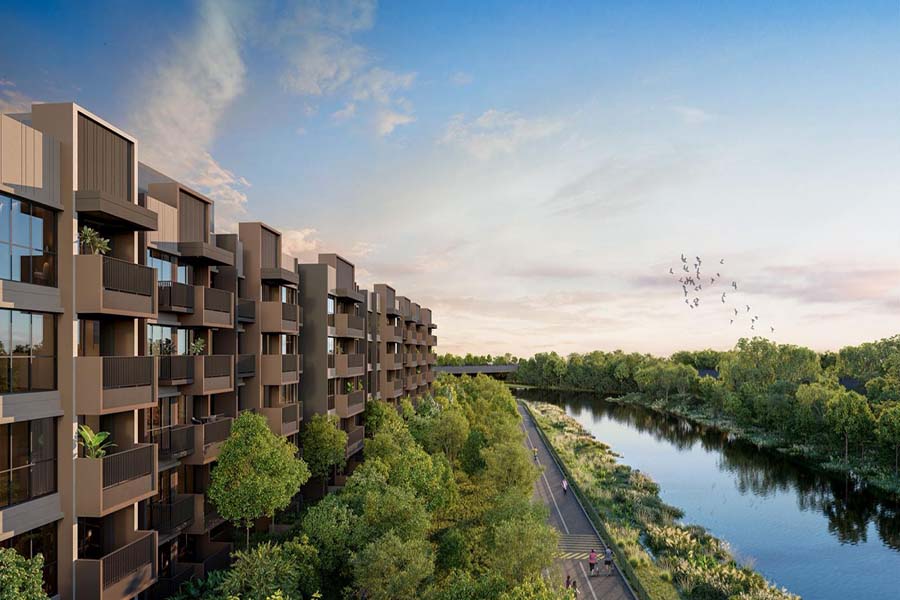
Faber Residence is a 99-year leasehold, low-rise residential development along Faber Walk in District 5, positioned within the Clementi Planning Area. Comprising nine five-storey blocks and 399 units, the project differentiates itself not through transport integration or urban convenience, but through a rare combination of low density, river adjacency, and proximity to a top-tier primary school.
Unlike high-rise launches concentrated around Clementi Central and Jurong East, Faber Residence targets a narrower buyer segment: family-oriented owner-occupiers who prioritise a quieter living environment, nature access, and long-term schooling considerations over immediate MRT convenience. Its pricing strategy—deliberately set below Clementi’s high-rise benchmarks—allowed it to achieve a strong initial take-up, clearing the bulk of its family-sized inventory early.
Faber Residence works best as a niche, low-rise OCR option: it appeals to buyers who value a quieter landed-adjacent environment, river/park-connector access, and school-driven liveability more than MRT-adjacent convenience. The trade-off is clear—daily transport friction and potentially higher running costs typical of landscaped, low-density projects.
Faber Residence Pricing, Investment Potential and Buyer Suitability
What is the price of Faber Residence?
Faber Residence pricing is positioned below high-rise Clementi launches, reflecting its non-MRT location and low-rise typology. Buyers are paying for space, privacy, and school proximity rather than transport convenience. Absolute quantum remains the key decision factor, particularly for larger family-sized units.
Is Faber Residence a good investment?
Faber Residence functions as a defensive, lifestyle-driven asset rather than a high-growth investment. Demand is supported by school proximity and low-density scarcity, but capital appreciation is likely to be steady rather than aggressive.
Is Faber Residence suitable for own stay?
Faber Residence is well suited for family owner-occupiers prioritising space, quiet surroundings, and proximity to Nan Hua Primary School. It is less suitable for buyers who require MRT accessibility for daily commuting.
Explore the Full Faber Residence Analysis
This article is part of the full Faber Residence cluster:
- Faber Residence Price Guide – pricing structure, market positioning, and buyer entry analysis
- Faber Residence Floor Plan Analysis – layout efficiency, unit mix, and stack considerations
- Faber Residence Showflat Guide – viewing strategy, location context, and buyer evaluation framework
Together, these articles provide a structured analysis of the project’s positioning, pricing framework,
If you’re considering this project, you might want to check how it actually compares and what most buyers tend to overlook — before deciding.
Key details (at a glance)
99-year leasehold | 399 units | Private residential (low-rise, 5-storey blocks)
Located at Faber Walk | District 5 (OCR / Clementi Planning Area)
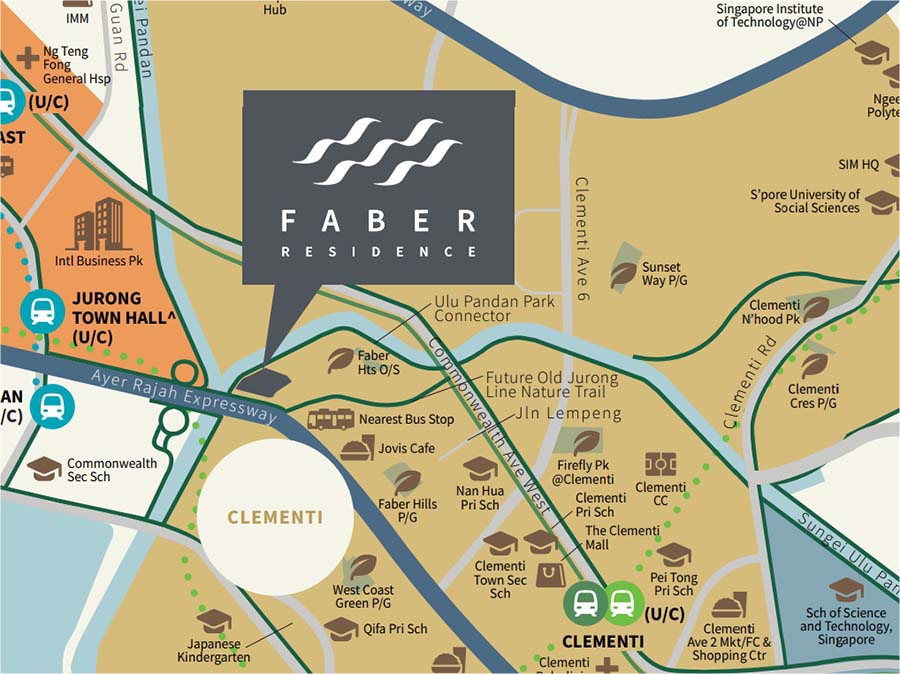
Near Ulu Pandan Park Connector and Sungei Ulu Pandan | Not immediately next to an MRT station
Est. TOP Q1 2029 | 2–5 Bedroom mix (family-weighted)
Project Factsheet
| Item | Details |
|---|---|
| Project Name | Faber Residence |
| District / Region | District 5 / OCR / Clementi Planning Area |
| Address | 54–70 Faber Walk |
| Developer | GuocoLand, Hong Leong Holdings & TID |
| Tenure | 99 years commencing 24 Feb 2025 |
| Site Type | GLS New Launch |
| Development | 9 blocks of 5-storey residential buildings |
| Total Units | 399 units |
| Plot Ratio | 1.4 |
| Site Area | ~277,600 sqft |
| Unit Mix | 2BR to 5BR (family-centric) |
| Estimated TOP | Q1 2029 |
Faber Residence is a low-density, school-anchored waterfront condominium designed for family owner-occupiers who value space, privacy, and long-term liveability over MRT adjacency.
Faber Residence Location Analysis (Clementi, District 5)
Faber Residence is located within the Clementi Planning Area in Singapore’s West Region, a mature residential zone with established schools, amenities, and transport connectivity.
Faber Residence is situated within the Faber landed enclave, an area defined by low-rise housing, limited through-traffic, and direct adjacency to Sungei Ulu Pandan. Unlike projects along Clementi Avenue 1 or Commonwealth Avenue West, the site is intentionally insulated from commercial activity, reinforcing its residential character.
While the development is not immediately next to an MRT station, daily needs are supported by Clementi Central and the West Coast cluster via bus or private transport. The future Jurong Town Hall MRT station on the Jurong Region Line introduces a medium-term uplift narrative, but buyers should treat this as a secondary benefit rather than a core driver of value.
Faber Residence Project Positioning: Low-Rise vs High-Rise Trade-Offs
The defining feature of Faber Residence is its five-storey, low-rise configuration—a typology that has become increasingly rare in Clementi due to land scarcity and rising plot ratios. This design choice preserves privacy, reduces visual density, and creates a living environment closer to landed housing than to typical OCR condominiums.
However, this also introduces trade-offs. Lower density and extensive landscaping often translate into higher per-unit maintenance costs, and the absence of integrated retail or transport amenities places greater reliance on private mobility. Buyers are effectively choosing lifestyle alignment over urban efficiency.
Faber Residence Amenities and Facilities Overview
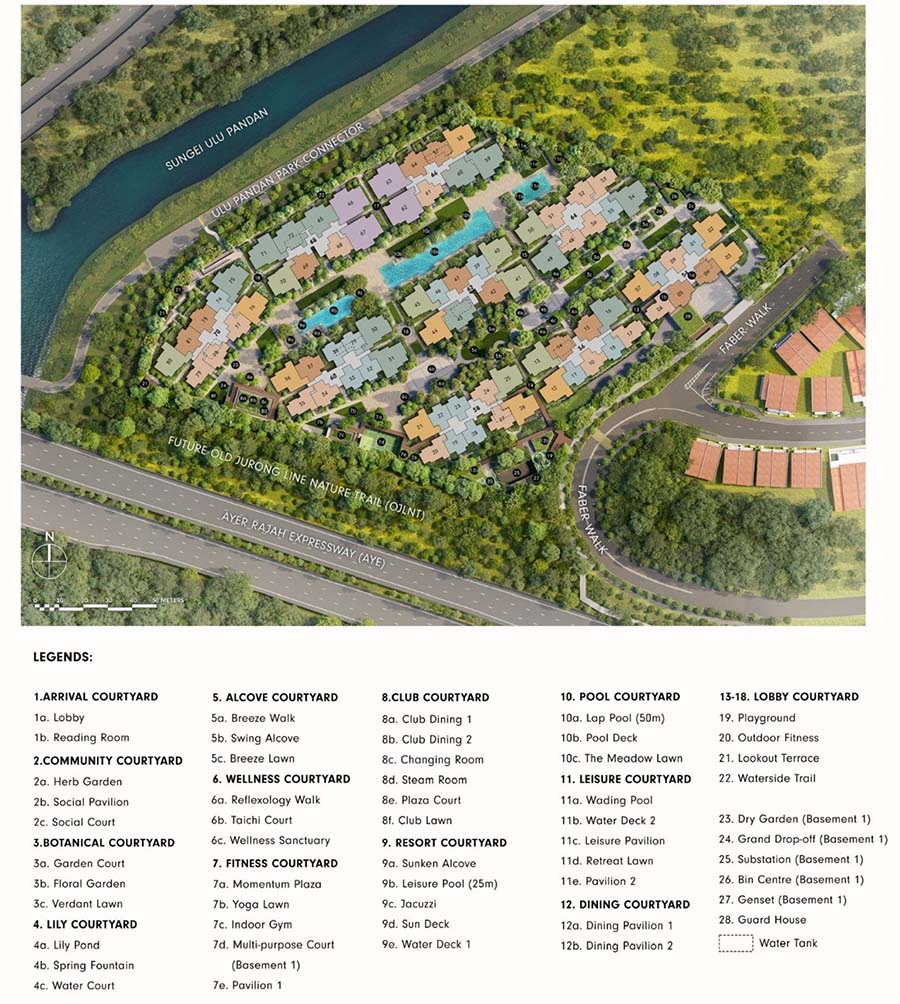
Faber Residence is designed around low-density, family-oriented living, with facilities integrated into landscaped spaces rather than concentrated in a centralised, high-traffic zone.
Unlike larger high-rise developments that prioritise scale and variety, the facilities here are distributed to support quieter, everyday usage aligned with owner-occupier needs.
Core Facilities
Residents can expect a full suite of essential condominium facilities, including:
- Lap pool and leisure pool areas positioned within landscaped surroundings
- Children’s play zones designed for family use
- Fitness areas and gym facilities supporting daily routines
- BBQ pits and communal spaces for small-group gatherings
- Function rooms and indoor spaces for private use
These facilities are designed to be functional rather than resort-style, reflecting the project’s residential positioning.
Landscape and River Integration
A defining feature of Faber Residence is its integration with the surrounding natural environment.
The development sits adjacent to Sungei Ulu Pandan and the Ulu Pandan Park Connector, allowing direct access to:
- Cycling and jogging routes
- Riverside green corridors
- Extended connectivity towards Clementi and beyond
This creates a living environment that is closer to landed housing in feel, rather than a typical high-density condominium.
Practical Trade-Offs
While the low-rise layout enhances privacy and reduces visual density, it also introduces structural trade-offs:
- Fewer units sharing maintenance costs → higher per-unit fees
- Larger landscaped areas → increased long-term upkeep
- Less centralised facilities → more distributed usage patterns
Buyers should evaluate facilities not based on quantity, but on how well they align with daily lifestyle needs.
Faber Residence Buyer Profile and Suitability
Best Suited For
-
Families prioritising Nan Hua Primary School (within 1km) for long-term schooling certainty
-
Owner-occupiers seeking quiet, low-density living within a mature OCR estate
-
Buyers upgrading from HDB or older condos who value space, privacy, and nature access
Less Suitable For
-
Buyers who require immediate MRT adjacency for daily commuting
-
Investors focused on short-term capital appreciation or yield compression
-
Households sensitive to higher maintenance costs typical of landscaped, low-density projects
Buyers comparing Faber Residences against other upcoming launches may find it helpful to frame their decision using the New Launch Condo Guide, which outlines how pricing logic, buyer intent, and holding horizon differ across project types.
Takeaway
Faber Residence succeeds by narrowing its audience rather than broadening it. In a market dominated by high-rise, transit-oriented developments, it offers a fundamentally different proposition—low-rise, riverside living anchored by school proximity and long-term liveability.
For family owner-occupiers aligned with its lifestyle trade-offs, the project presents a defensible entry into Clementi at a price point below the urban core. For buyers seeking convenience or aggressive appreciation, its constraints are structural rather than temporary.
If you’re seriously considering this project, it’s worth checking how it actually compares and what most buyers tend to overlook — before deciding.
FAQs (Decision-Stage)
1) What is the price of Faber Residence?
Faber Residence pricing is positioned below high-rise Clementi launches due to its non-MRT location and low-rise configuration. Buyers are paying for space, privacy, and school proximity rather than transport convenience. Absolute quantum remains the key decision driver, especially for larger units. Pricing should be assessed against similar OCR family-oriented developments.
2) Is Faber Residence a good investment property?
Faber Residence is more of a defensive, lifestyle-driven asset rather than a high-growth investment. Demand is supported by Nan Hua Primary School proximity and low-density scarcity. However, capital appreciation is likely to be moderate rather than aggressive. It is more suitable for selective investors than yield-focused buyers.
3) Is Faber Residence suitable for own stay?
Faber Residence is well suited for family owner-occupiers prioritising space, quiet surroundings, and long-term liveability. The low-rise environment creates a landed-like feel within a condominium setting. However, it is less suitable for buyers who require MRT access for daily commuting. Suitability depends on lifestyle alignment rather than location alone.
4) How far is Faber Residence from the nearest MRT?
Faber Residence is not within immediate walking distance of an MRT station. Residents typically rely on bus connectivity or private transport to reach Clementi MRT. The future Jurong Region Line may improve connectivity, but should not be the primary purchase driver. Daily transport convenience is a key trade-off.
5) Is Faber Residence within 1km of Nan Hua Primary School?
Yes, Faber Residence is within 1km of Nan Hua Primary School, which is a key demand driver for family buyers. School proximity supports long-term own-stay demand and resale interest. It acts as a defensive factor rather than a growth catalyst. This is one of the project’s strongest positioning elements.
6) Are Faber Residence units considered large or compact?
Faber Residence units are generally larger than typical new launches due to its family-oriented positioning. Layouts prioritise livability and usability rather than maximising unit count. This makes it more suitable for families rather than singles or investors. Buyers should evaluate space efficiency alongside absolute size.
7) How does Faber Residence compare to high-rise Clementi condos?
Faber Residence differs significantly from high-rise Clementi projects. High-rise developments prioritise MRT access and urban convenience, while Faber Residence focuses on privacy, space, and environment. Buyers are choosing between lifestyle preferences rather than competing products. The decision is structural rather than price-driven.
8) What are the main risks of buying Faber Residence?
The main risks include lack of MRT proximity, higher maintenance costs, and leasehold positioning within a landed enclave. These are structural characteristics rather than temporary conditions. Buyers must accept these trade-offs upfront. Expectation mismatch is the biggest risk factor.
Pricing Logic, Planning Context, and Market Absorption
Pricing Logic: Why Faber Residence Cleared Early — Then Slowed
Faber Residence’s pricing success was not driven by momentum or speculative narratives, but by intentional under-positioning relative to Clementi’s high-rise core. By anchoring entry prices materially below nearby high-density launches, the project created an immediate perception of value for buyers who wanted access to Clementi amenities without accepting vertical density.
Early absorption was strongest in the 2- and 3-bedroom segments, where absolute quantum remained within reach for HDB upgraders. These buyers were less concerned about MRT adjacency and more focused on school access, environment, and long-term liveability. As a result, sales velocity reflected conviction-led demand, not promotional urgency.
As prices approached the upper bands of OCR tolerance, resistance began to emerge. This resistance manifested not as rejection, but as slower decision cycles, particularly for larger 4- and 5-bedroom units where leasehold tenure becomes a more explicit consideration.
Comparison Context: Why Buyers Did Not Treat Faber Residence as a High-Rise Substitute
Buyers rarely compared Faber Residence directly with projects like ELTA or other Clementi core towers on a like-for-like basis. Instead, the decision frame was binary: high-rise convenience versus low-rise lifestyle. Once buyers mentally exited the “urban tower” category, Faber Residence effectively stood alone.
Resale benchmarks such as Waterfront @ Faber served as valuation anchors, but buyers recognised that those older developments lacked modern layouts, facilities, and landscaping. This allowed Faber Residence to command a meaningful premium without triggering immediate rejection.
Crucially, the project was not priced to compete with RCR or city-fringe narratives. Its competitive set remained tightly defined within OCR family-oriented housing, which reduced volatility and supported steady absorption.
Planning Context: Low-Rise Scarcity as a Structural Advantage
From a planning perspective, Faber Residence benefits from structural scarcity rather than future transformation stories. The planning controls limiting height to five storeys are unlikely to change, which caps future competing supply of similar typology within the Clementi/Faber enclave.
Environmental buffers along Sungei Ulu Pandan and the park connector further restrict redevelopment intensity. These constraints reduce the risk of future overbuilding and support the project’s long-term positioning as a low-rise residential pocket rather than a transition zone.
This planning reality reinforces the project’s appeal to buyers seeking stability, privacy, and predictability — qualities that are increasingly rare in mature OCR estates.
Buyer Segmentation, Exit Dynamics, Risks, and Suitability
Buyer Segmentation: Who Faber Residence Works Best For
Demand at Faber Residence is dominated by family-centric owner-occupiers, particularly those prioritising Nan Hua Primary School eligibility and a quieter residential environment. These buyers typically have longer holding horizons and lower sensitivity to short-term price movements, which contributes to more stable post-launch behaviour.
A secondary cohort consists of upgraders from within Clementi, West Coast, and Jurong East who value familiarity with the area. Investor participation exists, but is selective and focused mainly on mid-sized family units rather than yield-maximisation strategies.
Buyers seeking immediate MRT convenience or aggressive capital appreciation are generally filtered out early, reducing mismatch risk.
Exit and Liquidity: Stable, But Segment-Dependent
Liquidity prospects are strongest for 3-bedroom family-sized units, where school proximity and low-rise scarcity create a reliable resale audience. These units are likely to transact within a defined price band rather than experience sharp appreciation spikes.
Larger 4- and 5-bedroom units face a narrower resale pool due to higher absolute quantum and leasehold tenure within a predominantly freehold landed enclave. While they benefit from lifestyle appeal, exit timelines may be longer and more price-sensitive.
Overall, exit dynamics favour predictability over acceleration, aligning with the project’s original buyer base.
Structural and Market Risks to Monitor
The absence of immediate MRT adjacency remains the most persistent friction point, especially as transport expectations continue to rise. While the future Jurong Region Line improves optionality, it should be viewed as a supplementary benefit rather than a core value driver.
Maintenance costs may also trend higher due to extensive landscaping and water features across a relatively low unit count. Buyers must factor this into long-term holding costs, particularly if rental yield is a priority.
Finally, leasehold tenure within a freehold-dominated enclave places a natural ceiling on long-term appreciation. This does not negate value, but it requires buyers to enter with realistic expectations.
FAQs
1) What is the PSF of Faber Residence compared to other Clementi condos?
Faber Residence should not be judged by psf alone because its larger family-sized layouts can make total quantum the more important decision point. Compared to higher-density Clementi launches, its psf positioning reflects a lower-rise, non-MRT product rather than a transport-led one. Buyers are paying for space, privacy, school proximity, and river-adjacent liveability instead of immediate rail convenience. In practice, psf matters less here than whether the total price fits the buyer’s long-term family plan.
2) Is Faber Residence overpriced for a 99-year leasehold project?
Faber Residence is not positioned as a discount leasehold project, but neither is it trying to command a premium on MRT convenience. Its pricing reflects a niche product type: low-rise, family-oriented, and located within a landed-adjacent environment in Clementi. Buyers who benchmark it purely against MRT-linked new launches may view it differently from those comparing it against scarce low-density family stock. The better question is whether its quieter environment and school-driven demand justify the trade-offs for your household.
3) Will Faber Residence face oversupply risk in Clementi or District 5?
Oversupply risk is more limited here than in areas with multiple competing high-rise plots because Faber Residence occupies a more unusual low-rise niche. Clementi and the broader west region will still see new supply over time, but not all of it will appeal to the same buyer pool. Family buyers prioritising Nan Hua, low density, and quieter surroundings are not automatically interchangeable with buyers chasing MRT-led convenience elsewhere. That means supply can affect sentiment, but the project’s positioning remains narrower and more defensible than a generic OCR launch.
4) How does Faber Residence compare to West Coast or Jurong new launches?
Faber Residence competes differently from many West Coast or Jurong projects because it is not built around transformation hype or commercial adjacency. Jurong-led projects often attract buyers who prioritise future growth narratives, while Faber Residence tends to appeal more to buyers focused on current family use, environmental quality, and schooling. West Coast projects may offer different convenience and sea-facing trade-offs, but they do not always replicate the same low-rise landed-edge feel. Buyers are therefore choosing between distinct lifestyles rather than obvious substitutes.
5) What type of buyers are most likely to choose Faber Residence?
The project is most naturally aligned with family owner-occupiers who want a quieter, more residential setting within the Clementi catchment. It also suits buyers upgrading from HDB or older condos who are prepared to trade MRT convenience for more space and a lower-density environment. Selective investors may still consider it, but it is not a natural fit for short-term or yield-first buyers. Its buyer base is therefore narrower, but also more intentional.
6) How is Faber Residence likely to perform after TOP?
Faber Residence is likely to behave as a steady, niche, family-led project rather than a post-TOP momentum story. Demand after completion should come mainly from school-driven households and buyers who value low-rise living within Clementi, not from broad market hype. This can support stable resale interest, especially for well-positioned family units, but it may not translate into aggressive price spikes. The project’s post-TOP strength is more about usability and resale relevance than excitement.
7) Is Faber Residence suitable for rental demand?
Rental demand is possible, particularly from expatriate families or tenants linked to one-north, the NUS belt, or the Jurong area, but this is not a classic rental-led project. The absence of immediate MRT access narrows the tenant pool compared to more transport-linked developments. Larger layouts may still appeal to family tenants who prioritise environment over commuting convenience. Overall, rental demand should be seen as selective and moderate rather than broad and highly yield-efficient.
8) Which unit types at Faber Residence may have the strongest resale demand?
Family-sized 3-bedroom units are usually the broadest resale segment because they balance affordability, space, and practicality. They tend to appeal to a wider pool of both owner-occupiers and school-driven buyers without pushing total quantum too far. Larger 4- and 5-bedroom units can still perform, but the resale audience is narrower because of the higher capital commitment. In this project, liquidity is likely to favour the middle of the unit mix rather than the extremes.
9) How important is stack selection at Faber Residence?
Stack selection matters because the project’s appeal is closely tied to privacy, outlook, and environmental quality. Some units may benefit more from river-facing or greener aspects, while others may feel more exposed to road influence or less differentiated internal views. In a low-rise development, buyers often pay closer attention to day-to-day liveability rather than just headline project branding. Choosing the right stack can therefore affect both long-term satisfaction and eventual resale ease.
10) Will larger 4-bedroom and 5-bedroom units be harder to exit in future?
Larger units naturally face a smaller buyer pool because absolute quantum becomes a bigger barrier, especially in a 99-year leasehold development. While these layouts may be highly attractive for genuine own-stay families, resale later on can be more price-sensitive and slower than mid-sized units. Buyers considering them should do so because the layout genuinely fits their household needs, not because they expect broad market liquidity. These units can still work well, but they are more specialised.
11) Are maintenance fees likely to be higher at Faber Residence?
Maintenance costs are likely to be a more visible consideration in a low-rise, heavily landscaped project because fewer units share the cost base. That does not automatically make the project poor value, but it does mean buyers should treat holding costs as part of the real affordability picture. A development built around greenery, water features, and a lower-density layout often carries a different cost profile from a taller, denser condominium. For owner-occupiers, the question is whether the lifestyle gained is worth the additional running cost.
12) Does the future Jurong Town Hall MRT station meaningfully improve the story?
The future Jurong Town Hall MRT station helps the medium-term connectivity narrative, but it should be treated as supportive rather than central. Buyers should still be comfortable with the project’s present-day transport reality rather than relying on future infrastructure to justify today’s purchase. Where it helps is in widening the area’s long-term appeal and reducing the perception gap versus more rail-linked alternatives. It is a useful tailwind, but not the foundation of the project’s value.
13) Is Faber Residence more of a lifestyle buy or a capital-growth buy?
Faber Residence is much more convincingly framed as a lifestyle-driven own-stay purchase than a pure capital-growth vehicle. Its strongest attributes are environmental quality, low density, family suitability, and school adjacency rather than strong speculative upside. Buyers who enter expecting a calm, long-term housing proposition are more likely to feel aligned with it. Those seeking sharper growth may find other project types more suitable.
14) Will school-driven demand continue to support Faber Residence over time?
School-driven demand is one of the more persistent demand anchors in Singapore’s residential market, especially for family-oriented homes. Proximity to Nan Hua Primary School helps keep the project relevant to a recurring pool of buyers who prioritise schooling logistics and stability. This does not eliminate price sensitivity, but it does add resilience to the demand base. Over time, that tends to support the project’s long-term usability and resale relevance.
15) How should buyers think about resale competition at Faber Residence?
Resale competition is likely to be most manageable for units that sit in the most practical price-and-size range and have good internal characteristics. If too many similar units are listed at the same time, buyers may become more selective, especially in a project where many households are owner-occupier driven. This makes entry discipline and unit differentiation important from the start. In short, resale is unlikely to be weak, but it will favour the better-positioned units.
16) What is the biggest mistake buyers make when evaluating Faber Residence?
The biggest mistake is benchmarking it against the wrong product type. Buyers who compare it directly with MRT-adjacent high-rise launches may conclude it is less convenient, while missing the fact that it is designed around a different housing proposition altogether. Faber Residence should be judged as a low-rise, school-anchored, family-oriented enclave project, not as a transport-led urban condo. Once that framing is correct, the trade-offs become much clearer.
If you prefer a more structured walkthrough, you can leave your details below and we’ll follow up with you.