
Summary
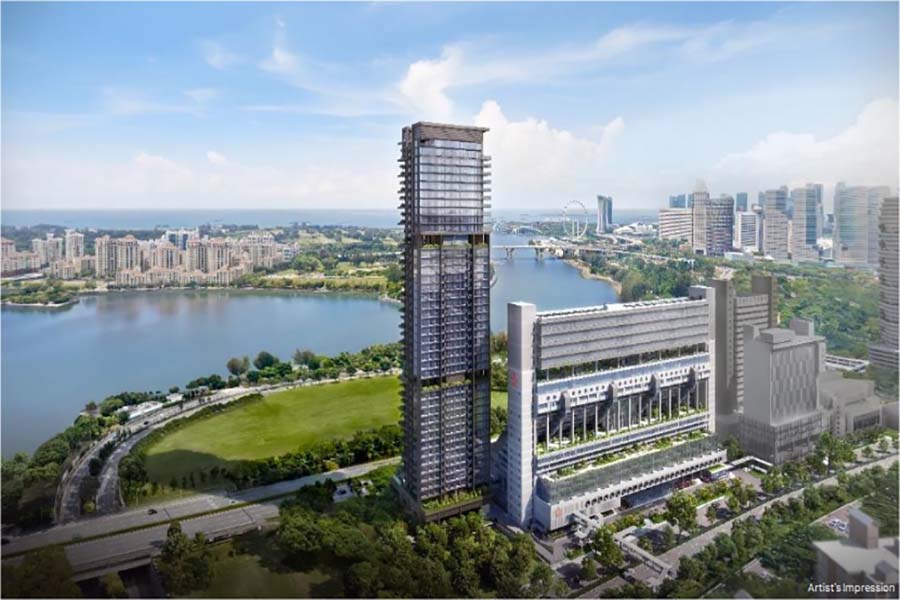
Aurea is a 188-unit residential tower within the conserved Golden Mile Complex redevelopment along Beach Road in District 7. Positioned within Singapore’s Downtown Core corridor near Bugis and Suntec City, the project functions primarily as a city-living and rental-resilient asset rather than a tranquillity-focused residential enclave.
For buyers searching “Aurea review” today, the real question is not whether it is “cheap” or “expensive” on a headline psf basis. The decision is whether Aurea’s Downtown Core utility (Suntec/Bugis/Marina Bay access, strong tenant depth, and long-run city-living relevance) outweighs the trade-offs that come with a central mixed-use setting—especially if you are sensitive to neighbourhood perception, unit orientation, or the lack of a tranquil enclave feel.
This Aurea review assesses pricing logic, buyer fit, rental resilience, and exit liquidity for a Downtown Core mixed-use redevelopment, where urban convenience and tenant depth matter more than tranquillity, tenure scarcity, or short-term speculative upside.
Aurea should be evaluated as a Downtown Core, mixed-use city-living asset rather than a tranquillity-led or family-centric residence. Located within the conserved Golden Mile Complex redevelopment along Beach Road, its value proposition is anchored in central accessibility, rental depth, and long-term urban relevance, not tenure scarcity or short-term price momentum. Pricing behaviour is driven more by absolute quantum, tenant demand, and proximity to Suntec, Bugis, and Marina Bay than by headline psf comparisons with suburban or boutique CCR projects. Buyers who view Aurea as a rental-resilient, utility-driven city home—accepting urban density, mixed-use intensity, and gradual capital appreciation—are more likely to find its positioning coherent than those expecting a quiet enclave or rapid re-rating.
Explore the Full Aurea Analysis
- Aurea Price Guide – pricing logic, market positioning, and entry analysis
- Aurea Floor Plan Analysis– layout efficiency, unit mix, and liveability considerations
- Aurea Showflat Guide viewing strategy and buyer evaluation framework
Together, these articles provide a structured breakdown of how the project performs across pricing, layout design, buyer suitability, and long-term holding considerations.
If you’re considering this project, you might want to check how it actually compares and what most buyers tend to overlook — before deciding.
Key details (at a glance):
99-year | 188 units | Golden Mile Complex (Beach Road) | Nicoll Highway MRT (CCL) nearby | Downtown Core D7 city-living + rental relevance | Best fit: urban own-stay + long-horizon hold (not family-first, not short-term flip)
Project Factsheet
| Item | Details |
|---|---|
| Project Name | Aurea |
| Location | Former Golden Mile Complex, Beach Road |
| District / Region | District 7 / CCR (Downtown Core planning area) |
| Tenure | 99 years |
| Developer | JV between Perennial Holdings, Sino Land, Far East Organization |
| Site Type | Enbloc redevelopment (Golden Mile Complex) |
| Site Area | ~13,462.3 sqm (144,908 sq ft) |
| Plot Ratio | 5.6 |
| Residential Units | 188 |
| Development Type | Mixed-use (residential + retail + offices + medical) with conserved podium + new residential tower |
| Official Launch Date | 8 Mar 2025 |
| Estimated TOP | Q2 2029 |
| Nearest MRT | Nicoll Highway (CC5) |
Aurea is best understood as a Downtown Core, rental-resilient city-living asset built on a landmark conservation redevelopment—strong on access and long-term tenant depth, but not designed to feel like a quiet, family-centric enclave.
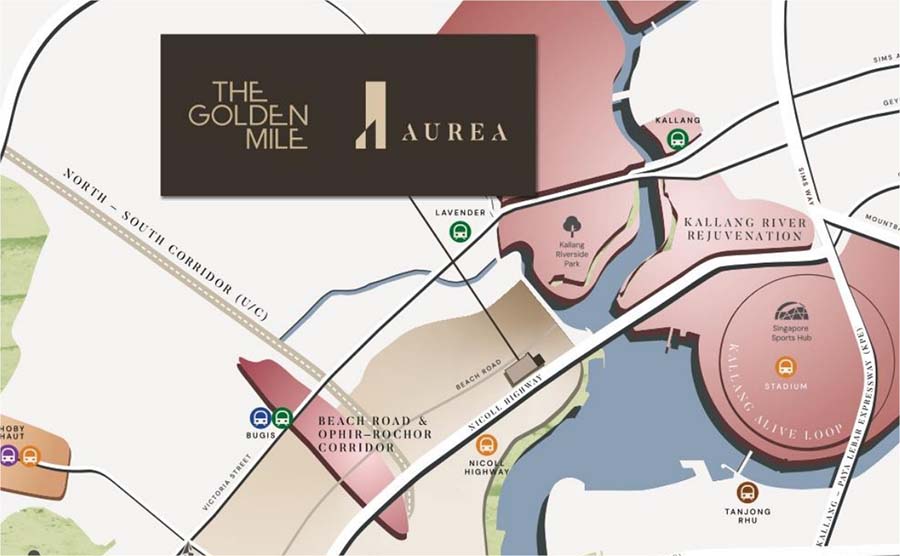
Location Context: Beach Road Downtown Core Corridor (Work–Live–Play District)
Aurea’s location advantage is not about one single anchor (like being directly on Orchard Road). It is about sitting inside the Downtown Core’s practical triangle:
Suntec / Marina Centre as the corporate and MICE cluster
Bugis / Rochor as the arts, education, and city-fringe retail belt
Kallang Basin / Sports Hub direction as the waterfront recreation corridor
This creates a daily-living profile that tends to be attractive to two groups:
(1) owner-occupiers with central work routines, and (2) tenants who want short commutes and city convenience without paying a premium for boutique freehold addresses.
Transport reality (what matters for decision-stage buyers)
Nicoll Highway MRT (CCL) is about 0.4 km away. That is not “MRT-at-doorstep”, but it is a workable urban walk for the audience Aurea naturally attracts (professionals, couples, students, and faculty). Bus connectivity is immediate outside the site.
For city-centre developments like Aurea, proximity to multiple employment clusters often matters more than MRT adjacency alone. The Beach Road corridor sits within short commuting distance of Suntec City, Marina Bay, the CBD, and Bugis commercial districts, which collectively form one of Singapore’s deepest employment catchments. This employment density supports long-term rental resilience even when broader property cycles slow.
The key point: Aurea’s location is highly functional, but it is not “enclave-lifestyle”. Buyers who need quiet streets and low pedestrian intensity will feel the difference the moment they step out of the development.
Project positioning: what Aurea is — and what it is not
What Aurea is
A central mixed-use redevelopment with real daily convenience
Rental-relevant due to proximity to Suntec, Bugis, CBD corridors and institutions
A project where unit efficiency and absolute quantum matter more than “landed-style” living narratives
A rare chance to buy into a conserved landmark redevelopment (for buyers who value this story)
What Aurea is not
Not a tranquil, greenery-led, low-density environment
Not a family-first suburban project
Not a tenure-led “legacy hold” (it’s 99-year)
Not a typical mall-integrated mixed-use where residents must pass through commercial spaces to go home
That last point is important. Based on your site observation, Aurea’s residential tower is more exclusive than many mixed developments because the residential experience can be designed as its own “private tower”—a meaningful difference for privacy and daily comfort.
Amenities at Aurea: What Residents Actually Get
Aurea’s facilities are designed around a city-core lifestyle, where convenience, accessibility and shared spaces take priority over large-scale family-oriented grounds.
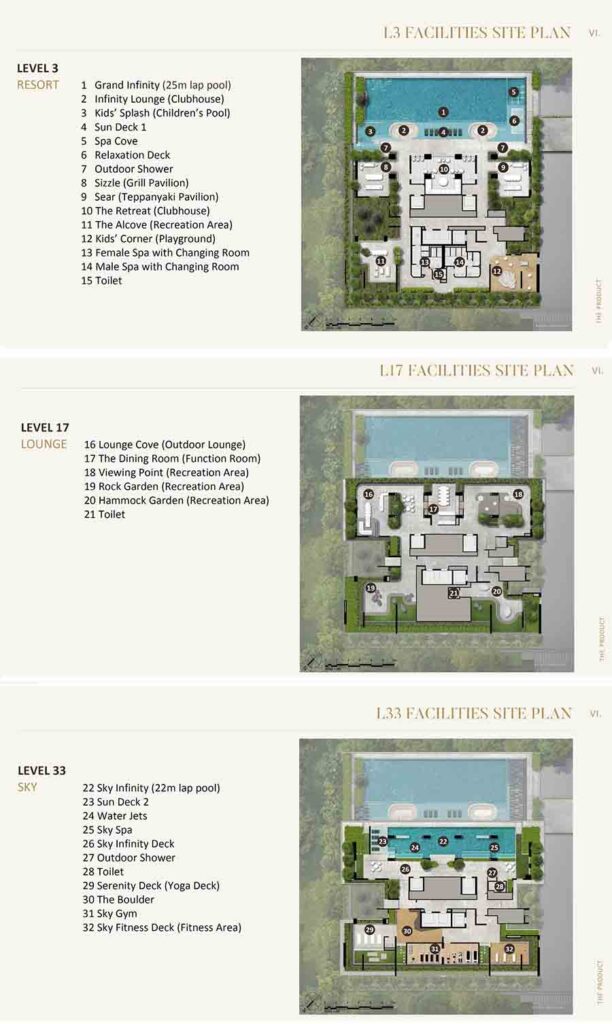
Based on the development’s design and brochure, facilities include:
- Infinity swimming pool and leisure pools
- Sky gym and fitness areas
- Spa and wellness zones
- Dining pavilions and clubhouse spaces
- Sky terraces and landscaped gardens
- Social and communal spaces integrated within the development
The facilities are distributed across elevated decks and sky levels, reflecting the development’s vertical living concept rather than land-heavy layouts.
What This Means in Reality
Aurea’s amenities are sufficient for lifestyle convenience, but not designed to compete with large suburban developments offering:
- tennis courts
- large playground clusters
- expansive green spaces
Instead, the focus is on:
- efficient shared spaces
- city-facing views
- social and lifestyle usability
This aligns with its positioning as a central, convenience-led development rather than a family-centric residential environment.
Why Golden Mile Redevelopment Matters
Aurea forms part of the conservation-led redevelopment of the former Golden Mile Complex, one of Singapore’s most recognisable Brutalist landmarks. The redevelopment retains the conserved podium while introducing a new residential tower designed for modern urban living.
From an urban planning perspective, projects that integrate conservation with redevelopment tend to carry a distinct identity compared with typical city launches. While this does not guarantee price outperformance, it can support long-term differentiation in both rental and resale markets because the development becomes tied to a recognisable architectural story rather than simply a new residential tower.
Buyer suitability: who Aurea is really for
1) Urban own-stay buyers (singles/couples)
If you live a city routine—work in town, dine out often, and value short travel time—Aurea’s proposition is straightforward. You’re buying time and access, not a lifestyle enclave.
2) Rental-driven investors (long-horizon)
Aurea’s investor case is built on tenant depth, not yield-maximisation. The likely tenant pool is broad:
Professionals in Bugis / Suntec / CBD corridors
Institution-linked tenants (education / training)
City renters who want convenience without boutique freehold pricing
3) “City-living buyers who must like the area”
Your earlier point about “buyers must know and like the place” applies strongly here. Golden Mile is not a blank-slate address. Buyers who already understand the Beach Road / Bugis / Kallang fringe character will usually evaluate Aurea more rationally than buyers who are unfamiliar and anchor to old stigma.
Buyers who may want to reconsider
Families seeking tranquillity, greenery-led living, or school-first selection
Buyers highly sensitive to “what the neighbourhood used to be”
Short-term traders expecting quick momentum moves
If you’re weighing city-core quantums against OCR alternatives and trying to avoid being misled by psf comparisons, the New Launch Condo Guide helps clarify which metrics matter for your holding intent
Takeaway
Aurea should not be evaluated as a quiet luxury residence. Its core proposition lies in Downtown Core utility — the ability to live or invest within a central employment corridor that remains relevant across property cycles.. Its edge is Downtown Core utility—the ability to live and rent within a central corridor that remains relevant across cycles. The trade-off is that you are buying into an active urban fabric with mixed-use intensity and a location story that not every buyer will emotionally accept.
For buyers who already understand the Beach Road / Bugis / Suntec corridor and want a central, rental-resilient hold, Aurea’s positioning can be coherent—especially if entry pricing stays disciplined relative to comparable city stock.
For buyers comfortable with city density and mixed-use environments, Aurea functions more as a long-horizon urban asset than a short-term momentum-driven purchase.
If you’re seriously considering this project, it’s worth checking how it actually compares and what most buyers tend to overlook — before deciding.
FAQs (Decision-Stage)
1) Is Aurea a good investment property in Singapore?
Aurea can function as a rental-supported, long-hold investment property in Singapore rather than a short-term flipping opportunity. Its strength lies in central location relevance and tenant demand, but capital upside depends more on long-term positioning and market cycles than immediate price growth.
2) Is Aurea worth buying for own stay?
Aurea may be worth buying for own stay if daily convenience, MRT access and proximity to the city are key priorities. However, it may not suit buyers seeking a quieter residential environment or family-oriented living conditions.
3) Who is Aurea condo most suitable for?
Aurea condo is more suitable for individuals, couples and investors who prioritise city access, rental flexibility and convenience. It is less aligned with buyers looking for larger space, family infrastructure or suburban-style living environments.
4) Why are Aurea condo sales relatively slower?
Aurea condo sales have been relatively measured due to perception factors such as the Golden Mile identity and mixed-use positioning. These can create hesitation among some buyers despite its central location and pricing competitiveness.
5) Is Aurea a mixed-use development and is that a concern?
Aurea is part of a mixed-use redevelopment linked to the conserved Golden Mile Complex. However, residential and commercial components are functionally separated, which reduces the typical concerns associated with mixed-use developments.
6) What are the main risks of buying Aurea?
The main risks of buying Aurea include density, surrounding environment and perception factors tied to its location and legacy identity. These may affect resale demand and buyer pool depth more than rental performance.
7) Is Aurea condo suitable for families?
Aurea condo is generally not designed for family living. Its unit mix, environment and lifestyle positioning are more aligned with individuals, couples and investors rather than family households.
8) Why do buyers choose Aurea over other condos?
Buyers typically choose Aurea for its central location, MRT accessibility and rental relevance. The decision is usually driven by convenience and city connectivity rather than exclusivity, tranquillity or large-scale residential living.
Pricing Logic, URA Planning Intent & Buyer Segmentation
Pricing Logic: Why Aurea Is Priced the Way It Is (and Why That Matters)
Aurea’s pricing behaviour should be interpreted through the lens of central mixed-use redevelopment rather than conventional suburban condominium launches. Projects located within Singapore’s Downtown Core corridor typically price according to accessibility to employment clusters, tenant depth, and urban convenience rather than land scarcity or school-driven family demand.
Aurea’s pricing must be understood through a Downtown Core redevelopment lens, not by comparing it mechanically to OCR launches or even generic CCR projects. The project sits at the intersection of three structural forces:
Conserved redevelopment economics
Downtown Core land scarcity
Investor-relevant unit sizing
At launch, Aurea’s pricing ranged broadly between ~$2,700 to just above $3,100 psf, with smaller 2-bedroom units forming the bulk of initial transactions. On the surface, many buyers perceived this as “expensive”, especially when contrasted against OCR projects offering larger unit sizes at lower absolute psf.
That comparison, however, is incomplete.
Absolute Quantum vs PSF — the correct lens for Aurea
For Aurea’s target buyers, absolute quantum matters more than headline psf.
Why:
Most buyers are singles, couples, or investors, not large families
Mortgage serviceability is driven by total price, not unit size
Rental yield and exit liquidity depend more on entry quantum than theoretical psf benchmarks
In practice:
A $1.7M–$2.1M 2-bedroom in Aurea competes more directly with:
Midtown Bay
The Collective at One Sophia
Select city-fringe CCR projects
than with any suburban development.
This is why, despite slower headline sales, buyer feedback often acknowledges that Aurea’s pricing is not irrational — it is simply positioned in a narrow, investor-tilted band that requires confidence in city-core fundamentals.
Why Sales Are Steady (But Not Fast)
Your market observation is important and accurate.
Aurea’s sales pace has been measured rather than momentum-driven, and this is due to a combination of structural perception factors, not pricing alone.
1. Legacy perception of Golden Mile
Even though Aurea is a complete redevelopment with a segregated residential tower, some buyers still associate the site with:
Past nightlife / KTV activity
Heavy commercial footfall
Non-residential identity
This perception does not affect rental demand as much as it affects own-stay emotional comfort, which slows decision-making.
2. Unit orientation trade-offs
Some of Aurea’s 2-bedroom units face:
HDB estates
Dense urban surroundings
While layouts without balconies improve efficiency, buyers who are view-sensitive hesitate — even if pricing compensates for it.
3. Market cycle reality
Aurea launched into a period where:
Interest rates were no longer at historical lows
Buyers became more discerning
Speculative behaviour reduced
In this environment, projects without an immediate emotional hook (e.g. sea view, freehold tenure, family narrative) naturally transact more slowly.
URA Planning Analysis: Why Aurea Fits the Downtown Core Blueprint
URA’s Draft Master Plan 2025 makes one thing clear:
Singapore’s Downtown Core is evolving from a 9-to-5 commercial district into a 24-hour live-work-play environment.
Aurea aligns structurally with this direction.
Key URA themes relevant to Aurea
1. Mixed-use densification (not decentralisation)
Unlike OCR growth areas, the Downtown Core is not about spreading demand — it is about intensifying use where infrastructure already exists.
URA initiatives include:
CBD Incentive Scheme (office → residential conversions)
Residential intensification around Beach Road, Bugis, Marina Centre
Encouraging more people to live within the city, not commute in
Aurea benefits from this because:
It adds residential population without overloading new infrastructure
It complements nearby employment and education nodes
It is unlikely to face oversupply pressure in the same way city core areas might
2. Walkability and car-lite living
URA’s push for:
Underground pedestrian networks
Elevated walkways
Pedestrianisation of key streets
Enhances Aurea’s value proposition over time, even though it is not MRT-at-doorstep.
As these networks expand, effective walking distance shrinks, which supports long-term livability and rental appeal.
3. Heritage-integrated redevelopment
Golden Mile is not just another plot. It is part of Singapore’s architectural and urban history.
URA’s stance on adaptive reuse:
Protects the conserved podium
Limits aggressive rezoning nearby
Preserves the site’s identity while modernising its use
This reduces the risk of character dilution, even if price acceleration is gradual.
Buyer Segmentation: Who Aurea Really Serves
1. Rental-Driven Investors (Primary Buyer Group)
Profile
Medium- to long-horizon investors
Not chasing peak yields
Prioritise tenant depth and vacancy resilience
Why Aurea works
Strong tenant catchment (Bugis, Suntec, CBD)
Education institutions nearby
Smaller unit sizes aligned with rental demand
Limitations
Yields are stable, not spectacular
Capital growth is gradual, not explosive
2. Urban Own-Stay Buyers (Selective)
Profile
Singles or couples
Work in the city
Value convenience over tranquillity
Why Aurea works
Reduced commute friction
Immediate access to food, retail, and services
Efficient layouts without suburban maintenance concerns
Trade-offs
Noise and activity levels
Limited greenery buffer
Less “home-like” feel compared to boutique developments
3. Buyers Who May Want to Reconsider
Families with school-centric priorities
Buyers seeking greenery, views, or low density
Short-term traders expecting launch-driven momentum
Aurea does not fail these buyers — it simply does not serve them well.
Interim Assessment (End of Part 2)
Aurea should be evaluated as:
A Downtown Core, rental-resilient asset designed for long-term relevance, not short-term excitement.
Its performance will depend on:
Pricing discipline
Rental market stability
Gradual perception shift over time
Not on:
Launch-day sales velocity
Speculative flipping behaviour
Exit & Liquidity, Risk Scenarios, Pros & Cons, FAQs
(Show More)
Exit & Liquidity Analysis: What Selling Aurea Really Looks Like
In central mixed-use developments, liquidity behaves differently from suburban projects.
For Aurea:
Exit demand is broad but price-sensitive
Buyer pool is investor-heavy
Liquidity is steady, not cyclical
Unit-type liquidity dynamics
2-Bedroom Units
Most liquid
Largest buyer pool
Rental-friendly and affordable
3-Bedroom Units
Selective liquidity
Works best for dual-income couples
Requires patience
Large Units / Sky Villas
Highly selective
Prestige-driven buyers only
Long holding horizon required
Timing and pricing matter more than unit size alone.
Comparative Risk Positioning
Aurea vs OCR Family Projects
OCR projects benefit from upgrader demand
Aurea benefits from tenant demand
OCR liquidity spikes in good markets; Aurea remains stable across cycles
Aurea vs Boutique Freehold City Projects
Boutique projects rely on scarcity and tenure
Aurea relies on access and utility
Different exit psychology entirely
Multi-Scenario Risk Analysis
Scenario 1: Prolonged High Interest Rates
Speculation remains muted
Rental demand stabilises prices
Aurea performs defensively
Scenario 2: Downtown Core Residential Revival
Increased city living adoption
Improved walkability
Gradual uplift for Aurea
Scenario 3: Oversupply in Fringe Areas
Fringe projects compete heavily on price
Aurea remains insulated due to location
Scenario 4: Perception Lag Persists
Price growth remains modest
Rental stability still holds
Exit patience required
Pros & Cons Summary
Pros
Downtown Core location
Strong tenant depth
Segregated residential tower
Heritage-integrated redevelopment
Cons
99-year tenure
Urban density
Limited family appeal
Gradual, not fast, appreciation
Frequently Asked Questions (Advanced Decision)
1) Will Aurea face strong resale competition in the future?
Yes. The Beach Road / Ophir-Rochor corridor is undergoing ongoing redevelopment, which means future residential supply may compete directly with Aurea. This creates a more competitive resale environment, especially if multiple projects complete within a similar timeframe.
2) How does Aurea compare to other CCR and city-fringe condos?
Aurea sits in a transitional positioning between CCR and city-fringe developments. While it benefits from central proximity, its surrounding environment and mixed-use nature differentiate it from traditional prime CCR projects, which may affect buyer perception and pricing benchmarks.
3) Is Aurea’s pricing supported by its location?
Aurea’s pricing is generally supported by its proximity to the city and MRT connectivity. However, pricing sensitivity remains higher compared to established prime districts due to perception factors and the surrounding environment.
4) Which unit types at Aurea are likely to have better resale demand?
Smaller units typically have broader resale demand due to lower quantum and stronger rental appeal. Larger units may face a narrower buyer pool, especially given the development’s limited alignment with family-oriented living.
5) How important is unit selection at Aurea?
Unit selection is critical. Factors such as facing, noise exposure, surrounding buildings and internal layout efficiency can significantly impact both liveability and future resale performance.
6) Will rental demand be strong for Aurea?
Rental demand is expected to be supported by its central location, MRT access and proximity to employment zones. However, rental competition from nearby developments should also be considered.
7) What type of tenant profile is Aurea likely to attract?
Aurea is more likely to attract working professionals, expatriates and tenants prioritising convenience and connectivity. It is less likely to attract family tenants due to limited family-oriented infrastructure.
8) How does Aurea’s mixed-use nature affect long-term value?
Mixed-use developments can provide convenience and vibrancy, but may also introduce perception challenges for certain buyer groups. Aurea mitigates this through separation of components, though perception impact may still persist.
9) Will Aurea benefit from future URA transformation plans?
The surrounding Beach Road, Kallang and Ophir-Rochor areas are undergoing long-term transformation. While this can enhance vibrancy and connectivity, the benefits tend to materialise gradually rather than immediately.
10) Is Aurea more suitable for holding or exiting early?
Aurea is generally more suited for medium to long-term holding strategies. Short-term exit strategies may be more challenging due to competition, perception factors and pricing sensitivity.
11) What are the key exit risks buyers should consider?
Key exit risks include competition from nearby projects, buyer perception of the location, and broader market conditions. These factors can affect liquidity and resale timelines.
12) How does Aurea compare against integrated developments?
Unlike full integrated developments with direct MRT or mall integration, Aurea offers proximity without full integration. This affects how buyers perceive convenience and long-term value.
13) Is Aurea affected by surrounding environment factors?
Yes. Surrounding buildings, traffic flow and overall urban density contribute to liveability and perception. These factors vary by stack and unit orientation.
14) Will Aurea appeal to future buyers in the resale market?
Aurea is likely to appeal to buyers seeking central convenience and accessibility. However, it may be less attractive to buyers prioritising exclusivity, privacy or family-oriented environments.
15) How does Aurea perform in terms of long-term positioning?
Aurea’s long-term positioning is tied to its central relevance and ongoing urban transformation. Its performance depends on how the surrounding district evolves and how buyer perception shifts over time.
16) What is the biggest mistake buyers make when evaluating Aurea?
The most common mistake is evaluating Aurea purely on price or location without considering buyer pool depth and exit dynamics. Understanding who the next buyer is becomes critical for long-term decision-making.
If you prefer a more structured walkthrough, you can leave your details below and we’ll follow up with you.