


The map above highlights the position of Zyon Grand along Zion Road near Havelock MRT (TE16), illustrating its location within the River Valley and Singapore River city-fringe corridor.
Summary
Zyon Grand is a 99-year leasehold private condominium located along Zion Road in District 3 (Rest of Central Region), positioned at the city fringe between Orchard Road, River Valley, and the southern CBD corridor. The project is conceived as a high-density, MRT-accessible urban residence, targeting buyers who prioritise central connectivity, commute efficiency, and long-term city relevance over low-density living or tenure-driven value narratives.
Rather than competing as a boutique or prestige-led development, Zyon Grand’s value proposition is anchored in location adjacency and daily practicality. Buyers are effectively trading density, traffic exposure, and leasehold tenure for proximity to Orchard, the CBD, and established city infrastructure. This makes the project most coherent for own-stay buyers and longer-horizon holders, while less suitable for those seeking quiet enclave living or short-term price momentum.
This review evaluates Zyon Grand from a decision-stage perspective, focusing on who the project genuinely works for, who should eliminate it early, and how its structural trade-offs affect long-term satisfaction.
Zyon Grand is a high-density, leasehold condominium in District 3 designed for buyers who value city-fringe accessibility and MRT connectivity over low density or tenure security. It suits own-stay and long-term buyers comfortable with urban intensity, while being poorly aligned with those seeking boutique living or short-term appreciation.
Zyon Grand is a District 3 city-fringe, MRT-accessible residential project suited for long-term own-stay buyers who value central connectivity and daily convenience, but it is not designed for low-density living or short-term speculative gains.
Quick Project Positioning
Zyon Grand is a large-scale mixed-use residential development along Zion Road in District 3, directly connected to Havelock MRT on the Thomson–East Coast Line. Positioned between River Valley, Orchard Road and the Singapore River corridor, the project functions as a city-fringe residential hub prioritising accessibility and commute efficiency rather than boutique exclusivity. Buyers evaluating Zyon Grand are typically comparing central convenience, MRT connectivity and long-term urban relevance against trade-offs such as high density, leasehold tenure and road exposure.
Explore the Full Zyon Grand Analysis
• Zyon Grand Price Guide
• Zyon Grand Floor Plan Analysis
• Zyon Grand Showflat Guide
Together, these articles examine pricing behaviour, layout efficiency, and the showflat viewing process to provide a clearer decision framework for prospective buyers.
If you’re considering this project, you might want to check how it actually compares and what most buyers tend to overlook — before deciding.
Key Details (at a glance)
99-year leasehold | District 3 (RCR)
High-density urban residential development
Along Zion Road, near Orchard Road and the Singapore River
Primarily suited for own-stay and long-term buyers
Project Factsheet
| Item | Details |
|---|---|
| Project Name | Zyon Grand |
| Location | 3 & 5 Kim Seng Road, Singapore |
| District / Region | District 3 (Rest of Central Region / Bukit Merah Planning Area) |
| Tenure | 99-year leasehold |
| Developer | City Developments Limited (CDL) & Mitsui Fudosan |
| Site Type | GLS (Government Land Sales) |
| Development Type | Mixed-Use Development (Residential towers with serviced apartments, retail and childcare components) |
| Site Area | Approximately 15,276.8 sqm |
| Plot Ratio | 5.6 |
| Total Units | 706 residential units |
| Nearest MRT | Havelock MRT (TE16) |
| Launch Status | Launched (25 October 2025) |
| Expected TOP | September 2032 (estimated) |
Location Context: Zion Road, River Valley and Havelock MRT Connectivity
Zyon Grand is located along Zion Road, a corridor that functions as a connective spine between Orchard Road, River Valley, and the southern CBD. This is not a quiet residential pocket; it is a working urban edge defined by traffic flow, accessibility, and proximity to employment and lifestyle nodes.
For residents, the benefit is clear: shorter commutes and strong city integration. The trade-off is equally clear: urban activity, density, and road exposure are part of daily life. Buyers who expect enclave-style calm will likely find the environment mismatched, while city-centric households often view this as an acceptable and intentional compromise.
Structural Upside: Accessibility and Relevance, Not Lifestyle Reinvention
Zyon Grand’s upside is structural rather than experiential. Its value lies in remaining relevant as the city grows outward and densifies, not in delivering a transformed lifestyle environment.
Buyers should frame expectations around:
Long-term accessibility to Orchard, CBD, and central employment nodes
Sustained relevance driven by MRT connectivity
Gradual infrastructure and urban improvements
It should not be viewed as a project where immediate lifestyle uplift or environmental quietude is a core selling point.
Density & Design Reality: Urban Living by Design
Zyon Grand is intentionally designed as a high-density urban residence.
What this enables
Efficient land use close to the city core
More accessible entry points relative to low-density alternatives
Alignment with city-fringe living patterns
What it compromises
Lower privacy and exclusivity
Greater reliance on shared facilities and lifts
Less separation from surrounding urban activity
These are not design flaws but structural characteristics. Buyer satisfaction depends on whether these realities align with personal living preferences.
What Zyon Grand Is — and Is Not
What it is
A city-fringe, MRT-linked residential development in District 3
Designed for own-stay buyers and longer holding horizons
Anchored by daily convenience and central accessibility
What it is not
Not a low-density or boutique project
Not a tenure-driven capital preservation play
Not a quiet, residential enclave
Not structured for short-term trading strategies
Clear positioning here prevents expectation mismatch later.
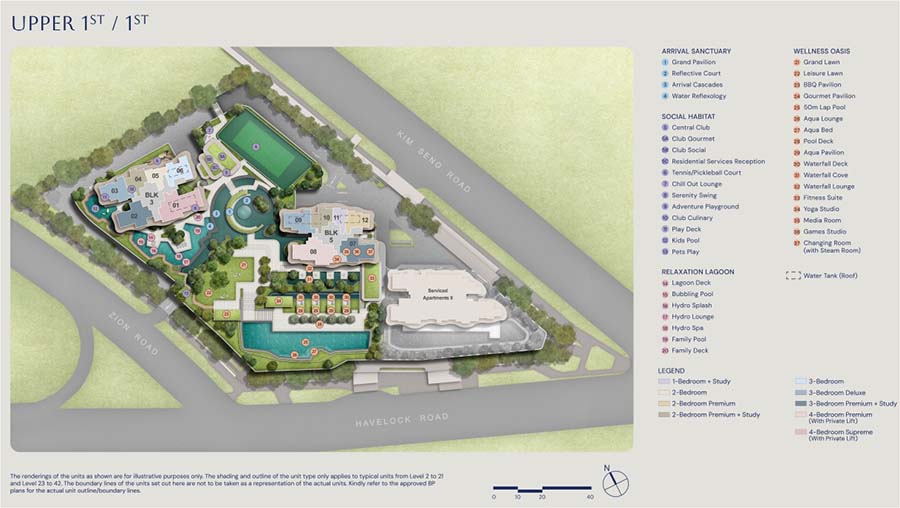
The facilities plan reinforces Zyon Grand’s positioning as a large-scale city-fringe development where shared amenities support density rather than boutique exclusivity.
Buyer Suitability: Who This Project Works For
1. City-Centric Own-Stay Buyers
Professionals working in Orchard, the CBD, or the southern city area who prioritise commute efficiency and central access over tranquillity.
2. Long-Term Holders Comfortable with Leasehold
Buyers who accept 99-year tenure and are focused on relevance, accessibility, and usability over scarcity.
3. Urban Lifestyle-Oriented Buyers
Those who value connectivity, dining access, and movement within the city more than privacy or suburban calm.
Buyers Who Should Eliminate Zyon Grand Early
Zyon Grand should be eliminated early by buyers who:
Require low density or privacy as a core lifestyle requirement
Are highly sensitive to traffic noise or urban activity
View freehold tenure as non-negotiable
Are seeking short-term price momentum or speculative upside
These constraints are inherent to the project’s structure and cannot be mitigated through unit selection alone.
Buyers comparing Zyon Grand against other upcoming launches may find it helpful to frame their decision using the New Launch Condo Guide, which outlines how pricing logic, buyer intent, and holding horizon differ across project types.
Takeaway
Zyon Grand works best for long-term own-stay buyers who prioritise District 3 city-fringe accessibility and MRT connectivity, while it works poorly for buyers seeking low density, tenure-led security, or short-term price acceleration.
For buyers comfortable with urban intensity, leasehold tenure, and a large-scale development format, Zyon Grand can make sense as a long-term District 3 home anchored by MRT convenience rather than scarcity value.
If you’re seriously considering this project, it’s worth checking how it actually compares and what most buyers tend to overlook — before deciding.
FAQs (Decision Stage)
1) Is Zyon Grand considered a prime district project?
No. Zyon Grand is located in District 3 within Singapore’s Rest of Central Region (RCR) rather than the traditional Core Central Region prime districts. While the development sits close to Orchard Road and the Singapore River corridor, it should be evaluated as a city-fringe residential project along Zion Road near Havelock MRT rather than a prestige-driven prime enclave. Buyers typically approach Zyon Grand for its accessibility and location convenience rather than exclusivity or tenure scarcity.
2) Is Zyon Grand more suitable for own-stay or investment?
Zyon Grand is generally better aligned with own-stay buyers and longer-term holders rather than short-term speculative investors. The development’s high-density format and 99-year leasehold tenure mean its value proposition centres on accessibility and daily usability rather than scarcity-driven appreciation. Buyers who prioritise MRT connectivity and central convenience typically find the project more suitable for long-term occupation.
3) How important is MRT access for this development?
MRT connectivity is one of the most important structural drivers for Zyon Grand. The project sits directly beside Havelock MRT on the Thomson–East Coast Line, which connects residents to Orchard Road, Shenton Way, Marina Bay and the wider central corridor. For many buyers, this proximity significantly improves commute efficiency and supports the long-term residential relevance of the development.
4) Does the high density affect liveability?
Yes, density is a structural characteristic of Zyon Grand and should be evaluated carefully by buyers. With over 700 residential units, the development prioritises efficient land use and urban accessibility rather than boutique-scale privacy. For buyers comfortable with city living near transport infrastructure, this density may be acceptable, but those seeking quieter enclave environments may find it less suitable.
5) Is traffic noise a realistic concern?
Traffic exposure is a realistic consideration because Zyon Grand sits along Zion Road, a major city connector between River Valley and the southern CBD corridor. Units facing the main road or positioned on lower floors may experience higher levels of urban activity. Buyers typically evaluate stack orientation and floor height carefully to mitigate this factor.
6) How does Zyon Grand compare with boutique District 3 projects?
Boutique District 3 developments usually offer lower density, fewer units and a more private residential environment. Zyon Grand instead prioritises scale, MRT connectivity and central accessibility, which appeal to buyers focused on commute convenience. The trade-off is reduced exclusivity compared with smaller developments in the River Valley or Tiong Bahru areas.
7) Is Zyon Grand suitable for families?
Zyon Grand may suit some families, but it is not primarily structured as a family-centric development. Its positioning along a busy city corridor means the environment is more urban than suburban. Families who prioritise central location and commute efficiency may still find the project suitable, but those seeking quiet residential surroundings may prefer alternative neighbourhoods.
8) Who is most likely to be satisfied here long term?
Buyers most likely to remain satisfied with Zyon Grand are those who prioritise city accessibility, MRT connectivity and proximity to Orchard Road and the CBD. Professionals working in central employment areas often value the reduced commute time offered by the location. Long-term holders who accept the trade-offs of density and leasehold tenure are typically the best fit for the development.
Pricing Logic, URA Planning Intent & Buyer Segmentation
Summary
Zyon Grand’s pricing behaviour is best understood through its city-fringe accessibility and MRT connectivity, rather than through district prestige or lifestyle-led differentiation. It does not compete as a low-density River Valley or Orchard enclave, nor as a mass-market OCR project. Instead, it sits in a functional urban band, where buyers are effectively paying for relevance, commute efficiency, and long-term city integration, while accepting density and leasehold trade-offs. This section examines how pricing behaves, how URA planning intent supports the location structurally, and which buyer segments align most coherently with the project.
Pricing Logic: Paying for Accessibility, Not Exclusivity
Pricing Context: Launched Pricing Behaviour
Zyon Grand has already launched, and its pricing reflects a combination of:
-
District 3 city-fringe positioning
-
Proximity to Orchard Road and the Singapore River
-
MRT accessibility via Havelock (TE16)
-
High-density urban residential format
At the same time, pricing also internalises the following constraints:
-
99-year leasehold tenure
-
Dense site utilisation
-
Exposure to a busy urban road environment
As a result, pricing does not behave like a boutique CCR project. Buyers are not paying for scarcity or tenure security, but for location adjacency and day-to-day convenience.
Pricing Behaviour: Structural and Use-Driven
Zyon Grand’s pricing behaviour is structural rather than momentum-driven.
Key characteristics include:
-
Moderate upside expectations rather than sharp spikes
-
Less sensitivity to launch-day absorption optics
-
Stronger correlation with interest-rate cycles and urban demand
Because the project relies on usability rather than exclusivity, pricing tends to move in line with broader RCR affordability and city-fringe demand, rather than speculative sentiment.
Absolute Quantum vs PSF: How Buyers Actually Decide
For Zyon Grand, absolute quantum is as important as psf, particularly for own-stay buyers.
Reasons include:
-
Larger absolute prices amplify mortgage sensitivity
-
Buyers often compare against older CCR condos and nearby RCR alternatives
-
Monthly affordability matters more than headline psf
If pricing stretches too far beyond comparable city-fringe options, buyer resistance tends to surface quickly, regardless of location advantages.
Explicit Pricing Decision Rules
-
If your priority is central access, MRT convenience, and long-term relevance, Zyon Grand’s pricing logic is coherent.
-
If you are paying primarily for low density, tenure security, or prestige branding, the pricing will feel misaligned.
-
Buyers expecting fast price momentum should recalibrate expectations early.
URA Planning Intent: City Fringe Consolidation, Not Transformation
URA’s planning direction for District 3 and the southern city fringe emphasises:
-
Consolidation of residential uses near transport nodes
-
Efficient land use along city connectors
-
Support for decentralised employment and mixed-use corridors
Zyon Grand fits this intent by reinforcing transport-led urban living, rather than relying on large-scale environmental transformation.
Importantly:
-
Planning support enhances long-term relevance, not immediate lifestyle change
-
Value accrual is gradual and structural
-
Demand stability is prioritised over speculative uplift
Buyer Segmentation: Who Zyon Grand Truly Serves
1. City-Fringe Own-Stay Buyers (Primary Segment)
Profile
-
Work in Orchard, CBD, or central-south corridors
-
Value commute efficiency
-
Comfortable with urban density
Why It Works
-
MRT access supports daily routines
-
Central adjacency reduces travel friction
-
Project relevance holds over time
2. Long-Term Holders Accepting Leasehold Trade-Offs
Profile
-
Planning to hold through multiple cycles
-
Focused on usability rather than scarcity
-
Comfortable with 99-year tenure
Limitations
-
Yield expectations should be conservative
-
Exit performance tied to broader RCR conditions
3. Urban Lifestyle Buyers (Selective)
Profile
-
Prefer accessibility, dining, and movement
-
Less sensitive to noise and density
-
Not seeking retreat-style living
4. Short-Term Traders & Boutique-Oriented Buyers
Suitability: Low
-
Density caps scarcity-driven upside
-
Leasehold tenure limits speculative narratives
-
Price behaviour favours stability over volatility
Interim Assessment
Zyon Grand should be evaluated as:A functional, city-fringe residential project designed for long-term usability and relevance, rather than short-term excitement or prestige-driven differentiation.
Exit & Liquidity, Risk Scenarios, Pros & Cons, and Buyer FAQs
Summary
Zyon Grand’s exit dynamics are shaped primarily by affordability, density, and location practicality. Liquidity is expected to be steady but selective, supported by own-stay demand rather than investor churn. This section evaluates exit behaviour, downside risks, and realistic holding expectations.
Exit & Liquidity Analysis
Liquidity Profile of High-Density City-Fringe Projects
For projects like Zyon Grand:
-
Resale demand is consistent but price-sensitive
-
Buyer pool is dominated by owner-occupiers
-
Liquidity depends on affordability more than branding
This typically results in stable but unspectacular resale volumes.
Unit-Type & Orientation Sensitivity
Exit performance varies by:
-
Floor height
-
Exposure to traffic noise
-
Unit layout efficiency
Higher-floor, inward-facing or shielded units tend to maintain stronger liquidity.
Timing Sensitivity
Exit outcomes are more sensitive to:
-
Interest rate cycles
-
RCR affordability conditions
-
Competing supply in District 3
They are less sensitive to:
-
Launch marketing narratives
-
Short-term market sentiment
Multi-Scenario Risk Analysis
Scenario 1: Prolonged High Interest Rates
Impact: Affordability pressure
Implication: Entry discipline becomes critical
Scenario 2: Increased City-Fringe Supply
Impact: Competition intensifies
Implication: Price growth moderates
Scenario 3: Stable Urban Demand
Impact: Consistent resale support
Implication: Project performs as intended
Scenario 4: Stronger Preference for Central Living
Impact: Demand resilience improves
Implication: Zyon Grand benefits structurally
Pros & Cons Summary
Pros
-
District 3 city-fringe location
-
MRT accessibility
-
Strong long-term relevance
-
Suitable for own-stay buyers
Cons
-
High density
-
99-year leasehold
-
Traffic and noise considerations
-
Limited speculative upside
FAQs
1) How is Zyon Grand priced relative to District 3?
Zyon Grand’s pricing reflects its positioning as a city-fringe development along Zion Road in District 3 rather than a prestige-driven Core Central Region project. Buyers are effectively paying for proximity to Orchard Road, the Singapore River corridor and Havelock MRT connectivity rather than exclusivity or low-density living. As a result, its pricing behaviour tends to align with other Rest of Central Region launches rather than boutique River Valley developments.
2) Is Zyon Grand expensive for its location?
Whether Zyon Grand feels expensive depends largely on what buyers prioritise. For those valuing central accessibility and MRT connectivity, pricing can appear reasonable within the broader District 3 and city-fringe market. However, buyers comparing it with older resale condominiums or boutique developments may perceive the density and leasehold tenure as trade-offs.
3) What affects pricing the most?
The main factors influencing Zyon Grand’s pricing include location adjacency, MRT connectivity, and overall development scale. Its position along Zion Road near Havelock MRT significantly supports long-term accessibility and demand. At the same time, density, leasehold tenure and road exposure moderate pricing compared with lower-density alternatives.
4) Is this suitable for short-term investment?
Zyon Grand is generally not structured for short-term speculative investment. High-density developments typically produce more stable but moderate price movements rather than rapid appreciation. Buyers approaching the project from an investment perspective usually adopt longer holding horizons.
5) How important is MRT access for resale?
MRT connectivity is one of the strongest resale drivers for developments like Zyon Grand. Being located beside Havelock MRT on the Thomson–East Coast Line significantly improves accessibility to Orchard Road, Marina Bay and the CBD. Over time, projects with strong transport connectivity often maintain more consistent buyer interest.
6) Does high density cap appreciation?
High density can moderate price appreciation because supply within the development is relatively large. However, density alone does not prevent steady long-term growth if the location remains relevant. For Zyon Grand, its central accessibility and MRT proximity provide structural support for long-term demand.
7) Is rental demand a key support factor?
Rental demand around Zion Road and the River Valley corridor is generally supported by proximity to central employment areas and lifestyle districts. However, Zyon Grand’s long-term stability is more closely tied to owner-occupier demand rather than purely rental-driven investment demand.
8) What is a realistic holding period?
A medium- to long-term holding period typically aligns best with the logic of developments like Zyon Grand. Buyers expecting quick resale gains may find the project less suitable due to its density and leasehold structure. Long-term holders focusing on location relevance and usability often see more coherent outcomes.
9) Will future supply affect resale outcomes?
Future supply within District 3 and the surrounding city-fringe areas can influence resale pricing. New launches nearby may create additional competition in the buyer pool. However, developments with strong MRT connectivity and central accessibility generally maintain baseline demand.
10) How does Zyon Grand compare with boutique District 3 projects?
Boutique developments in District 3 usually emphasise lower density and a quieter residential environment. Zyon Grand instead focuses on scale, MRT connectivity and central accessibility. Buyers typically choose between these projects based on their preference for convenience versus exclusivity.
11) Is noise a major drawback?
Noise exposure can be a consideration due to Zyon Grand’s location along Zion Road, a key city connector. Units facing the main road or positioned on lower floors may experience higher traffic activity. Buyers often evaluate stack orientation and floor height carefully to manage this factor.
12) Are families well suited to Zyon Grand?
Zyon Grand may work for families who prioritise central accessibility and MRT connectivity. However, its urban environment and density mean it is not structured as a traditional family-oriented development. Families seeking quieter neighbourhoods or larger internal spaces may prefer alternative locations.
13) What is the biggest downside risk?
The most common risk for buyers is overpaying relative to comparable city-fringe projects. Because the development’s value proposition relies heavily on accessibility and convenience, pricing discipline becomes important. Buyers who enter at reasonable price levels tend to experience more balanced long-term outcomes.
14) How resilient is demand in downturns?
Demand for developments like Zyon Grand tends to remain relatively stable because it is supported by owner-occupier demand rather than purely investor activity. Central accessibility and MRT connectivity often help maintain baseline interest even during slower market cycles.
15) Does leasehold tenure materially matter?
Leasehold tenure can matter for buyers who prioritise long-term land scarcity or generational holding periods. However, for many owner-occupiers, the more important factors are location convenience, accessibility and everyday usability. Zyon Grand therefore appeals primarily to buyers comfortable with 99-year tenure.
16) How should buyers evaluate Zyon Grand overall?
Zyon Grand should be evaluated through the lens of urban accessibility rather than exclusivity. Buyers need to be comfortable with high-density living, city traffic and leasehold tenure in exchange for proximity to Orchard Road, the CBD and MRT connectivity. When these trade-offs align with lifestyle priorities, the project can make sense as a long-term urban residence.
If you prefer a more structured walkthrough, you can leave your details below and we’ll follow up with you.