
Summary
The Orie is a 99-year leasehold condominium located in Toa Payoh (District 12), positioned as a rare new private residential development within a fully mature and land-constrained estate.
Unlike city-fringe growth zones or emerging residential clusters, Toa Payoh is structurally complete, with established MRT connectivity, schools, amenities and daily infrastructure already in place. As a result, The Orie’s value is driven by location scarcity and upgrader demand rather than transformation potential.
The project primarily attracts HDB upgraders and owner-occupiers who prioritise staying within Toa Payoh for school continuity, transport convenience and familiarity. This creates a stable demand base, but also means price sensitivity is higher when compared against larger resale alternatives nearby.
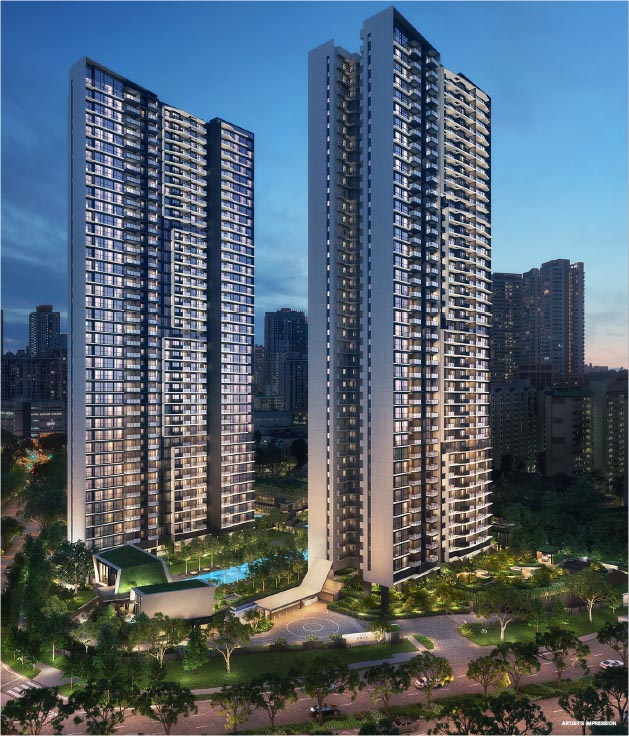
However, buyers must accept key trade-offs. The Orie consists of two 40-storey towers with 777 units, resulting in higher density and shared facilities. It is not a low-density or lifestyle-driven development, but a high-rise urban living environment within a mature town.
The Orie is best suited for buyers seeking a modern private upgrade within Toa Payoh, rather than those prioritising space, privacy, or short-term capital appreciation.
Understanding buyer alignment, pricing discipline and unit selection is critical to long-term satisfaction and resale performance.
The Orie is a modern high-rise condominium designed for buyers who prioritise staying within Toa Payoh’s mature, school-centric estate over low-density living or price-driven value optics.
The Orie Pricing and Investment Positioning
The Orie pricing is driven primarily by location scarcity within Toa Payoh rather than transformation or future growth potential.
In mature estates, buyers are less price-elastic due to strong location attachment, which supports demand even at higher price points. However, this also creates direct comparison against nearby resale developments, particularly in terms of unit size and overall quantum.
Smaller and mid-sized units tend to align more closely with upgrader affordability, while larger units face greater resistance due to higher financial commitment.
As a result, The Orie behaves more as a defensive, owner-occupier driven asset rather than a growth-led investment. Price performance is typically steady and supported by local demand, rather than rapid appreciation driven by new infrastructure or redevelopment catalysts.
Explore the Full The Orie Analysis
This article is part of the full The Orie cluster:
- The Orie Price Guide – pricing structure, market positioning, and buyer entry analysis
- The Orie Floor Plan Analysis – layout efficiency, unit mix, and stack considerations
- The Orie Showflat Guide – viewing strategy, location context, and buyer evaluation framework
Together, these articles provide a structured analysis of the project’s positioning, pricing framework, layout strategy, an
If you’re considering this project, you might want to check how it actually compares and what most buyers tend to overlook — before deciding.
Key Details (At a Glance)
-
99-year leasehold high-rise residential development99-year leasehold private condominium in Toa Payoh (District 12, RCR)
-
Two 40-storey residential towers with 777 units
-
Developed by CDL, Frasers Property, and Sekisui House
-
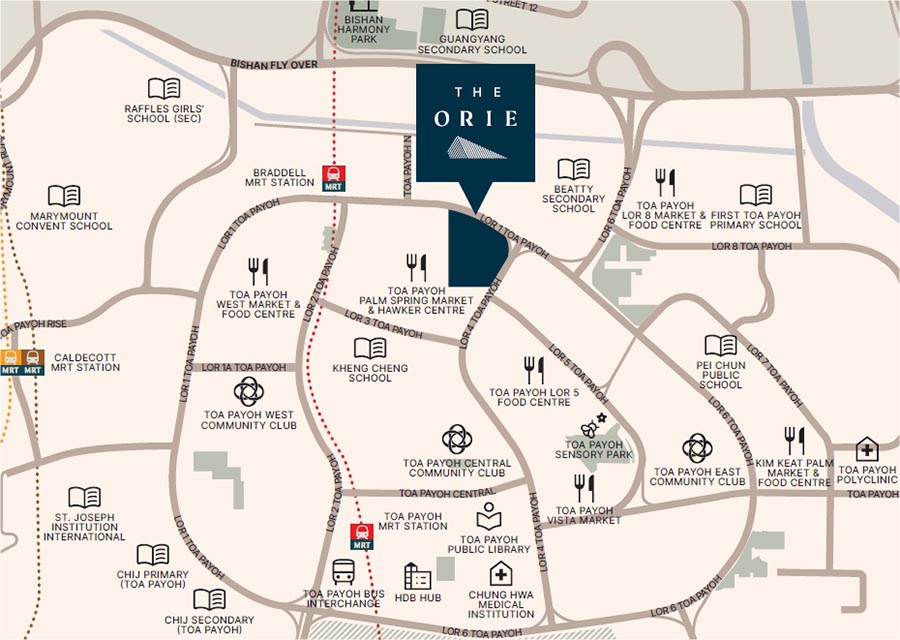
Located within a fully mature estate with established amenities
-
Approximately 5-minute walk to Braddell MRT (North-South Line)
-
Positioned as a city-fringe upgrade option for Toa Payoh households
Project Factsheet
| Item | Details |
|---|---|
| Project Name | The Orie |
| Chinese Name | 艺景峰 |
| Address | 10–12 Toa Payoh Lorong 1 |
| District / Planning Area | District 12 / Toa Payoh |
| Region | Rest of Central Region (RCR) |
| Tenure | 99-year leasehold |
| Site Type | Government Land Sale (GLS) |
| Developer | Joint venture by CDL, Frasers Property, Sekisui House |
| Development Type | High-rise residential condominium |
| Site Area | 15,743 sqm |
| Plot Ratio | 4.2 |
| Residential Units | 777 units |
| Building Form | Two 40-storey towers |
| Parking | Basement car parks |
| Expected TOP | Provided |
Location Context: Why Toa Payoh Changes the Buying Logic
Toa Payoh is not an emerging precinct. It is one of Singapore’s most established residential towns, with entrenched amenities, dense public transport coverage, and a strong school ecosystem. In such environments, buyer behaviour differs materially from fringe or growth areas.
Purchasers here are often unwilling to trade location familiarity for newer towns, even when pricing differentials exist. This creates a form of demand insulation for new private launches, where buying decisions are anchored to “staying within the district” rather than chasing relative value across regions.
For The Orie, this means its competitive set is not hypothetical future supply, but existing resale stock within Toa Payoh and adjacent estates. Buyers are implicitly choosing between modernity and space, rather than between neighbourhoods.
Development Character: Height, Density, and Urban Reality
The Orie’s defining physical trait is vertical intensity. Two 40-storey towers on a compact site produce an unmistakably urban living environment, with shared decks, communal facilities, and concentrated resident activity.
This configuration is not accidental; it is the logical outcome of maximising limited land in a central, built-out estate. While landscaping and deck design soften the environment, the project cannot — and does not attempt to — replicate low-rise or boutique living conditions.
As such, comfort with density becomes a prerequisite rather than a negotiable factor. Buyers transitioning from HDB blocks may find the scale familiar, while those expecting private-estate quietude may experience expectation mismatch.
## Amenities: What You Actually Get
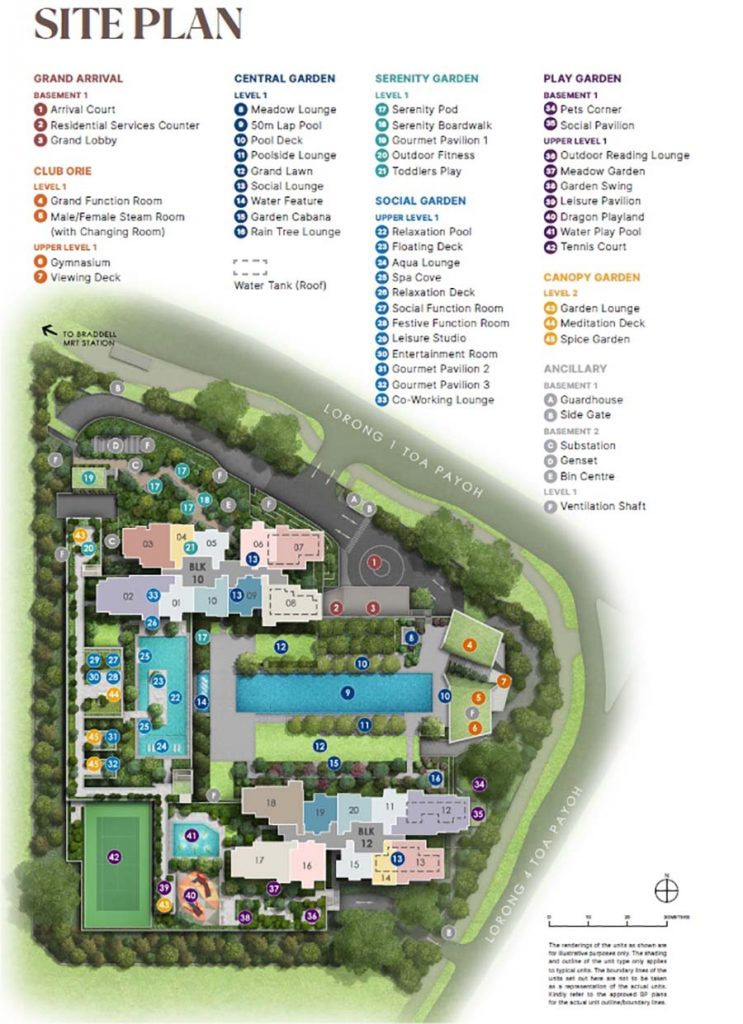
The Orie is designed as a full-facility development, offering a comprehensive range of communal amenities within a compact high-rise environment.
Key facilities include:
- 50-metre lap pool and relaxation pools
- Clubhouse with function rooms and viewing decks
- Gymnasium and fitness spaces overlooking landscaped zones
- Co-working lounge and indoor communal areas
- Multiple garden zones including Serenity Garden and Social Garden
- Gourmet pavilions and outdoor dining areas
- Children’s play areas including a reinterpreted dragon playground
- Tennis court and active lifestyle facilities
These facilities support a wide range of daily needs, from fitness and recreation to social gatherings and remote work.
However, due to the project’s density, facilities are shared across a large resident base. Usage intensity is expected to be higher during peak periods, particularly for key amenities such as pools, gym and function spaces.
As such, buyers should evaluate not just the presence of facilities, but their tolerance for shared usage and crowding in a high-density development.
Tenure and Pricing Reality: Scarcity Without Tenure Premium
Although The Orie is leasehold, its pricing behaviour is shaped less by tenure considerations and more by locational scarcity. In mature estates, leasehold projects can command strong demand when alternatives are limited and buyer attachment to place is high.
However, this does not eliminate comparison friction. Buyers inevitably benchmark against older freehold or larger resale units nearby, especially when absolute unit sizes and total quantum become salient. As a result, purchase justification relies heavily on lifestyle preference, building age, and future maintainability rather than pure tenure mathematics.
The Orie therefore rewards buyers who value modern living standards and building efficiency over land permanence or spatial generosity.
What The Orie Is — and Is Not
What It Is
A rare new private condominium within Toa Payoh
A modern, high-rise alternative to ageing resale stock
A location-anchored upgrade for Central North households
What It Is Not
Not a low-density or boutique development
Not a value-driven substitute for larger resale units
Not a growth-corridor or transformation-led project
Understanding this distinction early prevents expectation conflict later.
Buyer Suitability: Who This Project Works For
Most Suitable For
Long-term owner-occupiers with strong ties to Toa Payoh
Families prioritising school proximity and transport access
Buyers upgrading from HDB who are comfortable with vertical living
Households valuing building age and modern standards over unit size
Least Suitable For
Buyers seeking privacy, low density, or expansive layouts
Those highly sensitive to pricing gaps versus resale alternatives
Purchasers expecting speculative or momentum-driven upside
Buyers comparing The Orie against other upcoming launches may find it helpful to frame their decision using the New Launch Condo Guide, which outlines how pricing logic, buyer intent, and holding horizon differ across project types.
Takeaway
The Orie is a filtering project rather than a broad-appeal one.
It succeeds by offering modern private housing in a district where such options are structurally scarce, but it asks buyers to accept density, pricing discipline, and urban intensity in return.
For buyers aligned with Toa Payoh’s mature-estate logic, this trade-off can be coherent and defensible. For those expecting space, quiet, or value optics, misalignment is likely regardless of market conditions.
If you’re seriously considering this project, it’s worth checking how it actually compares and what most buyers tend to overlook — before deciding.
FAQs (Decision-Stage)
1) Is The Orie worth buying?
The Orie may be worth buying for buyers who prioritise staying within Toa Payoh, MRT access and long-term residential stability. It is less suitable for buyers seeking low-density living or strong short-term capital appreciation.
2) Is The Orie a good investment property?
The Orie functions more as a defensive, location-driven investment supported by upgrader demand and central accessibility, rather than a high-growth or speculative opportunity.
3) Who is The Orie most suitable for?
The Orie is most suitable for HDB upgraders, Toa Payoh residents, and owner-occupiers who prioritise location familiarity, school access and daily convenience.
4) Why is The Orie priced higher than some resale condos nearby?
Pricing reflects its new-build status, modern layouts and limited new supply in Toa Payoh, rather than land size or unit spaciousness.
5) Is The Orie considered expensive?
The Orie sits at a higher price point relative to older resale developments, with price acceptance depending on how buyers value modern living versus larger unit sizes.
6) Is The Orie suitable for families?
The Orie can suit families prioritising school proximity and central convenience, though compact layouts and density may not appeal to those seeking larger living spaces.
7) What are the main risks of buying The Orie?
Key risks include high density, pricing sensitivity compared to resale alternatives, and limited short-term upside.
8) Why do buyers choose The Orie?
Buyers choose The Orie primarily for its rare new supply in Toa Payoh, MRT proximity and ability to upgrade within a familiar neighbourhood.
Pricing Logic, Planning Intent & Buyer Segmentation
Pricing Logic: Location Loyalty Over Value Optics
The Orie’s pricing behaviour is best understood through the lens of location loyalty rather than traditional value optics. In a fully matured estate like Toa Payoh, many buyers anchor decisions to staying within the district, preserving school continuity, and maintaining daily routines. This creates a demand base that is less elastic than in emerging precincts, even when absolute prices appear elevated.
That said, pricing tolerance is not uniform across unit types. Smaller and mid-sized family layouts tend to align more naturally with upgrader budgets, while larger formats face sharper resistance as absolute quantum rises. As a result, price acceptance narrows progressively with size, making realistic expectations essential for future exit planning.
Planning Intent: Consolidation, Not Transformation
The Orie sits within an estate whose planning intent is consolidation and enhancement, not wholesale transformation. Infrastructure, transport, and amenities are already embedded; future improvements are incremental and focused on quality of life rather than land-use change. This stabilises long-term relevance but limits event-driven repricing narratives.
For buyers, this means returns are shaped more by replacement value and scarcity of new supply than by macro redevelopment catalysts. The project’s defensibility lies in permanence and usability, not in anticipation of structural change.
Buyer Segmentation: Who Converts and Why
The core buyer segment comprises local owner-occupiers upgrading from nearby public housing, often with multi-generational considerations. Their priorities centre on staying put, accessing schools, and securing a modern home without relocating to a new town. This group is less sensitive to comparisons outside the district.
Secondary demand comes from parent-buyers and long-term holders seeking certainty and ease of use. Conversely, buyers driven primarily by price arbitrage or short-cycle performance tend to hesitate, as the project does not offer a clear discount narrative or rapid repricing thesis.
Exit, Liquidity & Risk Scenarios
Exit Behaviour: Liquidity With Discipline
Exit liquidity at The Orie is supported by a steady pool of local demand, but outcomes are price-disciplined rather than momentum-driven. Transactions are more likely to occur when pricing aligns with buyer expectations within the district, not when sellers push for premium spreads over comparable resale stock.
This dynamic favours patience and realistic positioning. Sellers who over-anchor to peak narratives risk extended time-on-market, while those who price to the district’s absorption capacity tend to transact more predictably.
Density and Competition: Unit-Specific Outcomes
High density introduces internal competition, particularly among similar layouts. Over time, performance diverges at the unit level based on orientation, stack desirability, and distance from communal activity. Project-wide narratives matter less than micro-attributes during resale.
Buyers should therefore model outcomes with unit specificity. Strong selection can mitigate density effects; weak selection amplifies them.
Risk Framing: Expectation Mismatch Over Market Risk
The primary risk is expectation mismatch, not structural failure. Buyers expecting low-density privacy, expansive layouts, or rapid appreciation may experience dissatisfaction regardless of market conditions. By contrast, buyers aligned with high-rise urban living and district loyalty typically view trade-offs as acceptable.
Macro risks affect affordability and buyer sentiment, but they tend to express as longer selling periods rather than abrupt repricing. This reinforces the importance of holding horizon and financial resilience.
FAQs (Deep Decision-Stage Analysis)
1) Will The Orie face strong resale competition in the future?
Yes. Toa Payoh is a mature estate with multiple resale options, and future new launches in central locations may also compete for the same buyer pool. This creates a competitive resale environment where buyers compare closely across price, size and convenience. The Orie benefits from being a newer development, but competition remains a structural factor.
2) How does The Orie compare to other city-fringe or CCR developments?
The Orie sits closer to a city-fringe positioning rather than core prime districts. While it benefits from central accessibility, it does not carry the same prestige or pricing benchmark as traditional CCR developments. Its value is driven more by liveability and location familiarity than by prime-district status.
3) Is The Orie’s pricing supported by its location?
The Orie’s pricing is supported by its rare new supply within Toa Payoh and proximity to MRT connectivity. However, buyers remain highly price-sensitive due to nearby resale comparisons. This means pricing support exists, but is not unlimited.
4) Which unit types are likely to face more resale resistance?
Units with higher absolute quantum typically face more resistance due to a smaller buyer pool. Buyers in Toa Payoh often compare based on total price rather than just PSF, which affects demand for larger layouts. Smaller and mid-sized units generally maintain broader appeal.
5) How does supply in Toa Payoh affect The Orie’s resale potential?
Supply in Toa Payoh is largely resale-driven, which creates constant comparison for buyers evaluating The Orie. While resale supply supports transaction activity, it also limits pricing power for new developments. The Orie must compete on modernity rather than scarcity alone.
6) What type of future buyer is The Orie likely to attract?
Future buyers are likely to be HDB upgraders, existing Toa Payoh residents and owner-occupiers seeking convenience. The project is less likely to attract lifestyle-driven buyers or those prioritising exclusivity. Demand is therefore stable but not broad-based across all segments.
7) How does The Orie’s non-integrated nature affect long-term value?
The Orie is not an integrated development with direct retail or MRT linkage. While this reduces convenience compared to fully integrated projects, it also avoids the congestion and commercial activity that some buyers prefer to avoid. This creates a trade-off rather than a clear disadvantage.
8) Will future developments in nearby areas impact The Orie?
Yes. Future developments in central and city-fringe locations can influence buyer expectations and pricing benchmarks. As more options become available, buyers may compare more aggressively across projects. This increases the importance of unit-level differentiation.
9) How important is buyer perception for The Orie?
Buyer perception plays a key role, especially regarding density, layout efficiency and overall living environment. Even if the location is strong, perception can influence how quickly units transact in the resale market. This affects liquidity more than underlying demand.
10) Is The Orie sensitive to property market cycles?
The Orie is moderately sensitive to market cycles, but less volatile than transformation-led projects. Demand is supported by owner-occupiers rather than speculative buyers, which creates more stability. However, price growth may also be more gradual during upcycles.
11) How does The Orie compare to older resale or freehold condos nearby?
The Orie offers newer construction, modern layouts and updated facilities, while older resale or freehold condos may offer larger unit sizes or tenure advantages. Buyers typically weigh newness against space and tenure rather than choosing based on price alone.
12) What are the key exit risks buyers should consider?
Key exit risks include pricing sensitivity, competition from resale units and differences in buyer expectations across unit types. These factors can affect how long it takes to sell rather than whether the unit can be sold. Exit risk is primarily related to liquidity timing.
13) Will The Orie appeal equally to all buyer segments?
No. The Orie appeals more strongly to owner-occupiers and upgraders than to investors or luxury-segment buyers. Its positioning is focused rather than universal, which creates a narrower but more predictable demand base.
14) How does The Orie perform in terms of long-term positioning?
The Orie’s long-term positioning is tied to its location within a mature, fully developed estate. Its value is supported by stability and continuity rather than transformation or major infrastructure changes. This results in steady but less aggressive growth.
15) How does density influence buyer decisions at The Orie?
Density affects daily living conditions such as facility usage, waiting time and overall environment. Buyers who prioritise privacy or exclusivity may be less aligned with high-density developments. However, many upgraders are already accustomed to similar density levels.
16) What is the biggest mistake buyers make when evaluating The Orie?
The most common mistake is focusing only on location and newness without considering resale competition and buyer pool depth. Understanding who the next buyer is and how the unit will be compared is critical. Misalignment often leads to slower resale rather than immediate losses.
If you prefer a more structured walkthrough, you can leave your details below and we’ll follow up with you.