
Summary
The Hillshore is a 59-unit, freehold residential development along Pasir Panjang Road in District 5, positioned as a low-rise boutique project prioritising tenure permanence and privacy over scale, amenities, or near-term price momentum. Unlike larger freehold developments in the same corridor, it is not lifestyle-driven but asset-led, appealing mainly to buyers with long holding horizons. While linked to the Greater Southern Waterfront narrative, its benefits are indirect and time-based rather than immediate or catalytic.
Positioned within the Queenstown Planning Area of the Rest of Central Region (RCR), The Hillshore occupies a narrow but deliberate niche. It is structured around low resident density, long-term ownership logic, and controlled living conditions rather than experiential amenities or neighbourhood vibrancy.
This positioning introduces clear trade-offs. Road-facing exposure, limited on-site facilities, and pricing that sits above older freehold resale benchmarks mean the project does not compete as a lifestyle-led or momentum-driven new launch. Buyer conversion has therefore been selective, reflecting the need for strong alignment between buyer intent and the project’s asset-first proposition.
As such, The Hillshore should be assessed as a long-horizon, preservation-oriented asset, not as a lifestyle-ready family development or a short-cycle investment play.
The Hillshore is a boutique freehold development designed for buyers who prioritise long-term tenure security and privacy over lifestyle convenience, facility scale, and short-term price acceleration.
For buyers assessing whether The Hillshore aligns with their financing comfort, holding horizon, and exit assumptions, a structured project breakdown covering entry positioning, pricing logic, stack considerations, and buyer suitability may provide additional clarity before arranging any viewing.
Key Details (At a Glance)
Freehold | Boutique, low-density residential development
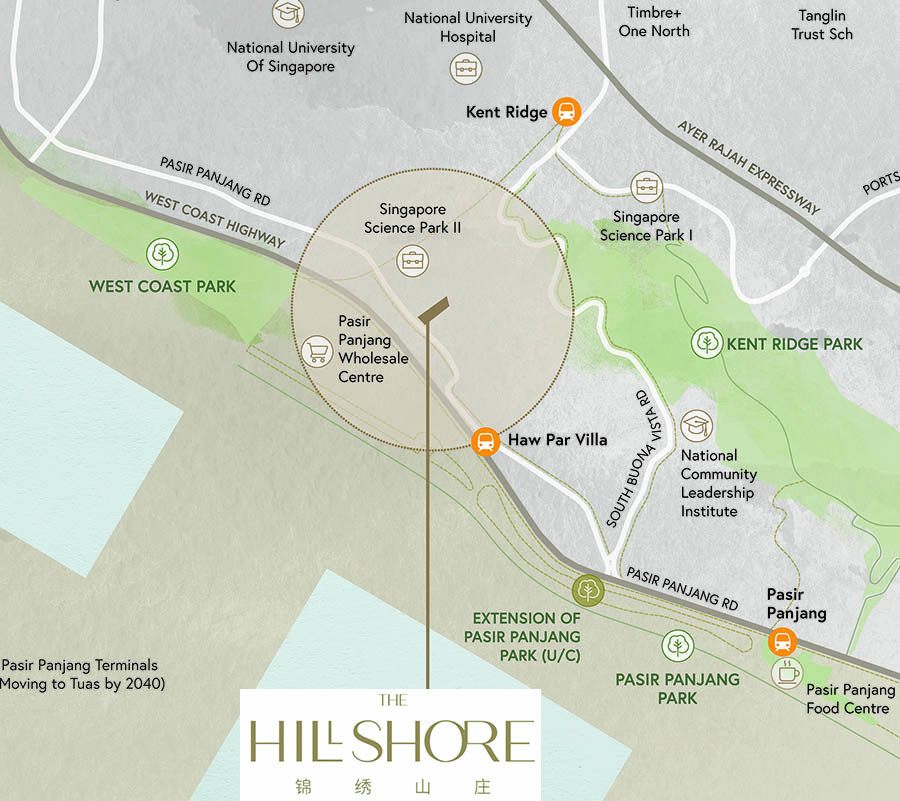
Pasir Panjang Road, District 5 (Queenstown Planning Area)
Rest of Central Region (RCR)
Positioned primarily for long-horizon owner-occupiers and asset-preservation buyers
Project Factsheet
| Item | Details |
|---|---|
| Project Name | The Hillshore |
| Location | 292 Pasir Panjang Road, Singapore |
| District / Region | District 5 / Rest of Central Region (Queenstown Planning Area) |
| Tenure | Freehold |
| Developer | FRX Capital |
| Site Type | En-bloc redevelopment (former Gloria Mansion) |
| Development Type | Pure residential |
| Site Area | ~4,249.6 sqm |
| Plot Ratio | 1.4 |
| Total Units | 59 residential units |
| Nearest MRT | Haw Par Villa MRT (Circle Line), ~500m walk |
| Launch Status | Launched |
| Expected TOP | Q2 2027 (estimated) |
Location Context: Pasir Panjang Today vs Long-Term
Pasir Panjang differs structurally from lifestyle-oriented residential corridors. The area is characterised by arterial roads, institutional uses, and pockets of low-rise housing rather than pedestrianised retail streets or self-contained neighbourhood hubs.
At present, daily convenience is limited. Supermarkets, hawker centres, and major retail nodes are not within immediate walking distance, and most residents rely on short drives or delivery services for daily needs. Street-level activity remains subdued outside peak commuting hours, reinforcing the area’s functional rather than vibrant character.
Over the long term, Pasir Panjang is expected to benefit from the gradual transformation of Singapore’s southern coastline under the Greater Southern Waterfront framework. However, this evolution is incremental. Buyers should treat Pasir Panjang as a district undergoing structural change rather than an already-complete residential neighbourhood.
Connectivity remains a key strength. The Circle Line provides direct rail access to HarbourFront, one-north, and the city fringe, supporting both owner-occupier convenience and rental demand from nearby employment clusters.
Development Character: Why Boutique Scale Is Central to the Proposition
The Hillshore’s defining feature is its intentional small scale.
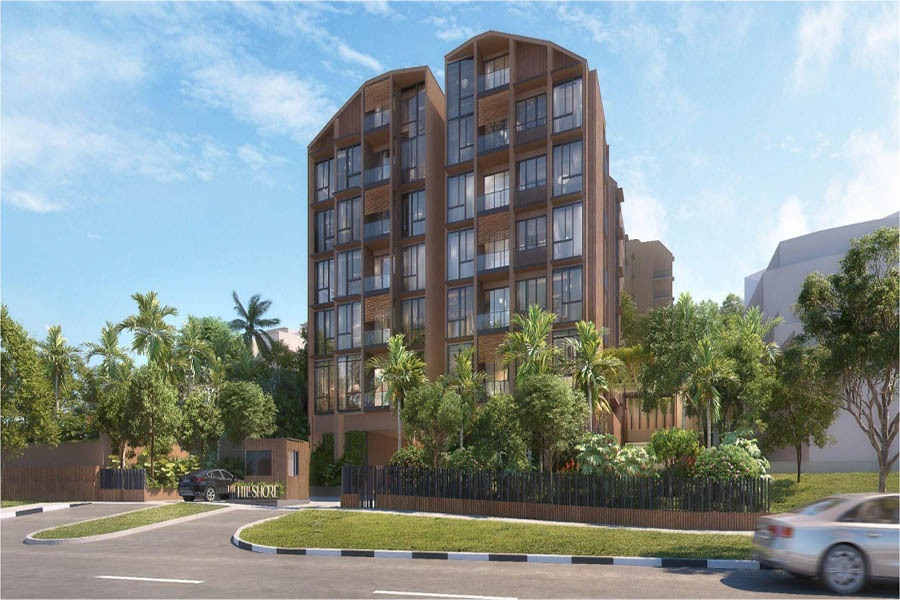
With only 59 units across two five-storey blocks, the development offers a materially lower density than most new launches in the Pasir Panjang corridor. This results in fewer shared facilities, quieter common areas, and a more controlled living environment.
The site’s narrow and sloping topography necessitated a tiered configuration organised around a central courtyard. Facilities are consolidated and functional rather than expansive, reinforcing the project’s residential focus instead of creating a resort-style setting.
This design choice is deliberate. The Hillshore is not meant to impress through scale or spectacle; it is meant to remain discreet and low-profile once occupied.
Freehold Positioning: Preservation Over Performance
Freehold tenure forms the core of The Hillshore’s value proposition.
For buyers with multi-decade holding horizons, freehold removes lease decay considerations and provides long-term optionality. This is particularly relevant in District 5, where many competing new launches operate on 99-year tenures.
However, freehold status does not equate to automatic liquidity. Boutique developments typically experience lower transaction volumes, and resale exits may take longer, especially during periods of softer demand. Buyers should approach The Hillshore as a preservation-oriented asset, not a vehicle for short-term appreciation.
This distinction is critical. The project rewards patience and conviction rather than timing or speculation.
Greater Southern Waterfront: Influence Zone, Not a Core Parcel
Under NLR classification, The Hillshore sits within the Greater Southern Waterfront Influence Zone, not within a core redevelopment parcel.
This means that while the project may benefit structurally from the long-term repositioning of Pasir Panjang and surrounding coastal areas, it does not enjoy direct waterfront activation or immediate redevelopment adjacency. Any uplift is likely to be gradual and time-led rather than event-driven.
Buyers expecting visible transformation within the early years of occupation may find expectations misaligned. The GSW narrative here is supportive, not catalytic.
Pricing Context: Where Buyer Resistance Emerges
At launch, The Hillshore entered the market at pricing levels that exceeded nearby freehold resale benchmarks. Buyer feedback indicates increasing sensitivity as absolute unit prices rise, particularly for three-bedroom configurations where quantum thresholds become more pronounced.
Many buyers struggle to justify the premium when compared against older freehold alternatives offering larger layouts or integrated retail environments. This dynamic has resulted in selective conversion and slower overall sales momentum.
For decision-stage buyers, the key question is not whether pricing is high in absolute terms, but whether the combination of freehold tenure, boutique scale, and west-side connectivity sufficiently compensates for the lack of lifestyle density and convenience.
How Buyers Actually Evaluate The Hillshore
In practice, The Hillshore is rarely assessed in isolation.
One comparison set comprises larger freehold developments along Pasir Panjang Road, such as Terra Hill. These projects provide more extensive facilities and a stronger lifestyle narrative but come with higher resident density and less privacy.
The second comparison set consists of older freehold resale developments like Bijou or The Orient. These offer lower entry prices and immediate convenience but lack modern layouts, new-build warranties, and long-term asset clarity.
Buyers who ultimately choose The Hillshore tend to prioritise tenure permanence and privacy over value optics or amenity breadth. This explains why interest is broad but conversions remain selective.
What The Hillshore Is — and Is Not
What It Is
A boutique, low-density freehold residential project
Designed for long-horizon holding and asset preservation
Suited for buyers valuing privacy and quiet over vibrancy
Positioned within the long-term influence of the Greater Southern Waterfront
What It Is Not
Not a lifestyle-driven or amenity-rich development
Not a family-centric project with school-led demand
Not a high-liquidity or momentum-based investment
Not structured for short-term trading or flipping
Understanding this distinction early prevents expectation mismatch.

Buyer Suitability: Who This Project Works For
Most Suitable For
Buyers prioritising freehold tenure and long-term ownership
Owner-occupiers seeking quiet, low-density living
Parents purchasing for children with extended holding horizons
Investors targeting niche tenant pools near research and business hubs
Least Suitable For
Buyers requiring walkable daily amenities
Families seeking extensive recreational facilities
Buyers sensitive to road exposure and traffic noise
Those expecting near-term capital appreciation
Buyers comparing The Hillshore against other upcoming launches may find it helpful to frame their decision using the New Launch Condo Guide, which outlines how pricing logic, buyer intent, and holding horizon differ across project types.
Takeaway
The Hillshore is not a compromise project — it is a filtering project.
It rewards buyers who are clear about why they want freehold in this specific corridor and penalises those expecting lifestyle completeness or short-term upside. For the right buyer, it offers tenure security and privacy that are increasingly scarce. For the wrong buyer, it will feel expensive, quiet, and inconvenient.
Clarity of intent matters more here than almost any other buying decision.
If The Hillshore is on your shortlist and being compared against nearby alternatives, a structured review of capital commitment differences, downside exposure scenarios, liquidity positioning, and realistic exit pool dynamics may help clarify the decision framework before any commitment is made.
FAQs (Decision-Stage)
1) Is The Hillshore overpriced relative to nearby freehold options?
The Hillshore can appear overpriced when benchmarked against older freehold resale developments with lower entry prices. However, buyers who proceed typically place greater weight on new-build condition, modern layouts, and long-term holding clarity rather than short-term value optics. The premium only makes sense for buyers who prioritise tenure permanence and privacy over convenience and resale velocity.
2) Is The Hillshore affected by Pasir Panjang Road traffic and noise?
Yes. Road-facing stacks may experience sustained ambient noise and dust due to Pasir Panjang Road’s arterial traffic profile. This is not a marginal issue but a structural one, making unit orientation a critical decision factor rather than a minor trade-off.
3) Does freehold tenure make The Hillshore a safer long-term asset?
Freehold removes lease decay risk, which is most relevant for buyers planning to hold across multiple decades or generations. However, in boutique developments like The Hillshore, resale outcomes are driven less by tenure and more by buyer-pool depth. This means long-term value preservation may be stronger, but resale liquidity can be slower compared to larger, lifestyle-driven projects.
4) Why has sales momentum been relatively selective?
Buyer interest is broad, but conversion is narrower because pricing sits above older freehold resale benchmarks while offering fewer lifestyle amenities than larger new launches. This places the project in a narrow decision band where buyers must consciously value privacy and tenure permanence over convenience or value optics. Developments with this profile typically see slower, conviction-driven absorption rather than rapid sales velocity.
5) Is The Hillshore suitable for families with children?
It depends on how families prioritise lifestyle versus living environment. While the low-density and private setting may appeal to some, the limited facilities and lack of nearby daily amenities can be restrictive for family-centric living. Families expecting activity-driven facilities or school-anchored neighbourhoods may find the project misaligned.
6) How strong is rental demand for this project?
Rental demand is supported by nearby universities, research institutions, and business parks, creating a stable tenant pool of professionals and academics. However, higher entry prices may cap yields, meaning the project works better as a capital-preservation rental asset rather than a yield-maximisation play.
7) How relevant is the Greater Southern Waterfront to The Hillshore?
The Hillshore sits within the Greater Southern Waterfront influence zone, not a core redevelopment parcel. As a result, any benefits are structural and long-dated rather than immediate or event-driven. Buyers should view GSW exposure here as a supportive backdrop, not a near-term catalyst.
8) Who should seriously consider buying The Hillshore?
The Hillshore is best suited for buyers prioritising freehold tenure, privacy, and long holding horizons over lifestyle density and resale speed. It works for those comfortable trading convenience and momentum for controlled living conditions and asset permanence. Buyers expecting short-term upside or neighbourhood vibrancy should eliminate it early.
PRICING LOGIC, URA PLANNING INTENT & BUYER SEGMENTATION
Summary
This section examines how The Hillshore’s pricing behaves across different market phases, how URA planning intent for the Pasir Panjang–Greater Southern Waterfront corridor frames long-term outcomes, and which buyer segments are actually converting versus hesitating.
Pricing Logic: Boutique Premium Across Market Phases
Early Launch Phase: Asset Scarcity Framing
At launch, The Hillshore was priced to reflect three scarcity attributes rather than neighbourhood completeness: freehold tenure, boutique scale, and new-build condition. In District 5, where most new supply is leasehold and higher density, this positioned the project as a niche alternative rather than a mass-market competitor.
Early buyers tended to focus less on immediate comparables and more on the absence of lease decay and the rarity of low-unit-count freehold launches in the west. During this phase, pricing resistance was muted, provided absolute quantum remained within psychologically acceptable bands.
Mid-Cycle Phase: Benchmarking Resistance Emerges
As the sales cycle progressed, buyer behaviour shifted. Pricing scrutiny intensified as purchasers increasingly benchmarked The Hillshore against:
older freehold resale developments offering larger layouts at lower entry prices, and
larger freehold new launches along Pasir Panjang Road offering more extensive facilities
This is the natural resistance zone for boutique developments. At this stage, buyers stop asking “Is this freehold?” and start asking “What am I giving up for this?”
Sales momentum becomes selective, not because the pricing is objectively unjustifiable, but because the buyer pool narrows to those who explicitly prioritise privacy and tenure permanence over convenience or perceived value-for-money.
Mature Phase Outlook: Stability Over Acceleration
In a mature phase, pricing behaviour at The Hillshore is likely to be range-bound rather than momentum-driven. Boutique freehold projects tend to exhibit:
fewer transactions rather than sharp repricing, and
price stability anchored by scarcity rather than demand surges
This supports capital preservation over performance but limits upside acceleration relative to larger, lifestyle-oriented projects.
URA Planning Intent: Pasir Panjang Within the GSW Structure
URA planning intent is a critical driver for understanding The Hillshore’s long-term context — not as a catalyst, but as a structural backdrop.
The Pasir Panjang corridor sits within the Greater Southern Waterfront influence zone, not a core redevelopment parcel. Unlike Marina South or Keppel, this area is not subject to wholesale redevelopment, but to gradual repositioning through infrastructure upgrades, land-use optimisation, and connectivity improvements.
Key implications for The Hillshore include:
Incremental improvement, not visible transformation at TOP
Indirect uplift driven by broader district maturity rather than adjacency to new landmarks
Policy stability, supporting long-term residential relevance without speculative repricing
For buyers, this means URA intent reinforces long-term defensibility, not near-term upside.
Buyer Segmentation: Who Converts — and Who Does Not
Primary Segment: Long-Horizon Owner-Occupiers
These buyers prioritise tenure permanence, privacy, and controlled living environments. They are less sensitive to resale velocity and more focused on long-term suitability, often planning to hold across decades.
Secondary Segment: Capital Preservation Investors
This group views The Hillshore as a defensive asset rather than a yield or growth play. Freehold tenure and low density matter more than rental yield optimisation or transaction liquidity.
Tertiary Segment: Parents Purchasing for Future Occupation
Parents buying for children value new-build condition and tenure security, accepting that immediate lifestyle completeness is secondary to long-term optionality.
Notably Absent Buyer Profiles
Short-term investors
Momentum-driven traders
Lifestyle-led buyers prioritising facilities and vibrancy
This absence explains selective absorption and reinforces the project’s conviction-led nature.
EXIT, LIQUIDITY & RISK SCENARIOS
Summary
This section models exit behaviour, liquidity constraints, and downside scenarios buyers should acknowledge before committing to a long-term holding decision.
Exit Liquidity: Boutique Projects Follow a Different Curve
Resale liquidity at The Hillshore is likely to be episodic rather than continuous.
With only 59 units, transaction volume will be naturally low. Resale demand tends to surface when market conditions align with the project’s buyer profile — typically during stable or rising markets favouring owner-occupiers and capital-preservation buyers.
During weaker cycles, liquidity does not collapse, but time-to-exit lengthens, requiring patience rather than repricing.
Time-Phased Exit Scenarios
Early Post-TOP (0–3 Years)
Limited direct competition
Exit supported mainly by scarcity and new-build appeal
Liquidity strongest for smaller units with favourable orientation
Mid-Cycle (3–8 Years)
Increased competition from newer launches
Buyer focus shifts to pricing realism and liveability
Exit becomes more unit-specific than project-wide
Long-Term (8+ Years)
Freehold tenure becomes more relevant
Leasehold alternatives begin facing tenure perception issues
Exit favours buyers aligned with long holding horizons
Key Risk Scenarios Buyers Must Accept
1) Liquidity Compression Risk
Boutique scale reduces buyer pool depth. In downcycles, this manifests as longer holding periods rather than sharp price declines.
2) Quantum Sensitivity for Larger Units
Higher absolute prices amplify buyer hesitation, particularly in a location without strong family-centric infrastructure.
3) Persistent Road Exposure
Traffic noise and environmental exposure for certain stacks are structural and permanent, affecting both liveability and resale appeal.
4) Limited GSW Visibility Risk
As an influence-zone project, uplift depends on long-term district repositioning rather than direct redevelopment adjacency.
5) Interest Rate Sensitivity
Higher rates disproportionately affect boutique, high-PSF developments with moderate yields, narrowing the leveraged buyer pool.
Freehold Reality: Protection, Not Acceleration
Freehold tenure supports downside protection and long-term optionality. It does not guarantee faster exits or higher short-term prices.
For The Hillshore, freehold functions as a risk-mitigation tool, not a performance multiplier.
Final Assessment
The Hillshore behaves exactly as its structure predicts.
It trades liquidity, convenience, and short-term upside for tenure permanence, privacy, and long-term stability. Buyers aligned with this profile may find it coherent and defensible across market cycles. Buyers expecting momentum, rapid repricing, or lifestyle completeness will likely experience frustration rather than underperformance.
This is not a project that rewards optimism — it rewards alignment.
FAQs
1) Is The Hillshore a good long-term investment?
The Hillshore works best as a long-term, capital-preservation asset rather than a growth-oriented investment. Freehold tenure removes lease decay risk, which becomes meaningful only over extended holding periods rather than short cycles. However, returns are more likely to be gradual and stability-driven rather than appreciation-led, given the project’s boutique scale and non-lifestyle positioning. Buyers expecting market-cycle outperformance or rapid repricing are likely to be disappointed. Alignment between holding horizon and expectations is critical here.
2) How liquid will resale units be in the future?
Resale liquidity at The Hillshore is likely to be episodic rather than continuous due to its limited unit count and narrow buyer pool. Transactions tend to occur when market conditions favour owner-occupiers or capital-preservation buyers, rather than during speculative phases. In softer markets, liquidity does not typically collapse, but time-to-exit lengthens materially. This means sellers may need patience rather than price aggression to secure a transaction. Liquidity risk manifests as delay, not necessarily sharp price correction.
3) Does freehold guarantee better exit prices?
No. Freehold protects against lease decay but does not override buyer sensitivity to pricing, convenience, and comparative alternatives. In resale scenarios, buyers still benchmark against newer launches, nearby resale stock, and overall liveability. Freehold tends to support downside protection over long periods rather than ensure premium exit prices in the short or medium term. It is a defensive attribute, not a performance accelerator. Buyers relying on tenure alone to justify exit pricing may misjudge market behaviour.
4) How does The Hillshore compare to larger freehold projects for exit?
Larger freehold developments generally enjoy deeper buyer pools due to higher visibility, more facilities, and broader lifestyle appeal. This supports more consistent resale liquidity, particularly during neutral market conditions. The Hillshore trades this liquidity for privacy and exclusivity, which narrows its resale audience. As a result, exit outcomes depend more on finding the right buyer than on general market momentum. This dynamic favours patient sellers over opportunistic ones.
5) Is rental demand sustainable over time?
Rental demand is supported by nearby universities, research institutions, and employment nodes, creating a stable but specialised tenant base. However, higher entry prices cap achievable yields, meaning rental performance is more defensive than aggressive. Demand is likely to remain consistent rather than expand materially over time. This makes the project suitable for holding through rental cycles but less effective for yield-maximisation strategies. Rental stability should be viewed as a holding buffer, not a return driver.
6) Will the Greater Southern Waterfront materially improve resale prospects?
Any benefit from the Greater Southern Waterfront is likely to be gradual and indirect, as The Hillshore sits outside core redevelopment parcels. Uplift depends on broader district repositioning rather than proximity to new landmarks or infrastructure. This means resale improvements, if any, will unfold over long timelines rather than occur around discrete milestones. Buyers expecting event-driven repricing tied to GSW announcements are likely to be disappointed. GSW exposure here functions as long-term support, not a catalyst.
7) What are the key downside risks buyers should model?
Key risks include slower resale liquidity, quantum sensitivity for larger units, and persistent road exposure for certain stacks. These factors are structural rather than cyclical and do not self-correct over time. In down markets, they translate into longer holding periods rather than immediate price compression. Buyers must be comfortable absorbing these constraints without relying on market recovery to “fix” them. Risk here is about patience, not volatility.
8) Who should avoid The Hillshore?
Buyers seeking short-term capital appreciation, rapid resale liquidity, or lifestyle-led living should eliminate the project early. These expectations conflict directly with the project’s low-density, preservation-oriented design. Frustration risk is highest among buyers who value convenience, facilities, or momentum more than tenure permanence. Avoidance is not about the project being flawed, but about misalignment of objectives. Clarity upfront prevents regret later.
9) Is The Hillshore suitable for leveraged investors?
It is less suitable for highly leveraged strategies, particularly in higher interest-rate environments. Rental yields may not fully offset financing costs, increasing holding pressure during prolonged ownership. Leveraged investors are also more sensitive to resale timing, which is inherently less predictable in boutique developments. The project favours buyers with lower financing dependency and longer holding flexibility. Leverage amplifies friction rather than returns here.
10) Does boutique scale help or hurt long-term value?
Boutique scale enhances privacy, exclusivity, and living quality for aligned buyers, which can support long-term value preservation. However, it simultaneously reduces transaction volume, narrowing the resale buyer pool. This trade-off becomes most visible during exit rather than during ownership. Over time, value stability is more likely than sharp appreciation. Boutique scale rewards conviction, not optionality.
11) How does interest-rate risk affect this project?
Higher interest rates compress affordability and disproportionately affect boutique, high-PSF developments with moderate yields. This reduces the pool of leveraged buyers, particularly during resale. In such environments, demand skews more heavily toward owner-occupiers and cash-rich buyers. While this limits volatility, it also slows transaction velocity. Rate sensitivity here shows up as time risk rather than price risk.
12) Can The Hillshore outperform leasehold alternatives?
It may outperform leasehold alternatives over very long holding horizons where lease decay becomes a meaningful differentiator. Over shorter cycles, performance is more dependent on entry price, unit selection, and buyer demand than tenure alone. Freehold advantage compounds slowly rather than immediately. Buyers expecting near-term outperformance solely due to tenure may overestimate its impact. Time is the variable that makes freehold matter.
13) Are price corrections more likely in boutique projects?
Boutique projects tend to experience fewer transactions rather than sharp repricing during downturns. This can create the perception of price stability, but it also slows price discovery. Corrections, if they occur, often happen through extended selling periods rather than abrupt discounts. Sellers may choose to wait rather than adjust pricing aggressively. This dynamic favours long-horizon holders over forced sellers.
14) How important is unit selection at The Hillshore?
Unit selection is critical due to the narrow buyer pool and structural factors such as road exposure and orientation. Differences between stacks can materially affect both liveability and resale appeal. Poor unit selection can underperform even if the project behaves as expected overall. Buyers should prioritise orientation and exposure over floor area alone. Unit-level decisions matter more here than in larger developments.
15) Is The Hillshore a “safe” buy?
It is “safe” only for buyers whose expectations align with long-term holding, lower liquidity, and defensive capital behaviour. Safety here refers to stability, not performance. Buyers expecting flexibility, rapid exits, or strong upside may perceive risk even if prices hold. The primary risk is expectation mismatch rather than structural failure. Alignment defines safety more than market conditions.
16) Who is the ideal long-term buyer for The Hillshore?
The ideal buyer is an owner-occupier or capital-preservation investor with a long holding horizon and low reliance on leverage. This buyer values tenure permanence, privacy, and stability over lifestyle density or resale optionality. Patience and conviction are prerequisites rather than advantages. For such buyers, the project’s limitations are acceptable trade-offs rather than deterrents. For others, restraint is the rational choice.
If a structured discussion is preferred over WhatsApp, or if detailed floor plans, pricing breakdowns, or showflat arrangements are required, your details may be left below for a follow-up.