
Summary
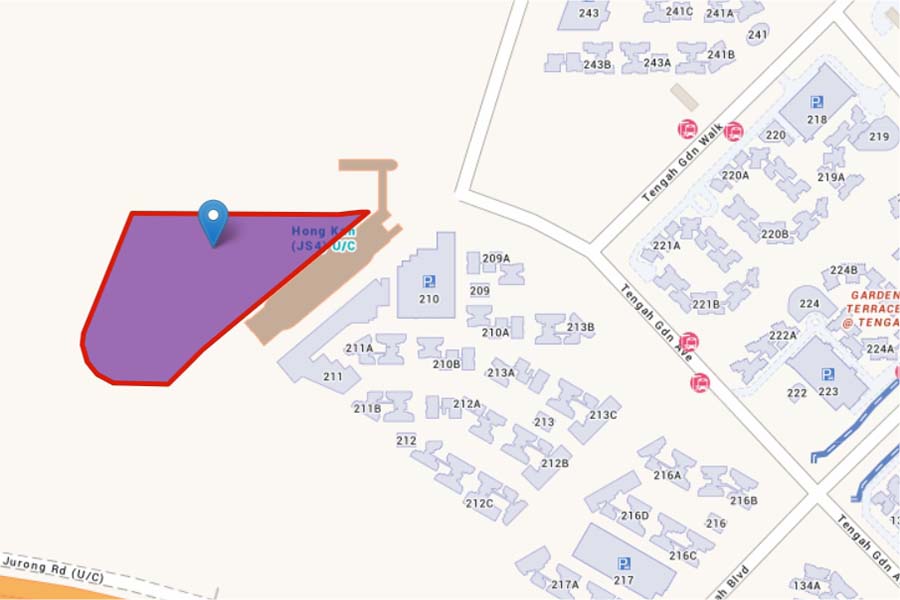
Tengah Garden Residences is a 99-year leasehold integrated mixed-use development located along Tengah Garden Avenue in District 24, developed by a Hong Leong–CSC Land–GuocoLand consortium under the GLS programme. Positioned directly beside Hong Kah MRT (JS4) on the Jurong Region Line, it is the first private condominium ever launched in Tengah, Singapore’s first purpose-built “Forest Town.”
Rather than competing as a conventional OCR suburban project, Tengah Garden Residences functions as a first-mover, infrastructure-led development. Its appeal is anchored in MRT adjacency, an on-site commercial podium serving a growing BTO population, and long-term town maturation tied to the Jurong Region Line, the Jurong Innovation District, and the future Jurong Lake District.
This review assesses Tengah Garden Residences from a decision-stage perspective — focusing on who the project is realistically suited for, what buyers are actually paying for, and the trade-offs involved in entering a new township early, rather than relying on promotional narratives or speculative pricing assumptions.
Tengah Garden Residences is the first private integrated condominium in Tengah, designed for buyers willing to enter a new town early in exchange for MRT connectivity, future town maturity, and first-mover positioning. It is best suited for long-horizon own-stay families and early entrants into the West’s growth corridor, while buyers seeking immediate estate maturity or short-term upside may find the trade-offs less suitable.
For buyers assessing whether Tengah Garden Residences aligns with their financing comfort, holding horizon, and exit assumptions, a structured project breakdown covering entry positioning, pricing logic, stack considerations, and buyer suitability may provide additional clarity before arranging any viewing.
Key details (at a glance)
99-year leasehold | Est. ~862 units | Integrated mixed-use development
Directly beside Hong Kah MRT (JS4) | First private condo in Tengah
Est. launch Q2 2026 | Est. TOP 2030
Project Factsheet
| Item | Details |
|---|---|
| Project Name | Tengah Garden Residences |
| Location | Tengah Garden Avenue |
| District / Region | District 24 / OCR (West Region) |
| Tenure | 99 years |
| Developer | Hong Leong Group, CSC Land Group & GuocoLand |
| Site Type | GLS (New Launch) |
| Development Type | Integrated Mixed-Use Development |
| Site Area | ~25,458.4 sqm |
| Plot Ratio | 3.0 |
| Total Units | 862 residential units |
| Nearest MRT | Hong Kah MRT (JS4), Jurong Region Line |
| Expected Launch | Estimated Q2 2026 |
| Estimated TOP | 2030 |
Tengah Garden Residences is a first-mover, MRT-integrated private condominium designed for long-term own-stay buyers and early entrants into Tengah, not a mature-estate substitute or short-term trading play.
Location Context: Infrastructure Before Maturity
Tengah Garden Residences sits at a stage where infrastructure exists before lifestyle maturity. The immediate surroundings will feel transitional for several years, but the structural fundamentals are already locked in.
Being directly beside Hong Kah MRT (JS4) gives it a permanent advantage in a town planned around car-lite mobility. Unlike many OCR projects that rely on future rail lines, this project is positioned at a confirmed transit node from the outset. Over time, this proximity becomes more valuable as surrounding density increases.
The integrated commercial podium further reinforces its role as an interim town node. Until Tengah Town Centre is fully completed, daily services, groceries, and neighbourhood foot traffic are likely to concentrate here, particularly from nearby BTO clusters. This creates convenience through function, not lifestyle branding.
The ACS (Primary) Relocation Effect
The planned relocation of Anglo-Chinese School (Primary) to Tengah in 2030 introduces a forward-looking demand layer. Tengah Garden Residences falls within the 1–2 km radius, placing it within consideration for families planning early entry to the area.
This factor does not drive immediate demand, but it does shape long-term buyer behaviour, particularly among families with younger children who plan housing decisions several years ahead of school enrolment.
Employment Gravity: West-Side Growth, Not City-Centre Pull
Tengah Garden Residences benefits indirectly from the Jurong Innovation District (JID) and Jurong Lake District (JLD). Its role is residential rather than commercial — effectively housing professionals working in advanced manufacturing, research, and business hubs across the West.
This supports stable own-stay and rental demand, but it does not translate into prestige or speculative momentum. Demand here is practical and income-linked, not lifestyle-led.
What Tengah Garden Residences Is — and Is Not
What it is
The first private condo establishing Tengah’s private-market benchmark
An MRT-integrated, mixed-use development prioritising convenience
A long-horizon own-stay and early-entry growth play
What it is not
Not a mature estate experience at launch
Not a low-density or boutique project
Not designed for short-term trading or EC-style price momentum
Buyer Suitability
Best suited for
Families planning a 5–10 year holding horizon
Buyers priced out of ECs but seeking private housing in the West
Households comfortable entering a town before full completion
Professionals working in or around JID and JLD
Likely to be dissatisfied
Buyers expecting immediate neighbourhood maturity
Those sensitive to prolonged construction activity
Short-term investors focused on launch-to-TOP price spikes
The Core Trade-Off
Buyers of Tengah Garden Residences are effectively trading time and patience for first-mover positioning, MRT adjacency, and long-term town development upside. This trade-off is structural and cannot be priced away entirely.
Takeaway
Tengah Garden Residences works best for buyers who are comfortable being early — early into Tengah, early into its private-market pricing benchmark, and early into the West’s next growth corridor. It works poorly for buyers seeking immediate maturity, quiet exclusivity, or short-term performance.
Pending Approval for Sale
If Tengah Garden Residences is on your shortlist and being compared against nearby alternatives, a structured review of capital commitment differences, downside exposure scenarios, liquidity positioning, and realistic exit pool dynamics may help clarify the decision framework before any commitment is made.
FAQs (Decision-Stage)
1) Is Tengah Garden Residences mainly for own-stay buyers or investors?
Tengah Garden Residences is primarily structured for own-stay buyers rather than short-term investors. Most demand is expected from families and upgrader households who value MRT access, integrated convenience, and long-term town development. Investor interest exists, but it is likely to be long-horizon and capital-growth focused rather than yield-driven.
2) Does being the first private condo in Tengah increase risk?
Yes, entering Tengah early carries estate-maturity risk, as surrounding infrastructure and amenities will take time to fully develop. However, this also allows buyers to enter at the lowest private-market benchmark in the town. The risk–reward trade-off depends heavily on holding period and tolerance for near-term inconvenience.
3) How important is the Hong Kah MRT (Jurong Region Line) location?
The MRT adjacency is one of the project’s most important structural advantages. In a car-lite town like Tengah, proximity to a confirmed rail node materially improves daily convenience and long-term desirability. This advantage becomes more pronounced as surrounding residential density increases.
4) Will nearby construction activity affect liveability?
Construction activity is expected to be a reality for several years, as Tengah is still in its early development phase. Buyers sensitive to noise, dust, or a transitional environment may find this challenging. Those with longer time horizons tend to view this as a temporary phase rather than a permanent drawback.
5) Is Tengah Garden Residences comparable to nearby Executive Condominiums?
Only partially. While buyer profiles may overlap, Tengah Garden Residences is a private condominium and will be priced without EC subsidies or eligibility restrictions. Buyers expecting EC-style price behaviour should recalibrate expectations accordingly.
6) Who is most likely to be satisfied living at Tengah Garden Residences?
Buyers with long holding horizons who prioritise MRT connectivity, future town planning, and integrated convenience are most likely to be satisfied. This includes families planning ahead and professionals working in the West. Short-term oriented buyers may find the trade-offs less compelling.
7) Does the planned relocation of ACS (Primary) materially affect demand?
The ACS (Primary) relocation is a forward-looking demand driver rather than an immediate one. It is most relevant for families with younger children who plan housing decisions several years in advance. While it does not guarantee demand, it introduces a structural family-buyer pipeline over time.
8) Should buyers wait for later Tengah private launches instead?
Later launches may benefit from a more developed town environment, but they are also likely to be priced higher as infrastructure matures. The decision depends on whether buyers prefer early entry at a lower benchmark or greater maturity at a higher price point.
Pricing Logic, URA Planning Intent & Buyer Segmentation
Summary
Tengah Garden Residences should not be evaluated using conventional OCR pricing heuristics. As the first private condominium in a brand-new town, its pricing behaviour is shaped more by benchmark-setting, infrastructure maturity, and buyer patience than by immediate comparables or resale anchoring. This section examines how pricing is likely to behave, how it aligns with URA’s long-term planning intent for Tengah, and which buyer segments are structurally supported — or constrained — by this positioning.
Pricing Logic: Benchmark-Setting, Not Market-Chasing
Indicative Pricing Context (No Official Prices Released)
At the time of writing, official pricing for Tengah Garden Residences has not been released. However, pricing behaviour can be analysed structurally based on known inputs:
-
GLS land cost of $821 psf per plot ratio
-
Integrated mixed-use construction cost (MRT adjacency + commercial podium)
-
Scale of development (862 units)
-
Buyer profile skewed toward own-stay families and early entrants
Rather than chasing nearby OCR price ceilings, Tengah Garden Residences functions as a reference point for future private launches in Tengah. As the first private condo, its pricing effectively establishes the historical floor for private housing in the town.
This means buyers are not paying for present-day maturity. They are paying for:
-
Entry at the earliest private benchmark
-
MRT adjacency that later projects may not replicate as closely
-
Exposure to long-term town completion rather than short-term optics
Pricing Behaviour: How It Is Likely to Move
Pricing at Tengah Garden Residences is expected to behave more like an early-cycle township launch than a mature OCR condo:
-
Initial pricing must justify private status over nearby ECs
-
Subsequent appreciation is more likely to track infrastructure completion milestones than market sentiment
-
Price performance is expected to be gradual and layered, not front-loaded
Unlike ECs, where subsidy-driven gaps create immediate repricing, Tengah Garden Residences depends on time compression — the narrowing of price gaps as Tengah matures.
Absolute Quantum vs PSF: The Correct Lens
For this project, absolute quantum matters more than psf.
Key reasons:
-
Core buyers are own-stay families, not traders
-
Larger unit sizes amplify sensitivity to total price
-
Buyers are comparing against ECs, resale condos, and future Tengah launches
-
MRT integration improves tolerance, but not infinitely
If pricing stretches too aggressively on the basis of being “integrated,” family demand elasticity narrows quickly.
Explicit Pricing Decision Rules
-
If your priority is early entry into Tengah with MRT integration and a 7–10 year horizon, the pricing logic is coherent.
-
If you expect EC-style price behaviour or short-term repricing, this project will feel expensive.
-
Buyers prioritising immediate resale benchmarks over long-term town maturity should recalibrate expectations or look elsewhere.
URA Master Plan Context: Tengah as a Structural Growth Play
URA’s vision for Tengah is not speculative. It is programmatic and phased.
Key planning features include:
-
42,000 new homes across multiple districts
-
A 100m-wide, 5km-long Forest Corridor
-
Car-free town centre and smart mobility systems
-
Jurong Region Line completion by 2029
-
Integration with Jurong Innovation District and Jurong Lake District
For Tengah Garden Residences, this matters because:
-
Its value proposition strengthens as planning intent is executed, not announced
-
MRT-linked projects benefit disproportionately once population density increases
-
Early integrated nodes tend to capture higher utility value over time
This is slow-burn planning, not catalytic rezoning.
Buyer Segmentation: Who Tengah Garden Residences Actually Serves
1. Long-Horizon Own-Stay Families (Primary Segment)
Profile
-
Planning 7–10 years or longer
-
Comfortable entering a developing town
-
Value MRT access, schools, and future amenities
Why it works
-
Integrated convenience reduces lifestyle friction
-
ACS (Primary) relocation adds forward-looking demand
-
Town maturation aligns with family life cycles
2. “Aspirational Gap” Buyers Exceeding EC Income Ceiling
Profile
-
Previously eligible for ECs, now priced out
-
Want private housing without moving east or central
-
Price-sensitive but planning-driven
Why it works
-
Entry into private market at earliest Tengah benchmark
-
Comparable family utility without EC restrictions
-
Accepts trade-off between price and maturity
3. Pioneer Investors (Secondary, Selective)
Profile
-
Long-term capital-growth mindset
-
Familiar with township development cycles
-
Less yield-focused
Why it partially works
-
MRT adjacency + future density supports rental demand
-
First-mover pricing advantage relative to later GLS sites
Limitations
-
Not a high-yield play
-
Performance depends on patience, not timing
4. Short-Term Traders
Suitability: Low
-
Large unit count limits scarcity
-
No subsidy-driven price gap
-
Early years dominated by construction-phase optics
Interim Assessment
Tengah Garden Residences should be assessed as:
An early-cycle, infrastructure-led private housing entry into a new town — not a mature OCR condo competing on familiarity or short-term pricing momentum.
Exit & Liquidity, Risk Scenarios, Pros & Cons, and Buyer FAQs
Summary
The exit and risk profile of Tengah Garden Residences is shaped by time, infrastructure completion, and buyer patience. Liquidity is expected to be steady rather than explosive, with outcomes improving as Tengah transitions from construction zone to functioning town. This section examines resale behaviour, downside risks, and realistic holding expectations.
Exit & Liquidity Analysis
Liquidity Profile of Early-Cycle Township Condos
For projects like Tengah Garden Residences:
-
Resale demand is primarily family-driven
-
Liquidity improves meaningfully post-TOP + town maturity
-
Early resale years may see thinner buyer pools
This creates stability over time, but caps short-term upside.
Unit-Type Liquidity Tendencies
-
2-bedroom units: Broadest buyer pool, strongest liquidity
-
3-bedroom units: Core family demand, stable resale
-
Larger units: More selective, income-sensitive
Family-sized units anchor long-term demand.
Timing Sensitivity
Exit outcomes are more sensitive to:
-
Interest rate cycles
-
Household income growth
-
Completion of JRL and town amenities
They are less sensitive to:
-
Launch-day psf optics
-
Short-term market sentiment
Multi-Scenario Risk Analysis
Scenario 1: Prolonged High Interest Rates
Impact: Affordability pressure
Implication: Family demand stabilises prices but limits upside
Scenario 2: Slower Tengah Build-Out
Impact: Delayed lifestyle maturity
Implication: Patience becomes critical; weak hands exit early
Scenario 3: Strong Jurong Employment Growth
Impact: Increased housing demand
Implication: Supports rental and resale absorption
Scenario 4: Preference Shift Toward Integrated Living
Impact: Structural tailwind
Implication: MRT-adjacent projects outperform within Tengah
Pros & Cons Summary
Pros
-
First private condo in Tengah
-
Direct MRT adjacency
-
Integrated commercial convenience
-
Long-term town planning support
Cons
-
Estate immaturity at launch
-
Construction activity for several years
-
Limited short-term upside
-
Large project scale
FAQs
1) How is Tengah Garden Residences priced relative to its location?
Pricing is expected to reflect first-mover private entry rather than mature OCR benchmarks. Buyers are paying for future positioning, not present-day maturity.
2) Is Tengah Garden Residences expensive for District 24?
It may feel expensive compared to ECs, but this reflects private-market pricing and integration, not subsidy removal alone.
3) What affects pricing the most for this project?
MRT adjacency, integrated design, land cost, and its role as Tengah’s first private benchmark.
4) Is this a good project for short-term investment?
No. It is better suited for long-horizon holding rather than short-term trading.
5) How does the Jurong Region Line affect value?
The JRL materially improves accessibility and supports long-term demand once fully operational.
6) Does the ACS (Primary) relocation matter for resale?
It strengthens family demand over time but should not be treated as a guaranteed price catalyst.
7) Will later Tengah launches be better buys?
They may feel more mature but are likely to be priced higher as the town develops.
8) How does Tengah Garden Residences compare to ECs?
It offers private status and integration but without EC subsidies or price gaps.
9) Is rental demand expected to be strong?
Rental demand is expected to be stable, driven by West-side employment hubs rather than expatriate concentration.
10) Does project size affect resale liquidity?
Large scale reduces scarcity but improves market familiarity and transaction depth over time.
11) What is a realistic holding period?
A minimum of 7–10 years aligns best with town maturity and infrastructure completion.
12) Is this suitable for retirees?
Possibly, if convenience and MRT access outweigh sensitivity to early construction activity.
13) How risky is buying before Tengah fully matures?
Risk lies in patience rather than viability; outcomes depend on holding power.
14) Will integrated retail meaningfully boost value?
It improves daily convenience but should not be overvalued as a price driver.
15) Does Tengah Garden Residences rely on hype?
No. Its value proposition is structural and time-dependent.
16) How should buyers evaluate this project overall?
By alignment with long-term plans, tolerance for early-stage trade-offs, and confidence in Tengah’s development trajectory.
If a structured discussion is preferred over WhatsApp, or if detailed floor plans, pricing breakdowns, or showflat arrangements are required, your details may be left below for a follow-up.