
Summary
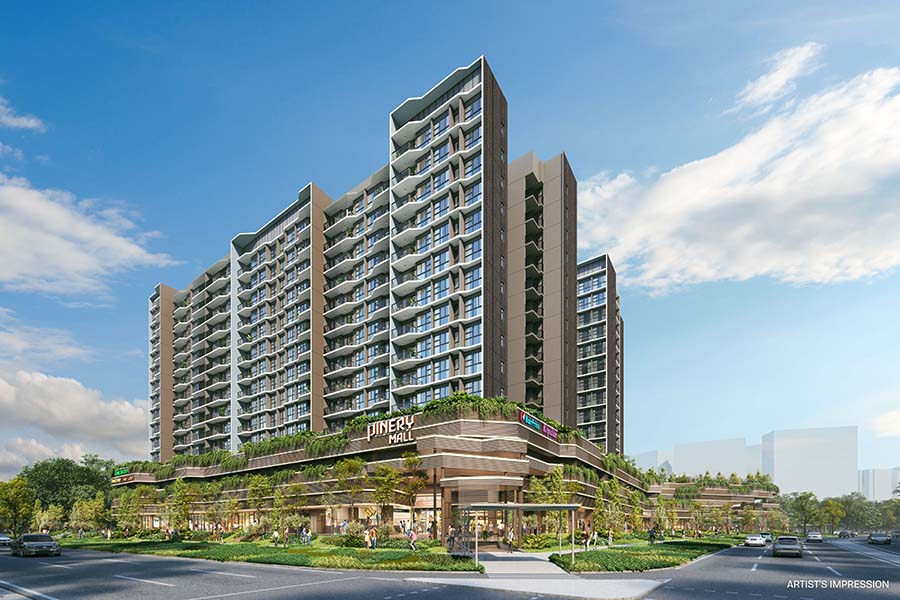
Pinery Residences is a 99-year leasehold, fully integrated residential development located at Tampines Street 94 in District 18 (Outside Central Region), jointly developed by Hoi Hup Realty and Sunway Developments under the Government Land Sales (GLS) programme. With a direct underground pedestrian connection to Tampines West MRT (DT31) and a sizeable commercial podium providing daily necessities, the project is best understood as a family-centric, long-hold own-stay development rather than a lifestyle-branded or momentum-driven launch.
This review is written for decision-stage buyers, particularly HDB upgraders and family households evaluating whether MRT integration and town-centre convenience justify the expected pricing premium over non-integrated OCR launches and nearby Executive Condominiums. Pinery Residences competes not on exclusivity or novelty, but on structural convenience and transport-led planning, aligned with URA’s long-term decentralisation strategy for Tampines.
Pinery Residences is a large-scale, MRT-integrated private condominium at Tampines Street 94, designed primarily for family own-stay buyers rather than short-term investors. Its defining advantage is a direct underground pedestrian link to Tampines West MRT (DT31) combined with a substantial on-site commercial podium, positioning it as a utility-first, convenience-led home within a mature regional centre. Buyers considering Pinery Residences should evaluate it through long-term liveability, daily efficiency, and transport integration, not scarcity or speculative upside.
For buyers assessing whether Pinery Residences aligns with their financing comfort, holding horizon, and exit assumptions, a structured project breakdown covering entry positioning, pricing logic, stack considerations, and buyer suitability may provide additional clarity before arranging any viewing.
Key Details (At a Glance)
99-year leasehold | 588 units | Direct underground access to Tampines West MRT (DT31) | Integrated commercial podium | District 18 (OCR) | Targeted Preview & Launch March 2026 | Expected TOP April 2030
Project Factsheet
| Item | Details |
|---|---|
| Project Name | Pinery Residences |
| Address | 51–71 Tampines Street 94, Singapore |
| District / Region | District 18 / OCR / Tampines Planning Area |
| Tenure | 99 years leasehold (commencing 7 January 2025) |
| Developer | Hoi Hup Realty & Sunway Developments |
| Site Type | GLS (New Launch) |
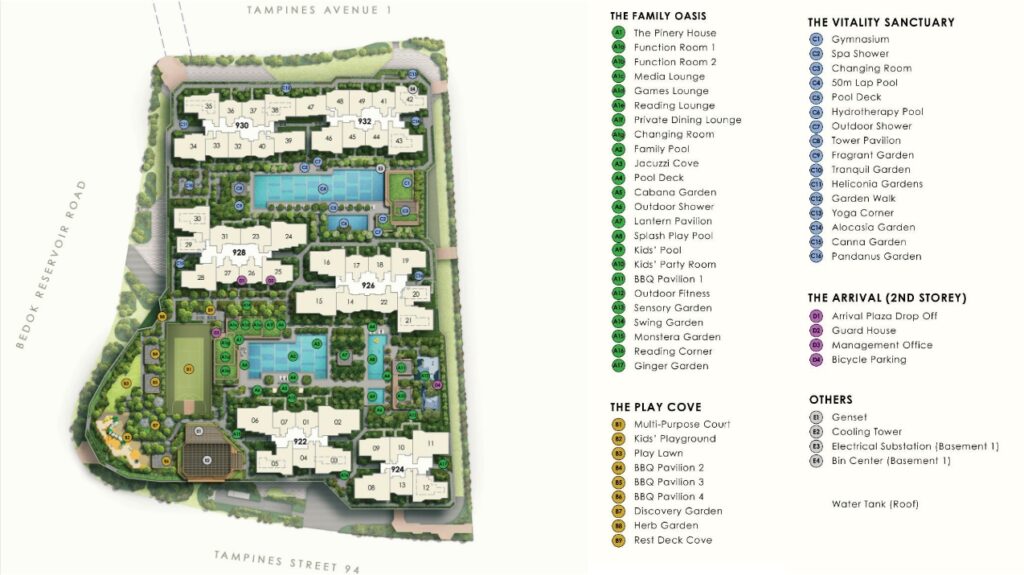
| Development Type | Integrated mixed-use development with commercial podium, communal facilities, basement carpark, and underground MRT link |
| Site Area | 23,512 sqm |
| Plot Ratio | 2.63 |
| Total Residential Units | 588 units |
| Unit Mix | 2 to 5 Bedroom Units |
| Nearest MRT | Tampines West MRT (DT31), direct sheltered underground access |
| Launched Status | Targeted Preview Date: 14–21 March 2026 Targeted Launch Date: 28 March 2026 |
| Expected TOP | April 2030 |
Unit Mix Breakdown
| Unit Type | Size Range (sqft) | No. of Units | % of Total |
|---|---|---|---|
| 2 Bedroom | 624–667 | 180 | 30.6% |
| 2 Bedroom + Study | 700 | 72 | 12.2% |
| 3 Bedroom | 807–1023 | 144 | 24.5% |
| 3 Bedroom + Study | 1055 | 60 | 10.2% |
| 4 Bedroom | 1141 | 24 | 4.1% |
| 4 Bedroom + Study | 1195–1389 | 96 | 16.3% |
| 5 Bedroom | 1475 | 12 | 2.0% |
Pinery Residences should be viewed as a transport-oriented, family-scaled private condominium, where integration and routine efficiency take priority over density avoidance or prestige positioning.
Pinery Residences is a long-horizon, MRT-integrated private condominium designed for family own-stay buyers who prioritise daily convenience, transport efficiency, and mature town infrastructure in Tampines.
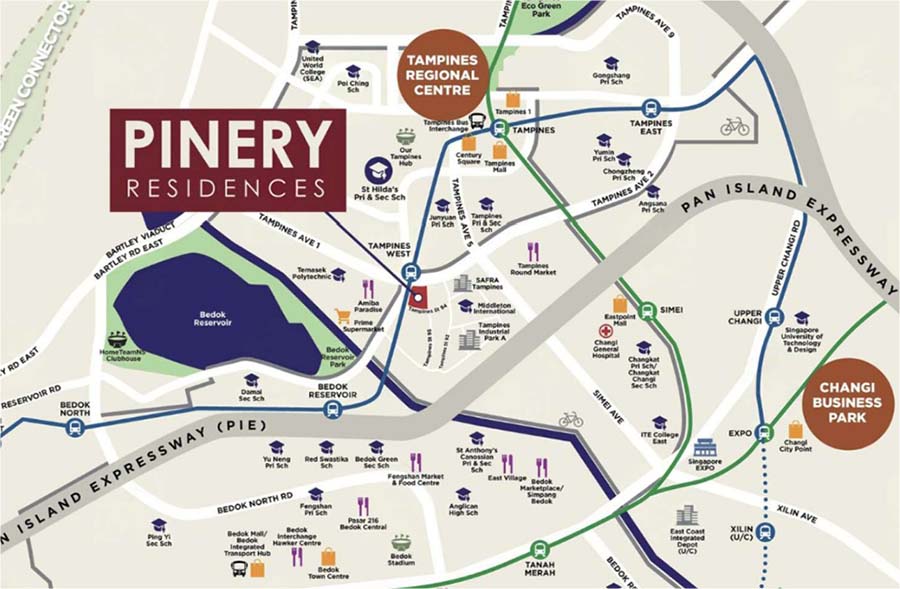
Location Context: Tampines Street 94 within a Mature Regional Centre
Pinery Residences sits within Tampines, one of Singapore’s most established and self-sufficient regional centres. Unlike emerging estates that depend on future infrastructure delivery, Tampines already offers a complete ecosystem of transport, schools, retail, healthcare, recreation, and employment nodes. This materially reduces lifestyle execution risk for owner-occupiers.
The project’s defining attribute is direct MRT integration with the Downtown Line at Tampines West. This improves commuting reliability to the city, Bugis, and Changi Business Park while reducing reliance on cars or feeder buses. For families balancing work, school, and daily errands, this level of connectivity compounds in value over time.
Beyond transport, residents benefit from proximity to Our Tampines Hub, SAFRA Tampines, Bedok Reservoir Park, and a dense network of primary and secondary schools. Tampines functions not as a dormitory town, but as a live-work-play hub — a key reason integrated developments here tend to attract sticky, long-term own-stay demand.
Project Positioning: What Pinery Residences Is — and Is Not
What Pinery Residences Is
-
A fully MRT-integrated private residential development
-
Designed primarily for family own-stay buyers
-
Anchored within a mature regional centre
-
Focused on daily convenience and transport-led living
What Pinery Residences Is Not
-
Not a boutique or low-density enclave
-
Not a prestige-driven or lifestyle-branding project
-
Not structured for short-term trading or flipping
-
Not a quiet, low-activity suburban pocket
This distinction matters. Pinery Residences deliberately trades serenity and exclusivity for connectivity, accessibility, and integration, aligning more closely with practical family living than speculative investment narratives.
Amenities & Integration: Utility Over Novelty
Pinery Residences’ strength lies in functional completeness, not novelty.
Transport
-
Direct underground access to Tampines West MRT (DT31)
-
Extensive bus services along Tampines corridors
On-Site Commercial Podium
-
Supermarket (FairPrice)
-
Food court (Kopitiam)
-
Childcare / early childhood facilities
-
Community plaza and daily retail
Surrounding Amenities
-
Our Tampines Hub, Tampines Mall, Century Square
-
SAFRA Tampines
-
Bedok Reservoir Park
-
Comprehensive school network
Rather than acting as a “destination mall,” the podium supports everyday needs — reducing friction in daily routines, which is a structural advantage over long holding periods.
Buyer Suitability: Who Pinery Residences Is For
-
Family Own-Stay Buyers (Primary Segment)
Families planning to live long-term who value MRT access, schools, and town-centre convenience over low density or exclusivity. -
HDB Upgraders in the East
Buyers upgrading from HDB flats in Tampines or Bedok who prioritise familiarity, infrastructure depth, and commuting efficiency. -
Selective Long-Horizon Investors
Investors focused on stability and tenant depth rather than yield maximisation or rapid capital appreciation. -
Buyers Who May Want to Reconsider
Those seeking boutique living, quiet enclaves, or short-term price momentum may find better alignment elsewhere.
Buyers comparing Pinery Residences against other upcoming launches may find it helpful to frame their decision using the New Launch Condo Guide, which outlines how pricing logic, buyer intent, and holding horizon differ across project types.
Ultimately, the decision should reflect not only price alignment but also the household’s intended flexibility and tolerance for future adjustment.
For readers evaluating whether the EC ownership framework may present a structurally different risk profile within the same Tampines cluster, our Pinery Residences vs Rivelle Tampines comparison outlines how private flexibility and EC lock-in diverge over time.
Takeaway
Pinery Residences is not designed to be a hype-driven launch. Its appeal lies in structural convenience — MRT integration, mature town infrastructure, and family-centric planning — rather than scarcity or branding.
For buyers evaluating it through a long-term own-stay lens, its positioning is coherent and defensible. For those expecting rapid upside or exclusivity, expectations should be adjusted accordingly.
Pending Approval for Sale
If Pinery Residences is on your shortlist and being compared against nearby alternatives, a structured review of capital commitment differences, downside exposure scenarios, liquidity positioning, and realistic exit pool dynamics may help clarify the decision framework before any commitment is made.
FAQs (Decision-Stage)
1) Is Pinery Residences mainly an own-stay project or an investment play?
Pinery Residences is best understood as an own-stay-first development. Its strongest value comes from MRT integration, daily convenience, and family usability rather than rental yield or short-term price movement. While rental demand may exist due to Changi Business Park proximity, it is secondary to owner-occupier demand. Buyers should evaluate it as a long-horizon home.
2) How important is the direct MRT integration in real life?
Direct MRT integration materially improves daily routines, especially for families managing work, school, and errands. An underground sheltered link reduces weather exposure and transfer friction compared to surface walking routes. Over many years, this convenience compounds in value more than most marketing features. It is a structural advantage, not a cosmetic one.
3) Does the integrated commercial podium improve or hurt liveability?
For most families, it improves liveability by shortening daily trips and simplifying routines. The trade-off is higher activity during peak hours, which makes unit orientation and stack selection more important. Buyers should focus on how their unit interfaces with active zones rather than avoiding integration entirely. Convenience generally outweighs the drawbacks for own-stay households.
4) Is pricing likely to feel stretched for OCR buyers?
Pricing expectations are elevated due to land cost and integration premium. This creates natural comparison pressure against ECs and non-integrated OCR launches. Whether it feels justified depends on how much value a buyer places on MRT access and daily efficiency. Absolute quantum, not headline psf, should guide the decision.
5) How does Pinery Residences compare with nearby Executive Condominiums?
ECs offer lower entry prices but come with income ceilings, MOP restrictions, and delayed flexibility. Pinery Residences trades a higher entry cost for immediate private status, rental flexibility, and MRT integration. The decision is less about which is “better” and more about eligibility, holding intent, and lifestyle priorities. Both serve different buyer profiles.
6) Is the project too dense at 588 units?
Density is a valid consideration, but context matters. This is a transport-oriented, mixed-use development where density supports retail viability and transit efficiency. Buyers seeking low-density serenity should look elsewhere, while those prioritising convenience may see density as a functional necessity. Layout efficiency and internal circulation matter more than headline unit count.
7) How does URA’s Master Plan support Pinery Residences long term?
URA’s plan for Tampines emphasises decentralisation, transport-led growth, and people-centric town centres. Pinery Residences aligns directly with this intent through MRT integration and mixed-use planning. This supports demand stability rather than speculative repricing. Long-term value here is structural, not cyclical.
8) Who should avoid Pinery Residences altogether?
Buyers seeking boutique exclusivity, quiet low-activity surroundings, or short-term capital gains are likely misaligned. The project is designed for households who value efficiency, connectivity, and long-term usability. Misaligned expectations — not project flaws — are the main risk.
Pricing Logic, URA Planning Intent & Buyer Segmentation
Summary
Pinery Residences should not be evaluated using scarcity or momentum frameworks. As a large-scale, MRT-integrated OCR development, its value behaviour is shaped by integration cost, absolute quantum tolerance, and family affordability, rather than boutique positioning or short-term upside narratives. This section examines whether the project’s expected pricing logic aligns with buyer psychology, URA planning intent, and the actual pool of long-horizon demand available in Tampines.
Pricing Logic: Why Integration Drives Value — and Resistance
Land Cost Sets the Floor, Not the Outcome
Pinery Residences was acquired at a high GLS land rate (~$1,004 psf ppr), reflecting the premium attached to MRT integration and mixed-use development costs. This structurally elevates the baseline pricing requirement, but it does not guarantee buyer acceptance. In OCR markets, land cost explains pricing pressure, not pricing success.
For buyers, the decision is rarely about whether the developer “deserves” a premium. It is about whether the total quantum still fits within realistic family affordability bands, especially for 3- and 4-bedroom units. Once pricing crosses certain psychological thresholds, buyers begin comparing against ECs, resale private condos, and even selective RCR options, regardless of project features.
Absolute Quantum Matters More Than PSF
For family-oriented OCR projects, absolute price is the primary decision driver. Buyers typically prioritise:
-
Monthly mortgage sustainability
-
CPF and cash buffer after purchase
-
Long-term holding comfort rather than resale arbitrage
MRT integration improves tolerance for higher psf, but it does not eliminate quantum sensitivity. If pricing pushes 3-bedroom units too close to higher-end OCR or entry-level RCR benchmarks, resistance emerges quickly — even among buyers who value integration.
Integration Premium vs EC Comparison
One of Pinery Residences’ structural challenges is direct comparison with nearby Executive Condominiums, particularly Rivelle Tampines. While the two products serve different buyer profiles, they compete for:
-
The same upgrader households
-
Similar school catchments
-
Comparable transport nodes
Pinery’s advantage lies in immediate private status, MRT integration, and rental flexibility, while ECs retain a strong entry-price advantage. The pricing gap must therefore feel justified by utility and convenience, not marketing narratives.
URA Planning Intent: Tampines as a Transport-Led Regional Centre
Tampines Master Plan Context
URA’s long-term planning framework positions Tampines as:
-
A decentralised employment and residential hub
-
A transport-anchored town with reduced car dependency
-
A people-centric environment with integrated amenities
Key initiatives — such as pedestrianisation, integrated transport hubs, and mixed-use intensification — support developments that reduce friction between living, working, and commuting. Pinery Residences fits squarely within this intent.
Why This Matters for Long-Term Value
URA planning does not promise price spikes. Instead, it supports:
-
Demand stability
-
Lifestyle resilience
-
Lower obsolescence risk
For Pinery Residences, alignment with planning intent strengthens its long-term own-stay appeal, but it also reinforces its utility-driven identity. Buyers should expect steady performance, not speculative re-rating.
Buyer Segmentation: Who the Project Truly Serves
1) Family Own-Stay Buyers (Primary Segment)
These buyers value:
-
MRT access without transfers
-
Proximity to schools and amenities
-
Reduced daily friction
They are less sensitive to short-term price movements and more focused on whether the home works year after year.
The unit mix reinforces this positioning. With no 1-bedroom supply and a significant concentration of 3-bedroom and 4-bedroom units, the project clearly targets upgrader households rather than compact-format investors. The 4-bedroom + Study allocation (96 units) is particularly notable, signalling deliberate accommodation for larger family structures rather than token larger-unit representation.
2) HDB Upgraders (Core Demand Base)
HDB upgraders from Tampines and Bedok form the backbone of demand. Familiarity with the area, school continuity, and commuting patterns heavily influence decisions. Pricing tolerance exists, but only up to a point where the upgrade still feels rational.
3) Long-Horizon Investors (Secondary Segment)
Investor participation is likely selective. These buyers prioritise tenant depth and convenience over yield maximisation. Pinery Residences is not designed to attract speculative or yield-chasing capital.
Interim Assessment
Pinery Residences competes on integration, not scarcity. Its success depends on disciplined pricing that respects family affordability and recognises the presence of nearby EC alternatives. Alignment with URA planning supports stability, but does not override buyer price sensitivity.
Exit & Liquidity, Risk Scenarios, Pros & Cons, and Buyer FAQs
Summary
Pinery Residences is best evaluated as a long-horizon, family-centric home rather than a trading asset. Its MRT integration and town-centre positioning provide downside protection and liquidity stability, while its scale and tenure naturally cap explosive upside. Understanding exit dynamics and risk scenarios is essential before committing.
Exit & Liquidity Analysis
Liquidity Profile of Integrated OCR Developments
Liquidity for projects like Pinery Residences is:
-
Steady rather than spiky
-
Driven primarily by family demand
-
Sensitive to affordability cycles rather than hype
Integrated convenience supports resale interest, but does not create scarcity-driven bidding behaviour.
Unit-Type Liquidity
- 2-Bedroom Units (252 units including Study):
These are likely to see the strongest transactional depth due to broader affordability and wider buyer pool. However, internal competition within the same project may moderate price differentiation. - 3-Bedroom Units (204 units including Study):
This segment forms the core family market and should anchor resale stability. Exit success will depend more on absolute quantum discipline than scarcity, as supply is meaningful but aligned with natural upgrader demand. - 4-Bedroom + Study Units (96 units):
While attractive to larger families, this is a substantial allocation for a large-format configuration. Liquidity during tighter affordability cycles may narrow, making entry price discipline particularly important. - 5-Bedroom Units (12 units):
True scarcity segment within the project. Liquidity will depend heavily on broader OCR affordability conditions, but limited supply provides differentiation within the development.
Layout efficiency and orientation often matter more than size alone.
Timing Sensitivity
Exit outcomes are more influenced by:
-
Interest rate environment
-
Household income growth
-
OCR affordability conditions
They are less influenced by launch-day momentum or short-term sentiment.
Risk Scenarios
Scenario 1: Prolonged High Interest Rates
Affordability tightens, particularly for larger units. Integrated convenience helps sustain demand, but buyers become more price-disciplined. Entry price matters more than features.
Scenario 2: OCR Market Correction
Projects without differentiation face sharper adjustments. Pinery’s integration buffers downside, but does not immunise it from broader market repricing.
Scenario 3: Strong Residential Recovery
Pinery participates in recovery, but is unlikely to lead price appreciation. Upside tends to be gradual rather than explosive.
Scenario 4: Rising Preference for Transit-Oriented Living
This is Pinery’s most favourable scenario. MRT integration and mixed-use planning become increasingly valued, supporting demand consistency.
Pros & Cons Summary
Pros
-
Direct MRT integration
-
Mature regional centre location
-
Strong family and upgrader alignment
-
Planning-backed long-term relevance
Cons
-
Large project scale limits scarcity
-
99-year tenure
-
Pricing sensitivity at higher quantums
-
Not suited for speculative strategies
FAQs
1) Is Pinery Residences a good exit-focused investment?
Pinery Residences is not structured as an exit-optimised or momentum-driven investment. Its large scale and OCR positioning mean resale demand is steady rather than scarcity-driven. Buyers should expect liquidity to be supported by family demand, not bidding pressure. It performs best when held through a full property cycle rather than treated as a short-term trade.
2) Does MRT integration guarantee strong resale demand?
MRT integration improves baseline demand and reduces obsolescence risk, but it does not guarantee price outperformance. Buyers still anchor decisions on absolute quantum, layout efficiency, and prevailing interest rate conditions. Integration supports liquidity resilience, not immunity from market cycles. Pricing discipline at entry remains critical.
3) How does the project’s large scale affect long-term performance?
A large unit count reduces scarcity but increases transactional depth. This typically results in smoother price movements with fewer sharp spikes or drops. For own-stay buyers, this stability can be positive, but investors should not expect scarcity-driven premiums. Performance tends to track broader OCR affordability trends.
4) Are larger units at Pinery Residences harder to exit?
Larger units face a narrower buyer pool, especially during periods of tight affordability. Exit success depends more on realistic pricing and functional layouts than unit size alone. Overpaying for larger formats significantly increases holding risk. Buyers should prioritise layout usability over headline square footage.
5) Does the integrated commercial podium reduce residential privacy?
Integrated developments naturally experience higher activity levels, particularly at lower floors. However, privacy impact varies significantly by stack orientation and elevation. Well-positioned stacks mitigate most concerns associated with footfall and noise. Buyers should assess unit placement rather than dismiss integration outright.
6) Is Pinery Residences suitable for buyers who may upgrade again later?
It can be suitable, but only if entry pricing leaves sufficient flexibility. Buyers planning future upgrades should avoid stretching their budget based on optimistic resale assumptions. Flexibility comes from affordability, not project features. A longer holding horizon reduces timing risk.
7) How does Pinery compare with non-integrated OCR launches?
Pinery trades serenity for convenience. Non-integrated projects may offer quieter environments but require greater reliance on transport and driving. Pinery appeals to buyers who value routine efficiency over seclusion. The choice depends on lifestyle priorities rather than price alone.
8) Will future residential supply in Tampines affect resale prospects?
Additional supply increases competition, particularly within the family buyer segment. Integrated projects tend to remain relevant longer, but pricing pressure still applies. Buyers should not assume supply constraints will protect values. Long-term relevance matters more than launch timing.
9) Is rental demand a meaningful safety net for owners?
Rental demand exists due to nearby employment nodes, but yields are unlikely to be exceptional. Pinery Residences is not a yield-optimised asset. Rental performance should be viewed as supplementary, not as a justification for paying a premium. Owners should prioritise own-stay suitability first.
10) Does URA planning support long-term value growth here?
URA planning strengthens liveability, connectivity, and long-term relevance. However, it does not guarantee capital appreciation. Planning alignment reduces obsolescence risk rather than creating price catalysts. Market cycles and affordability remain the dominant drivers.
11) Should buyers wait for final pricing and floor plans before deciding?
Yes. Pricing and unit mix will ultimately determine whether the value proposition holds. Early analysis helps frame expectations, but commitment should wait for confirmed numbers. Floor plan efficiency often matters more than headline psf.
12) How does the unit mix influence long-term liquidity?
The absence of 1-bedroom units signals limited investor-driven volatility, which supports price stability rather than short-term churn. The strong concentration of 2- and 3-bedroom units aligns with Tampines’ upgrader demographic, reinforcing steady family demand. Larger 4-bedroom allocations add flexibility but require disciplined entry pricing. Overall, the mix favours long-horizon own-stay liquidity rather than speculative trading behaviour.
13) How important is layout efficiency for long-term value?
Layout efficiency is critical in OCR markets. Efficient layouts support liveability, resale appeal, and rental demand. Poorly planned space magnifies price resistance over time. Buyers should scrutinise bedroom usability, storage, and circulation space.
14) Is Pinery Residences considered a “safe” purchase?
It is structurally sound but not risk-free. Safety depends on disciplined entry pricing and realistic holding expectations. Buyers who over-stretch face greater exposure to interest rate and market cycles. The project rewards prudence, not speculation.
15) What is a realistic holding period for buyers?
A realistic holding period is typically 7 to 12 years or longer. Shorter horizons increase sensitivity to market timing and pricing volatility. Longer holds allow the benefits of integration and planning alignment to compound. Buyers should plan accordingly.
16) What is the biggest mistake buyers could make at Pinery Residences?
The biggest mistake is over-paying based on integration hype alone. Convenience adds value, but only if the price leaves room for long-term comfort and flexibility. Buyers should anchor decisions on affordability and layout quality. Discipline at entry matters more than features.
If a structured discussion is preferred over WhatsApp, or if detailed floor plans, pricing breakdowns, or showflat arrangements are required, your details may be left below for a follow-up.