

Summary
Newport Residences is a freehold mixed-use residential development in District 2, located within the evolving Anson–Tanjong Pagar corridor, an area undergoing long-term transformation under Singapore’s Greater Southern Waterfront vision. Rather than targeting mass-market demand, Newport Residences is positioned for buyers who prioritise city-core living, freehold tenure, and long-horizon urban relevance, accepting higher entry quantums in exchange for long-term capital defensiveness.
Post-launch behaviour has clarified Newport Residences’ positioning rather than altered it. Buyer interest has been selective and quantum-led, favouring those who prioritise freehold tenure, elevation, and long-horizon city-core relevance over short-term price momentum.
This Newport Residences review assesses who the project is realistically designed for, how it fits into the CBD’s structural evolution, and the practical trade-offs buyers should expect — including quantum sensitivity, rental relevance, and long-term liquidity behaviour.
Newport Residences is a freehold, city-edge residential development in Singapore’s Core Central Region, positioned for buyers who prioritise central accessibility, walkable amenities, and long-term land tenure over expansive unit sizes or suburban pricing efficiency. Its value proposition centres on location permanence and urban convenience rather than aggressive short-term upside, making it more relevant to own-stay buyers and longer-horizon investors who are comfortable with higher entry pricing and selective liquidity. Buyers evaluating Newport should focus less on launch momentum and more on how freehold tenure, unit mix, and surrounding resale alternatives shape exit flexibility across a full market cycle.
For buyers assessing whether Newport Residences aligns with their financing comfort, holding horizon, and exit assumptions, a structured project breakdown covering entry positioning, pricing logic, stack considerations, and buyer suitability may provide additional clarity before arranging any viewing.
Key details (at a glance):
Freehold | Est. ~246 units | Mixed-use CBD redevelopment | Tanjong Pagar MRT ~0.4 km | Anson / Downtown Core planning zone | Long-horizon city-core capital preservation profile
Post-Launch Reality Check
Launch behaviour has largely confirmed Newport Residences’ pre-launch positioning rather than altered it. Buyer interest has been selective and quantum-led, with stronger traction where absolute entry price felt manageable, even as headline psf figures appeared elevated.
The fact that residential units begin from higher floors is now more clearly understood as a structural feature rather than a marketing abstraction. At the same time, objections around layout efficiency, mixed-use privacy, and the absence of a family-oriented ecosystem have become more pronounced. This has reinforced Newport’s nature as a selective, conviction-based purchase rather than a broad market product.
Project Factsheet
| Item | Details |
|---|---|
| Project Name | Newport Residences |
| Location | Anson Road, Singapore |
| District / Region | District 2 (Central Core Region) |
| Tenure | Freehold |
| Developer | City Developments Limited (CDL) |
| Site Area | 5091.2 sqm |
| Estimated No. of Units | 246 residential units |
| Unit Mix | 1 to 4 Bedroom and Super Penthouse |
| Nearest MRT Station | Tanjong Pagar MRT |
| URA Planning Zone | Downtown Core / Anson |
| Launch Status | Sales launched |
| Expected TOP | 01 March 2030 |
Newport Residences is best understood as a city-core freehold asset designed for long-term urban relevance, not a volume-driven residential launch.
Location Context: Why Anson Is Different From the Rest of the CBD
Anson occupies a transitional zone between Singapore’s traditional office-centric CBD and the future residential-lifestyle districts envisioned under long-term planning frameworks. Historically dominated by commercial towers, the precinct is now part of a broader urban rebalancing strategy, where residential, office, and lifestyle uses increasingly coexist.
This shift is structural rather than speculative, shaped by planning policy, transport connectivity, and changing work-life patterns, and closely aligned with the Greater Southern Waterfront transformation.
Project Positioning: What Newport Residences Is — and Is Not
What Newport Residences Is
-
A freehold residential component within a mixed-use CBD setting
-
A long-horizon play on city-core residential evolution
-
A lifestyle-centric option for buyers prioritising proximity and walkability
-
A positioning bet on how Singapore’s CBD adapts beyond office use
What Newport Residences Is Not
-
Not a mass-market new launch
-
Not designed for first-time buyers
-
Not a yield-maximisation investment
-
Not a short-term flipping opportunity
This distinction is critical. Newport Residences is selective by design, and its buyer appeal reflects that.
Amenities Around Newport Residences
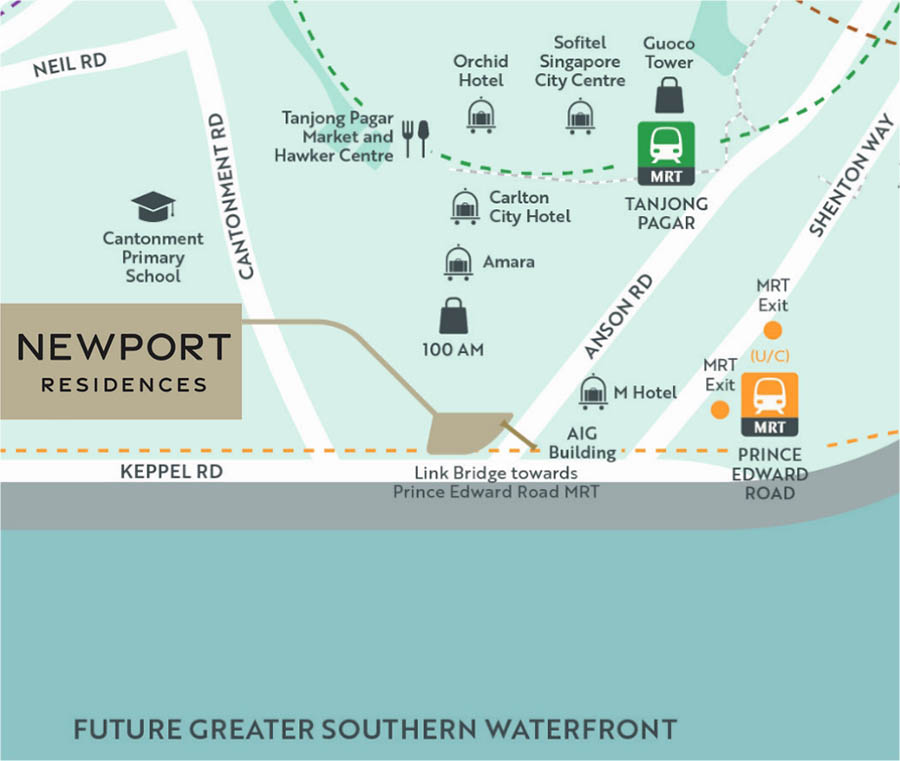
Newport Residences benefits from a highly walkable, amenity-dense city-core location, with transport, retail, food, and daily conveniences concentrated within a short radius. The amenity profile supports urban living efficiency rather than suburban family-centric needs.
Public Transport Connectivity
-
Tanjong Pagar MRT – approx. 0.4 km
-
Prince Edward Road MRT – approx. 0.4 km
-
Multiple bus services within approx. 0.1 km along Anson Road
Strong transport redundancy reduces reliance on private vehicles.
Daily Conveniences & Supermarkets
-
FairPrice (100AM) – approx. 0.1 km
-
Cold Storage (Altez) – approx. 0.1 km
-
Sheng Siong (Chin Swee) – approx. 1.5 km
Daily necessities are accessible within walking distance.
Shopping & Retail Nodes
-
Icon Village – approx. 0.1 km
-
100AM – approx. 0.1 km
-
Tanjong Pagar Centre – approx. 0.3 km
-
Chinatown retail cluster – within approx. 1.0–1.2 km
Retail options are functional rather than mall-centric.
Food Centres & Dining Options
-
Tanjong Pagar Plaza Market & Food Centre – approx. 0.3 km
-
Amoy Street Food Centre – approx. 0.7 km
-
Maxwell Food Centre – approx. 0.8 km
-
Chinatown Complex Market & Food Centre – approx. 1.0 km
The area offers one of Singapore’s densest concentrations of established food centres.
Schools & Education (Contextual, Not Primary Driver)
-
Cantonment Primary School – approx. 0.5 km
-
CHIJ (Kellock) Primary School – approx. 1.8 km
-
Duke-NUS Graduate Medical School – approx. 1.4 km
School proximity exists but is not the core appeal for CBD-centric buyers.
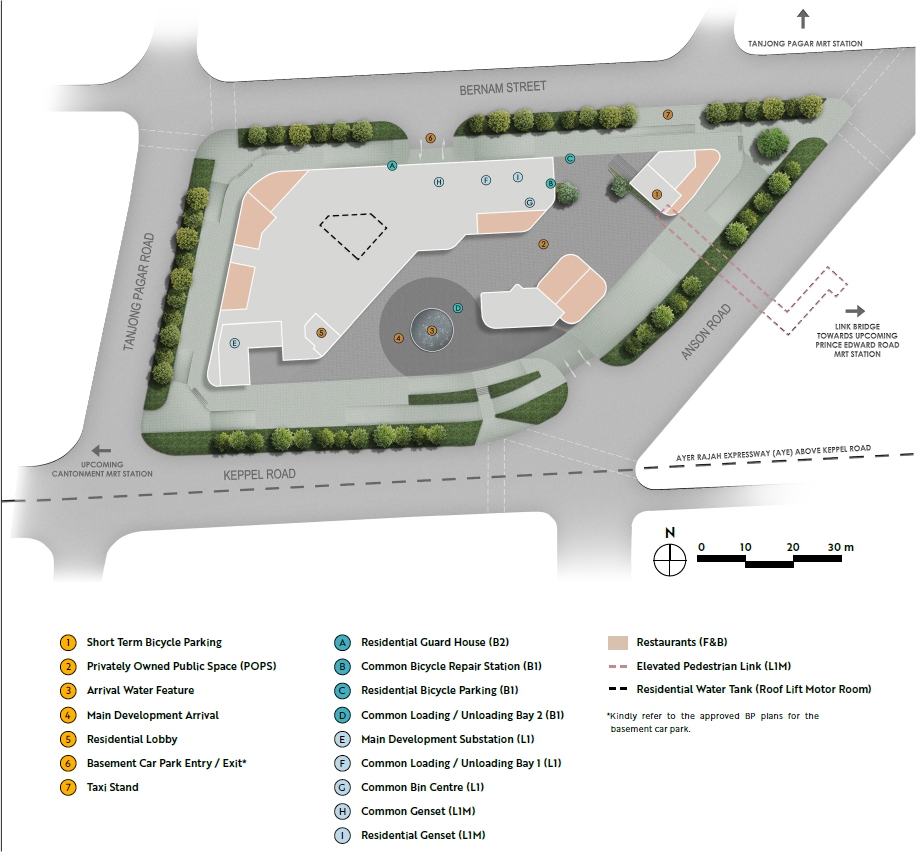
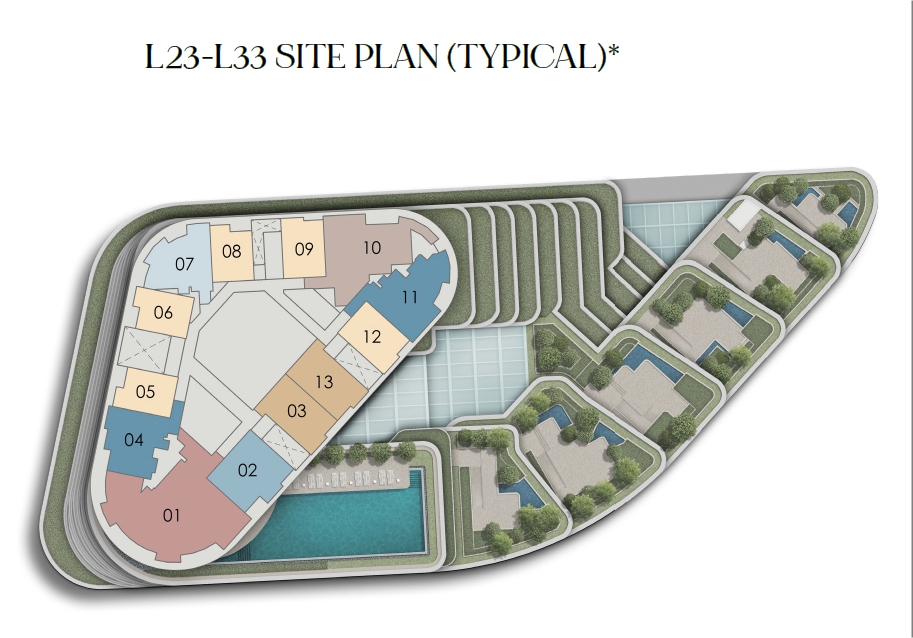
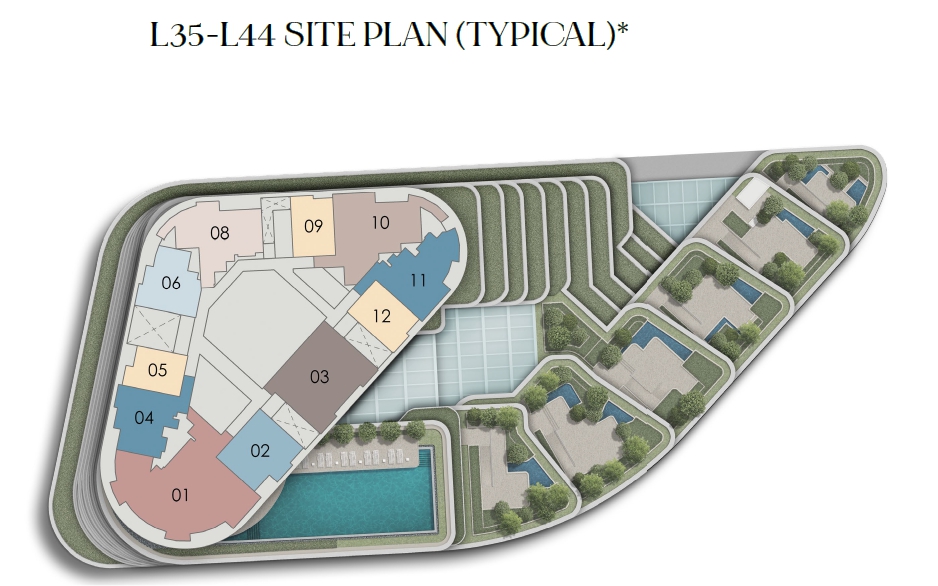
Buyer Suitability: Who Newport Residences Is For
1. City-Centric Owner-Occupiers
Professionals who:
Work within the CBD or Marina Bay area
Value walkability and reduced commute friction
Prefer an urban lifestyle over suburban living
For these buyers, Newport Residences offers location permanence, not space maximisation.
2. Long-Horizon Capital Preservation Buyers
These buyers view Newport Residences as:
A freehold holding in a land-scarce central zone
A hedge against long-term urban densification
An asset less exposed to lease decay considerations
Returns are expected to be gradual and structural, not speculative.
For buyers evaluating whether this long-horizon trade-off makes sense, understanding how freehold tenure compares against 99-year leasehold structures in new launches becomes a critical consideration.
3. Selective Investors (With Realistic Expectations)
Investor interest exists only for those who:
Understand CBD rental dynamics
Prioritise tenant quality over headline yields
Are comfortable with regulatory and market-cycle volatility
This is not a yield-first investment.
This selectivity is structural rather than temporary, and is unlikely to change meaningfully over time.
Pricing at Newport Residences is best understood through absolute entry quantum rather than psf comparison. Because residential units start from elevated floors, psf optics naturally skew higher. Buyers anchoring strictly to psf often struggle to reconcile value, while those evaluating tenure, elevation, and long-term holding intent tend to find the pricing logic more coherent.
Takeaway
Newport Residences is not designed to appeal to everyone — and that selectivity defines its positioning.
Its relevance lies in:
Freehold tenure within a transforming city-core zone
Alignment with long-term planning trajectories
A clearly defined, intentional buyer profile
Buyers assessing Newport Residences using short-term metrics may struggle to justify it.
Those evaluating it through a long-horizon urban lens may see its rationale more clearly.
If TMW Maxwell is on your shortlist and being compared against nearby alternatives, a structured review of capital commitment differences, downside exposure scenarios, liquidity positioning, and realistic exit pool dynamics may help clarify the decision framework before any commitment is made.
FAQs (Decision-Stage)
1) Where exactly is Newport Residences located?
Newport Residences is located along Anson Road in District 2, within the evolving Anson–Tanjong Pagar city-core corridor. It sits in a transitional pocket where the CBD is gradually shifting from office-dominant land use toward more integrated live-work-lifestyle formats.
2) Is Newport Residences considered a “Greater Southern Waterfront” play?
Indirectly, yes. It should not be framed as a short-term catalyst story, but Newport benefits structurally from the long-term direction of planning intent: improved liveability, urban integration, and a broader residential audience in and around the city core.
3) Who is Newport Residences realistically designed for?
The project is best suited for:
city-centric owner-occupiers (CBD / Marina Bay routines)
long-horizon buyers prioritising tenure defensiveness
selective investors who understand CBD tenant profiles
It is not designed for mass affordability or broad upgrader demand.
4) What became clearer after launch?
Launch behaviour clarified that Newport Residences appeals most to buyers comfortable with selective liquidity and long holding horizons. Rather than broad market demand, interest has been conviction-driven, reinforcing its positioning as a niche freehold CBD asset.
5) What is the biggest trade-off of buying Newport Residences?
The trade-off is entry quantum and selective buyer pool. Freehold city-core projects tend to require more patience, and resale demand is shaped by buyer profile fit rather than mass-market liquidity.
6) Is this project suitable for buyers upgrading from OCR/RCR homes?
Only selectively. For upgrader households, Newport works when lifestyle needs (CBD walkability, commute efficiency) outweigh family-space optimisation. It is typically less aligned for buyers who prioritise size, schools, or suburban family routines.
7) What should buyers watch for when pricing and layouts are compared?
Residential units begin from higher floors, which structurally lifts psf optics. Post-launch behaviour suggests most buyers assess Newport based on absolute entry quantum and long-term holding logic rather than direct psf benchmarking against nearby projects.
This project should be evaluated on a risk-adjusted basis, not psf alone.
8) Does freehold automatically mean stronger returns?
Residential units begin from higher floors, which structurally lifts psf optics. Post-launch behaviour suggests most buyers assess Newport based on absolute entry quantum and long-term holding logic rather than direct psf benchmarking against nearby projects.
Newport Residences: Pricing Logic, URA Master Plan & Buyer Segmentation
Summary
Newport Residences sits in a distinct pricing and positioning bracket within the Central Core Region (CCR). Its value proposition is not driven by affordability or short-term momentum, but by tenure defensiveness, CBD adjacency, and long-horizon urban transformation under Singapore’s planning framework. In Part 2, we examine Newport Residences through three lenses that matter most at decision stage: pricing logic, URA Master Plan alignment, and buyer segmentation — separating structural value from marketing narratives.
Pricing Analysis: Understanding Newport Residences Beyond PSF Headlines
Pricing Context: Unit Mix, Entry Quantums & How to Read Them
For a freehold CCR project like Newport Residences, pricing should be read through a structural lens, rather than short-term affordability or mass-market comparison. The unit mix and indicative price bands reveal more about intended buyer profile than value signalling.
Unit Mix Overview
Newport Residences is characterised by a deliberately skewed, low-volume unit distribution, reinforcing its selective positioning.
| Unit Type | Approx. Size Range | Number of Units |
|---|---|---|
| 1 Bedroom | 431–495 sqft | 86 |
| 1 Bedroom + Study | 581 sqft | 22 |
| 2 Bedroom | 646–753 sqft | 24 |
| 2 Bedroom Premium | 689–710 sqft | 30 |
| 2 Bedroom Premium + Ensuite Study | 818–926 sqft | 33 |
| 3 Bedroom | 980 sqft | 7 |
| 3 Bedroom + Study | 1,227 sqft | 10 |
| 3 Bedroom Premium | 1,206 sqft | 15 |
| 4 Bedroom Premium | 2,067 sqft | 18 |
| Super Penthouse | 12,960 sqft | 1 |
This distribution signals a clear emphasis on compact and mid-sized city homes, with larger formats intentionally limited.
Unit distribution reflects published launch information and is used here to illustrate positioning rather than future availability.
Entry Pricing Context (Launch Reference)
Based on launch reference pricing:
1 Bedroom from ~$1.2xM
2 Bedroom from ~$1.9xM
3 Bedroom from ~$3.2xM
Pricing bands reflect initial launch positioning and should be interpreted as contextual reference points rather than fixed benchmarks.
How This Pricing Should Be Interpreted
These figures should be viewed as contextual anchors, not affordability benchmarks.
For Newport Residences:
Pricing reflects freehold tenure in a CCR micro-location
Absolute quantum matters more than PSF optics
Entry prices function as filters, not volume drivers
Unlike OCR or family-led developments, Newport is not designed to optimise mass take-up. Instead, its pricing structure prioritises:
Buyer selectivity
Long-horizon holding assumptions
Reduced reliance on transaction velocity
Key Observations for Buyers
The dominance of 1- and 2-bedroom units aligns with urban owner-occupiers and long-term rental profiles
Larger family units are intentionally scarce, reinforcing exclusivity rather than scale
Entry pricing is unlikely to appeal to yield-driven investors, by design
This reinforces the broader positioning of Newport Residences as a long-hold, tenure-driven city asset, rather than a trading-oriented launch.
Why PSF Alone Is Inadequate for CBD Freehold Projects
In the CBD and immediate fringe, PSF comparisons are often misleading. Unlike OCR or RCR projects where land cost, unit size, and buyer profiles are relatively homogenous, city-core developments exhibit:
Wide dispersion in unit sizes and layouts
Strong influence of tenure (freehold vs 99-year)
Greater sensitivity to macro cycles and policy shifts
A smaller, more selective buyer pool
For Newport Residences, pricing must be assessed on a risk-adjusted and tenure-adjusted basis, not headline PSF competitiveness.
Newport Residences vs Nearby CCR Developments (Conceptual Benchmarking)
Rather than listing raw numbers in isolation, Newport Residences should be framed against three categories of nearby projects:
99-year CCR launches
Older freehold CBD projects
Mixed-use / integrated city developments
Across these categories, a few consistent observations emerge:
99-year CCR projects increasingly price aggressively, relying on lifestyle branding, integration, or proximity to employment nodes to justify premiums.
Freehold CBD projects tend to transact with wider PSF ranges, reflecting heterogeneous buyer intent rather than mass demand.
Exit liquidity is less about PSF competitiveness and more about unit suitability and timing.
Newport Residences fits squarely into the second category — where tenure stability matters more than short-term pricing optics.
Entry Quantum vs Buyer Psychology
For most Newport Residences buyers, the key question is not:
“Is this cheap?”
but rather:
“Is this the right long-term asset to hold in the city core?”
This distinction matters because:
Absolute entry quantum limits speculative churn
Buyers are more likely to be owner-occupiers or long-horizon holders
Resale dynamics are driven by asset scarcity, not transaction velocity
As a result, Newport Residences is structurally less exposed to rapid repricing in either direction.
URA Master Plan Analysis: Newport Residences in the Context of CBD Evolution
The CBD Is No Longer Single-Use
The URA Master Plan has, over multiple cycles, shifted the CBD away from a pure office-dominated model toward a more balanced mix of:
Residential uses
Lifestyle and F&B
Cultural and public spaces
Transport-led decentralisation
Newport Residences benefits from this transition precisely because it is located within the zone of change, not outside it.
Anson–Tanjong Pagar as a Transitional Precinct
From a planning perspective, Anson is not treated the same way as:
Marina Bay (financial core)
Orchard Road (retail-centric)
Outlying CCR residential enclaves
Instead, Anson functions as a transitional urban precinct, where:
Commercial intensity is gradually moderated
Residential liveability becomes more important
Mixed-use developments are encouraged
This creates long-term relevance, even if short-term sentiment fluctuates.
Transport Infrastructure Is Already “Priced In”
Unlike fringe developments that depend on future MRT announcements, Newport Residences benefits from:
Existing MRT connectivity
Dense bus networks
Walkability to employment nodes
This reduces speculative risk but also means upside is incremental rather than explosive.
Buyer Segmentation: Who Newport Residences Actually Works For
Newport Residences is not a “catch-all” project. Its buyer base is narrower but more intentional, which has implications for both stability and exit behaviour.
1. CBD-Based Owner-Occupiers
Profile
Professionals working in the CBD, Marina Bay, or One-North spillover areas
Buyers prioritising commute efficiency and walkability
Often downsizing from larger suburban homes or upgrading from fringe locations
Why Newport Works
Freehold tenure removes long-term uncertainty
Centrality supports lifestyle consistency
Less reliance on car ownership
Trade-Offs
Smaller unit sizes compared to suburban projects
Higher absolute quantum
2. Capital Preservation & Legacy Buyers
Profile
High-net-worth individuals
Multi-generation planners
Buyers less sensitive to rental yield or short-term appreciation
Why Newport Works
Freehold land in the city core is structurally scarce
Long-term holding reduces exposure to lease decay
Asset functions as urban land banking rather than trading stock
This group often values certainty and permanence over upside.
3. Selective Investors (Non-Yield Focused)
Profile
Investors familiar with CCR dynamics
Comfortable with longer vacancy periods if needed
Focused on tenant quality rather than headline yields
Reality Check
Rental yields are typically moderate
Exit timing matters more than entry timing
This is not a volume investor play
Buyer Profiles Less Suited to Newport Residences
First-time buyers sensitive to entry quantum
Short-term flippers
Yield-maximisation investors
Buyers prioritising school proximity as a primary factor
Understanding who should not buy Newport Residences is as important as understanding who should.
Risk Framing: What Buyers Should Be Honest About
Structural Strengths
Freehold tenure in a land-scarce zone
Alignment with URA’s long-term CBD rebalancing
Reduced lease decay risk
Stable owner-occupier profile
Structural Constraints
Slower transaction velocity
Greater sensitivity to macro cycles
Narrower resale buyer pool compared to mass-market projects
These constraints do not negate value — they define the holding strategy required.
Interim Assessment
Newport Residences should be approached as a long-horizon, city-core holding, not a tactical trade. Its appeal strengthens when evaluated over full property cycles, particularly in an environment where:
Leasehold CCR prices are increasingly stretched
Buyers are re-evaluating tenure risk
Urban living patterns continue to evolve
Newport Residences: Exit Liquidity, Risk Scenarios & Final Investment Synthesis
Newport Residences should be approached as a long-horizon, city-core freehold holding rather than a tactical trade. Its performance profile is defined by selective liquidity, tenure defensiveness, and exposure to CBD evolution, not by rapid turnover or yield optimisation. Part 3 completes the analysis by examining exit and resale dynamics, bull/base/bear scenarios, a clear suitability verdict, and 16 AEO-optimised FAQs to address decision-stage questions directly.
Exit & Resale Liquidity Analysis
How Liquidity Works in CBD Freehold Projects
Liquidity for CBD freehold assets behaves differently from suburban or mass-market launches:
Lower transaction velocity but higher holding conviction
Buyer pool is smaller but more deliberate
Resales are driven by asset scarcity and timing, not volume demand
This means exits are less frequent, but not inherently weaker—provided expectations are aligned with the asset type.
Unit-Type Liquidity (Generalised)
While exact unit mixes vary, CBD freehold projects typically exhibit the following patterns:
1-Bedroom / Compact 2-Bedroom
Liquidity: Strongest
Buyer pool: Professionals, downsizers, selective investors
Use case: Primary residence or quality-focused rental
Exit profile: Most flexible, least friction
2-Bedroom / Compact 3-Bedroom
Liquidity: Stable
Buyer pool: Owner-occupiers upgrading from fringe locations
Use case: Live-work CBD lifestyle
Exit profile: Timing-sensitive, but defensible
Large 3-Bedroom and Above
Liquidity: Niche
Buyer pool: Legacy and capital-preservation buyers
Use case: Long-term hold
Exit profile: Requires patience, but less prone to forced discounts
What Drives Exit Outcomes More Than PSF
For Newport Residences, exit success is influenced less by headline PSF and more by:
Tenure (freehold vs leasehold alternatives)
Unit usability and layout
Market cycle timing
Relative pricing against newer 99-year CCR launches
In flat or uncertain markets, freehold CBD assets tend to trade less frequently but correct less sharply.
Comparative Risk Positioning
Newport Residences vs Newer 99-Year CCR Launches
99-year CCR projects
Often rely on launch momentum
More sensitive to interest rates and rental expectations
Can see sharper repricing in corrections
Freehold CBD projects (like Newport)
Less dependent on launch hype
More resilient to lease decay concerns
Slower upside in bull markets, but shallower downside in weak ones
This difference matters most over full property cycles, not within a single year.
Scenario Analysis: What Could Go Right — and Wrong
Scenario 1: Prolonged High-Interest-Rate Environment
Impact
Speculative demand remains muted
Owner-occupiers dominate transactions
Prices stabilise, transactions slow
Assessment
Newport Residences is relatively insulated, as its buyer base is less leverage-driven.
Scenario 2: Broad Residential Market Correction
Impact
High-PSF, yield-dependent assets face pressure
Liquidity tightens across the board
Assessment
Freehold CBD assets historically experience shallower drawdowns, with sellers more able to hold rather than discount aggressively.
Scenario 3: Strong Bull Market
Impact
New launches and integrated projects may outperform short-term
Transaction volume increases
Assessment
Newport Residences participates in upside, but is unlikely to lead the market. It trades momentum for durability.
Scenario 4: Accelerated CBD Residentialisation
Impact
Increased demand for city-core living
Improved liveability metrics
Greater acceptance of CBD residential norms
Assessment
This is the most favourable long-term scenario for Newport Residences, benefiting from planning-led rather than speculative growth.
Final Investment Synthesis
What Newport Residences Does Well
Provides freehold exposure in a land-scarce CBD zone
Aligns with long-term URA planning direction
Offers tenure defensiveness against lease decay
Appeals to a clear, intentional buyer profile
What Newport Residences Does Not Optimise For
Short-term capital flips
Yield maximisation
High transaction velocity
Mass-market affordability
Understanding these trade-offs is essential to making a correct decision.
Pros & Cons (Decision-Stage Summary)
Pros
Freehold tenure in District 2
Strong alignment with CBD evolution
Walkable, amenity-dense environment
Lower long-term tenure risk
Stable owner-occupier profile
Cons
Higher absolute entry quantum
Slower resale velocity than OCR/RCR projects
Moderate rental yields
Performance dependent on long-term planning outcomes
Frequently Asked Questions
1. Is Newport Residences suitable for first-time buyers?
Generally no. Entry quantum and CBD dynamics favour experienced buyers or upgraders.
2. Is Newport Residences a good investment property?
It can be, but primarily for long-term capital preservation rather than yield or short-term gains.
3. How does freehold tenure affect long-term value?
Freehold assets are less exposed to lease decay and tend to hold value better over long horizons.
4. Will Newport Residences benefit from the Greater Southern Waterfront?
Indirectly, through improved liveability and urban integration rather than immediate price spikes.
5. Are rental yields high at Newport Residences?
Typically moderate. Tenant quality matters more than headline yield.
6. How liquid are CBD freehold condos on resale?
Liquidity is selective but stable, especially for smaller units.
7. Is Newport Residences affected by office market cycles?
Yes, but diversification into residential uses reduces pure office dependency over time.
8. How does Newport compare to newer 99-year CCR launches?
Newer launches may show stronger short-term momentum, while Newport offers tenure stability.
9. Is this project suitable for short-term flipping?
No. It is not designed for speculative turnover.
10. Does proximity to MRT fully justify pricing?
MRT access supports pricing, but tenure and location scarcity are more significant drivers.
11. Who should avoid buying Newport Residences?
Yield-focused investors, short-term traders, and buyers prioritising school catchments.
12. What holding period makes sense for Newport Residences?
Typically 8–15 years to realise tenure and planning advantages.
13. How sensitive is Newport to market downturns?
Less volatile than high-PSF leasehold projects, but not immune.
14. Are large units harder to sell later?
They have a narrower buyer pool and require longer exit timelines.
15. Is Newport Residences more of a lifestyle or investment purchase?
It functions primarily as a long-horizon, capital-preservation asset, with lifestyle benefits serving as a secondary consideration rather than the primary driver.
16. How should buyers evaluate Newport Residences fairly?
By comparing it on a risk-adjusted, tenure-adjusted basis, not just headline PSF.
If a structured discussion is preferred over WhatsApp, or if detailed floor plans, pricing breakdowns, or showflat arrangements are required, your details may be left below for a follow-up.