
Summary
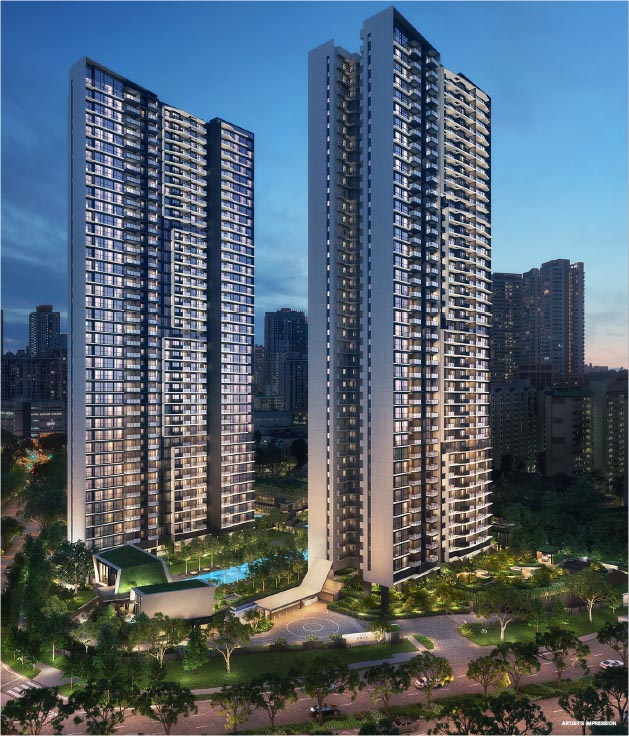
The Orie is a high-rise residential development positioned within Lorong 1 Toa Payoh, a fully mature and land-constrained estate with deep owner-occupier roots. Unlike city-fringe renewal zones or emerging residential clusters, Toa Payoh is structurally complete: amenities, transport, schools, and daily infrastructure are already in place. As a result, The Orie’s value proposition is not transformation-led, but scarcity-led — offering a modern private condominium option in an area where new private supply is extremely limited.
This positioning creates a distinct buyer dynamic. Demand is driven less by speculative upside or lifestyle novelty, and more by location loyalty, schooling continuity, and the desire to upgrade without leaving a familiar neighbourhood. The Orie therefore behaves less like a typical launch competing on future narratives, and more like a replacement asset for households anchored to Central North Singapore.
However, the project’s structure introduces clear trade-offs. Two 40-storey towers housing a sizeable number of units inevitably result in higher density, shared facilities, and urban intensity. Buyers considering The Orie must therefore evaluate not whether it is “good” in isolation, but whether its modern high-rise format aligns with expectations formed in a traditionally low-rise, HDB-dominated town.
The Orie is best understood as a scarcity-driven private upgrade within a fully matured estate, rather than a growth-led or lifestyle-first development. Its long-term defensibility comes from location permanence and buyer loyalty, while its main risks stem from density, pricing expectations, and comparison against older but larger resale alternatives. Alignment with these realities is critical to long-term satisfaction.
The Orie is a modern high-rise condominium designed for buyers who prioritise staying within Toa Payoh’s mature, school-centric estate over low-density living or price-driven value optics.
For buyers assessing whether The Orie aligns with their financing comfort, holding horizon, and exit assumptions, a structured project breakdown covering entry positioning, pricing logic, stack considerations, and buyer suitability may provide additional clarity before arranging any viewing.
Key Details (At a Glance)
99-year leasehold high-rise residential development
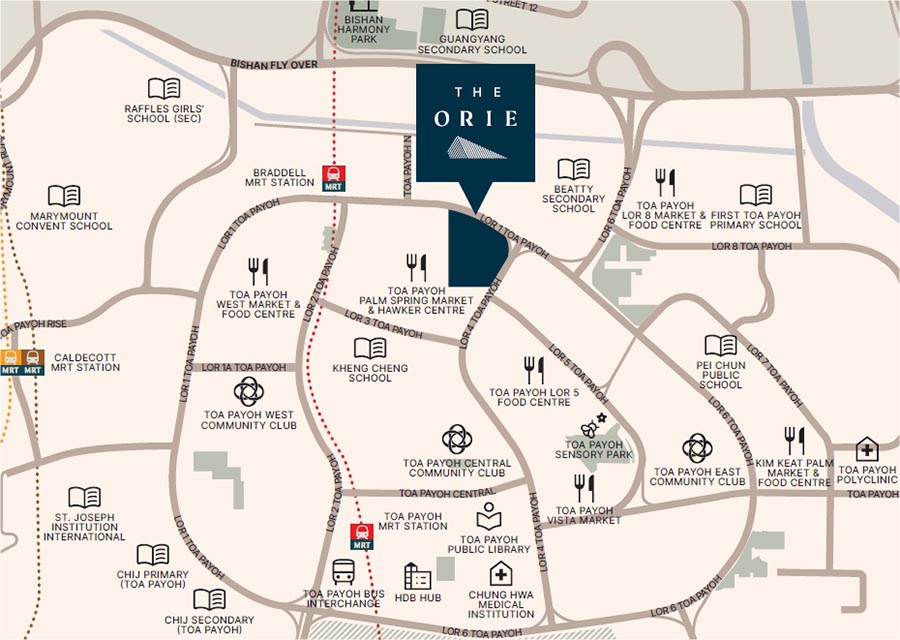
Located along Lorong 1 Toa Payoh, District 12 (RCR)
Two 40-storey residential towers within a compact site
Positioned in a fully built-out, HDB-dominated mature estate
Targeted primarily at local owner-occupiers and legacy-minded upgraders
Project Factsheet
| Item | Details |
|---|---|
| Project Name | The Orie |
| Chinese Name | 艺景峰 |
| Address | 10–12 Toa Payoh Lorong 1 |
| District / Planning Area | District 12 / Toa Payoh |
| Region | Rest of Central Region (RCR) |
| Tenure | 99-year leasehold |
| Site Type | Government Land Sale (GLS) |
| Developer | Joint venture by CDL, Frasers Property, Sekisui House |
| Development Type | High-rise residential condominium |
| Site Area | 15,743 sqm |
| Plot Ratio | 4.2 |
| Residential Units | 777 units |
| Building Form | Two 40-storey towers |
| Parking | Basement car parks |
| Expected TOP | Provided |
Location Context: Why Toa Payoh Changes the Buying Logic
Toa Payoh is not an emerging precinct. It is one of Singapore’s most established residential towns, with entrenched amenities, dense public transport coverage, and a strong school ecosystem. In such environments, buyer behaviour differs materially from fringe or growth areas.
Purchasers here are often unwilling to trade location familiarity for newer towns, even when pricing differentials exist. This creates a form of demand insulation for new private launches, where buying decisions are anchored to “staying within the district” rather than chasing relative value across regions.
For The Orie, this means its competitive set is not hypothetical future supply, but existing resale stock within Toa Payoh and adjacent estates. Buyers are implicitly choosing between modernity and space, rather than between neighbourhoods.
Development Character: Height, Density, and Urban Reality
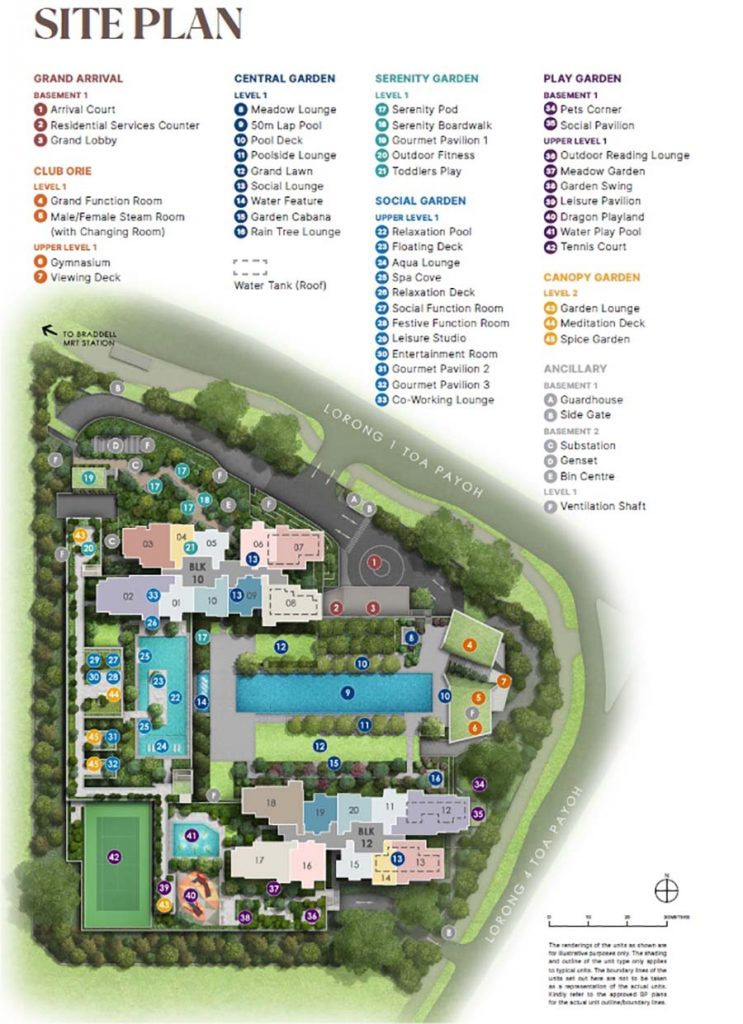
The Orie’s defining physical trait is vertical intensity. Two 40-storey towers on a compact site produce an unmistakably urban living environment, with shared decks, communal facilities, and concentrated resident activity.
This configuration is not accidental; it is the logical outcome of maximising limited land in a central, built-out estate. While landscaping and deck design soften the environment, the project cannot — and does not attempt to — replicate low-rise or boutique living conditions.
As such, comfort with density becomes a prerequisite rather than a negotiable factor. Buyers transitioning from HDB blocks may find the scale familiar, while those expecting private-estate quietude may experience expectation mismatch.
Tenure and Pricing Reality: Scarcity Without Tenure Premium
Although The Orie is leasehold, its pricing behaviour is shaped less by tenure considerations and more by locational scarcity. In mature estates, leasehold projects can command strong demand when alternatives are limited and buyer attachment to place is high.
However, this does not eliminate comparison friction. Buyers inevitably benchmark against older freehold or larger resale units nearby, especially when absolute unit sizes and total quantum become salient. As a result, purchase justification relies heavily on lifestyle preference, building age, and future maintainability rather than pure tenure mathematics.
The Orie therefore rewards buyers who value modern living standards and building efficiency over land permanence or spatial generosity.
What The Orie Is — and Is Not
What It Is
A rare new private condominium within Toa Payoh
A modern, high-rise alternative to ageing resale stock
A location-anchored upgrade for Central North households
What It Is Not
Not a low-density or boutique development
Not a value-driven substitute for larger resale units
Not a growth-corridor or transformation-led project
Understanding this distinction early prevents expectation conflict later.
Buyer Suitability: Who This Project Works For
Most Suitable For
Long-term owner-occupiers with strong ties to Toa Payoh
Families prioritising school proximity and transport access
Buyers upgrading from HDB who are comfortable with vertical living
Households valuing building age and modern standards over unit size
Least Suitable For
Buyers seeking privacy, low density, or expansive layouts
Those highly sensitive to pricing gaps versus resale alternatives
Purchasers expecting speculative or momentum-driven upside
Buyers comparing The Orie against other upcoming launches may find it helpful to frame their decision using the New Launch Condo Guide, which outlines how pricing logic, buyer intent, and holding horizon differ across project types.
Takeaway
The Orie is a filtering project rather than a broad-appeal one.
It succeeds by offering modern private housing in a district where such options are structurally scarce, but it asks buyers to accept density, pricing discipline, and urban intensity in return.
For buyers aligned with Toa Payoh’s mature-estate logic, this trade-off can be coherent and defensible. For those expecting space, quiet, or value optics, misalignment is likely regardless of market conditions.
If The Orie is on your shortlist and being compared against nearby alternatives, a structured review of capital commitment differences, downside exposure scenarios, liquidity positioning, and realistic exit pool dynamics may help clarify the decision framework before any commitment is made.
FAQs (Decision-Stage)
1) Why is The Orie considered scarce despite being leasehold?
Scarcity here is driven by location, not tenure. Toa Payoh has very limited opportunities for new private residential development, making any modern launch structurally rare. Buyers anchored to the district often prioritise staying put over tenure considerations. This creates demand resilience independent of freehold status.
2) Does the high-rise format reduce long-term appeal?
High-rise living introduces density and shared infrastructure, which can deter buyers seeking privacy. However, in central mature estates, vertical living is common and widely accepted. Long-term appeal depends less on height and more on estate management and maintenance quality.
3) How does The Orie compare to older resale condos in Toa Payoh?
Older resale projects typically offer larger layouts and sometimes freehold tenure. The Orie competes instead on building age, efficiency, and modern facilities. Buyers are effectively choosing between space and modernity rather than between neighbourhoods.
4) Is The Orie suitable for families with children?
It suits families prioritising school proximity and daily convenience. However, compact layouts may require careful unit selection for larger households. Families expecting expansive internal space may find resale options more suitable.
5) Does pricing limit future resale demand?
Higher entry pricing narrows the buyer pool, especially for larger units. Resale demand is likely to remain, but price sensitivity will be more pronounced than in lower-priced estates. Realistic pricing expectations are critical during exit.
6) How important is unit selection in this project?
Unit selection is highly consequential due to density and orientation differences. Stack position, facing, and distance from communal areas can materially affect liveability. Poor selection can underperform even if the project overall remains in demand.
7) Is The Orie more defensive or growth-oriented?
The Orie behaves more like a defensive, location-anchored asset. Its strength lies in sustained local demand rather than transformative growth narratives. Buyers should approach it with a holding mindset rather than a performance mindset.
8) Who should avoid The Orie altogether?
Buyers prioritising space, privacy, or low-density environments should eliminate it early. Expectation mismatch, rather than market risk, is the primary downside here. Clear self-selection is the best risk management tool.
Pricing Logic, Planning Intent & Buyer Segmentation
Pricing Logic: Location Loyalty Over Value Optics
The Orie’s pricing behaviour is best understood through the lens of location loyalty rather than traditional value optics. In a fully matured estate like Toa Payoh, many buyers anchor decisions to staying within the district, preserving school continuity, and maintaining daily routines. This creates a demand base that is less elastic than in emerging precincts, even when absolute prices appear elevated.
That said, pricing tolerance is not uniform across unit types. Smaller and mid-sized family layouts tend to align more naturally with upgrader budgets, while larger formats face sharper resistance as absolute quantum rises. As a result, price acceptance narrows progressively with size, making realistic expectations essential for future exit planning.
Planning Intent: Consolidation, Not Transformation
The Orie sits within an estate whose planning intent is consolidation and enhancement, not wholesale transformation. Infrastructure, transport, and amenities are already embedded; future improvements are incremental and focused on quality of life rather than land-use change. This stabilises long-term relevance but limits event-driven repricing narratives.
For buyers, this means returns are shaped more by replacement value and scarcity of new supply than by macro redevelopment catalysts. The project’s defensibility lies in permanence and usability, not in anticipation of structural change.
Buyer Segmentation: Who Converts and Why
The core buyer segment comprises local owner-occupiers upgrading from nearby public housing, often with multi-generational considerations. Their priorities centre on staying put, accessing schools, and securing a modern home without relocating to a new town. This group is less sensitive to comparisons outside the district.
Secondary demand comes from parent-buyers and long-term holders seeking certainty and ease of use. Conversely, buyers driven primarily by price arbitrage or short-cycle performance tend to hesitate, as the project does not offer a clear discount narrative or rapid repricing thesis.
Exit, Liquidity & Risk Scenarios
Exit Behaviour: Liquidity With Discipline
Exit liquidity at The Orie is supported by a steady pool of local demand, but outcomes are price-disciplined rather than momentum-driven. Transactions are more likely to occur when pricing aligns with buyer expectations within the district, not when sellers push for premium spreads over comparable resale stock.
This dynamic favours patience and realistic positioning. Sellers who over-anchor to peak narratives risk extended time-on-market, while those who price to the district’s absorption capacity tend to transact more predictably.
Density and Competition: Unit-Specific Outcomes
High density introduces internal competition, particularly among similar layouts. Over time, performance diverges at the unit level based on orientation, stack desirability, and distance from communal activity. Project-wide narratives matter less than micro-attributes during resale.
Buyers should therefore model outcomes with unit specificity. Strong selection can mitigate density effects; weak selection amplifies them.
Risk Framing: Expectation Mismatch Over Market Risk
The primary risk is expectation mismatch, not structural failure. Buyers expecting low-density privacy, expansive layouts, or rapid appreciation may experience dissatisfaction regardless of market conditions. By contrast, buyers aligned with high-rise urban living and district loyalty typically view trade-offs as acceptable.
Macro risks affect affordability and buyer sentiment, but they tend to express as longer selling periods rather than abrupt repricing. This reinforces the importance of holding horizon and financial resilience.
FAQs
1) How liquid is resale demand likely to be at The Orie?
Resale liquidity is supported by a consistent local upgrader pool within Toa Payoh. Transactions are feasible, but pricing discipline is crucial. Liquidity expresses as steadiness rather than rapid turnover.
2) Does high density weaken long-term value?
High density limits scarcity-driven premiums but does not negate demand. Value stability depends on management quality and unit selection. Density mainly caps upside rather than creating downside.
3) Are larger units harder to exit?
Larger units face a narrower buyer pool due to higher absolute commitment. Exits are achievable with realistic pricing and patience. Over-pricing tends to extend marketing periods.
4) How important is stack and orientation?
Stack and orientation materially affect liveability and resale appeal. Proximity to activity areas and exposure differences can create meaningful performance gaps. Unit choice matters more here than in low-density projects.
5) Is The Orie defensive in weaker markets?
It behaves defensively due to location permanence and local demand. Weak markets usually translate into slower sales rather than sharp discounts. Holding capacity is a key advantage.
6) Does leasehold tenure limit future buyers?
Tenure is secondary to location in mature estates. Buyers often prioritise staying within the district over tenure mathematics. Leasehold does not eliminate demand but shapes pricing expectations.
7) Can management quality change outcomes?
Yes. In high-rise developments, management directly affects daily experience and resale confidence. Consistent upkeep supports long-term desirability.
8) How does pricing realism affect exits?
Pricing realism is decisive. Buyers benchmark against nearby resale options within the same estate. Aligning with district affordability accelerates outcomes.
9) Is this suitable for leveraged strategies?
Highly leveraged strategies require caution due to price sensitivity. Rental stability can help, but leverage magnifies timing risk. Lower leverage improves flexibility.
10) Will future amenity enhancements drive repricing?
Enhancements tend to support comfort rather than trigger repricing. Benefits accrue gradually and defensively. Expect reinforcement, not acceleration.
11) Are compact layouts a long-term issue?
Compact layouts suit efficiency-oriented households but deter space-seeking buyers. Over time, they remain liquid if priced appropriately. Selection should match household needs.
12) How does buyer psychology affect resale?
Local loyalty supports demand, but buyers are value-aware. Emotional attachment does not override affordability thresholds. Sellers must price to psychology, not sentiment.
13) Is this a growth or preservation asset?
It leans toward preservation with measured appreciation. Returns are steadier than speculative. Alignment with holding horizon is essential.
14) What happens if interest rates stay elevated?
Affordability pressure narrows buyer pools, particularly for larger units. Outcomes shift toward longer marketing periods. Cash-flow resilience matters.
15) Who should avoid The Orie at exit?
Sellers seeking quick flips or premium spreads should avoid it. The project rewards discipline over aggression. Expectation management is critical.
16) What defines a successful exit here?
Correct unit selection, realistic pricing, and patience define success. District loyalty provides a floor, not a ceiling. Execution, not narrative, determines outcomes.
If a structured discussion is preferred over WhatsApp, or if detailed floor plans, pricing breakdowns, or showflat arrangements are required, your details may be left below for a follow-up.