
Summary
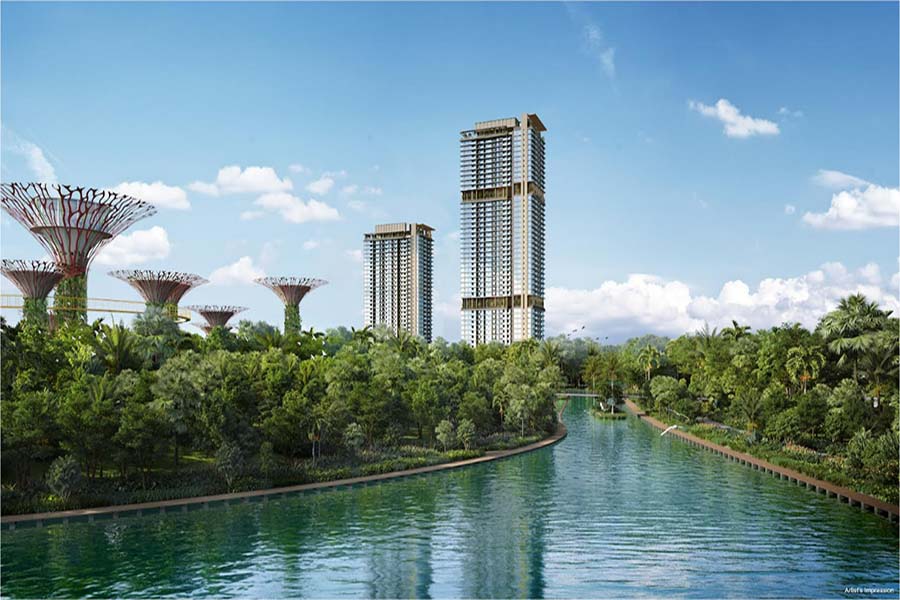
One Marina Gardens is a 937-unit, 99-year leasehold residential development located in the Marina South Planning Area of District 1, forming part of Singapore’s first purpose-built car-lite downtown residential precinct. As the earliest private residential launch in this zone, it occupies a structurally important position within the Greater Southern Waterfront (GSW) transformation, while also carrying the trade-offs associated with being a first-mover in an undeveloped district.
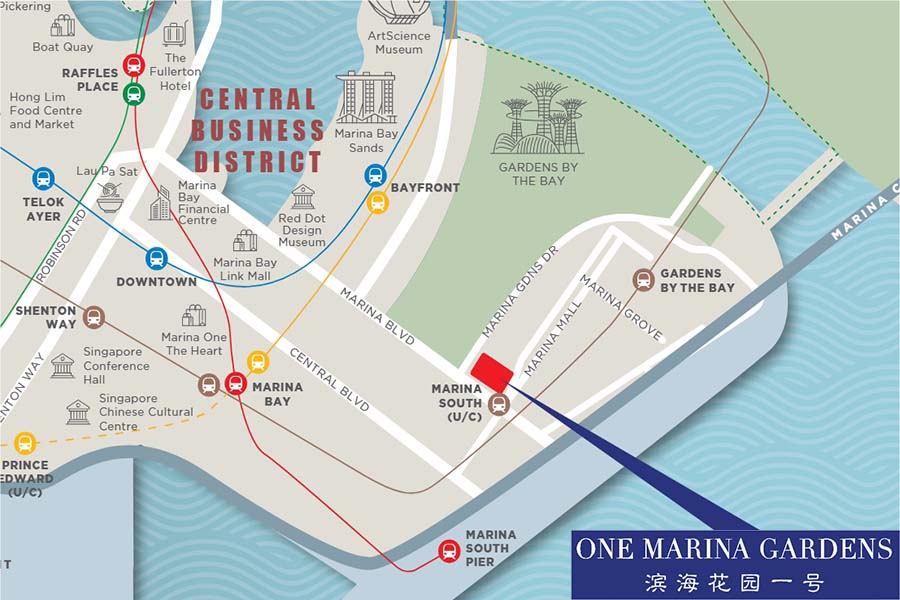
The project benefits from direct underground access to Marina South MRT on the Thomson–East Coast Line and immediate adjacency to Gardens by the Bay, offering strong long-term locational fundamentals. However, its surrounding environment remains largely unbuilt, with daily amenities, schools, and street-level activity still dependent on future precinct development rather than existing infrastructure.
As such, One Marina Gardens should be assessed primarily as a long-horizon, investment-led proposition anchored to Marina South’s eventual maturity, rather than a near-term lifestyle-ready city-centre residence.
One Marina Gardens represents an early entry into Singapore’s planned downtown residential expansion at Marina South, where long-term urban transformation is clear but near-term liveability remains limited. Its value proposition is driven by structural positioning within the Greater Southern Waterfront rather than immediate neighbourhood completeness.
One Marina Gardens is best understood as a first-cycle, investment-led entry into Marina South’s future downtown ecosystem, rather than a fully established city-centre residential environment today.
For buyers assessing whether One Marina Gardens aligns with their financing comfort, holding horizon, and exit assumptions, a structured project breakdown covering entry positioning, pricing logic, stack considerations, and buyer suitability may provide additional clarity before arranging any viewing.
Key Details (At a Glance)
99-year leasehold | Large-scale, high-density downtown residential development
Marina South, District 1 (Core Central Region)
Core Greater Southern Waterfront precinct
Positioned primarily for long-horizon investors and CBD-focused professionals
Project Factsheet
| Item | Details |
|---|---|
| Project Name | One Marina Gardens |
| Location | Marina Gardens Lane, Singapore |
| District / Region | District 1 (Core Central Region / Marina South Planning Area) |
| Tenure | 99-year leasehold (from 9 October 2023) |
| Developer | Kingsford Development |
| Site Type | GLS (Government Land Sales) |
| Development Type | Residential-led development with limited ground-floor commercial |
| Site Area | Approximately 6,238 sqm |
| Plot Ratio | 5.6 |
| Total Units | 937 residential units |
| Nearest MRT | Marina South MRT (TE21), Thomson–East Coast Line |
| Launch Status | Launched (12 April 2025) |
| Expected TOP | April 2029 (estimated) |
Location Context: Marina South Today vs Tomorrow
Marina South represents a fundamentally different urban proposition compared to established District 1 and District 2 residential zones. Unlike areas that evolved organically around offices and amenities, Marina South is being constructed top-down as a master-planned residential precinct under the Greater Southern Waterfront framework.
For One Marina Gardens, this means exceptional long-term planning clarity but limited present-day convenience. Outside of Gardens by the Bay and Marina Barrage, the surrounding area currently lacks supermarkets, hawker centres, schools, and daily retail. Evening and weekend activity remains sparse, reinforcing the project’s reliance on future precinct completion rather than existing vibrancy.
From a connectivity standpoint, the project performs strongly. Direct underground access to Marina South MRT on the Thomson–East Coast Line provides efficient connectivity to the CBD, Orchard Road, and the East Coast without transfers. For professionals working in Marina Bay Financial Centre or the downtown core, this is a genuine functional advantage.
However, liveability today remains transitional. Buyers should treat Marina South as a district under construction rather than an established neighbourhood.
Buyers comparing One Marina Gardens against other prime developments may find it helpful to contextualise its positioning within the broader Core Central Region (CCR) new launch landscape, where tenure, density, and buyer intent differ materially across projects.
GSW Narrative: Core Parcel with Phased Payoff
One Marina Gardens sits within a core Greater Southern Waterfront parcel, not merely within its influence zone. This distinction is critical.
Being GSW-core means transformation is planned and sequenced rather than speculative, but it is not immediate. Residents should expect prolonged surrounding construction activity as adjacent plots are released and built out over the next decade. Lifestyle enhancement will arrive progressively, following residential critical mass and amenity delivery, rather than at TOP.
In practical terms, value appreciation here is more likely to be infrastructure- and time-led rather than event-driven. Buyers aligned with this timeline may see One Marina Gardens as a foundational asset in a future downtown district. Those expecting near-term vibrancy or rapid repricing may find expectations misaligned.
Pricing Context (Decision-Stage Orientation)
One Marina Gardens entered the market with relatively accessible entry points for a District 1 address, particularly for smaller unit types. This pricing positioning supported early absorption of one-bedroom layouts, while two- and three-bedroom units were broadly aligned with prevailing CCR new-launch benchmarks at the time of entry.
As the sales cycle progressed, pricing moved into a materially higher band, with remaining inventory concentrated in mid-sized configurations. At these levels, buyer behaviour typically shifts: decisions are no longer driven by district access alone, but by relative value when compared against more established downtown residential options.
This evolution highlights the importance of entry price discipline and unit selection. For later-stage buyers, the decision is less about headline location and more about whether the specific unit offers sufficient differentiation against mature alternatives.
This pricing evolution underscores the importance of entry timing and unit selection. At this stage of the sales cycle, buyers are no longer evaluating “District 1 access” alone, but relative value versus mature alternatives.
What One Marina Gardens Is — and Is Not
What It Is
A first-mover residential project in a master-planned downtown precinct
Positioned for long-horizon investors and CBD-oriented professionals
A play on future urban transformation rather than existing amenity depth
Designed for buyers comfortable with high-density, vertical living
What It Is Not
Not a mature, amenity-rich city neighbourhood
Not a low-density or boutique luxury development
Not a family-oriented project with school-driven demand
Not structured for short-term trading or launch-momentum flipping
Understanding this distinction early helps prevent misaligned expectations.
Buyer Suitability: Who This Project Works For
1. Long-Horizon Investors
Buyers seeking early exposure to Marina South’s long-term transformation, and who are comfortable holding through multiple development phases, are best aligned with the project’s risk-reward profile.
2. CBD-Focused Professionals
Singles or couples working in Marina Bay, Shenton Way, or Orchard may value the project’s MRT connectivity and proximity to the downtown core despite current amenity gaps.
3. Buyers Comfortable with Transitional Living
Those who prioritise future district maturity over immediate neighbourhood completeness are more likely to accept the prolonged construction environment.
Buyers Who Should Eliminate One Marina Gardens Early
One Marina Gardens should be ruled out early by buyers who:
Require established amenities and schools at TOP
Prefer low-density or enclave-style living
Are sensitive to prolonged construction activity
Expect short-term capital appreciation driven by launch dynamics
These are structural mismatches, not negotiable compromises.
Buyers comparing One Marina Gardens against other upcoming launches may find it helpful to frame their decision using the New Launch Condo Guide, which outlines how pricing logic, buyer intent, and holding horizon differ across project types.
Takeaway
One Marina Gardens is not a conventional city-centre condominium. It is a long-duration bet on Marina South becoming Singapore’s next downtown residential district. For buyers aligned with that timeline, its positioning may be compelling. For others, restraint is the more rational decision.
If One Marina Gardens is on your shortlist and being compared against nearby alternatives, a structured review of capital commitment differences, downside exposure scenarios, liquidity positioning, and realistic exit pool dynamics may help clarify the decision framework before any commitment is made.
FAQs (Decision-Stage)
1. Is One Marina Gardens suitable for own-stay buyers today?
For most own-stay buyers, the project is better suited to future living rather than immediate occupation. Current amenity gaps and ongoing construction activity mean liveability is still transitional. Buyers must be comfortable prioritising long-term district potential over present-day convenience.
2. Why did one-bedroom units sell faster than larger units?
Lower absolute quantum at launch reduced the entry barrier for a District 1 address. Smaller units also align more clearly with a rental-led thesis given proximity to the CBD. Larger units face a narrower buyer pool due to the lack of family-oriented infrastructure.
3. How should buyers view the 99-year leasehold tenure here?
Tenure is less of a differentiating factor in the early life of a master-planned district. However, over time, resale competition and lease decay considerations may matter more as surrounding supply increases. Buyers should assess holding horizon carefully.
4. Does direct MRT access fully offset the lack of amenities?
Strong connectivity improves commute efficiency but does not replace daily conveniences. MRT access enhances rental appeal but does not eliminate the need for future amenity build-out. These are complementary, not interchangeable, factors.
5. Is pricing still attractive at current levels?
Pricing today reflects reduced early-mover discounts and greater buyer selectivity. Value is increasingly unit-specific rather than project-wide. Buyers should benchmark against mature downtown alternatives rather than relying on district branding alone.
6. How long will the surrounding construction environment last?
Marina South is expected to undergo phased development over the next decade. Residents should anticipate ongoing construction activity well beyond TOP. This is inherent to first-cycle precinct development.
7. Who is the typical tenant profile for this project?
Likely tenants include professionals working in Marina Bay, finance, consulting, and technology sectors. Rental demand is expected to skew towards smaller units rather than family-sized formats.
8. Is One Marina Gardens more of an investment or lifestyle purchase?
It is primarily an investment-led proposition at this stage. Lifestyle benefits are long-dated and dependent on precinct maturity. Buyers should align expectations accordingly.
Pricing Logic, URA Planning Intent, Buyer Segmentation
Summary
This section examines how One Marina Gardens is priced relative to its launch cycle, competing downtown projects, and Marina South’s planning intent, before breaking down the actual buyer segments driving demand — and those staying sidelined.
Pricing Logic: From Early Entry to Resistance Zone
One Marina Gardens’ pricing behaviour since launch reflects a textbook early-cycle, first-mover pattern rather than a uniform upward trajectory.
At launch in April 2025, pricing was structured to encourage early participation in a largely untested residential precinct. One-bedroom units entered the market at approximately S$1.16M–S$1.19M, with two- and three-bedroom units positioned competitively against other CCR new launches at the time. This pricing window successfully unlocked demand from investors seeking District 1 exposure at lower absolute quantum levels, explaining the rapid clearance of smaller units.
As of early February 2026, the remaining balance inventory sits at materially higher entry levels. Observed prices range from approximately S$2,740 to S$3,174 psf, with most remaining stock concentrated in two- and three-bedroom configurations. This shift has introduced a visible resistance zone around the S$3,200 psf mark, where buyers increasingly benchmark against established downtown luxury developments rather than future-oriented precincts.
The pricing challenge is not that One Marina Gardens is “overpriced” in isolation, but that it now competes for attention against projects offering either:
stronger immediate liveability, or
clearer luxury differentiation, or
more established resale comparables
At this stage of the sales cycle, pricing sensitivity has become unit-specific rather than project-wide, with buyers scrutinising orientation, floor level, and layout efficiency much more closely.
Relative Positioning Against Downtown Alternatives
When compared against other recent or nearby downtown launches, One Marina Gardens occupies a distinct middle ground.
Projects such as W Residences Marina View command significantly higher psf levels, but justify this through branded positioning, concierge-style offerings, and immediate proximity to the established Marina Bay core. On the other end of the spectrum, older resale developments in the Marina Bay area trade at materially lower psf levels, but lack the “new precinct” optionality embedded in Marina South.
One Marina Gardens therefore sits between:
established downtown residences with mature surroundings, and
future-oriented precinct plays where liveability is deferred
This positioning explains the bifurcation in buyer response: investors focused on long-term transformation remain engaged, while buyers seeking immediate value or near-term exit clarity hesitate.
URA Planning Intent: Marina South as a Purpose-Built Residential District
The URA Master Plan frames Marina South as a 45-hectare, high-density, car-lite residential precinct forming a core component of the Greater Southern Waterfront. Unlike piecemeal redevelopment zones, Marina South is designed to function as a complete district over time, integrating housing, employment, green spaces, and pedestrian infrastructure.
Key planning features relevant to One Marina Gardens include:
a “10-minute neighbourhood” concept prioritising walkability and cycling,
mandatory sustainability standards such as BCA Green Mark Super Low Energy (SLE), and
phased residential release intended to build population critical mass before full amenity deployment
For buyers, this confirms that Marina South’s transformation is deliberate and policy-backed, not speculative. However, it also reinforces that benefits accrue sequentially rather than immediately. The planning intent supports long-term value stability, but does not guarantee short-term price acceleration.
Buyer Segmentation: Who Is Actually Buying
Sales behaviour to date suggests a clearly segmented buyer profile.
Primary Segment: Local Investors
The dominant buyer group consists of Singaporean investors targeting the CBD rental market. This group is typically drawn to:
direct MRT connectivity,
proximity to Marina Bay employment nodes, and
smaller unit formats with manageable quantum
For these buyers, the appeal lies in long-term rental demand rather than immediate yield optimisation.
Secondary Segment: High-Income Singles and Couples
A smaller but consistent group comprises professionals working in Marina Bay or Orchard who prioritise commute efficiency over neighbourhood maturity. These buyers are generally less sensitive to current amenity gaps but more selective on layout and view orientation.
Tertiary Segment: Select Foreign Buyers
Foreign participation exists but remains constrained by ABSD considerations. Where present, it is largely concentrated in smaller units acquired through trust structures or PR-linked purchases, rather than broad-based overseas demand.
Exit & Liquidity, Risk Scenarios, Pros & Cons, FAQs
Summary
This section focuses on exit liquidity, structural risks, and realistic constraints buyers should account for before committing to a long-term holding decision
Exit & Liquidity: Timing Matters More Than Narrative
Exit outcomes for One Marina Gardens are likely to be highly timing-dependent.
In the early post-TOP years, resale liquidity may benefit from limited immediate competition, particularly if adjacent plots are still under construction. However, as multiple Marina South parcels reach completion over a similar timeframe, resale competition is expected to intensify, placing pressure on pricing differentiation.
Liquidity is likely to remain strongest for:
smaller units with lower absolute quantum, and
units with favourable orientation or unblocked views
Larger family-sized units may face a narrower resale pool given the absence of nearby schools and family infrastructure, even after precinct maturation.
Key Risk Scenarios Buyers Should Acknowledge
1. Prolonged Construction Environment
With multiple residential plots slated for development over the next decade, early residents should expect sustained construction noise, dust, and traffic disruption well beyond TOP.
2. Pricing Compression Risk
As new supply enters the market at potentially lower land costs, resale pricing may face compression, particularly for mid-sized units lacking strong differentiation.
3. Leasehold Sensitivity Over Time
While lease tenure is less impactful in the early years, long-term holding scenarios must account for lease decay and increasing competition from newer launches within the same precinct.
4. Policy and Macro Exposure
Downtown residential demand is more sensitive to ABSD policy changes and global employment conditions, particularly in finance and professional services.
Pros and Cons Summary
Key Strengths
Direct underground MRT access on the Thomson–East Coast Line
First-mover positioning in a master-planned downtown district
Strong long-term policy support under the GSW framework
Clear rental demand profile for smaller units
Key Limitations
Minimal existing amenities and schools
High-density environment with limited privacy
Long construction horizon for surrounding plots
Price resistance at higher psf levels
FAQs
1. Is One Marina Gardens likely to outperform other downtown projects over the long term?
Long-term performance depends on Marina South maturing into a fully functional residential district as planned under the Greater Southern Waterfront framework. Structural support exists through policy-led development and infrastructure sequencing, but returns are likely to be gradual rather than front-loaded. Buyers should not expect rapid repricing driven by launch momentum alone.
2. How risky is it to buy into Marina South at this early stage?
Buying into Marina South today carries higher transitional risk than established downtown locations due to prolonged surrounding construction and deferred amenity delivery. This risk is offset only for buyers with longer holding horizons who are comfortable waiting through multiple development phases. Short-term certainty is limited.
3. Will rental demand be strong immediately after TOP?
Rental demand is expected to be stable for smaller units, particularly from professionals working in Marina Bay, Shenton Way, and the CBD. However, rental performance for larger units may be uneven due to limited family-oriented infrastructure in the immediate vicinity. Rental demand here is more tenant-profile specific than broad-based.
4. Does the car-lite precinct concept restrict future buyer appeal?
For some buyers, limited reliance on private vehicles may be a constraint, particularly families or older owner-occupiers. However, for younger professionals and investors, car-lite planning increasingly aligns with urban living preferences. Buyer appeal will therefore be segmented rather than universal.
5. Is oversupply a genuine concern in Marina South?
Yes. Multiple residential plots are planned within the Marina South precinct, and overlapping completion timelines could increase competition for both resale and rental demand. This makes unit differentiation and entry pricing particularly important for exit outcomes.
6. How does One Marina Gardens compare with freehold options in Districts 9 or 10?
Freehold projects in Districts 9 and 10 offer different value propositions, often trading higher entry prices for tenure permanence and established surroundings. One Marina Gardens instead offers exposure to future district transformation but with leasehold and supply-related risks. These are fundamentally different investment profiles.
7. Is One Marina Gardens suitable for wealth preservation or legacy planning?
It is less suited for legacy or intergenerational planning due to its 99-year leasehold tenure and the likelihood of increased future supply within the same precinct. The project is better viewed as a strategic, time-bound holding rather than a permanent asset. Buyers prioritising capital preservation may prefer alternative structures.
8. Which buyer profiles should be most cautious about this project?
Buyers seeking immediate lifestyle completeness, low-density living, or short-term capital appreciation should approach with caution. The project’s strengths lie in long-term positioning rather than near-term comfort. Misaligned expectations are the primary risk here.
9. How important is unit selection within One Marina Gardens?
Unit selection is critical. Orientation, floor height, layout efficiency, and proximity to construction zones materially affect both liveability and exit liquidity. Poorly chosen units may underperform even if the precinct matures as planned.
10. Will Greater Southern Waterfront development directly lift prices in the near term?
GSW-related uplift is more likely to be structural and time-based rather than driven by singular announcements or events. While planning clarity supports long-term confidence, near-term price movements remain constrained by supply and liveability factors. Buyers should temper expectations of immediate uplift.
11. Is the pricing gap versus nearby resale developments justified?
The pricing gap reflects future optionality rather than present-day amenity advantages. Buyers are effectively paying for early access to a planned district rather than current neighbourhood maturity. Whether this gap is justified depends on individual holding horizon and risk tolerance.
12. Could future Marina South launches undercut current pricing?
Yes. Future land sales and market conditions could result in new launches entering at competitive pricing levels, particularly if demand softens. This introduces medium-term pricing risk for current buyers, especially for mid-sized units without strong differentiation.
13. How does Kingsford’s track record affect buyer risk assessment?
Developer track record remains part of buyer consideration, particularly for higher-quantum purchases. While recent projects have improved delivery outcomes, historical quality concerns still influence perception among risk-averse buyers. This factor may affect resale sentiment rather than initial demand.
14. Are larger units at One Marina Gardens a value trap?
Not inherently, but they carry higher liquidity risk due to a narrower buyer pool. Without nearby schools or family-centric amenities, demand for larger units is structurally limited. Buyers should be prepared for longer holding periods if targeting these configurations.
15. Is Marina South comparable to other new or reclaimed precincts in Singapore?
Yes, in the sense that master-planned districts typically require time to mature before liveability and pricing stabilise. Early entrants benefit from policy clarity but must endure longer transition periods. Patience is a prerequisite rather than a bonus.
16. What is the single biggest decision risk buyers face here?
The greatest risk is expectation misalignment. Buyers who underestimate the time required for Marina South to mature may become dissatisfied despite the project performing as planned. Clear alignment between holding horizon and precinct reality is essential.
If a structured discussion is preferred over WhatsApp, or if detailed floor plans, pricing breakdowns, or showflat arrangements are required, your details may be left below for a follow-up.