
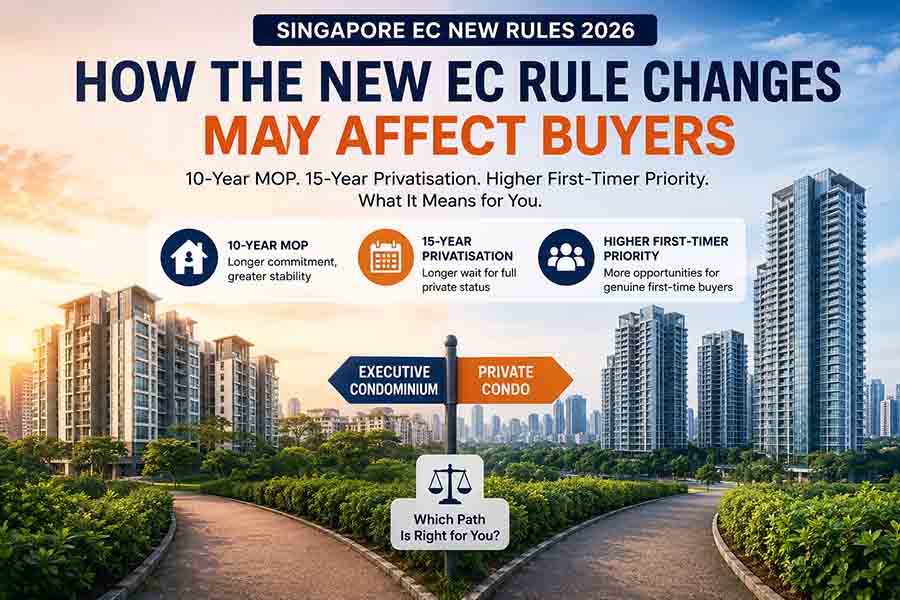
Singapore’s latest Executive Condominium (EC) policy changes announced by the Ministry of National Development (MND) may initially appear administrative on the surface.
Longer holding periods, tighter first-timer allocation rules and the removal of deferred payment structures can sound like technical housing adjustments.
But collectively, these changes may signal something much larger.
The latest policy changes may suggest the government increasingly wants Executive Condominiums to function more as long-term owner-occupied housing rather than shorter-cycle upgrading assets.
That distinction matters.
Because many buyers may now be reassessing whether ECs still offer the same balance between affordability, flexibility and future optionality as before.
Over the past decade, Executive Condominiums gradually evolved beyond simply being subsidised housing.
For many Singaporean households, they increasingly became one of the market’s most attractive hybrid housing assets:
- lower entry pricing compared to private condominiums,
- CPF housing grants,
- private-style facilities,
- and historically manageable holding timelines before future resale flexibility.
The latest changes do not necessarily make ECs unattractive.
But they could fundamentally change how buyers evaluate trade-offs between affordability, flexibility, holding periods and long-term suitability.
Quick Snapshot: What Has Changed for Executive Condominiums (ECs)?
| Policy Area | Previous Structure | New Change |
|---|---|---|
| Minimum Occupation Period (MOP) | 5 years | Increase to 10 years |
| Full EC Privatisation Timeline | 10 years | Increase to 15 years before full privatisation |
| First-Timer Allocation | Around 70% reserved initially | 90% reserved for first-timers for first 2 years |
| Deferred Payment Scheme (DPS) | Available for EC buyers | DPS to be removed |
| EC Positioning | Flexible upgrader pathway | Stronger focus on long-term owner-occupation |
Prefer Watching Instead?
For readers who prefer a video breakdown, I’ve also summarised the key implications of Singapore’s new EC rule changes below, including the new 10-year MOP, DPS removal, affordability considerations and how these changes may affect future buyers differently.
Key Takeaways
- Singapore’s latest EC framework may significantly lengthen the long-term holding horizon for buyers.
- The 10-year MOP and 15-year privatisation timeline could shift Executive Condominiums further toward long-term owner-occupation.
- Expanded first-timer priority may improve access for genuine first-time households.
- Some buyers may increasingly reassess the trade-offs between EC affordability and private condominium flexibility.
- Existing EC projects and earlier GLS sites are generally not affected by the new framework.
Importantly, the new rules apply only to Executive Condominium Government Land Sales (GLS) sites with tender closing dates on or after 8 May 2026.
This means existing EC projects and earlier GLS sites are generally not affected by the latest framework.
Why Executive Condominiums Became So Attractive to Buyers
To understand why these policy changes matter, it is important to first understand how Executive Condominiums evolved psychologically within Singapore’s housing market.
Historically, ECs occupied a very unique middle ground between public and private housing.
They offered:
- lower entry pricing compared to fully private condominiums,
- private-style facilities,
- eligibility for CPF housing grants,
- and eventual privatisation over time.
For many Singaporean households, Executive Condominiums became one of the few realistic pathways toward private-style living without immediately entering full private condo pricing.
But over time, ECs also became increasingly attractive for another reason.
They offered a relatively structured pathway for wealth progression.
Many buyers viewed Executive Condominiums as:
- an upgrader step,
- a transitional housing asset,
- or a way to progressively move up Singapore’s property ladder.
The combination of:
- subsidised land economics,
- private facilities,
- and historically shorter holding flexibility
created a very powerful psychological proposition.
In particular, the previous five-year MOP structure still felt manageable for many buyers.
Even if owners were not planning to sell immediately after MOP, the shorter timeline still preserved a sense of optionality.
That flexibility mattered psychologically.
This is also why comparisons between Executive Condominiums vs New Launch Condos After ABSD have become increasingly important for buyers evaluating affordability, flexibility and long-term housing pathways.
The Government’s Broader Concern May Not Simply Be Prices
Much of the discussion surrounding Executive Condominiums often focuses on affordability and pricing.
But the latest policy changes may suggest the government’s concern extends beyond pricing alone.
Over time, newer EC launches increasingly attracted:
- stronger upgrader demand,
- higher second-timer participation,
- and buyers with significantly larger financial resources.
As Executive Condominium launches became increasingly competitive, younger first-time buyers often found themselves competing against households with:
- accumulated HDB sale proceeds,
- larger CPF balances,
- and stronger purchasing power.
At the same time, EC pricing also rose meaningfully across newer launches.
This gradually created an interesting contradiction.
The more successful Executive Condominiums became as upgrading assets, the further they risked drifting away from their original social positioning.
That may explain why the latest policy changes focus so heavily on:
- expanding first-timer priority,
- lengthening holding periods,
- and removing structures that potentially encouraged more aggressive purchasing behaviour.
The broader policy signal appears increasingly clear.
The government may want Executive Condominiums to function primarily as long-term homes first — rather than flexible wealth-transition assets.
Why a 10-Year MOP Could Change Buyer Psychology Significantly
Among all the changes, the increase from a five-year to ten-year Minimum Occupation Period may potentially have the biggest behavioural impact.
At the same time, the extension of full EC privatisation from 10 years to 15 years further lengthens the overall flexibility timeline for buyers.
Historically, many Executive Condominium buyers were comfortable knowing that full privatisation remained relatively achievable within a decade.
A fifteen-year horizon changes that framing considerably — particularly for buyers who previously viewed ECs as transitional housing assets within a shorter wealth progression cycle.
This is because the difference is not merely numerical.
It changes how buyers psychologically frame the entire purchase.
A five-year commitment still felt relatively manageable for many households.
A ten-year horizon is fundamentally different.
Suddenly, buyers may begin evaluating questions such as:
- Will this location still suit my family much later?
- How important is MRT connectivity over a longer holding period?
- Will nearby amenities mature sufficiently?
- What happens if my work location changes?
- How important is future resale liquidity?
These become much more serious considerations when buyers are effectively committing toward a decade-long horizon.
This may also increase the importance of:
- estate maturity,
- transport connectivity,
- surrounding amenities,
- school accessibility,
- and long-term neighbourhood liveability.
Historically, many Executive Condominiums have been located within newer or outer-region estates where land pricing remains more manageable.
That does not automatically make these projects unattractive.
Many eventually perform very well.
Importantly, slower take-up rates under the new framework may not necessarily indicate weak demand.
Under the revised structure, some second-timer buyers may simply require more time before entering the market.
Instead of rushing during launch weekend, some households may wait until:
- they sell their existing flat,
- work through their finances more comfortably,
- or reassess remaining unit availability later in the project lifecycle.
This could potentially change how future EC launches are absorbed over time — even if underlying demand remains healthy.
However, longer holding periods may increase the importance of how surrounding estates evolve over time.
In other words, future resale demand may increasingly depend not just on entry pricing — but also on how attractive the surrounding environment becomes many years later.
Why Removing DPS Matters More Than Many Buyers Realise
The removal of the Deferred Payment Scheme (DPS) may also have a larger behavioural impact than many buyers initially expect.
Traditionally, DPS helped reduce immediate financial strain by deferring a significant portion of payments until later stages of construction.
But psychologically, DPS also lowered commitment barriers.
It allowed buyers to:
- reserve units more comfortably,
- reduce immediate cash flow pressure,
- and enter projects with greater financial flexibility.
Without DPS, Executive Condominium purchases may become:
- more financially disciplined,
- more cash-flow conscious,
- and potentially less speculative.
This does not mean EC demand disappears.
Genuine owner-occupiers and family buyers may still find Executive Condominiums highly attractive compared to private condos.
However, the removal of DPS could gradually reduce:
- highly aggressive upgrading behaviour,
- short-cycle positioning,
- and more opportunistic buying activity.
Could Some Buyers Shift Back Toward Private Condos Instead?
Interestingly, the latest Executive Condominium changes may not only affect EC buyers.
They could also indirectly change how some households evaluate private condominiums.
Historically, many buyers were willing to accept EC restrictions because:
- the holding horizon still felt manageable,
- the pricing discount remained meaningful,
- and future flexibility remained psychologically accessible.
But once buyers begin evaluating:
- a ten-year commitment,
- reduced flexibility,
- and the removal of DPS,
some households may start reassessing the trade-offs differently.
Particularly for:
- dual-income professionals,
- younger households with uncertain future plans,
- buyers prioritising flexibility,
- or purchasers concerned about long-term mobility.
Some may increasingly ask:
If I am already committing long-term, should I simply consider a private condo instead?
The answer will ultimately depend on each buyer’s affordability, flexibility needs and long-term housing priorities.
This does not automatically mean private condo prices will rise because of the new EC rules.
The situation is probably more complicated than that.
While some buyers may increasingly value private condo flexibility, genuine owner-occupiers may still continue finding Executive Condominiums highly attractive due to their lower entry pricing and private-style living environment.
However, stricter EC conditions could strengthen the perceived value proposition of certain OCR and city-fringe private condominium projects — especially those offering:
- stronger connectivity,
- greater flexibility,
- or more established surrounding infrastructure.
Flexibility itself may increasingly become part of the value equation.
Buyers still deciding between subsidised housing and private ownership may also find it useful to understand the broader differences between an EC vs Condo in Singapore before evaluating long-term trade-offs involving flexibility, resale timelines and holding periods.
The Importance of Resale Demand and Long-Term Buyer Appeal
One of the less discussed implications of a longer MOP is how buyers may increasingly think about future resale attractiveness.
This is particularly relevant because many Executive Condominiums are located within developing suburban estates.
Again, this is not necessarily negative.
In many cases, newer estates improve significantly over time.
Amenities mature. Transport connectivity expands. Neighbourhood ecosystems strengthen.
But a longer holding horizon means buyers may pay much closer attention to:
- future buyer pool depth,
- estate maturity,
- accessibility,
- and long-term neighbourhood positioning.
For example, buyers may increasingly evaluate:
- whether daily convenience improves over time,
- how dependent the project is on future transformation plans,
- and whether resale demand remains broad enough many years later.
This may especially matter for buyers who previously viewed ECs primarily through:
- affordability,
- grants,
- or shorter-cycle upgrading pathways.
Under a longer MOP structure, the conversation may gradually shift toward:
- long-term liveability,
- family suitability,
- and sustainable owner-occupation.
The latest EC changes may also increase the importance of understanding who should actually buy new launch condos in Singapore based on flexibility needs, holding horizon and long-term lifestyle suitability.
So, Should Buyers Still Consider ECs?
The short answer is yes.
But buyers may increasingly need to evaluate Executive Condominiums differently.
The latest changes do not necessarily make ECs unattractive.
For many genuine owner-occupiers, Executive Condominiums may still offer:
- meaningful affordability advantages,
- private-style living,
- and long-term housing value compared to fully private condominiums.
However, the decision-making framework may gradually shift.
Instead of viewing ECs primarily as:
- flexible upgrader assets,
- strategic stepping stones,
- or shorter-cycle wealth-transition vehicles,
buyers may increasingly need to evaluate:
- long-term suitability,
- lifestyle fit,
- connectivity,
- estate maturity,
- and future resale attractiveness over a much longer horizon.
That is a very different psychological framework.
And it may ultimately reshape how Executive Condominiums function within Singapore’s housing market over the next decade.
Chinese Version Available
Readers who prefer reading in Chinese can view the full Chinese version of this analysis here:
Need Help Comparing ECs Against Private Condos?
If you are comparing:
- Executive Condominiums,
- OCR private launches,
- city-fringe projects,
- or longer-term upgrader pathways,
we can help you assess the trade-offs more objectively based on:
- your budget,
- holding horizon,
- family needs,
- and flexibility priorities.
Explore the trade-offs more clearly before making a long-term housing decision.
Frequently Asked Questions About Singapore’s New EC Rules
1) Should buyers still consider ECs after the new rule changes?
Yes. Executive Condominiums may still remain attractive for long-term owner-occupiers seeking private-style housing at a lower entry point compared to fully private condos. However, buyers may increasingly need to evaluate long-term suitability, flexibility and estate maturity more carefully.
2) How does a 10-year MOP affect EC buyers?
A longer MOP significantly changes the holding horizon psychologically. Buyers may place greater emphasis on long-term liveability, transport connectivity, family planning and future resale demand because they are effectively committing to a much longer ownership period.
3) What does the 15-year full privatisation timeline mean for ECs?
The 15-year full privatisation timeline means EC buyers may wait longer before the project becomes fully private and open to all buyer groups. This may reduce shorter-term flexibility and make long-term suitability more important.
4) Will EC prices fall because of the new rules?
Not necessarily. Demand for ECs may remain strong among genuine owner-occupiers and first-time households. However, the changes could reduce some speculative or aggressive upgrader behaviour over time.
5) Why is the government increasing first-timer priority for ECs?
The broader intention appears to be ensuring Executive Condominiums continue serving first-time Singaporean households rather than becoming dominated by stronger upgrader demand and wealthier second-timer buyers.
6) Could private condos become more attractive after these EC changes?
Potentially for certain buyer groups. Some households may increasingly value flexibility, shorter commitment horizons and stronger connectivity, which could strengthen the appeal of selected OCR or city-fringe private condominiums.
7) Do Singapore’s new EC rules affect all existing EC projects?
No. The new EC rules apply to EC Government Land Sales sites with tender closing dates on or after 8 May 2026. Existing EC projects and earlier GLS sites are generally not affected by the new framework.
If you are currently evaluating different property options in Singapore, it can sometimes help to look at the numbers and trade-offs more carefully before making a decision.
Every buyer’s situation is different — budgets, timelines, and long-term plans can lead to very different conclusions even when looking at the same development.
If you would like to discuss your situation or compare a few options, you may leave your details below.
Your details are kept private and will only be used to respond to your enquiry.