
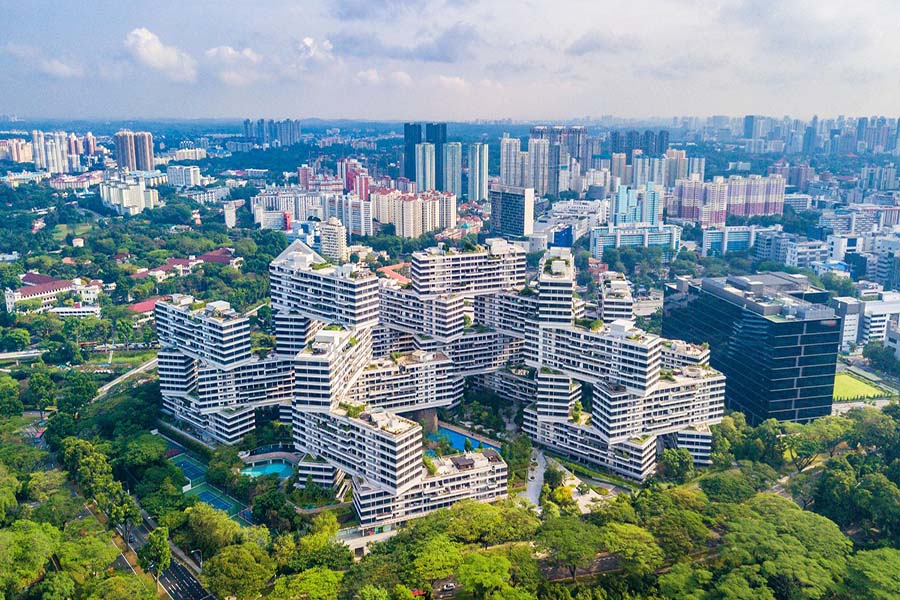
In Singapore’s new launch market, certain districts are frequently described as “safe.”
Prime addresses. Established central areas. Mature neighbourhoods.
These labels carry psychological authority. Buyers instinctively associate them with stability and protection.
But safety in property is rarely embedded in geography alone.
In reality, what most buyers call “safe” is often a simplified shorthand for something more complex: perceived prestige, historical resilience, or familiarity. When examined more closely, true durability depends less on postcode and more on entry alignment, holding flexibility, and demand mechanics.
Understanding that distinction matters — especially when prices converge across regions and traditional boundaries blur.
Why “Safe” Locations Feel Reassuring
The appeal of a “safe” district typically rests on four visible signals:
- Established reputation
- Scarcity of prime land
- Historical pricing resilience
- Strong rental narratives
These are powerful cues. They are discussed publicly, reinforced by media coverage, and embedded in long-standing market memory.
But visible cues can create cognitive shortcuts. Buyers begin to treat district classification as risk elimination rather than risk moderation.
Prestige may reduce certain downside sensitivity over full cycles. It does not remove volatility, liquidity lag, or personal timeline pressure.
The Difference Between Stability and Liquidity
One of the most common misconceptions is equating price resilience with easy exit.
A district may show:
- Smaller percentage corrections during downturns
- Slower but steadier appreciation
- Lower speculative volatility
But that does not automatically translate to:
- Immediate resale demand
- Fast transaction timelines
- Narrow bid–ask spreads
Prime areas often rely on expectation-driven demand. When sentiment softens, transactions may slow even if headline prices appear stable.
Liquidity is about transaction flow.
Stability is about price movement.
They are related — but not identical.
Demand Structure Is More Important Than District Labels
New launch outcomes are heavily influenced by the type of demand that supports resale.
Broadly speaking, demand can form through:
- Expectation-driven buyers (long-term positioning, scarcity narrative)
- Substitution-driven buyers (relative value, comparison shopping)
Prime districts often lean more heavily on expectation-driven demand. City-fringe or substitution districts rely more on comparative value logic.
When market sentiment is strong, expectation-driven assets can outperform. When sentiment tightens, substitution-driven assets may see more fluid transaction activity because buyers compare options more pragmatically.
Neither demand type is inherently superior. But each behaves differently under stress.
Calling one “safe” oversimplifies how resale mechanics actually work.
Safety Depends on Timeline Elasticity
A crucial but under-discussed variable is timeline elasticity — the buyer’s ability to hold longer than planned.
A location perceived as stable may still feel unsafe if:
- Loan servicing stretches comfort levels
- Interest rates rise unexpectedly
- Personal liquidity needs accelerate
Conversely, a non-prime district may feel stable when:
- Entry is conservative
- Rental fallback is realistic
- Holding horizon is flexible
Safety is less about district classification and more about whether ownership can endure timeline extension.
Capital Preservation vs Capital Compression
Prime districts are often described as capital-preservation zones.
That description can be broadly accurate over extended cycles. However, preservation is not equivalent to compression.
Capital compression occurs when:
- Entry prices already reflect long-term expectations
- Upside becomes incremental rather than accelerated
- Appreciation depends on future buyers sharing similar narratives
In such cases, risk does not disappear — it shifts.
Instead of high volatility risk, buyers may face expectation risk: the need for future demand to validate premium positioning.
Understanding this difference helps buyers avoid overestimating how much protection a postcode provides.
Why Buyers Overestimate District Protection During Price Convergence
When price bands across regions begin to overlap, buyers often assume risk has equalised — or that prime labels guarantee downside insulation.
But price convergence does not eliminate:
- Interest rate cycles
- Policy shifts
- Supply introductions
- Personal financial constraints
It simply changes the starting assumptions.
If entry is aggressive relative to income or timeline, even a historically resilient district can become uncomfortable.
District strength cannot compensate for structural misalignment at entry.
Institutional vs Upgrader Psychology
Another overlooked factor is buyer composition.
Prime districts often attract:
- Long-horizon investors
- Asset-allocation buyers
- Capital-preservation thinkers
City-fringe districts more frequently attract:
- Owner-occupiers
- Upgraders
- Value-sensitive buyers
These groups respond differently during market slowdowns.
Institutional or allocation-style buyers may tolerate extended holding periods. Upgraders may transact more actively based on personal transitions.
District behaviour reflects who participates in it.
Safety, therefore, is partly behavioural — not purely geographic.
A More Durable Definition of “Safe”
Instead of asking:
“Is this a safe district?”
A more durable question is:
“Is this entry safe relative to my holding capacity?”
That includes:
- Conservative loan servicing assumptions
- Flexibility if holding extends
- Rental fallback viability
- Comfort with slower transaction velocity
If you’re unfamiliar with how new launches are structured across their lifecycle, grounding your assessment in that framework clarifies why structural alignment often outweighs location branding.
District Quality vs Ownership Fit
High-quality districts can still produce uncomfortable ownership experiences when:
- Entry expectations are aggressive
- Holding horizons are short
- Liquidity needs are time-sensitive
Conversely, non-prime districts can produce stable outcomes when:
- Entry pricing reflects realistic growth
- Demand substitution remains strong
- Ownership flexibility exists
Prestige is visible.
Durability is structural.
Buyers who prioritise structural durability over branding typically experience fewer forced decisions during market transitions.
Safe” is one of the most commonly used words in Singapore property conversations — and one of the least precisely defined. In new launches, durability is a more accurate concept than safety. Postcodes influence behaviour, but ownership resilience determines outcomes. Buyers who align entry fit with timeline flexibility often discover that safety is less about district reputation and more about structural endurance.