
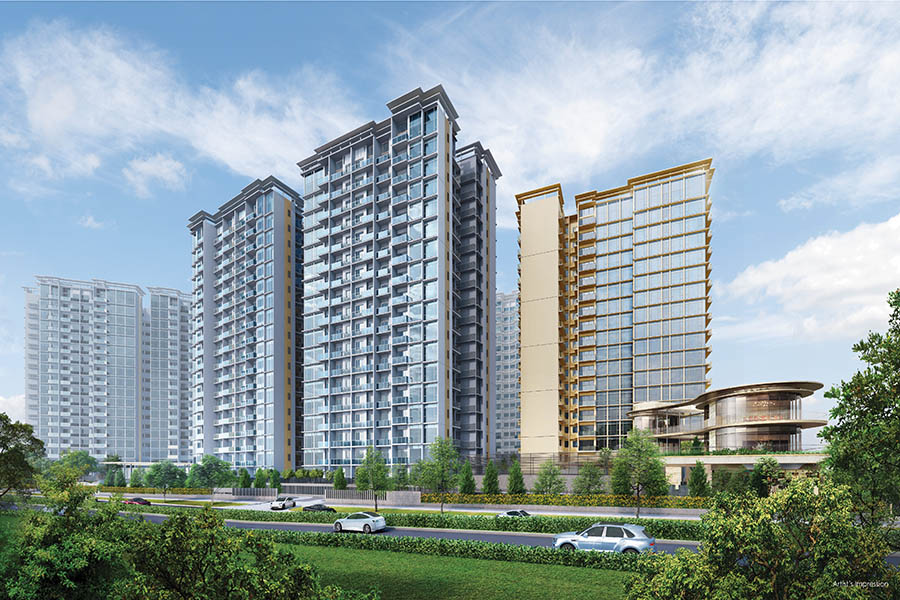
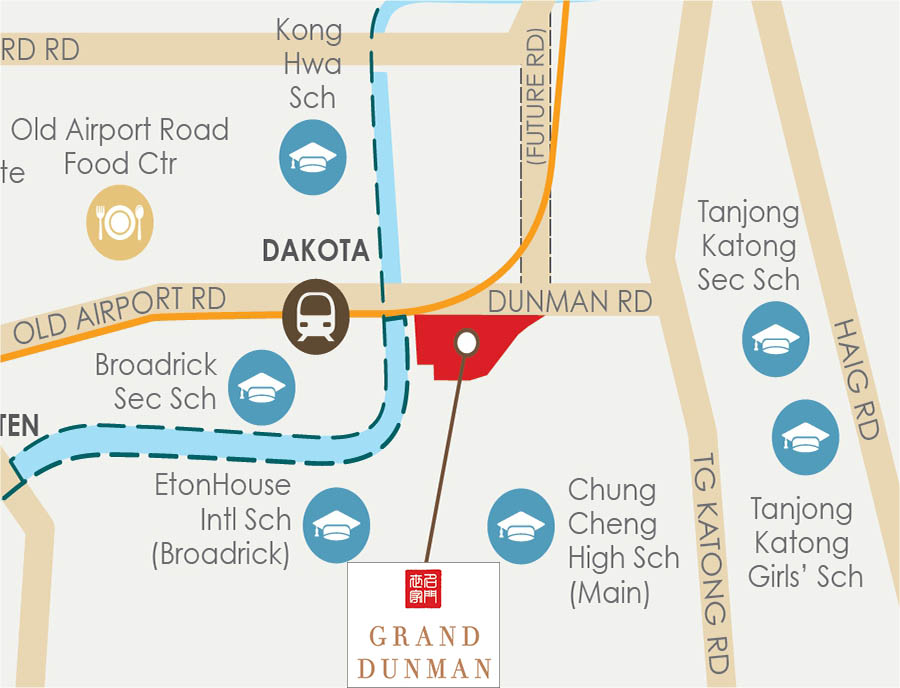
Grand Dunman is a 99-year leasehold condo in District 15 located directly beside Dakota MRT, with over 1,000 units and pricing driven by connectivity rather than tenure. It is best suited for buyers prioritising MRT access, city-fringe convenience and long-term own-stay usability, while less suitable for those seeking freehold value, low-density living or short-term capital upside.
Summary
Grand Dunman is a 99-year leasehold condominium located along Dunman Road in District 15, positioned directly beside Dakota MRT on the Circle Line. With 1,008 residential units across a large-scale site, it is one of the most significant new launch developments in the East Coast city-fringe corridor.
Rather than competing on freehold tenure or boutique exclusivity, Grand Dunman is positioned as a transit-oriented, high-density development focused on connectivity, accessibility, and day-to-day convenience. Buyers are effectively trading land tenure and privacy for immediate MRT access and comprehensive on-site facilities.
This project is best suited for owner-occupiers and long-term holders who prioritise commute efficiency, functional layouts, and consistent demand drivers over speculative capital upside or legacy positioning.
From a market perspective, Grand Dunman has functioned less like a typical District 15 project and more like a transit-anchored city-fringe node. Buyers have consistently prioritised walkable MRT access over freehold tenure, allowing the project to command pricing levels that historically would have faced resistance in this location. This has resulted in strong absorption despite the project’s size, density, and leasehold status.
The development’s scale is both its advantage and its constraint. While the large site enables extensive facilities, internal landscaping, and a wide range of unit configurations, it also introduces density considerations that are unavoidable for buyers sensitive to privacy, crowding, or long-term wear of shared amenities. As such, Grand Dunman is best evaluated as a functional, connectivity-driven residential choice rather than a lifestyle or legacy asset.
In practical terms, Grand Dunman illustrates how direct MRT adjacency and employment-linked demand can sustain buyer absorption at elevated price levels, provided purchasers are entering with long-term, own-stay or use-driven expectations rather than short-term capital gain assumptions.
Grand Dunman is a connectivity-first mega condominium designed for buyers who prioritise direct MRT access and city-fringe efficiency over tenure and low-density living.
Explore the Full Grand Dunman Analysis
This article is part of the full Grand Dunman cluster:
- Grand Dunman Price Guide – pricing structure, market positioning, and buyer entry analysis
- Grand Dunman Floor Plan Analysis – layout efficiency, unit mix, and stack considerations
- Grand Dunman Showflat Guide – viewing strategy, location context, and buyer evaluation framework
Together, these articles provide a structured analysis of the project’s position
If you’re considering this project, you might want to check how it actually compares and what most buyers tend to overlook — before deciding.
Key details (at a glance)
99-year leasehold | 1,008 residential units | Private residential with limited retail
Located along Dunman Road | Sheltered walk to Dakota MRT (Circle Line)
Est. TOP 2028 | District 15 (RCR / Geylang Planning Area)
Project Factsheet
| Item | Details |
|---|---|
| Official Project Name | Grand Dunman |
| Address / Locality | 2–18 Dunman Road |
| District | 15 |
| Planning Area | Geylang |
| Region (NLR classification) | RCR |
| Tenure | 99-year leasehold (commencing 3 June 2022) |
| Site Type | GLS |
| Developer | SingHaiyi Group Ltd & CSC Land Group (Singapore) Pte Ltd |
| Development Type | Residential condominium with limited retail |
| Site Area | Approx. 271,622 sq ft (25,243.3 sqm) |
| Plot Ratio | 3.5 |
| Residential Units | 1,008 |
| Nearest MRT | Dakota MRT (Circle Line), sheltered walk |
| Expected TOP | December 2028 |
Location Context: Why Dakota MRT Changes the Equation
District 15 is traditionally characterised by freehold low-rise developments, landed housing, and a reliance on private transport. Grand Dunman departs from this pattern by anchoring itself directly to Dakota MRT, introducing a level of rail accessibility that most surrounding developments cannot replicate.
The Circle Line provides efficient access to Paya Lebar, Marina Bay, and multiple employment nodes without requiring transfers. For car-lite households, this materially changes daily commuting behaviour and reduces reliance on peak-hour road travel along Mountbatten and Dunman Road.
Beyond transport, the location benefits from proximity to established amenities such as Old Airport Road Food Centre and the Paya Lebar commercial cluster. This positions the project firmly within a functional city-fringe ecosystem rather than a purely lifestyle-driven East Coast enclave.
Project Positioning: What Grand Dunman Is — and Is Not
Grand Dunman’s positioning is unambiguous. It is not attempting to compete with freehold boutique projects on exclusivity or long-term land value narratives. Instead, it competes on scale, connectivity, and immediacy of use.
Grand Dunman is:
A transit-linked mega development optimised for daily convenience
A high-density project offering comprehensive facilities on a large site
A practical option for buyers prioritising MRT access and employment connectivity
Grand Dunman is not:
A low-density or privacy-oriented residential environment
A tenure-driven legacy or generational asset
A short-term trading or speculative product
Understanding this distinction is critical to aligning expectations with the project’s actual strengths.
Scale, Density, and Facility Trade-Offs
With over 1,000 residential units on a high plot ratio site, density is an inherent characteristic of Grand Dunman. The development mitigates this through extensive landscaping, a wide spread of communal facilities, and internal zoning that separates quieter residential stacks from more active amenity areas.
The project’s scale enables features such as a large lap pool, multiple function spaces, and a 1:1 carpark ratio, which are difficult to achieve in smaller District 15 developments. However, buyers should also factor in higher shared-facility usage and longer lift wait times during peak hours.
Amenities and Facilities Overview
Grand Dunman’s scale allows for a full suite of condominium facilities that are typically not achievable in smaller District 15 developments. These include multiple swimming pools, fitness areas, function spaces, landscaped zones, and recreational amenities distributed across the site.
While the breadth of facilities enhances lifestyle flexibility, it also reinforces the project’s high-density nature, as usage is shared across a large resident base. For buyers who actively use facilities, this provides value; for those who do not, it becomes less relevant in the overall evaluation.
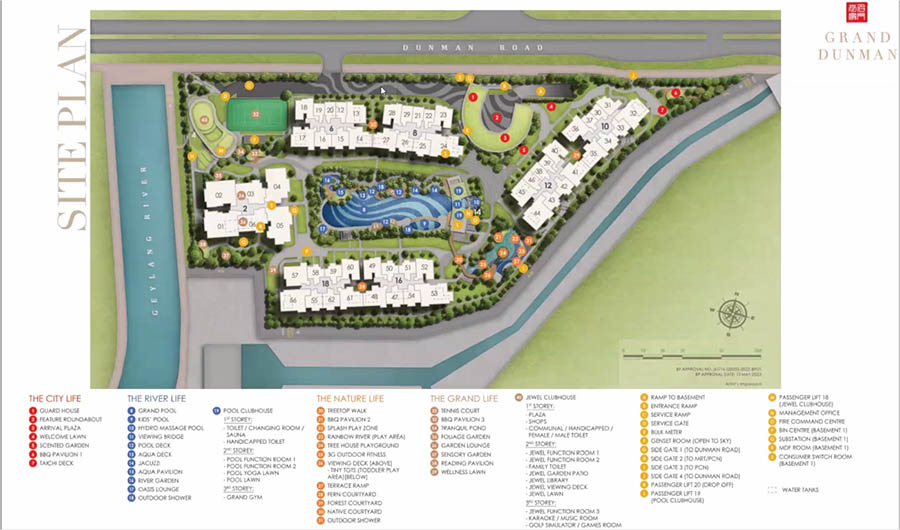
Ultimately, the value of the facility offering depends on how frequently buyers intend to use on-site amenities versus external lifestyle options.
Buyer Suitability: Who Grand Dunman Fits Best
Grand Dunman is most suitable for buyers with clearly defined, use-based priorities.
Well-matched buyer profiles include:
-
Urban professionals working in Paya Lebar, Marina Bay, or CBD locations
-
HDB upgraders seeking MRT-centric living without moving into the core city
-
Families prioritising school access and daily commute efficiency
Who Should NOT Buy Grand Dunman
Grand Dunman should be eliminated early by:
- Buyers prioritising low-density or boutique living environments
- Investors seeking high rental yield or short-term flipping opportunities
- Buyers comparing primarily on freehold tenure value
- Purchasers sensitive to crowding or shared facility usage
For these profiles, the project’s strengths will not offset its structural trade-offs.
Buyers comparing Grand Dunman against other upcoming launches may find it helpful to frame their decision using the New Launch Condo Guide, which outlines how pricing logic, buyer intent, and holding horizon differ across project types.
Takeaway
Grand Dunman is a clear example of how MRT connectivity can override traditional district and tenure preferences in buyer decision-making. For purchasers who value efficiency, scale, and immediate usability, it offers a compelling proposition. For those seeking privacy, exclusivity, or tenure-led upside, its strengths may not align with expectations.
If you’re seriously considering this project, it’s worth checking how it actually compares and what most buyers tend to overlook — before deciding.
FAQs (Decision-Stage)
1) Is Grand Dunman considered expensive for District 15?
Pricing is high relative to historical District 15 benchmarks, but reflects MRT adjacency and city-fringe demand rather than tenure value. Buyers are paying for connectivity and scale rather than land permanence. Whether this is acceptable depends on use priorities rather than district labels.
2) Does being next to Dakota MRT materially improve long-term demand?
Direct MRT access consistently supports both own-stay demand and resale liquidity in Singapore. Even in market slowdowns, MRT-linked projects tend to transact more steadily than car-dependent alternatives. This forms a key demand anchor for Grand Dunman.
3) Will 1,008 units create resale competition in the future?
Large projects can experience internal competition, especially in early resale phases. However, high transaction volume also improves price discovery and liquidity. Unit differentiation will matter more than overall project size.
4) How significant are density concerns in daily living?
Density affects lift usage, facilities, and peak-hour movement rather than basic liveability. Buyers sensitive to crowding should focus carefully on block placement and unit orientation. The issue is manageable but not avoidable.
5) How does leasehold status affect buyer decision-making here?
For connectivity-driven buyers, leasehold tenure is often secondary to MRT access. Freehold alternatives in the area lack equivalent transport advantages. This trade-off is central to Grand Dunman’s market positioning.
6) Are dual-key units a meaningful advantage?
Dual-key layouts offer flexibility for multi-generational living or partial rental income. However, they require higher upfront capital and appeal to a narrower buyer pool. They are strategic rather than mainstream choices.
7) Is Grand Dunman more suitable for own-stay or rental?
The project works best for long-term own-stay or stable rental strategies. High entry prices limit yield compression but support consistent tenant demand due to location. It is not designed for aggressive yield optimisation.
8) What is the most common buyer mistake with this project?
Assuming it behaves like a traditional District 15 freehold asset is the biggest error. Grand Dunman functions as a transit-oriented city-fringe product. Buyers should evaluate it on that basis alone.
Grand Dunman Pricing, Value and Investment Considerations
What is the price of Grand Dunman?
Grand Dunman pricing is positioned at the higher end of District 15 due to direct MRT adjacency and city-fringe positioning rather than tenure value.
Is Grand Dunman worth buying?
Grand Dunman is more suitable for buyers prioritising MRT connectivity and long-term own-stay usability rather than short-term capital appreciation.
Is Grand Dunman a good investment?
It functions as a stability-driven asset supported by rental demand and transport connectivity rather than a high-growth investment play.
What are the risks of buying Grand Dunman?
Key risks include density from 1,000+ units, internal resale competition, and pricing sensitivity at higher quantum levels.
Pricing Logic, Market Behaviour, and Comparative Reality
Pricing Logic: Why Grand Dunman Reset District 15 Expectations
Grand Dunman’s pricing does not behave like a conventional District 15 benchmark. Instead of competing purely on tenure or boutique scarcity, it is priced as a transit-anchored city-fringe product, where immediate MRT access materially alters buyer behaviour. For many buyers, the value comparison shifts away from freehold versus leasehold and toward commute compression and daily usability.
Resistance tends to surface not at a specific PSF threshold, but at absolute price quantum levels. Smaller units maintain liquidity even at elevated PSFs because total entry remains manageable, while larger family-sized units face slower decision cycles once they cross affordability comfort zones. This explains why headline PSF records do not translate evenly across the unit mix.
Crucially, the market has already “priced in” the project’s scale and density. Buyers who remain active are not surprised by the mega-development format; they are instead calibrating whether connectivity sufficiently compensates for size-related trade-offs.
Scale and Absorption: When Volume Becomes a Feature, Not a Bug
With over 1,000 units, Grand Dunman introduces scale effects that smaller projects simply cannot replicate. High transaction volume improves price discovery, keeps comparables fresh, and sustains market visibility—advantages that matter in long holding periods. While internal competition exists, it is also what ensures ongoing liquidity.
Absorption patterns show clear selectivity. MRT-facing convenience supports consistent demand for entry and mid-sized units, while premium formats require a more specific buyer profile. This is typical for mega projects, where breadth of choice replaces scarcity as the main attraction.
Long-term performance is therefore less about “how many units exist” and more about which units remain desirable once novelty fades. Orientation, distance from road noise, and internal stack placement become decisive.
Layout Efficiency and Buyer Perception
Layout criticism has focused on perceived efficiency rather than liveability failure. Certain configurations prioritise compactness or aesthetic symmetry over utility, which may not suit all household types. However, these compromises are not universal across the development.
The practical implication is that unit selection matters more than project branding. Buyers who align layout choice with household use patterns mitigate most efficiency concerns. Those who buy generically based on size alone are more likely to experience regret.
As newer projects with higher efficiency standards enter the market, buyer sensitivity will increase. This does not negate Grand Dunman’s appeal but reinforces the importance of choosing the right stack and format.
Comparative Context: Why Buyers Look Beyond District Labels
Grand Dunman is frequently compared with both leasehold and freehold projects across District 15 and adjacent city-fringe zones. This behaviour reflects modern buyer logic, where functional equivalence matters more than postal prestige. MRT access, commute time, and amenity reach are the real comparators.
Against freehold peers, Grand Dunman trades tenure for transport certainty and facility scale. Against other leasehold launches, it differentiates through direct MRT adjacency and unit variety. These are not superior or inferior positions—just different optimisation paths.
Understanding this comparison framework prevents misaligned expectations. Buyers who insist on tenure primacy will remain unconvinced; those who value efficiency will see clearer justification.
Exit Strategy, Liquidity, Risk & Investment Reality
Exit Strategy: Liquidity Is Driven by MRT, Not Scarcity
Grand Dunman does not rely on scarcity to support resale performance. Instead, liquidity is structurally anchored to its direct adjacency to Dakota MRT.
In practical terms, this creates repeatable demand cycles rather than a single peak exit window. Buyers entering later phases, HDB upgraders, and replacement buyers form a continuous pool of demand driven by commute efficiency rather than timing speculation.
However, this liquidity is not evenly distributed across all units.
- 1–2 bedroom units benefit from lower quantum and broader affordability → faster resale
- Larger family units face more selective demand → slower transaction velocity
The implication is clear:
Grand Dunman offers reliable liquidity at the project level, but selective liquidity at the unit level.
Liquidity Structure: Volume Creates Movement, Not Uniform Demand
With over 1,000 units, internal competition is unavoidable. But this scale also creates an advantage that smaller projects cannot replicate: consistent transaction volume.
High volume does three things:
- Keeps pricing benchmarks active and visible
- Reduces “stale listing” risk
- Sustains buyer awareness over time
Rather than weakening resale prospects, scale shifts the dynamic from scarcity-driven pricing to movement-driven liquidity.
That said, not all units participate equally.
- Units with better orientation, lower noise exposure, and efficient layouts remain competitive
- Units with weaker attributes rely more heavily on pricing adjustments to transact
This reinforces a key principle:
Project strength does not override unit-level weaknesses.
Pricing Resistance: Where It Actually Shows Up
Pricing resistance at Grand Dunman does not typically appear at the PSF level. It emerges at absolute quantum thresholds.
- Smaller units remain active because total entry stays manageable
- Larger units slow down once they exceed buyer affordability comfort
This creates a divergence:
- PSF can continue to hold or rise
- Transaction speed can still slow at higher quantum
For sellers, this means:
- Pricing incorrectly at higher quantum leads to longer holding periods
- Market resistance shows up as time, not immediate price correction
Rental Behaviour: Stability Over Yield
Rental demand is structurally supported by:
- Direct MRT access (Dakota MRT)
- Connectivity to Paya Lebar and CBD
- Established amenities (Old Airport Road, PLQ)
This creates consistent tenant demand, particularly from professionals prioritising commute efficiency.
However:
- Entry prices are relatively high
- Yield compression is therefore expected
Grand Dunman should be viewed as:
- A rental stability asset
- Not a yield-maximisation play
Investors expecting aggressive rental returns are likely to be misaligned with the project’s actual performance profile.
Market Cycle Behaviour: Speed Adjusts, Not Just Price
In stronger market conditions:
- Demand is supported by connectivity and upgrader flow
- Pricing holds due to MRT-driven desirability
In weaker conditions:
- Transaction speed slows
- Buyers become more selective
- Larger units experience longer holding periods
Importantly, MRT-linked projects like Grand Dunman tend to experience:
- Less demand collapse
- But clearer slowdown in execution speed
This distinction matters — the downside is typically friction, not failure.
Unit Selection: The Single Biggest Performance Variable
At Grand Dunman, unit selection is not a minor detail — it is the primary determinant of future performance.
Key factors include:
- Facing (road vs internal)
- Distance from Dakota MRT track and traffic flow
- Stack positioning within the site
- Layout efficiency and usability
Because of the project’s scale:
- Weak units cannot “hide” behind overall project strength
- Strong units benefit disproportionately from demand concentration
This creates performance dispersion within the same development.
Buyers who treat all units as interchangeable are the most exposed.
Structural Risks That Do Not Change Over Time
Certain characteristics of Grand Dunman are permanent and non-improving:
- High density (1,000+ units)
- Peak-hour lift and facility usage
- Internal competition during resale phases
- Leasehold tenure relative to surrounding freehold context
These are not temporary conditions that resolve over time.
They are built into the project’s structure.
Buyers who accept them upfront will remain comfortable.
Those who underestimate them will experience persistent friction.
Comparative Positioning: Why Buyers Still Choose It
Grand Dunman is rarely evaluated in isolation. Buyers typically compare it against:
- Freehold District 15 projects
- Other city-fringe leasehold launches
Its differentiation is consistent:
- Against freehold → trades tenure for MRT certainty and usability
- Against leasehold peers → differentiates via direct MRT adjacency
This positions Grand Dunman as a functional decision, not an emotional or legacy-driven purchase.
Investment Reality: What It Is — and What It Is Not
Grand Dunman is:
- A connectivity-driven residential asset
- Supported by real, recurring demand drivers
- Suitable for long-horizon holding
Grand Dunman is not:
- A scarcity-driven capital appreciation play
- A high-yield investment product
- A low-density lifestyle environment
Understanding this distinction is critical.
Most negative experiences with the project do not come from poor quality —
they come from misaligned expectations.
Final Investment Take: Alignment Determines Outcome
Grand Dunman performs well when used correctly.
- Buyers aligned with MRT-driven living → high satisfaction
- Buyers expecting freehold dynamics or low-density experience → friction
The decision is not whether the project is strong.
The decision is whether:
- Connectivity outweighs density
- Usability outweighs tenure
- Stability outweighs upside expectations
If the answer is yes, the project holds its logic.
If not, it should be eliminated early — not debated further.
FAQs (Advanced Decision & Investment Analysis)
1. Is Grand Dunman a good investment in Singapore?
Grand Dunman functions more as a stability-driven asset than a high-growth investment. Its value is anchored in MRT connectivity and consistent demand rather than scarcity or land tenure advantage. Buyers should not expect aggressive capital appreciation but can expect sustained relevance. It is better suited for long-horizon holding than short-term profit strategies.
2. Is Grand Dunman worth buying for long-term holding?
It can make sense for buyers prioritising commute efficiency and long-term usability. The MRT adjacency supports recurring demand across market cycles. However, its leasehold tenure and density mean it should not be evaluated as a legacy asset. Suitability depends on whether functionality outweighs tenure considerations.
3. How liquid will Grand Dunman be in the future?
Liquidity is expected to remain active due to MRT-driven demand and large transaction volume. However, it will not be uniform across all units. Smaller units will generally transact faster, while larger units may face longer holding periods. Buyers should assess liquidity at the unit level, not just the project level.
4. Which units are easier to sell at Grand Dunman?
Lower-quantum units such as 1- and 2-bedroom layouts typically have broader buyer demand. These units appeal to both investors and owner-occupiers, increasing resale flexibility. Larger units require more specific buyer profiles and therefore transact more slowly. Unit mix selection directly impacts exit ease.
5. Are larger units harder to exit in Grand Dunman?
Yes, larger units are more sensitive to absolute price quantum rather than PSF. This narrows the pool of eligible buyers and increases decision friction. While they may still transact, timelines are typically longer. Buyers should enter with realistic expectations on exit speed.
6. Does MRT proximity guarantee good resale performance?
MRT access is a strong demand driver but does not guarantee resale outcomes. Entry price, unit attributes, and market timing still play critical roles. While it supports liquidity, it cannot compensate for weak unit selection or overpaying. It should be viewed as a structural advantage, not a guarantee.
7. What are the biggest risks of buying Grand Dunman?
Key risks include high density, internal resale competition, and pricing resistance at higher quantum levels. These are structural characteristics rather than temporary issues. Buyers sensitive to crowding or long exit timelines should evaluate carefully. These risks do not disappear over time.
8. Will future supply affect Grand Dunman resale?
Future supply in the city-fringe region can introduce additional competition. However, MRT-linked projects tend to retain consistent baseline demand. The impact is more pronounced for larger or less desirable units. Differentiation within the project becomes more important over time.
9. How does pricing resistance affect resale at Grand Dunman?
Pricing resistance appears primarily at higher absolute quantum rather than PSF levels. Sellers may find that interest exists, but decision timelines are longer. This does not always lead to price drops but increases holding duration. Time becomes the main cost of mispricing.
10. Is Grand Dunman suitable for short-term investment or flipping?
It is not well suited for short-term flipping strategies. The project’s structure favours steady demand rather than rapid price spikes. Buyers relying on short holding periods may face limited upside. It aligns better with medium- to long-term holding strategies.
11. How does market cycle affect Grand Dunman’s performance?
In stronger markets, pricing is supported by connectivity and upgrader demand. In weaker markets, transaction speed slows rather than collapsing entirely. MRT-linked projects tend to retain demand but with increased selectivity. Performance is therefore more stable but less explosive.
12. How important is unit selection in Grand Dunman?
Unit selection is critical due to the project’s scale and density. Factors such as facing, noise exposure, and layout efficiency significantly affect both liveability and resale. Not all units perform equally even within the same development. Buyers should avoid treating units as interchangeable.
13. Does high unit count weaken long-term value?
High unit count introduces internal competition but also improves transaction volume and price discovery. This supports liquidity but reduces scarcity-driven pricing. The effect is neutral overall but shifts importance to unit-level differentiation. Scale changes how value is expressed, not whether it exists.
14. Is rental demand strong for Grand Dunman?
Rental demand is supported by MRT connectivity and proximity to employment nodes. This creates consistent tenant interest, particularly from professionals. However, yields are moderated by higher entry prices. It is a stability-driven rental asset rather than a yield-focused one.
15. What type of buyers will drive future resale demand?
Future demand is likely to come from owner-occupiers and MRT-dependent buyers. These include upgraders and households prioritising commute efficiency. Investor-driven demand may be more limited due to yield compression. The buyer pool is broad but not speculative.
16. What is the key decision when evaluating Grand Dunman?
The key decision is whether MRT connectivity and daily usability outweigh density and leasehold trade-offs. Buyers aligned with this positioning tend to remain satisfied over time. Those expecting freehold dynamics or low-density living may experience friction. Alignment determines outcome.
If you prefer a more structured walkthrough, you can leave your details below and we’ll follow up with you.